Y Combinator Summer 2026 Demo Day: Complete Startup List, Founders, Sectors & Trends
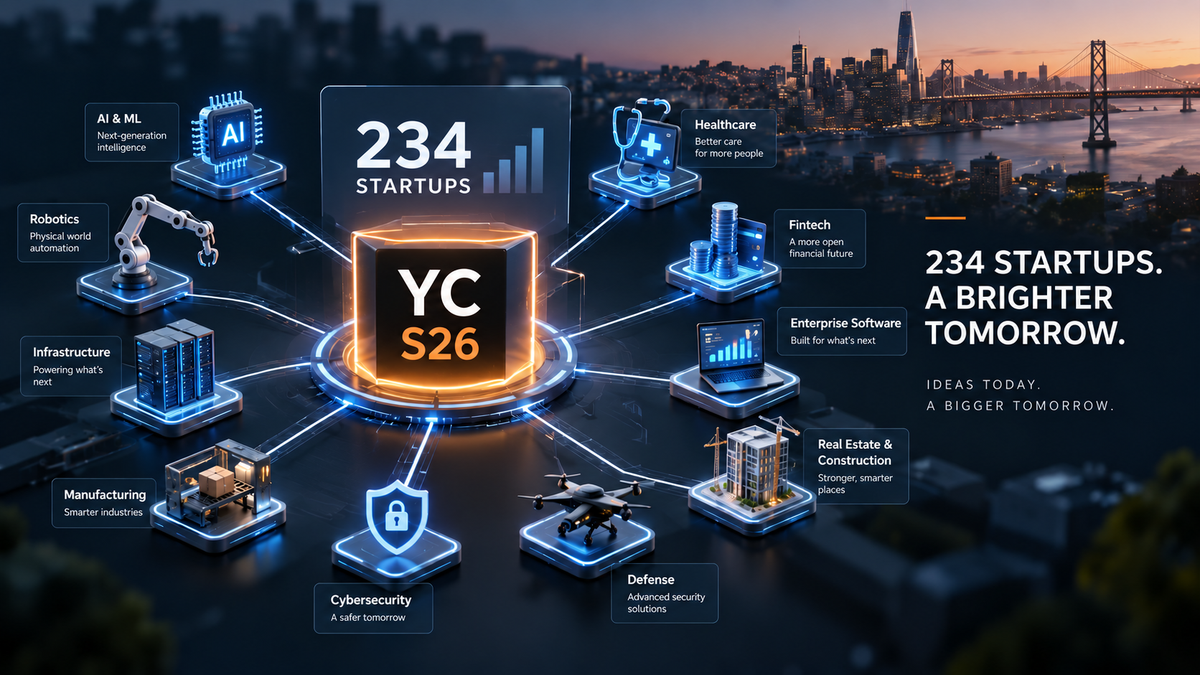
Y Combinator's Summer 2026 batch offers a revealing look at where the next generation of startups is heading.
From AI infrastructure and robotics to healthcare, fintech, defense, manufacturing, and enterprise software, the batch shows that today's founders are moving beyond simple AI applications. Many are building the infrastructure, automation systems, physical products, and specialized software needed to make AI useful in the real world.
Our YC Summer 2026 startup database contains 234 companies, organized by company, description, location, category, subcategory, website, and founder information where available.
In this guide, we'll look at the biggest trends emerging from the batch and what they tell us about the startup ecosystem in 2026.
What Is the Y Combinator Summer 2026 Batch?
Y Combinator's Summer 2026 batch is the accelerator's latest group of startups building products across technology, business, healthcare, industrials, finance, consumer products, and other markets.
The official YC directory includes companies such as Vendo, which is building a customization layer that lets users create features and micro-apps on top of existing products, and Dream, which is developing AI-powered cameras for detecting damage to vehicles and other high-value assets.
Other companies are tackling much larger infrastructure problems. Pacific is developing modular data centers designed to deploy quickly on stalled infrastructure projects, while Rise Reforming is working on converting waste gases into supply-secure chemicals.
That range is important: the Summer 2026 batch isn't concentrated in one narrow startup category.
How Many Companies Are in YC Summer 2026?
Our analyzed spreadsheet contains 234 companies in the Summer 2026 batch.
The data shows a strong concentration around business software and industrial technology:
| Category | Companies | Share |
|---|---|---|
| B2B | 122 | 51.7% |
| Industrials | 56 | 23.7% |
| Healthcare | 21 | 8.9% |
| Fintech | 17 | 7.2% |
| Consumer | 11 | 4.7% |
| Real Estate & Construction | 6 | 2.5% |
| Government | 2 | 0.8% |
| Education | 1 | 0.4% |
The biggest takeaway is clear: B2B startups dominate the batch, accounting for more than half of the companies in the dataset.
Industrials are also unusually prominent, suggesting that founders are increasingly applying software, AI, robotics, and automation to physical-world industries.
AI Is Everywhere — But the Interesting Part Is Where It Is Being Applied
AI is a major theme throughout the Summer 2026 companies, but many startups are using it as infrastructure or as part of a larger workflow rather than simply launching another chatbot.
For example:
- Assemble is building AI coworkers for IT teams that operate inside enterprise systems.
- Cerenovus uses AI to identify value-creation opportunities and operational inefficiencies across enterprise information.
- Orchestra is focused on reducing AI inference costs by training specialized models from production workloads.
- OpenRelay is working on distributed, hardware-agnostic AI inference.
- OneTriangle is focused on lightweight inference and the economics of AI serving.
This points to an important shift in the AI startup market.
The opportunity is no longer limited to building AI models. Founders are also building the infrastructure that makes models cheaper, faster, safer, easier to deploy, and more useful inside businesses.
The Biggest YC Summer 2026 Startup Categories
The spreadsheet contains 154 categorized subcategory entries, with several themes standing out.
1. AI Infrastructure
Infrastructure is the largest individual subcategory, with 25 companies.
These startups are working on the systems behind AI applications, including inference, model routing, deployment, compute, security, and enterprise infrastructure.
The emergence of this category reflects a simple reality: as companies deploy more AI, they need better infrastructure to control cost, reliability, performance, and security.
2. Manufacturing & Robotics
The dataset contains 24 companies in manufacturing and robotics.
This is one of the most significant trends in the batch.
Instead of focusing exclusively on software, founders are increasingly building systems that interact with factories, machines, physical assets, and industrial environments.
For example, Salem Robotics is building robots for inspections in hazardous environments, while Robocurve focuses on real-world evaluation for robots.
3. Engineering, Product & Design
There are 14 companies in the engineering, product, and design category.
AI is increasingly being used not just to generate text or images but to assist with complex engineering and product-development workflows.
Torus, for example, describes itself as building agentic engineering tools for physical infrastructure firms and says it is working with major companies on data centers and energy infrastructure.
4. Defense
Defense represents 9 companies in the dataset.
The presence of startups working on autonomous systems, security, intelligence, and defense technology highlights another major direction: AI and advanced technology are increasingly being applied to national security and physical-world problems.
5. Supply Chain & Logistics
There are 8 companies in supply chain and logistics.
This is another area where AI can have an immediate economic impact because supply chains contain enormous amounts of fragmented information, repetitive decision-making, and operational complexity.
Shielded, for example, is building an intelligence layer for supply-chain risk and supports use cases including supplier management, tariff analysis, and procurement decisions.
Where Are YC Summer 2026 Startups Located?
The geographic distribution is even more concentrated.
According to the spreadsheet:
- 216 companies are based in the United States
- 5 are in the United Kingdom
- 2 are in Canada
- 2 are in Singapore
- The remaining companies are distributed across countries including India, Israel, Switzerland, Australia, Finland, France, Sweden, Norway, Costa Rica, and others.
San Francisco Dominates
San Francisco is by far the largest startup hub in the batch.
The dataset lists 174 companies in San Francisco, representing approximately 74% of all companies.
New York City follows with 16 companies, followed by Boston with 8 and Los Angeles with 7.
This concentration isn't surprising given the importance of the Bay Area for AI talent, venture capital, engineering, and access to technology companies.
However, the international companies show that YC's founder network remains global.
B2B Is the Defining Theme of the Batch
More than half of the companies in the dataset are categorized as B2B.
That's significant because it reveals where many founders see immediate opportunities for AI and automation: business processes where companies already spend money and where better software can produce measurable ROI.
Examples include:
- IT operations
- Accounting
- Sales
- Procurement
- Supply chains
- Engineering
- Security
- Manufacturing
- Infrastructure
- Enterprise software
Rational, for example, is building AI employees for accounting firms, while Bizmark is applying AI to manufacturing workflows including quoting, scheduling, inventory, purchasing, and operations.
The common thread is straightforward: replace repetitive, expensive work with software that can actually perform the work.
The Rise of AI Agents
Another major pattern across the Summer 2026 companies is the movement from AI assistants toward AI agents.
Traditional AI software often helps people find information or generate content.
Agentic software aims to go one step further: it can make decisions, interact with systems, execute workflows, and complete tasks.
This is visible across the batch.
Async describes its product as AI agents that run small businesses.
Meanwhile, Assemble is building AI coworkers that can perform development work inside enterprise systems, and Marker is building a platform for rebuilding enterprise workflows around agents.
This suggests that the next stage of enterprise AI may be less about asking an AI a question and more about giving AI responsibility for completing an entire workflow.
AI + Physical Infrastructure Is Another Major Trend
One of the most interesting aspects of this YC batch is the growing overlap between AI and the physical world.
The companies are not only building software.
They are working on:
- Data centers
- Robotics
- Industrial automation
- Energy infrastructure
- Manufacturing
- Construction
- Engineering
- Inspection systems
- Defense technology
- Physical asset monitoring
Dream's AI cameras, Torus's engineering software, Pacific's modular data centers, and Rise Reforming's industrial technology are all examples of this broader movement.
The implication is important for entrepreneurs and investors: AI's next wave may be increasingly physical.
What the YC Summer 2026 Batch Tells Us About Startups
Looking across the 234 companies, several themes stand out.
1. AI is becoming infrastructure
Founders aren't just building AI applications. They're building model-routing systems, inference platforms, security layers, evaluation tools, and specialized models.
2. Automation is moving deeper into businesses
AI is increasingly being positioned as a worker rather than simply a productivity tool.
3. Industrial technology is having a comeback
Robotics, manufacturing, infrastructure, energy, and engineering are major areas of activity.
4. Enterprise problems remain attractive
B2B represents the largest category, showing that founders continue to target problems with clear economic value.
5. Physical-world applications are becoming more important
The batch includes startups addressing infrastructure, manufacturing, energy, robotics, and other industries where software meets the physical world.
6. San Francisco remains the center of gravity
Despite the global nature of startup building, the overwhelming majority of companies in the dataset are still concentrated in the United States, particularly San Francisco.
Complete YC Summer 2026 Company List
The complete dataset contains 234 YC Summer 2026 companies and includes available information such as:
- Company name
- Company description
- Location
- Country
- YC batch
- Category
- Subcategory
- Company website
- LinkedIn profile
- Founder names
- Founder LinkedIn profiles
This makes the list useful for founders, investors, recruiters, researchers, job seekers, journalists, and anyone tracking the newest Y Combinator startups.
The official YC directory can also be used to explore individual company profiles and verify current company information. Explore the Y Combinator Company Directory
Subscribe to Download the Full List
Want the complete YC Summer 2026 company database?
Get the full list with company details, categories, locations, websites, and available founder information.
Enter your email address to subscribe and unlock access to the complete list. 👇
Subscribe first to unlock the download.
Why This YC Startup List Is Useful
A structured YC company database can be useful for several types of research.
For investors: identify emerging sectors, companies, and founders.
For job seekers: discover early-stage startups that may be hiring before they become widely known.
For founders: research competitors, adjacent markets, and potential partners.
For recruiters: find founders, engineering teams, and emerging companies.
For researchers: analyze startup trends by category, geography, and industry.
For entrepreneurs: understand what kinds of problems today's YC founders are choosing to solve.
Frequently Asked Questions
How many companies are in YC Summer 2026?
The analyzed dataset contains 234 companies in the YC Summer 2026 batch.
What is the largest category in YC Summer 2026?
B2B is the largest category, with 122 companies, representing approximately 51.7% of the dataset.
How many YC Summer 2026 companies are in San Francisco?
The dataset lists 174 companies in San Francisco, making it the dominant location for the batch.
What are the biggest startup sectors in YC Summer 2026?
The leading subcategories include Infrastructure, Manufacturing & Robotics, Engineering/Product/Design, Defense, Supply Chain & Logistics, and Security.
Are most YC Summer 2026 companies focused on AI?
AI is a major theme across the batch, particularly in B2B software, infrastructure, robotics, enterprise automation, and industrial applications. Individual YC company profiles such as Orchestra, Assemble, Dream, Torus, and Cerenovus illustrate the breadth of these applications.
Final Takeaway
The YC Summer 2026 batch is a strong snapshot of where startup innovation is heading in 2026.
The biggest story isn't simply that AI is everywhere.
It's that AI is moving into the systems that run companies, factories, supply chains, infrastructure projects, accounting firms, engineering teams, and physical assets.
With 234 companies, a strong B2B concentration, 56 industrial startups, 21 healthcare companies, and 17 fintech companies, the batch represents a broad startup ecosystem rather than a single AI trend.
For anyone tracking emerging startups, founders, investors, or technology trends, this is a batch worth watching.