80 VC Firms and Accelerators Every Founder Should Know (and How to Choose Among Them)

The quickest way to waste a good investor introduction is to pitch a firm that doesn't invest at your stage, in your sector, or in your kind of business. Plenty of strong startups hear “not a fit” for exactly that reason, and it has nothing to do with the quality of the idea.
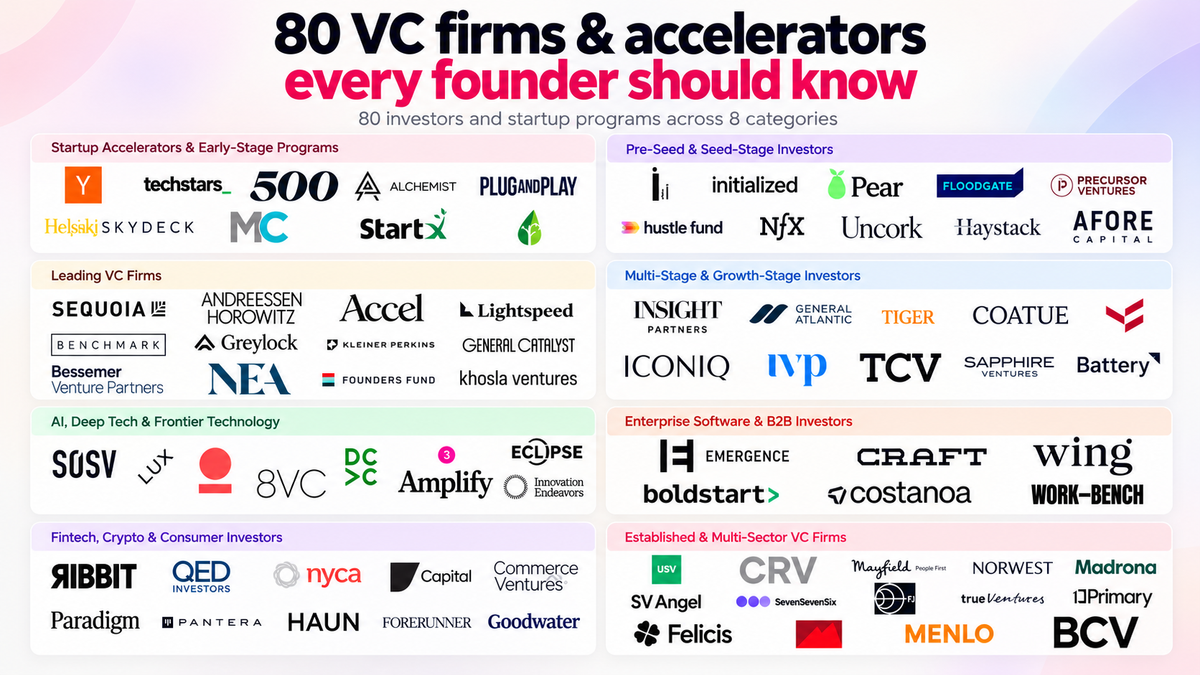
This guide groups 80 well-known venture capital firms and startup accelerators into eight categories by what they invest in, then shows how to narrow them to a shortlist you can actually work through. It is a starting map, not a complete directory. Firm strategies change, so confirm current focus on each firm's own website before you reach out.
The short answer: how to pick the right investor
Match four things, in this order: your stage, your sector, the check size you need, and the help you want beyond money. Then confirm that a specific partner at the firm has backed companies like yours recently.
Where you are | Start with | Why |
|---|---|---|
Idea or prototype, no network yet | Accelerators (Category 1) | Structure, peers, and introductions matter more than a large check |
MVP with early users or pilots | Pre-seed and seed funds (Category 2), plus sector specialists (Categories 5 to 7) | These investors back people and early signals |
Revenue growing, repeatable sales or usage | Leading and multi-sector firms (Categories 3 and 8) | They write Series A and B checks and expect measurable traction |
Scaling a proven model | Growth investors (Category 4) | They look closely at unit economics, retention, and efficiency |
Accelerator, VC firm, or angel: what's the difference?
An accelerator is a time-limited program that offers mentorship, a peer cohort, and often a small investment, usually in exchange for equity. Some, such as MassChallenge, are known for taking no equity. A venture capital (VC) firm invests pooled money from limited partners in startups it believes can become very large companies. An angel investor invests personal money, often earlier and in smaller amounts.
One honest caveat: venture capital is designed for companies that can plausibly return many times the money invested. If you are building a steady, profitable business, bootstrapping, revenue-based financing, grants, or angel money may fit better, and that is a perfectly good path.
Four filters for choosing an investor
- Stage. Does the firm lead or join rounds at your stage right now? Check its announced deals from the last six to twelve months, not its history.
- Sector fit. Look for two or three portfolio companies adjacent to yours. Zero suggests a thesis mismatch; a direct competitor may signal a conflict.
- Check size and role. Some funds lead rounds, others follow. Know which one you need before you ask.
- The partner, not the logo. The person who joins your board shapes the next several years. Ask founders they have backed how that partner behaves when a quarter goes badly.
Category 1: Startup accelerators and early-stage programs
Firms: Y Combinator, Techstars, 500 Global, Alchemist Accelerator, Plug and Play, Berkeley SkyDeck, MassChallenge, StartX, Founder Institute.
Accelerators suit first-time and solo founders who want structure, a cohort, and credibility with later investors. Equity terms, funding, and program length differ by program and by year, so read them before you apply.
- Y Combinator counts Airbnb, Stripe, Dropbox, and DoorDash among its alumni, and its brand carries weight with later-stage investors.
- Techstars runs multiple programs tied to specific cities and industries.
- Alchemist Accelerator focuses on enterprise and B2B startups.
- Plug and Play is known for connecting startups with large corporate partners.
- Berkeley SkyDeck and StartX are connected to UC Berkeley and Stanford.
- MassChallenge is known for its equity-free model.
- Founder Institute works with people at the idea stage.
- 500 Global runs programs and invests in many markets outside the US.
What to check before applying: Talk to two or three recent alumni. Ask what support continued after demo day and which investors engaged afterward.
Category 2: Pre-seed and seed-stage investors
Firms: First Round Capital, Initialized Capital, Pear VC, Floodgate, Precursor Ventures, Hustle Fund, NFX, Uncork Capital, Haystack, Afore Capital.
Pre-seed and seed funds decide mostly on the founder, the problem, and early signals, because there is little financial history to analyze.
- Hustle Fund, Precursor Ventures, and Afore Capital are associated with very early backing.
- NFX writes extensively about network effects, which makes it a natural fit if your product improves as more people use it.
- First Round Capital publishes a lot of founder-focused writing that is worth reading before you pitch.
- Pear VC pairs investment with hands-on support for early teams.
- Initialized Capital, Floodgate, Uncork Capital, and Haystack are long-standing early-stage firms.
What to bring: Evidence of demand, such as a waitlist, signed pilots, letters of intent, or first revenue. A few customer conversations you can describe in detail will do more than a polished market-size slide.
Category 3: Leading VC firms
Firms: Sequoia Capital, Andreessen Horowitz, Accel, Lightspeed Venture Partners, Benchmark, Greylock Partners, Kleiner Perkins, General Catalyst, Bessemer Venture Partners, New Enterprise Associates (NEA), Founders Fund, Khosla Ventures.
These firms typically back companies with large-market ambitions and clear traction, though many also invest earlier. Sequoia's early investments included Apple and Google, and Accel was an early investor in Facebook.
Each has its own reputation. Benchmark is known for its small, equal-partner structure, Founders Fund for contrarian long-horizon bets, and Khosla Ventures for backing ambitious, technical ideas.
What to ask: Which partner would work with us, how many boards do they sit on, and how do they support portfolio companies after the round closes?
Category 4: Multi-stage and growth-stage investors
Firms: Insight Partners, General Atlantic, Tiger Global Management, Coatue Management, Thrive Capital, ICONIQ Growth, IVP, TCV, Sapphire Ventures, Battery Ventures.
Growth investors write larger checks into companies that already have significant revenue. They focus on growth rate, retention, unit economics, and efficiency, and they often help with scaling operations, executive hiring, and go-to-market strategy.
What to prepare: A clean data room and metrics you can explain without hedging. Getting on a growth firm's radar early is reasonable, but only once your numbers can hold up to scrutiny.
Category 5: AI, deep tech, and frontier technology investors
Firms: SOSV, Lux Capital, DCVC, Radical Ventures, Eclipse, Playground Global, 8VC, Amplify Partners, Innovation Endeavors.
Deep tech takes longer and often costs more to build, so these investors should understand long development cycles and technical risk. Expect detailed technical questions from people with scientific or engineering backgrounds.
- Radical Ventures focuses on AI.
- Amplify Partners is known for backing technical founders in infrastructure and developer tools.
- Lux Capital and DCVC are known for science- and technology-heavy investing.
- Eclipse and Playground Global are associated with hardware and physical-world technology.
- SOSV runs multiple programs for deep tech and hardware-oriented startups.
What to prepare: A plain-language explanation of your technical advantage. If a smart non-expert cannot see why your approach is better, even specialist investors may struggle to explain it to their partners.
Category 6: Enterprise software and B2B investors
Firms: Emergence Capital, Craft Ventures, Wing Venture Capital, boldstart ventures, Costanoa Ventures, Work-Bench.
These firms understand sales cycles, buyer behavior, and retention in business software, and many can introduce you to potential customers. Work-Bench is closely associated with New York's enterprise startup scene.
What to bring: Customer proof. A paid pilot, a signed letter of intent, or a customer willing to take an investor's reference call is stronger evidence than a large market estimate.
Category 7: Fintech, crypto, and consumer investors
Firms: Ribbit Capital, QED Investors, Nyca Partners, Fin Capital, Commerce Ventures, Paradigm, Pantera Capital, Haun Ventures, Forerunner Ventures, Goodwater Capital.
- Fintech and commerce: Ribbit Capital, QED Investors, Nyca Partners, Fin Capital, and Commerce Ventures focus on financial services and commerce.
- Crypto: Paradigm, Pantera Capital, and Haun Ventures focus on crypto and blockchain.
- Consumer: Forerunner Ventures and Goodwater Capital invest in consumer businesses.
Financial and crypto products are regulated, so specialist investors can help with compliance, banking partners, and policy shifts. Consumer investors look hard at retention, brand, and community.
What to prepare: In regulated sectors, state your licensing plan, banking partners, and compliance approach early. It signals maturity and removes a common source of doubt.
Category 8: Established and multi-sector VC firms
Firms: Union Square Ventures, CRV, Mayfield, Norwest Venture Partners, Madrona, SV Angel, 776, Slow Ventures, True Ventures, Primary Venture Partners, Felicis, Redpoint Ventures, Menlo Ventures, Bain Capital Ventures.
This group spans many sectors and regions. Madrona is rooted in the Pacific Northwest, and Primary Venture Partners is closely associated with New York. SV Angel, 776, and Slow Ventures are known for backing very early companies.
Why geography matters: A firm with strong local roots often has deeper customer, hiring, and advisor networks in that region. If you are raising outside a major hub, ask how they help portfolio companies there.
Build your shortlist in one afternoon
- Pick the one or two categories that match your stage and sector.
- List 20 to 30 firms from them. This range is a suggested starting point, not a rule.
- For each firm, find the partner who has invested in your space in the last year and note one recent deal.
- Find a warm path to that partner: portfolio founders, advisors, accelerator alumni, or co-investors.
- Track everything in a simple sheet: firm, partner, stage, recent deal, intro path, status, and next-step date.
How to reach out
Warm introductions usually beat cold emails, because they come with a trusted person's endorsement. Make it easy for your connector by writing a short forwardable blurb they can paste.
If you must email cold, keep it to four elements: what you do, one real traction number, why this investor specifically, and one small ask such as a 20-minute call. Here is an illustrative, fictional example:
We help independent clinics reduce billing errors. We have 18 paying clinics and $12K in monthly recurring revenue after four months. I saw you backed two healthcare infrastructure companies this year, and I'd value 20 minutes of your perspective.
Common mistakes to avoid
- Mass-blasting. Targeted outreach to well-matched investors beats a form email to hundreds.
- Ignoring current focus. A firm's past portfolio does not guarantee it invests that way today.
- Choosing the biggest name over the best partner. The person on your board matters more than the logo.
- Raising before you know your numbers. Be ready to explain growth, retention, burn, and runway without hedging.
- Treating a no as permanent. Ask for feedback, and update the investor when you hit the milestone they named.
Frequently asked questions
What is the difference between an accelerator and a VC firm? An accelerator runs a structured, time-limited program, usually with mentorship and a small investment. A VC firm invests larger amounts over a longer period and often joins the board in later rounds.
Which VC firms invest at the pre-seed stage? Hustle Fund, Precursor Ventures, Pear VC, and Afore Capital are commonly associated with very early investing. Confirm each firm's current focus on its website.
Do I need an accelerator to raise venture capital? No. Many founders raise without one. Accelerators help most when you need structure, a network, and credibility.
How do I find the right investors for my startup? Match investors by stage, sector, geography, and check size. Then review their recent deals and talk to founders in their portfolio.
Is venture capital right for every startup? No. It suits businesses with a credible path to a very large outcome. Others may be better served by bootstrapping, revenue-based financing, grants, or angel investment.
Your next step
You do not need all 80 names. You need the five to ten that fit your stage, your sector, and what you want from an investor. This week, choose your categories, build the shortlist, and request your first five warm introductions.
This list is not exhaustive. Hundreds of other investors and accelerators support founders, and I plan to cover more in future posts.
Where to verify details
Program terms and fund focus change. Before you reach out, check each firm's own website and recent announcements. Useful starting points include Y Combinator, Techstars, MassChallenge, and the National Venture Capital Association for industry research.
This article is general information, not financial or legal advice.