30 Startup Terms Every Founder Should Know | Startup Glossary

The first time you sit in a room with investors, advisors or other founders, it can feel like everyone is speaking a secret language. Someone mentions their CAC, someone else asks about your ICP, and a third person wants to know if you have found PMF yet.
Good news: none of it is as complicated as it sounds. Startup jargon is mostly shorthand for ideas you already understand, just packed into three or four letters.
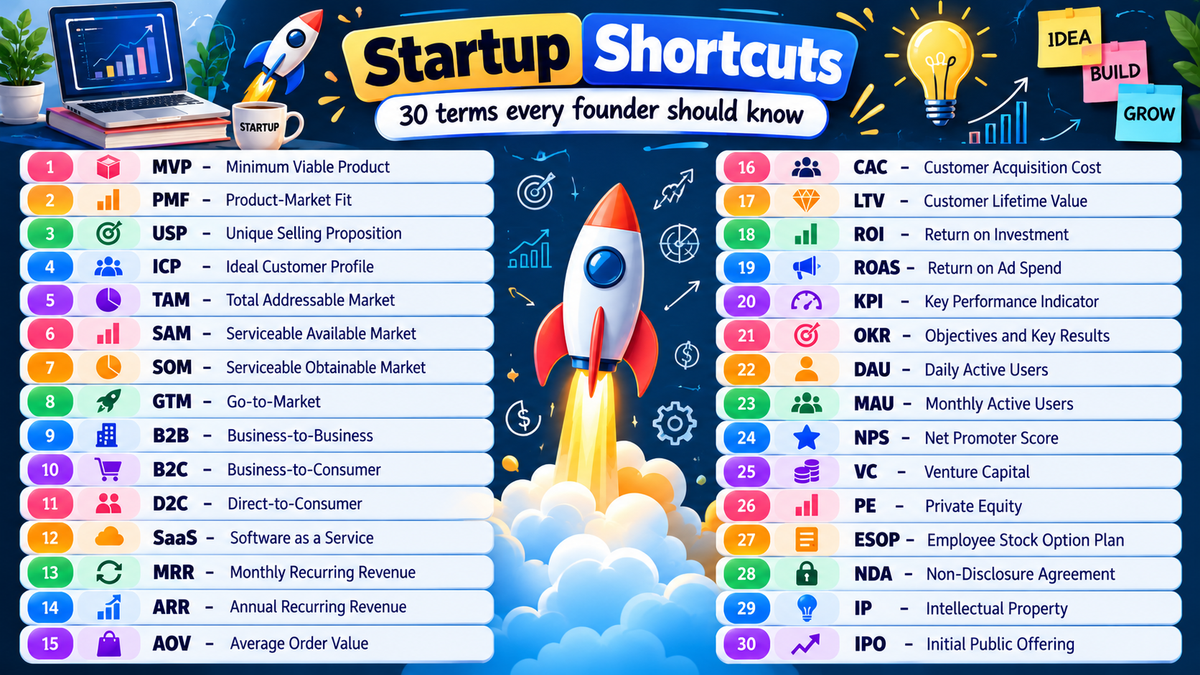
This guide breaks down 30 startup terms every founder should know. We have grouped them by theme so they are easier to remember, and each one comes with a short, plain explanation. Bookmark it, share it with your team, and come back whenever an acronym trips you up.
Quick Answer: What Are the Most Important Startup Terms?
If you only have a minute, start with these: MVP (Minimum Viable Product), PMF (Product-Market Fit), CAC (Customer Acquisition Cost), LTV (Customer Lifetime Value), MRR (Monthly Recurring Revenue) and KPI (Key Performance Indicator). Together they cover what you build, who wants it, what it costs to win a customer, and how the business is performing.
The full list of 30 is below.
1. Product and Positioning Terms
These terms describe what you are building and why anyone should care.
MVP – Minimum Viable Product. The simplest version of your product that still solves a real problem. You launch it to test your idea with actual users before investing months in extra features.
PMF – Product-Market Fit. The point where your product genuinely satisfies a strong market demand. Users stick around, recommend it, and would be unhappy if it disappeared. Many founders consider it the most important milestone in an early-stage company.
USP – Unique Selling Proposition. The one thing that sets you apart from competitors. If you cannot explain your USP in a sentence, customers will struggle to remember you.
ICP – Ideal Customer Profile. A description of the type of customer who gets the most value from your product and is most likely to buy it. Defining your ICP keeps your marketing and sales from wasting effort on the wrong people.
2. Market Size Terms
Investors love to ask about market size. These three terms are usually presented together.
TAM – Total Addressable Market. The total revenue opportunity if every possible customer bought your product. It is the biggest, most optimistic number.
SAM – Serviceable Available Market. The portion of the TAM you can realistically reach with your product, business model and geography.
SOM – Serviceable Obtainable Market. The slice of the SAM you can realistically capture in the near term, given your resources and competition.
Tip: Think of it as three circles, one inside the other. TAM is the whole pie, SAM is the part you can serve, and SOM is the piece you can actually win.
3. Go-to-Market and Business Model Terms
These describe how you reach customers and who they are.
GTM – Go-to-Market. Your plan for launching a product and getting it in front of customers, covering pricing, channels, messaging and sales approach.
B2B – Business-to-Business. You sell to other companies. Sales cycles tend to be longer, but contracts are often larger.
B2C – Business-to-Consumer. You sell directly to individual people. Volume is usually higher, while the price per sale is lower.
D2C – Direct-to-Consumer. You sell your own products straight to customers, skipping retailers and middlemen. This gives you more control over branding and customer data.
SaaS – Software as a Service. Software delivered online through a subscription rather than a one-time purchase. Think of the tools you pay for monthly or yearly.
4. Revenue Terms
These help you measure how much money is coming in and how it behaves over time.
MRR – Monthly Recurring Revenue. The predictable revenue you expect to earn every month from subscriptions.
ARR – Annual Recurring Revenue. The yearly version of MRR. A quick rule of thumb is that MRR multiplied by 12 gives you ARR.
AOV – Average Order Value. The average amount a customer spends per order. Raising AOV through bundles or upsells is one of the easiest ways to grow revenue without finding new customers.
5. Customer Economics and Marketing Terms
This is where many startups win or lose. Understanding these numbers tells you whether your growth is healthy.
CAC – Customer Acquisition Cost. What you spend, on average, to win one new customer, including marketing and sales costs.
LTV – Customer Lifetime Value. The total revenue you expect from a customer over the entire time they stay with you.
ROI – Return on Investment. How much you gain compared with how much you spent. It works for any investment, from a campaign to a new hire.
ROAS – Return on Ad Spend. The revenue you earn for every unit of currency spent on advertising. It is a focused way to judge whether your ads are paying off.
Why CAC and LTV belong together: if it costs you more to acquire a customer than that customer will ever bring in, the business model needs fixing. Many founders look for an LTV that comfortably exceeds CAC before scaling spend.
6. Performance and Goal-Setting Terms
These keep your team focused and show whether people actually use what you have built.
KPI – Key Performance Indicator. A measurable number that shows how well you are doing against an important goal.
OKR – Objectives and Key Results. A goal-setting framework. The objective says what you want to achieve, and the key results are the measurable outcomes that prove you got there.
DAU – Daily Active Users. The number of unique users who engage with your product each day.
MAU – Monthly Active Users. The number of unique users who engage with your product each month. Comparing DAU to MAU gives a feel for how sticky your product is.
NPS – Net Promoter Score. A customer loyalty metric based on how likely people are to recommend you to others.
7. Funding and Legal Terms
Sooner or later, every founder runs into these.
VC – Venture Capital. Funding from investors who put money into high-growth startups in exchange for equity.
PE – Private Equity. Investment in more established private companies, often through buyouts or large stakes. It usually comes later than VC.
ESOP – Employee Stock Option Plan. A plan that lets employees own a share of the company, which helps attract and retain talent when cash is tight.
NDA – Non-Disclosure Agreement. A legal contract that keeps sensitive information confidential. Founders often sign one before sharing ideas, code or financials.
IP – Intellectual Property. Creations of the mind that have legal protection, such as trademarks, patents, copyrights and trade secrets. For many startups, IP is the most valuable asset they own.
IPO – Initial Public Offering. The moment a private company first sells shares to the public on a stock exchange.
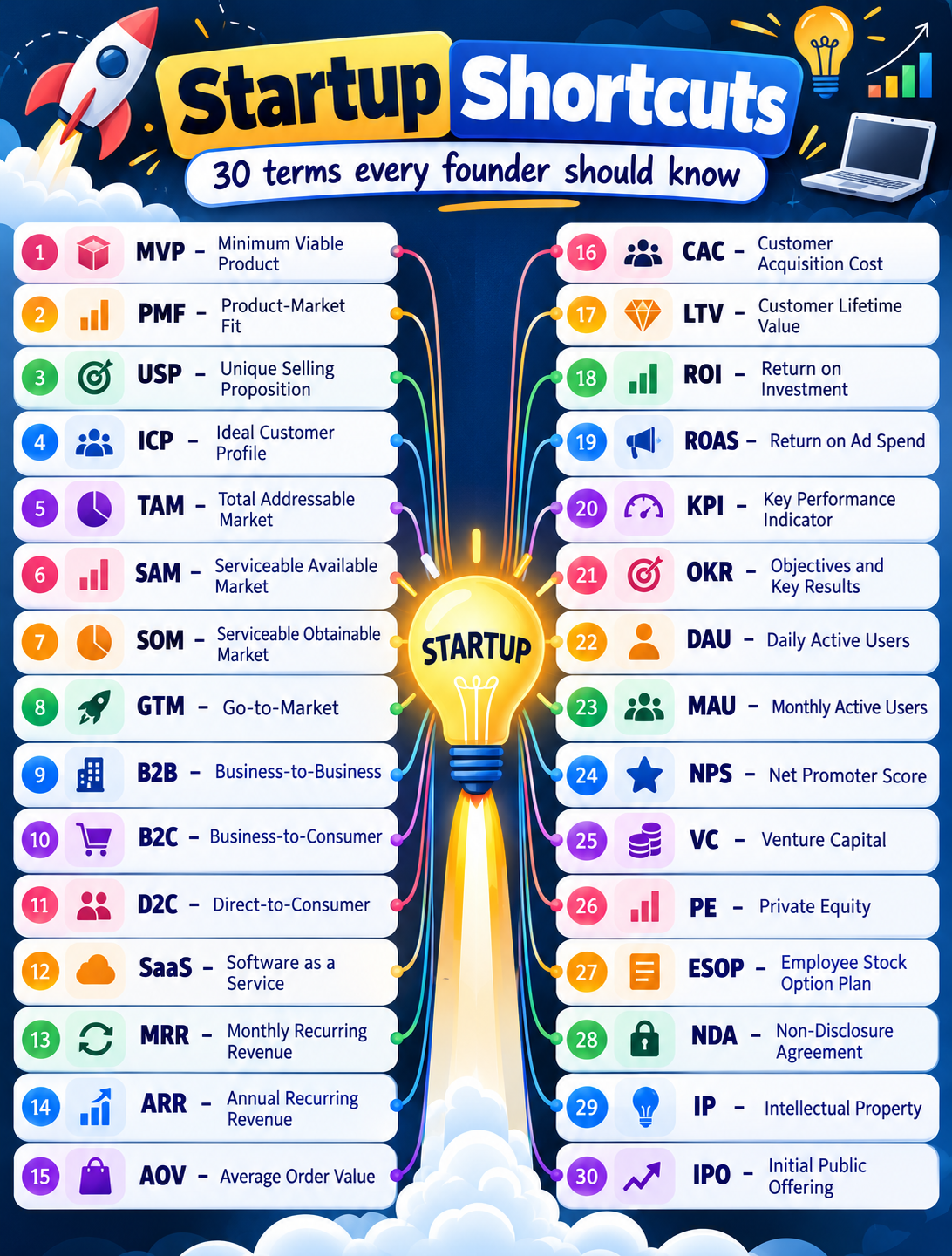
Startup Terms at a Glance
# | Acronym | Meaning |
|---|---|---|
1 | MVP | Minimum Viable Product |
2 | PMF | Product-Market Fit |
3 | USP | Unique Selling Proposition |
4 | ICP | Ideal Customer Profile |
5 | TAM | Total Addressable Market |
6 | SAM | Serviceable Available Market |
7 | SOM | Serviceable Obtainable Market |
8 | GTM | Go-to-Market |
9 | B2B | Business-to-Business |
10 | B2C | Business-to-Consumer |
11 | D2C | Direct-to-Consumer |
12 | SaaS | Software as a Service |
13 | MRR | Monthly Recurring Revenue |
14 | ARR | Annual Recurring Revenue |
15 | AOV | Average Order Value |
16 | CAC | Customer Acquisition Cost |
17 | LTV | Customer Lifetime Value |
18 | ROI | Return on Investment |
19 | ROAS | Return on Ad Spend |
20 | KPI | Key Performance Indicator |
21 | OKR | Objectives and Key Results |
22 | DAU | Daily Active Users |
23 | MAU | Monthly Active Users |
24 | NPS | Net Promoter Score |
25 | VC | Venture Capital |
26 | PE | Private Equity |
27 | ESOP | Employee Stock Option Plan |
28 | NDA | Non-Disclosure Agreement |
29 | IP | Intellectual Property |
30 | IPO | Initial Public Offering |
Frequently Asked Questions
What is the difference between MVP and PMF? An MVP is the first, simplified version of your product that you build to test an idea. PMF is the stage where the market clearly wants what you have built. You build an MVP to find your way toward PMF.
What is the difference between TAM, SAM and SOM? TAM is the total market demand for your type of product. SAM is the part of that market your business can realistically serve. SOM is the share you can realistically win in the near term.
What is a good LTV to CAC ratio? There is no single magic number, but a commonly cited benchmark is an LTV at least three times your CAC. The right ratio depends on your industry, margins and how quickly you recover acquisition costs.
What is the difference between MRR and ARR? MRR measures recurring revenue per month, while ARR measures it per year. Early-stage startups often track MRR because it shows changes faster, and then switch to ARR as contracts get larger.
What is the difference between B2B, B2C and D2C? B2B means selling to businesses, B2C means selling to individual consumers, and D2C means a brand sells its own products directly to consumers without retailers in between.
What is the difference between VC and PE? Venture capital typically backs early-stage, high-growth startups, while private equity usually invests in more mature companies, often taking a large or controlling stake.
Why do founders need to know these terms? They are the shared language of investors, advisors and teams. Knowing them helps you read pitch decks, understand your own numbers, and have sharper conversations when you raise money or hire.
Final Thoughts
You do not need to memorize every acronym on day one. Start with the ones tied to what you are working on right now. If you are validating an idea, focus on MVP, PMF, ICP and USP. If you are launching, look at GTM and your revenue terms. If you are preparing to raise money, get comfortable with TAM, SAM, SOM, CAC, LTV and your funding vocabulary.
The more fluently you speak the language of startups, the more confident you will feel in every meeting, pitch and planning session. Save this glossary, share it with your co-founders, and keep it handy until these terms feel like second nature.
This article is for general educational purposes and is not financial or legal advice. For decisions about equity, contracts or fundraising, consult a qualified professional.