Startup Accelerators Accepting Applications in 2027: 8 Programs to Apply To

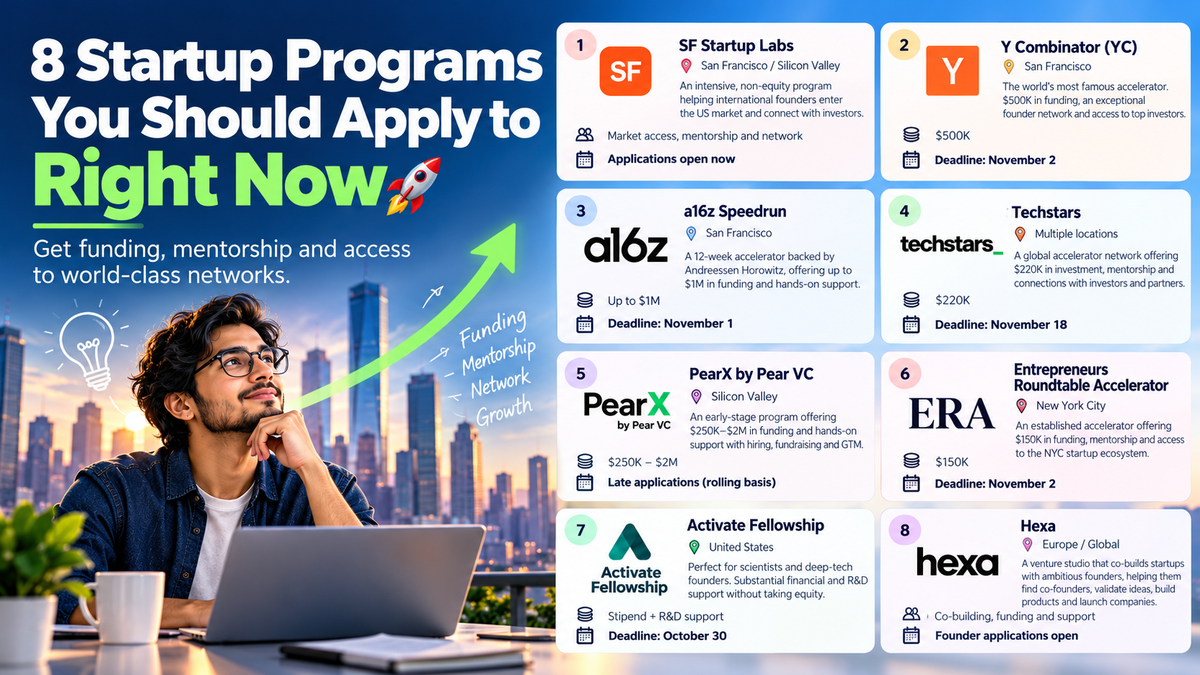
If you’re an early-stage founder, this is a busy stretch of the application calendar. Several of the best-known startup accelerators, fellowships and venture studios have deadlines between late October and mid-November 2026, with cohorts starting in early 2027.
This guide covers eight programs: Y Combinator, a16z Speedrun, Techstars, PearX, ERA, SF Startup Labs, Activate Fellowship and Hexa. Some invest in exchange for equity. Some charge a fee instead. One is a venture studio that co-builds companies with you. We list what’s confirmed, flag what isn’t, and point you to the official application page for each.
Applying early helps. Several programs review on a rolling basis or consider late applicants only after on-time ones. Even if a deadline is a week away, you can still prepare a solid application.
Deadlines and terms change. Confirm everything on the official page before you apply. Last checked: October 22, 2026.
How to choose the right startup program
Not all of these programs do the same job, and picking the wrong type wastes weeks.
- Accelerators (YC, Speedrun, Techstars, PearX, ERA) run time-boxed cohorts and typically invest in exchange for equity. You get capital, mentorship and an investor network.
- Fellowships (Activate) usually fund you as a founder over a longer period, often without taking equity.
- Non-equity programs (SF Startup Labs) trade equity for a participation fee. They’re built around learning, investor access and market entry.
- Venture studios (Hexa) co-build the company with you, often from the idea stage, in exchange for founder-level equity.
Four questions narrow it down:
- Stage: Do you have an idea, an MVP, or traction?
- Location: Can you relocate to San Francisco, New York or the Bay Area, or do you need something remote or international?
- Capital vs. equity: Do you want to raise a check now, or keep ownership and pay a fee?
- Domain: Are you building software, hardware, or science-based technology?
1. Y Combinator (Winter 2027 batch)
Type: Accelerator · Location: San Francisco · Status: Open
Y Combinator is the best-known startup accelerator in the world. The Winter 2027 batch runs January to March in San Francisco, and the on-time deadline is November 2 at 8pm PT. Late applications are still considered, but YC can’t promise when you’ll hear back. YC’s published offer has been $500,000 per accepted company. That’s an equity investment, so read YC’s standard deal terms before you apply.
Best for: Founders at any early stage who are ready to work full-time on the company and move to San Francisco for the batch. YC has repeatedly said you don’t need a finished product or a polished deck.
Apply: ycombinator.com/apply
2. a16z Speedrun (SR008)
Type: Accelerator / residency · Location: San Francisco · Status: Open
Speedrun is Andreessen Horowitz’s program for very early-stage startups. SR008 applications are open through November 1, 2026 at 11:59 PM PT. The residency runs February 1 to April 18, 2027 in San Francisco, with Demo Day on April 13. Speedrun says it invests up to $1M. Check the official “The Deal” page for how that’s structured, since the full amount isn’t all paid at the start.
An independent tracker reports that applications are reviewed on a rolling basis and that founders from anywhere can apply. Confirm both points on the official page.
Best for: Founders building in AI, software and other fast-moving categories who want hands-on support and a large investor network.
Apply: speedrun.a16z.com/apply
3. Techstars (Spring 2027 programs)
Type: Accelerator network · Location: Multiple cities and a remote option · Status: Open
Techstars runs separate city and industry programs under one brand. Techstars lists eight programs open until November 18, 2026, including Anywhere, Boston, Chicago, London, New York City, and healthcare and university-linked accelerators. The $220K investment, three-month format and November 18 deadline are confirmed on Techstars-linked pages, which also note that terms can vary by program and geography. One program page lists a March 8, 2027 start and standard terms of $220K for 5% equity. The investment is structured as convertible agreements plus a side letter, which keeps Techstars in an ongoing shareholder relationship.
Best for: Founders who want a specific city or sector, or a remote-friendly option rather than relocating to San Francisco.
Apply: [insert official Techstars application link]
4. PearX by Pear VC
Type: Accelerator · Location: San Francisco Bay Area · Status: Check the official page
PearX is Pear VC’s 12-week pre-seed program with small cohorts. It requires teams to relocate to the Bay Area for the duration. Past announcements describe a three-day founder retreat, Camp Pear, a dedicated recruiter, and office space at Pear Studio SF. A secondary source says the W27 cohort runs January to April 2027 and that the regular deadline has passed, so applications are now rolling. I couldn’t confirm this on Pear VC’s own site, so check before you apply.
Funding: Sources disagree. One lists $250K–$2M. Another lists $500K–$2M for 7%. Treat the terms as unconfirmed until you see them on Pear’s application page.
Best for: Pre-seed founders who want help with hiring, go-to-market and fundraising, and who are willing to relocate.
Apply: pear.vc/pearx-application
5. Entrepreneurs Roundtable Accelerator (ERA)
Type: Accelerator · Location: New York City · Status: Open
ERA’s Winter 2027 cohort has a November 2, 2026 deadline and a January 11, 2027 start. Selected companies receive $150,000 on a 6% post-money SAFE. The program lasts four months, with free office space at ERA’s Flatiron headquarters and access to more than 1,000 mentors. ERA accepts applications from anywhere in the world and runs in person, so plan to be in New York. Founders should also expect to be a C corporation before ERA invests.
Best for: Founders building fintech, commerce, health or enterprise products who want New York’s customers, mentors and investors.
Apply: eranyc.com/apply
6. SF Startup Labs (Spring 2027)
Type: Non-equity program · Location: Online, then San Francisco · Status: Open
SF Startup Labs is a three-week program for international founders who want to raise from US investors or launch in the US. The official site lists two weeks online (April 5–16, 2027) and one week in San Francisco (April 19–23, 2027). The program takes no equity but charges a $2,900 fee per startup for the whole team, not including flights or accommodation. The curriculum covers pitch training, investor panels, legal setup and visa guidance. It also says it’s for founders with a working MVP or validated prototype, not idea-stage teams. No closing date was published, and the site says spots fill on a rolling basis.
Best for: Non-US founders with an MVP who want US investor feedback and legal and visa preparation without giving up equity. It doesn’t provide funding.
Apply: sfstartuplabs.com/apply
7. Activate Fellowship
Type: Fellowship · Location: United States · Status: Closing soon (confirm the date)
Activate is a two-year program that helps scientists and engineers turn research into products. It doesn’t charge fees or take equity in fellows’ companies. An Activate event page says applications close October 30. Eligibility on Activate’s page requires:
- A bachelor’s degree and 4+ years of research, engineering or technology development experience
- First-time leadership of a hardware-based technology company
- A full-time commitment to the project
- Legal authorization to work in the US for the fellowship
- No more than $2M raised from non-governmental sources
The fellowship includes a living stipend and technical support. I couldn’t confirm the stipend amount.
Best for: First-time deep-tech and hard-science founders in the US. It isn’t designed for software-only startups.
Apply: activate.org/apply
8. Hexa
Type: Venture studio · Location: Paris-based, Europe/Global · Status: Check Hexa’s site
Hexa is a venture studio, which is different from an accelerator. It co-builds a company with you instead of investing in one you’ve already started. Hexa says it has launched 45+ companies, including Aircall, Spendesk and Front, and aims to take an idea to an independent company in about 12 months. A Welcome to the Jungle company profile describes its studios as a third co-founder, taking about a third of equity. That profile is older, so ask Hexa about current terms. Founder recruitment listings were published through summer 2026, but I couldn’t confirm a deadline. Treat the application as ongoing and check Hexa’s site.
Best for: Ambitious founders, including people without an idea or co-founder yet, who want to build a software company with studio support.
Apply: hexacc.notion.site
Comparison table
| Program | Type | Location | Funding / support | Next deadline or status |
|---|---|---|---|---|
| Y Combinator | Accelerator | San Francisco | $500K (equity) | Nov 2, 2026, 8pm PT |
| a16z Speedrun | Accelerator | San Francisco | Up to $1M | Nov 1, 2026, 11:59 PM PT |
| Techstars | Accelerator network | Multiple | $220K (5% equity on typical terms) | Nov 18, 2026 |
| PearX | Accelerator | Bay Area | Sources vary | Check official page |
| ERA | Accelerator | New York City | $150K, 6% post-money SAFE | Nov 2, 2026 |
| SF Startup Labs | Non-equity program | Online + SF | No funding; $2,900 fee | Rolling; starts Apr 5, 2027 |
| Activate | Fellowship | United States | Stipend and support, no equity | ~Oct 30 (confirm) |
| Hexa | Venture studio | Paris / Europe | Co-building (reported equity share) | Check Hexa’s site |
Practical tips for your application
- Apply when you’re a reasonable fit, not when you’re “ready.” Programs routinely fund teams whose decks and metrics looked thin to the founders themselves.
- Show momentum. A prototype, customer interviews, waitlist signups or early revenue all help.
- Explain why your team can build this. Reviewers read your background closely.
- Be specific about the problem and the customer, not the technology.
- Check the legal basics. Some programs expect a US entity or flag eligibility rules, such as Activate’s funding cap and work authorization.
- Read the terms before you apply. Equity, fees and SAFEs differ across programs.
- Reuse your core answers across applications, but tailor each to the program’s format.
FAQ
Which startup accelerators are accepting applications right now?
As of October 22, 2026, YC, a16z Speedrun, ERA and Techstars list open applications with deadlines between November 1 and November 18. SF Startup Labs is open on a rolling basis, and Activate’s deadline is approaching. PearX and Hexa need confirmation on their official pages.
Do I need to be incorporated to apply?
It depends on the program. ERA, for example, expects a C corporation before it invests. Check each program’s requirements.
What’s the difference between an accelerator, a fellowship and a venture studio?
An accelerator runs a fixed cohort and usually invests for equity. A fellowship funds you over a longer period, often without equity. A venture studio co-builds the company with you, often from the idea stage.
Is it worth applying with an idea-stage startup?
Some programs welcome it (YC and Speedrun encourage early applications), while others, like SF Startup Labs, expect an MVP. Match the program to your stage.
Do all of these programs take equity?
No. Activate takes none, and SF Startup Labs takes none but charges a fee. Accelerators like YC, Techstars and ERA invest in exchange for equity.
Conclusion
The calendar is tight, but you don’t need a perfect pitch deck to start. Shortlist the two or three programs that match your stage, location and appetite for equity, then verify terms on each official page.