18 New York Startups Just Raised a Series A

Some of the most interesting startup opportunities are emerging in industries that have traditionally relied on manual processes, complex software and specialized expertise.
From warehouse robots and AI-powered creative tools to legal technology, healthcare automation and financial software, startups are finding new ways to solve problems that businesses face every day.
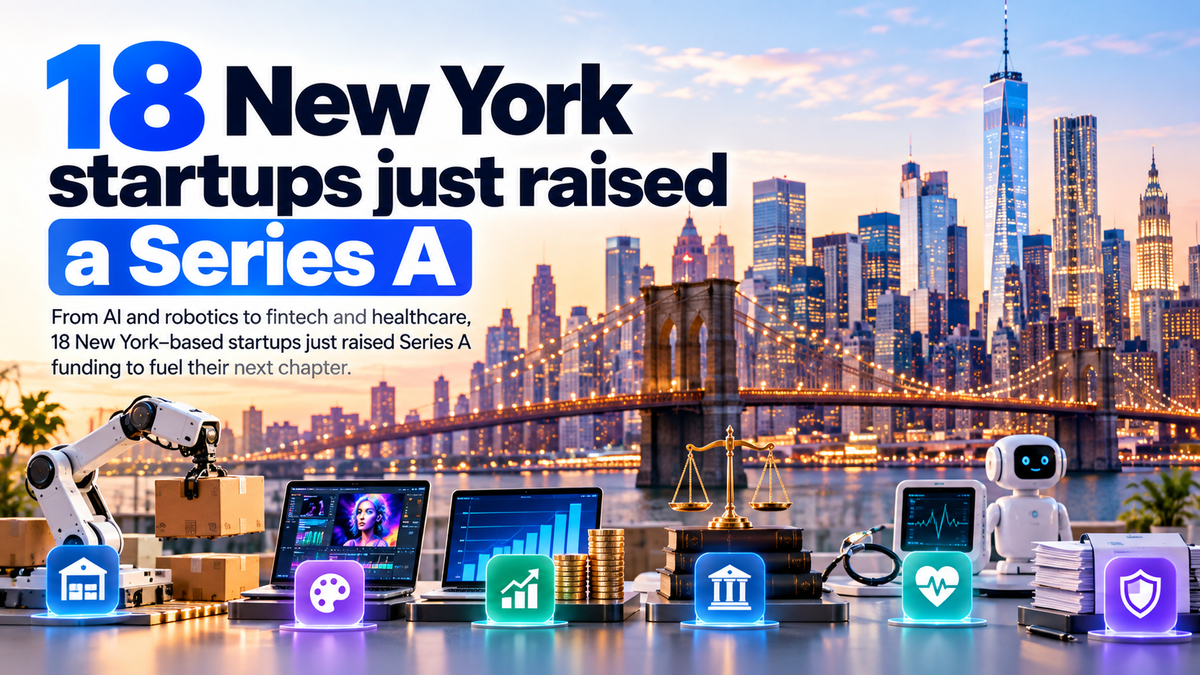
A list of 18 startups spanning these industries features reported funding totals ranging from $18.8 million to $62 million. Their products highlight several areas attracting attention across the startup ecosystem, including AI agents, industrial automation, regulatory compliance, wealth management and healthcare technology.
What makes these companies worth watching is not just the amount of capital they have reportedly raised. It is the variety of problems they are trying to solve.
Here are 18 startups to know, what they do and the broader technology trends their businesses represent.
1. Ultra — Warehouse Robotics for Industrial Operations
Reported total funding: $62 million
Ultra focuses on warehouse robotics designed to pack, sort and kit products for industrial customers.
Warehouses and manufacturing facilities must move products efficiently while managing labor costs, order accuracy and delivery deadlines. Robotics can help businesses automate repetitive tasks and improve operational consistency.
For industrial customers, the opportunity extends beyond replacing manual work. A well-integrated automation system can help increase throughput, reduce bottlenecks and support growing order volumes.
Ultra represents the broader opportunity in warehouse automation, where robotics and software are becoming increasingly important to modern supply chains.
2. Rein Security — Runtime Security for Enterprise AI Agents
Reported funding: $35 million
As companies introduce AI agents into business operations, security becomes more complicated. These systems may interact with internal applications, access sensitive information and perform tasks with limited human intervention.
Rein Security focuses on runtime security for enterprise AI agents. This category aims to help organizations manage risks while AI systems are actively operating.
The need is particularly relevant for businesses deploying AI in customer service, software development, internal operations and other enterprise workflows.
The broader opportunity is clear: organizations need more than capable AI models. They also need ways to control access, monitor behavior and reduce the risks associated with autonomous systems.
3. Melius — AI Agents for Creative Teams
Reported total funding: $25 million
Melius is building an AI-focused platform for creative work, including images, video and audio.
Creative professionals often work across multiple applications, manage repeated production tasks and coordinate feedback between different teams. AI agents can help streamline parts of this process, allowing creative teams to spend less time on repetitive work.
The company represents a growing category of AI products designed to support entire workflows rather than simply generate individual pieces of content.
For businesses producing marketing campaigns, branded visuals and digital media at scale, tools that connect creative tasks into a more coordinated process could become increasingly valuable.
4. Siena AI — AI Agents for Customer Experience
Reported funding in the supplied list: $29.7 million
Siena AI focuses on AI agents for consumer brands and customer experience.
Customer support teams regularly handle questions about orders, returns, product information and account issues. AI agents can help automate suitable interactions while allowing human employees to focus on more complex situations.
For consumer brands, the potential benefits include faster responses, more consistent service and the ability to handle large volumes of customer conversations.
The opportunity is not simply about adding a chatbot to a website. Businesses increasingly want AI systems that can understand customer needs and complete useful tasks across their service workflows.
Funding verification note: Siena AI announced a $17 million Series A on October 6, 2026, according to its company announcement. Confirm whether the $29.7 million figure represents total funding from multiple rounds before publication.
5. Santé — AI Solutions for Liquor and Wine Retailers
Reported total funding: $22.6 million
Santé combines point-of-sale (POS) technology with AI agents for liquor and wine stores.
Specialty retailers face several operational challenges, including inventory management, transaction processing, customer service and product discovery. Software built specifically for their industry can help bring these activities into a more coordinated system.
By combining retail technology with AI capabilities, platforms in this category can potentially help store owners improve daily operations and make better use of business data.
Santé illustrates an important startup opportunity: applying AI to specific industries where general-purpose software may not fully address the needs of smaller, specialized businesses.
6. Daptic — Regulatory Compliance Built Into Product Design
Reported funding: $22 million
Regulatory compliance can become expensive and complicated when companies treat it as a final checkpoint rather than part of the product development process.
Daptic focuses on regulatory compliance software built into product design.
This approach aims to help organizations consider applicable requirements earlier, document decisions and reduce the risk of discovering compliance problems late in development.
The concept is relevant to businesses operating in regulated markets, where product changes may require additional documentation, reviews and approvals.
For startups building enterprise products, integrating compliance into existing workflows can make it easier to manage requirements as products evolve.
7. Chamelio — AI Platform for In-House Legal Teams
Reported funding: $39.5 million
Corporate legal departments manage contracts, internal requests, research, documentation and collaboration with other departments. These activities often involve large amounts of repetitive administrative work.
Chamelio focuses on an AI platform for in-house legal teams.
AI-powered legal software can help professionals organize information, accelerate research and streamline document-related workflows. Depending on the application, these tools may also support contract review and internal knowledge management.
However, legal work requires careful handling of confidential information, accuracy and professional judgment. AI is most useful when it supports qualified legal professionals rather than replacing necessary review.
The market opportunity lies in making legal departments more efficient without compromising oversight or confidentiality.
8. Pave Finance — AI Portfolio Management for Wealth Advisors
Reported funding: At least $34 million
Pave Finance focuses on AI-powered portfolio management for wealth advisors.
Financial advisors must evaluate investment portfolios, understand client requirements, monitor risk and communicate recommendations. Technology can help organize financial information and support more efficient analysis.
AI-based portfolio management platforms may also help advisors identify relevant information and improve their workflows.
For wealth management businesses, the challenge is to use automation without losing the human judgment and client relationships that remain central to financial advice.
Pave Finance represents the intersection of AI and wealth management, where software aims to support professionals handling increasingly complex financial decisions.
9. Luminary — AI-Native Wealth Transfer and Estate Planning
Reported funding: Nearly $32 million
Estate planning and wealth transfer involve complex financial arrangements, personal documentation and decisions that can affect families for generations.
Luminary focuses on an AI-native platform for wealth transfer and estate planning.
Technology in this category can potentially help organize information, simplify administrative processes and make complex planning workflows easier to manage.
The opportunity is particularly relevant as financial services companies look for ways to improve the customer experience around traditionally paperwork-heavy processes.
Because estate planning involves legal and financial consequences, accuracy, privacy and appropriate professional oversight remain essential.
10. Aqua — Software for Alternative Investment Programs
Reported funding: $18.8 million
Aqua provides a turnkey platform for running alternative investment programs.
Alternative investments can involve specialized administration, investor onboarding, reporting and ongoing operational requirements. Managing these processes manually can create unnecessary complexity as a program grows.
A centralized software platform can help investment businesses coordinate operations and improve consistency across workflows.
Aqua represents a broader fintech trend: building infrastructure that simplifies the operational side of investing rather than focusing exclusively on investment products themselves.
For investment managers, efficient administration can be an important part of scaling a business.
11. Highstock — AI Marketplace for Surplus Inventory
Reported funding: $35.5 million
Brands can end up with surplus inventory because of changing demand, seasonal products, forecasting errors or product transitions.
Highstock focuses on an AI-powered marketplace designed to move surplus inventory for brands.
Helping businesses find suitable buyers for excess stock can potentially reduce waste, recover working capital and improve inventory utilization.
This problem is especially relevant to businesses operating in competitive consumer markets, where unsold inventory can affect profitability.
Highstock represents the combination of AI, marketplace technology and inventory management, with a focus on turning underused stock into commercial value.
12. Blee — AI-First Marketing Compliance
Reported funding: $27 million
Marketing teams must balance creative campaigns with brand guidelines, industry regulations and internal approval processes.
Blee focuses on an AI-first marketing compliance platform.
Solutions in this category can help organizations review marketing materials, identify potential compliance issues and organize approval workflows before content is published.
The need is particularly important for businesses in regulated industries, where inaccurate or noncompliant messaging can create legal and reputational risks.
As companies produce more content across websites, email, advertising and social media, software that helps maintain consistent standards can become a valuable part of the marketing technology stack.
13. Norbert Health — Robotic Nursing Assistants
Reported funding: $19 million
Healthcare providers face persistent operational challenges, including staff shortages, administrative workloads and the need to monitor patients efficiently.
Norbert Health focuses on robotic nursing assistants with contactless vital sign monitoring.
Technology in this category aims to support healthcare teams by helping collect patient information and reduce certain routine tasks.
The potential value is not limited to automation. Better-integrated monitoring systems could help healthcare professionals access relevant information more efficiently and direct their attention where it is most needed.
However, healthcare automation must meet appropriate standards for safety, accuracy, privacy and clinical oversight.
Norbert Health represents the broader opportunity in healthcare robotics and technology designed to support frontline medical professionals.
14. Antioch — Simulation Infrastructure for Autonomous Systems
Reported funding: $40.5 million
Autonomous systems need to be tested in a wide range of conditions before they can be deployed reliably in the real world.
Antioch focuses on simulation infrastructure for developing and testing autonomous systems.
Simulation environments allow developers to evaluate system behavior under different conditions, including scenarios that may be difficult, expensive or dangerous to reproduce physically.
This can be relevant to robotics, autonomous vehicles and other systems that must make decisions in changing environments.
As autonomous technology advances, testing infrastructure becomes an important part of the development process. Developers need tools to evaluate performance, identify failures and improve reliability before deployment.
15. Silicon Data — Pricing Intelligence for AI Computing
Reported funding: $35.2 million
AI development depends on computing infrastructure, including specialized chips, cloud services and data center capacity.
As organizations expand their AI workloads, understanding the cost and availability of computing resources becomes increasingly important.
Silicon Data focuses on pricing benchmarks and market data for the AI computing economy.
Market intelligence tools can help businesses compare costs, understand pricing trends and make more informed infrastructure decisions.
This category serves a growing need among companies that must balance computing performance against operating expenses.
The broader opportunity is in making a complex and fast-changing technology market easier to understand through reliable data and pricing transparency.
16. Aligned Marketplace — Connecting Employers With Independent Care Providers
Reported funding: $31 million
Employers that provide healthcare benefits to their workers must manage costs while ensuring employees can access appropriate care.
Aligned Marketplace focuses on connecting self-insured employers with independent care providers.
Platforms in this category aim to make it easier for employers to find healthcare services and coordinate relationships with providers outside traditional arrangements.
For self-insured organizations, healthcare spending can represent a significant business expense. Better access to providers and more transparent purchasing processes may help employers evaluate their options.
The opportunity sits at the intersection of healthcare technology, employer benefits and digital marketplaces.
17. Remepy — Combining Software With Traditional Therapeutics
Reported funding: $62 million
Remepy focuses on hybrid drugs that pair software with traditional therapeutics.
This approach sits within the broader field of digital therapeutics and technology-enabled healthcare, where software may be designed to complement conventional treatment approaches.
Depending on the specific product and clinical evidence, software-based interventions can potentially support patient engagement, treatment adherence or other aspects of care.
The category also presents significant challenges. Clinical validation, regulatory requirements and evidence of meaningful patient outcomes are essential.
Remepy illustrates how healthcare innovation can extend beyond conventional pharmaceuticals to explore ways of combining treatment with digital technology.
18. Axle — AI-Native Infrastructure for Insurance Workflows
Reported funding: $22 million
Insurance companies handle substantial amounts of data, documentation and administrative work across claims, policies and other processes.
Axle focuses on an AI-native clearinghouse for insurance data and workflows.
Platforms in this category aim to help organizations organize information, connect systems and streamline the movement of data between participants.
The potential benefits include less manual processing and more efficient coordination across insurance operations.
For an industry that often relies on complex systems and extensive documentation, better data infrastructure can be an important foundation for broader automation.
What These 18 Startups Reveal About the Future of Technology
Although these companies operate in different markets, several themes connect their business models.
1. AI is moving into industry-specific workflows
Many startups are applying AI to a defined business problem rather than building general-purpose AI products.
Examples include Siena AI for customer experience, Chamelio for legal teams, Blee for marketing compliance and Pave Finance for wealth advisors.
Industry-specific products can be attractive when they address specialized workflows, integrate with existing systems and meet the operational requirements of their customers.
2. AI agents need security and control
The rise of AI agents creates opportunities beyond the applications themselves.
Businesses also need systems to manage permissions, monitor activity and reduce operational risks. Rein Security's focus on runtime security reflects this need.
The long-term opportunity includes infrastructure that helps enterprises deploy AI agents more safely and reliably.
3. Robotics is expanding beyond manufacturing
Warehouse automation and healthcare robotics demonstrate how physical automation can support different industries.
Ultra targets industrial operations, while Norbert Health focuses on robotic nursing assistance and contactless monitoring.
These applications have different technical and regulatory requirements, but both illustrate how robotics can address repetitive tasks and operational constraints.
4. Regulated industries remain important markets for software
Legal services, healthcare, finance, insurance and regulated marketing all involve complex workflows and specialized requirements.
Startups such as Daptic, Chamelio, Norbert Health, Pave Finance and Axle are targeting problems in these environments.
Success in these markets depends on more than a compelling product. Companies must also build trust, address data privacy and demonstrate that their solutions fit existing processes.
5. Infrastructure businesses can solve less visible but important problems
Some startup opportunities are not immediately visible to consumers.
Silicon Data focuses on AI computing market intelligence, Antioch on simulation infrastructure, and Aqua on alternative investment operations.
These businesses target the systems and processes that enable other organizations to operate more effectively.
For founders and investors, this is a reminder that valuable technology companies are not always the ones with the most visible consumer products.
Funding Snapshot: How Much Capital Have These Startups Reportedly Raised?
Based on the supplied figures, the 18 companies represent approximately $592.8 million in combined reported funding.
The largest listed funding totals are:
| Startup | Reported funding |
|---|---|
| Ultra | $62 million |
| Remepy | $62 million |
| Antioch | $40.5 million |
| Chamelio | $39.5 million |
| Highstock | $35.5 million |
| Silicon Data | $35.2 million |
| Rein Security | $35 million |
| Pave Finance | At least $34 million |
These figures are based on the supplied list and have not all been independently verified. The combined total is a simple arithmetic sum, not a measure of current valuations, available cash or funding raised during a single period. Verify all amounts and company details before publication.
Frequently Asked Questions
What industries are represented by these 18 startups?
The list spans artificial intelligence, robotics, enterprise software, fintech, healthcare technology, legal technology, retail, insurance and industrial automation.
Which startups on the list focus on AI agents?
Rein Security focuses on runtime security for enterprise AI agents. Melius develops AI agents for creative work, while Siena AI focuses on customer experience. Chamelio, Blee and Pave Finance target other specialized business workflows involving AI.
Which startups focus on robotics and automation?
Ultra focuses on warehouse robotics, while Norbert Health works on robotic nursing assistants and contactless vital sign monitoring. Antioch focuses on simulation infrastructure used to develop and test autonomous systems.
How much funding have the 18 startups reportedly raised in total?
The figures supplied for the list add up to approximately $592.8 million. This is an unverified aggregate of the listed amounts and should not be interpreted as funding raised in one round or one year.
Why are investors interested in industry-specific AI startups?
Industry-specific AI startups can address well-defined business problems, integrate with existing workflows and offer specialized functionality. Their long-term prospects depend on customer demand, product performance, competition, distribution and their ability to build sustainable businesses.
What should founders learn from these startups?
Founders can learn the importance of identifying a clear customer problem, building products around practical workflows and addressing trust, compliance and integration from the beginning. Funding is one indicator of investor interest, but it does not guarantee product-market fit or long-term success.
Final Thoughts
These 18 startups demonstrate the range of problems technology companies are trying to solve, from automating warehouse operations to simplifying legal work, improving healthcare processes and building infrastructure for AI.
The common thread is a focus on practical applications. Rather than treating technology as an end in itself, these companies are building products around specific operational challenges.
For founders, the lesson is to start with a real customer need and build a product that solves it convincingly. For investors and startup watchers, the opportunity is to look beyond funding headlines and evaluate customer adoption, execution, market size and long-term business potential.
As AI, automation and enterprise software continue to evolve, the most interesting startups may be those that turn complex problems into solutions businesses can use every day.