
31 Cybersecurity Startups That Raised $20M+ in Q3 2026

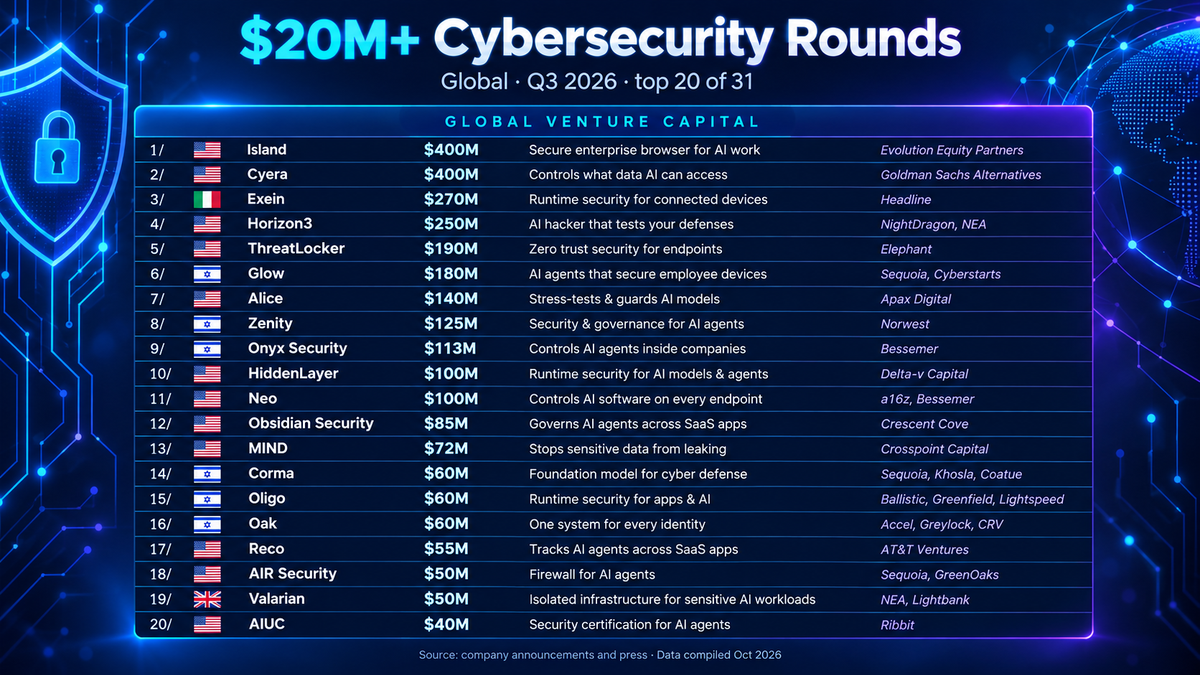
Thirty-one cybersecurity startups closed rounds of $20 million or more between July and September 2026. Together, the 29 rounds reported in US dollars add up to roughly $3.08 billion, before counting a €28M round in France and a £24M round in the UK.
The headline number is less interesting than where the money went. Read the one-line descriptions and a pattern jumps out: about two-thirds of the 31 companies (21 by our count) describe their product in terms of AI, whether that means securing AI agents, governing what data AI tools can reach, or using AI to run security work.
If you are a founder, this list is useful in three ways. It shows what security investors are actually paying for right now. It points to buyers who just got budget and will be shopping. And it hints at which problems your own company will be asked about in its next security review.
A quick note on sourcing: the companies, amounts and descriptions below come from a publicly shared roundup of Q3 2026 cybersecurity rounds. We have not independently confirmed each figure, and the limitations section explains what that means for how you use it.
The full list: 31 cybersecurity startups that raised $20M+ in Q3 2026
The table is sorted by round size. The category column is our own grouping, added to make the patterns easier to see. Company names link to each startup's LinkedIn page, which is also the quickest place to check open roles.
# | Company | HQ | Round | What it does | Category |
|---|---|---|---|---|---|
1 | US | $400M | Secure enterprise browser for AI work | Endpoint and browser | |
2 | US | $400M | Controls what data AI can access | Data security | |
3 | Italy | $270M | Runtime security for connected devices | Device and IoT | |
4 | Horizon3 | US | $250M | AI that attacks your systems to test defenses | Offensive testing |
5 | US | $190M | Zero trust security for endpoints | Endpoint and browser | |
6 | Israel | $180M | AI agents that secure employee devices | Endpoint and browser | |
7 | US | $140M | Guards AI models | AI model security |
Two notes on the table. The original roundup gave no description for AIUC; the line above reflects the company's name and stated focus on AI underwriting, so check its own site before quoting it. And HQ follows the roundup, which lists Alice as US-based even though ActiveFence was founded in Israel.
What investors are paying for
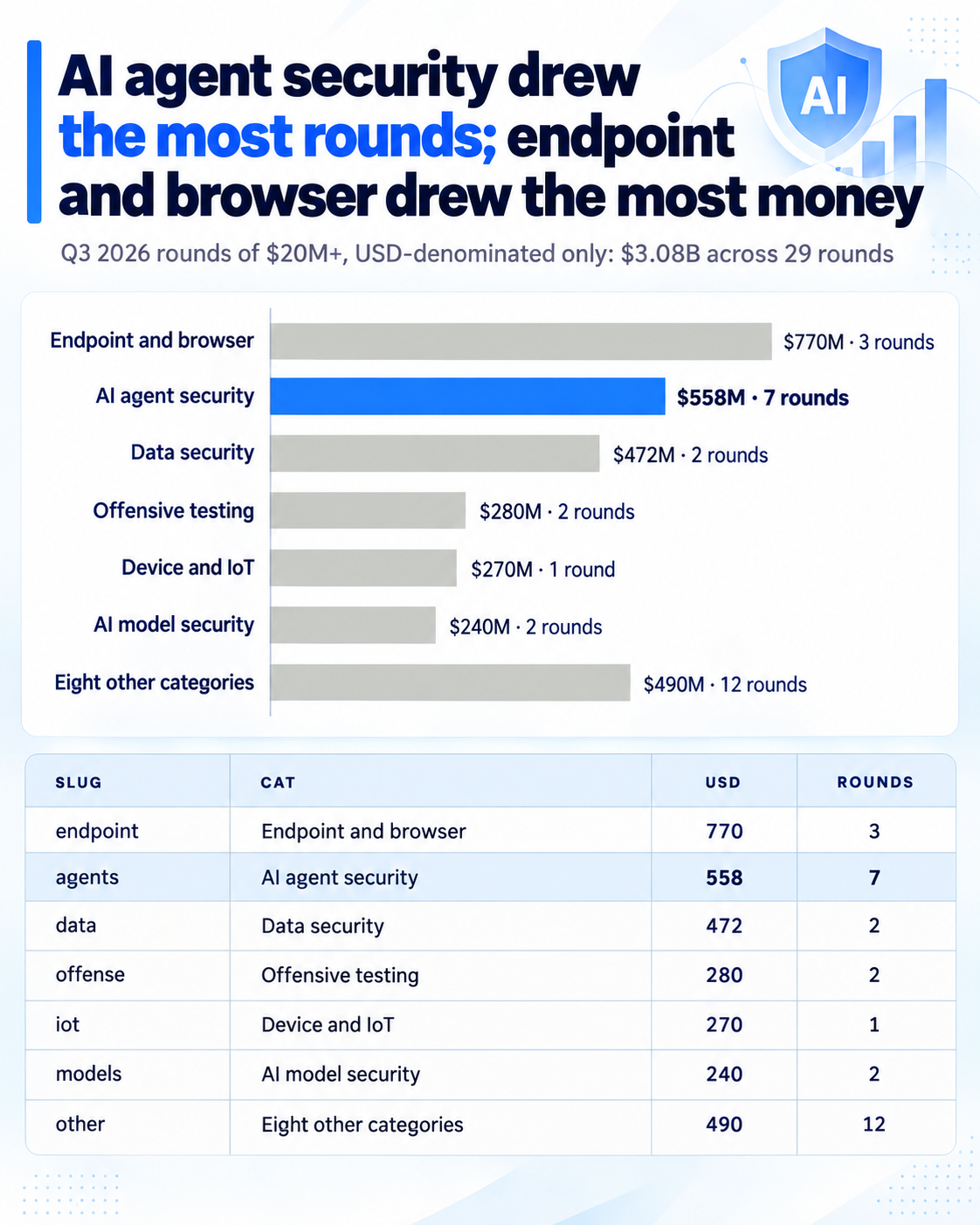
Seven companies in this list are building security for AI agents, more than any other category. Endpoint and browser security raised the most money, but that total rests on three large rounds, Island alone accounting for $400M.
1. Securing AI agents is now its own category
An AI agent is software that takes actions on its own, such as reading a mailbox, updating a CRM record or running code, rather than just answering a question. Once an agent can act, someone has to decide what it may touch and record what it did.
That is the problem Zenity, Onyx, Neo, Obsidian, Reco, AIR and Hush all describe, from slightly different angles. Some watch agents inside SaaS apps like Salesforce or Microsoft 365. Others sit on the laptop, or act as a firewall between the agent and the systems it calls. Seven separately funded companies in one quarter suggests buyers have the problem but no settled answer yet.
2. Data access is the other half of the AI question
Cyera's $400M round and MIND's $72M round are both about data. Before a company lets an AI assistant loose on its file shares, it needs to know where the sensitive files are and who can reach them. A data security tool that answers that question becomes the gatekeeper for every AI rollout.
3. Security teams are buying AI to do their own work
Corma, Mate, Arlequin AI and AegisAI sell AI that does security work: triaging alerts, investigating incidents, catching phishing. The pitch is labor, not just detection. Most security teams are short-staffed, so a product that clears a queue of alerts is easier to justify than another dashboard.
4. Testing your own defenses is getting automated
Horizon3 ($250M) runs automated attacks against a company's own network, and Mindgard does the same for AI systems. This is called red teaming: attacking yourself on purpose so you find the gaps first. Paying humans to do it once a year is expensive; software that does it continuously changes the cost.
5. The old categories still raise big rounds
Not everything is AI-first. ThreatLocker (endpoint control), Exein (connected devices), Oak (identity), Risk Ledger (supplier risk) and Comp AI (compliance) all solve problems that existed long before chat assistants. Several of them now mention AI in their positioning, but their buyers are paying for the core control.
6. Israel is overrepresented
By the roundup's own HQ labels, 18 companies are US-based, 8 Israeli, 3 British, and one each are Italian and French. Israel accounts for about a quarter of the list, which fits its long record as a source of security founders.
What this means for founders
Your takeaway depends on where you sit. Here is how we would read the list from four common positions.
If you are building a security startup
A crowded category is a fundraising question you will be asked. If you pitch AI agent security next quarter, expect investors to ask how you differ from the seven companies above. "We also secure agents" will not be enough. A narrower wedge tends to land better: one platform, one buyer, one painful workflow.
The flip side is that money flowing into a category validates the problem. Use these rounds as evidence of demand in your deck, but cite them accurately and do not imply the investors behind them would back you too.
If you are building an AI product that uses agents
Your enterprise customers' security teams are being sold tools to watch, limit and audit agents like yours. Expect sharper questions in procurement:
- Which systems and data can your agent reach, and can the customer narrow that?
- Do you keep a log of every action the agent takes?
- How do you handle prompt injection, where hidden instructions in a document or email trick the agent into doing something it should not?
Having clear, written answers before the security questionnaire arrives can shorten a sales cycle. Getting caught without them can stall one for weeks.
If you sell to security teams
A newly funded startup usually spends on hiring first, then tooling. Companies that just raised are worth a look as customers for recruiting, developer, data or compliance tools. Approach them as a vendor with a specific reason, not with a generic "congrats on the raise" message.
If you are hiring or job hunting
The roundup's own framing is that these companies are likely hiring, and that is a reasonable assumption after a large raise, not a guarantee. Check each LinkedIn page and careers site for current roles. Large rounds can also mean a company is buying growth through acquisitions rather than headcount.
A trade-off worth naming
Following the money is useful for spotting demand. It is a poor way to pick what to build. By the time a category shows seven funded companies in one quarter, the easy positions are taken. The better question for most founders is what these companies are not covering, and whether customers will pay for that gap.
What this list cannot tell you
A funding list is a snapshot, and this one has real gaps. Keep them in mind before you build a strategy or a pitch slide on it.
- It is a curated roundup, not a complete database. Rounds that were unannounced, or announced quietly, will be missing. Totals here are a floor, not the full market.
- Amounts and dates come from announcements. Some rounds may combine equity with debt or be extensions of earlier rounds, and announcement dates can lag the actual close.
- Round stage and investors are not included. A $25M Series A and a $25M growth extension mean very different things.
- The categories are ours. Several companies span two areas, and a different grouping would shift the chart.
- Currency matters. The €28M and £24M rounds sit outside the dollar totals rather than being converted at a rate we would have to choose.
- "Likely hiring" is an inference. Funding usually leads to hiring, but nothing here confirms open roles.
Before quoting any single figure, check the company's own announcement or a primary news report.
FAQ
How much did cybersecurity startups raise in Q3 2026?
The 31 rounds of $20M or more in this roundup total about $3.08 billion across the 29 reported in US dollars, plus a €28M and a £24M round. Smaller rounds are not included.
Which cybersecurity startups raised the largest rounds in Q3 2026?
Island and Cyera each raised $400M, followed by Exein ($270M), Horizon3 ($250M) and ThreatLocker ($190M). Those five account for about half of the dollar total.
What is AI agent security?
It covers tools that control and monitor AI agents, meaning software that takes actions on its own inside a company's systems. These tools decide what an agent can access, log what it does, and block risky actions. Seven companies on this list work in this area.
Which countries produced the most funded cybersecurity startups?
By the roundup's labels, the US (18 companies) and Israel (8) dominate, with three from the UK and one each from Italy and France.
Are these companies hiring?
Probably many of them, since hiring is the most common use of new capital. Check each company's LinkedIn page or careers site for current openings.