25 AI Startups Founded by Lab Alumni, Ranked by Funding Raised

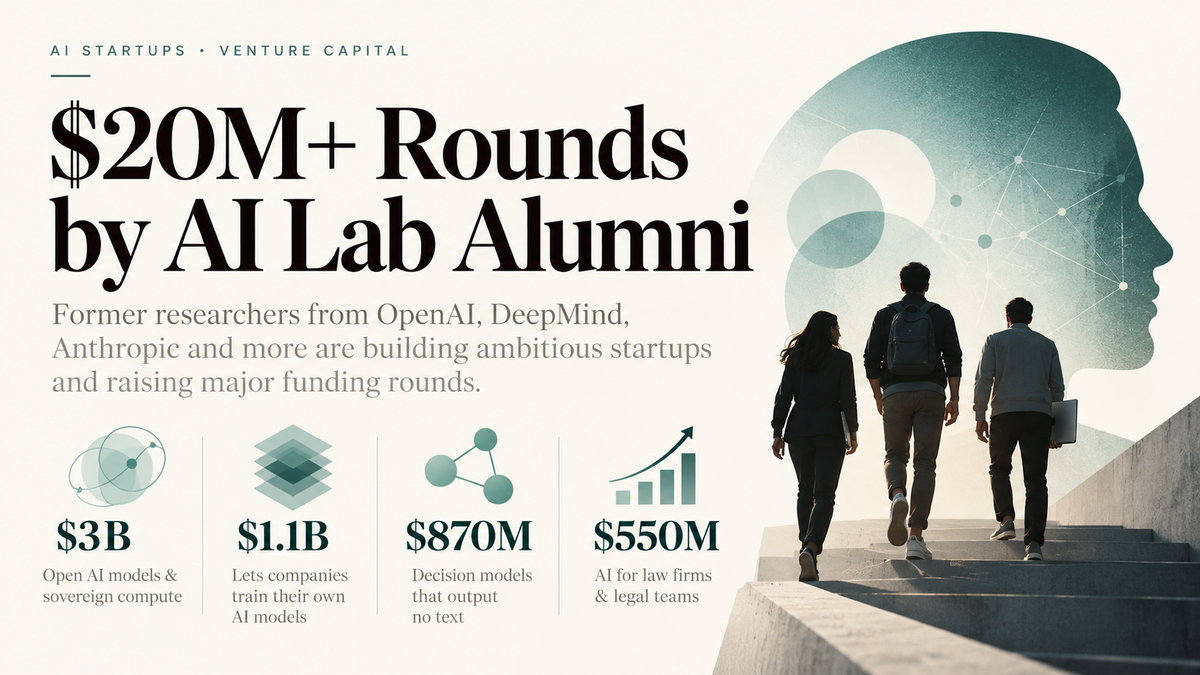
The 25 startups on this list were all founded by AI lab alumni, and each raised $20M or more in 2026, for about $10.4B combined. Three companies took 55% of that total, the US has the most companies, and Nvidia backed at least 11 of them. The headline number matters less than the pattern underneath it, and this post walks through that pattern, the limits of the data, and what it means if you’re building or hiring.
What the numbers say
The group is top-heavy. Mistral (€3B), River AI ($1.1B) and Ineffable Intelligence ($1.1B) account for roughly 55% of the combined total. Everyone else shares the remaining $4.7B or so.
The middle of the list looks very different from the top. Sorted by round size, the 13th company is Callosum at $100M, so the median round in this group is about $100M. Thirteen of the 25 raised $100M or less, and together those 13 account for only about 6% of the total, roughly $650M by my arithmetic from the list.
So if you’re benchmarking your own raise, don’t anchor on the top three. A $20M to $50M round, like those at Airspeed, Ethos, Mantic and Orbital Industries, is a normal outcome in this group, and it still counts as a serious raise.
The full list at a glance
Descriptions are taken from the source list. Mistral’s round is in euros and the rest are in US dollars.
| # | Company | Country | Raised | What it does |
|---|---|---|---|---|
| 1 | Mistral | France | €3B | Open AI models and sovereign compute |
| 2 | River AI | US | $1.1B | Lets companies train their own AI models |
| 3 | Ineffable Intelligence | UK | $1.1B | AI that learns without human data |
| 4 | TypeSafe AI | US | $870M | Decision models that output no text |
| 5 | Recursive | UK | $650M | AI that improves itself |
| 6 | Harvey | US | $550M | AI for law firms and legal teams |
| 7 | humans& | US | $480M | AI lab for human collaboration |
Two names are easy to confuse: Recursive (UK, AI that improves itself) and Ricursive Intelligence (US, chip design). They are separate companies. AIUC stands for Artificial Intelligence Underwriting Company. The source gives no description, and I’d rather not guess, so check its own site.
Geography: the US leads on count, France on a per-company basis
By company count:
- United States: 14
- United Kingdom: 8
- France: 3
That puts 11 of the 25 in Europe. The UK entries are Ineffable Intelligence, Recursive, Callosum, Inherent, Orbital Industries, Mantic, Ethos and Airspeed. France has Mistral, Dust and Gradium.
Dollars tell a more complicated story. Adding up the list myself, the US comes to roughly $4.8B, France to roughly $3.6B, and the UK to roughly $2.0B. Those figures assume Mistral’s €3B converts to about $3.5B, and they will shift with the exchange rate. The notable point is that France raised more than the UK with far fewer companies, almost entirely because of Mistral. Take Mistral out and France’s other two companies total about $70M.
The UK is the opposite case: eight companies, a wide spread of round sizes, and no single outlier carrying the total. If you’re thinking about where to base a team, a count of companies is a better signal of how deep a local ecosystem is, and dollars are a better signal of how concentrated the money is.
Nvidia’s footprint
Nvidia backed at least 11 of the 25, including River AI, Ineffable Intelligence and Recursive. Treat “at least” literally, since investor lists in funding announcements are often incomplete.
Why would a chipmaker invest this widely? A plausible reason is that model labs and AI infrastructure companies are potential large buyers of compute. That’s an inference, and the funding data doesn’t prove it.
For a founder, the practical question is what a strategic investor like this does for you:
- Possible upside: introductions, credibility with other investors, and easier conversations about hardware access.
- Possible downside: customers or other investors may read the relationship as a dependency, and strategic investors can have interests that differ from yours.
Neither outcome is guaranteed, and the list doesn’t tell us which one these companies experienced. If a strategic investor offers you money, ask what specifically they provide beyond the cheque, and get it in writing where you can.
How to read a list like this
A list of alumni-founded startups invites a tidy conclusion: lab pedigree equals big rounds. The data doesn’t quite support that, because the list was built by selecting alumni-founded companies. We can’t see the alumni-founded companies that didn’t raise $20M, or the non-alumni companies that did. Selecting on the outcome makes the pattern look stronger than it may be.
Here are three readings that are reasonable, and the first two are my inference rather than something the data proves:
- Investors may be paying for technical judgment. Lab alumni have seen frontier systems up close, which helps with deciding what is feasible, what is a dead end, and what is worth building next.
- Capital-intensive work needs big rounds. Training models and building chips costs a great deal more than building a software product on top of someone else’s API. Part of the size of these rounds is just what the work costs.
- The list reflects a narrow slice of the market. It covers 25 companies over one year, and one year is not a trend.
What these companies are building
The companies fall into a few loose groups.
Models and new ways of learning. Mistral builds open models and sovereign compute, meaning computing capacity a country or organization controls itself rather than renting from a foreign provider. Ineffable Intelligence works on AI that learns without human data. TypeSafe AI builds decision models that output no text, and Elorian AI builds models that reason in images. Poetiq focuses on making existing models reason better.
Automating AI and science work. Recursive (AI that improves itself), Mirendil (models that automate AI research) and Inherent (agents for open-ended scientific research) share a theme of AI doing research work. In the physical sciences, Chai Discovery designs molecules, Orbital Industries designs materials, and Ricursive Intelligence automates chip design.
Infrastructure and tooling. River AI lets companies train their own models, and Applied Compute builds custom models for enterprises. Callosum runs AI workloads across mixed chips, so teams aren’t tied to a single hardware type. Isara coordinates thousands of AI agents at once, and Goodfire builds interpretability tools, which are ways of seeing what happens inside a model.
Robotics. Generalist is building models meant to control any robot.
Applications. Harvey serves law firms and legal teams. Dust offers a workspace for teams of AI agents. Gradium makes real-time voice models for developers, Mantic forecasts world events, Ethos runs an expert network with voice AI, and Airspeed builds sales agents for revenue teams. humans& describes itself as an AI lab for human collaboration.
Few of these are thin layers over someone else’s model. Most either build models, build the tooling around them, or apply AI to a domain where specialist knowledge is hard to copy.
If you don’t have a lab background
Most founders reading this didn’t come out of an AI lab, and that doesn’t close the door. The applications group above, from Harvey to Airspeed, shows where other kinds of advantage can matter. Some practical ways to build a case:
- Lead with evidence a lab alumnus can’t easily match. That could be paying customers, proprietary data, or years inside an industry like law, sales or insurance.
- Be honest about your technical gaps. If you rely on third-party models, say so, and explain what you do that’s hard to replicate: workflow integration, data, distribution or trust.
- Hire for the gap early. A senior ML engineer or research advisor with a credible track record can add technical credibility, but make sure the role is real and not decorative.
- Describe the product in one sentence. Look at how the companies above describe themselves. “Designs new materials with AI” and “runs AI workloads across mixed chips” are each something a stranger can repeat. If your pitch needs a paragraph, tighten it before you send it.
- Match the round to the business. If you’re raising $5M to $30M, you’re in good company, since several companies on this list raised in the $20M to $45M range.
If you’re hiring: reading a funded startup
The source list is labeled “likely hiring,” and that’s a reasonable guess for well-funded companies, but it isn’t a confirmed count of open roles. If you’re a candidate, or competing with these firms for talent, a few checks help:
- Look at the careers page, not the funding announcement. Open roles show what the company actually needs.
- Compare funding to team size. A large round and a small team can mean a long runway. A large round and fast hiring can mean the opposite. Public headcount on LinkedIn is imperfect but useful.
- Ask how the money is being spent. Compute-heavy companies spend differently from software companies, so ask about it.
- Remember that talent is local. With 14 companies in the US, eight in the UK and three in France, the same pool of researchers and engineers is being courted from a few places. If you’re hiring in those cities, this list is also a map of who you’re competing with.
Limits of this data
A few caveats before you rely on any of this:
- This is one list, not a market survey. Alumni-founded startups below $20M aren’t included.
- Funding figures are as reported. The $10.4B total appears to convert Mistral’s euro round to dollars, so exact values depend on the exchange rate.
- The country and category breakdowns, and the dollar totals by country, are my own groupings and arithmetic based on the list, not figures from the original source.
- A big round says nothing about product quality or long-term success.
- Nvidia’s involvement is “at least 11,” and I haven’t verified which specific companies it backed beyond the three named.
Frequently asked questions
Which AI lab alumni startup raised the most in 2026? In this list, Mistral, at €3B.
How much did these startups raise in total? About $10.4B across 25 companies, each raising $20M or more.
How concentrated is the funding? Mistral, River AI and Ineffable Intelligence account for about 55% of the total.
What was the typical round size? The median in this group is about $100M, and 13 of the 25 raised $100M or less.
Where are these startups based? Fourteen are in the US, eight in the UK and three in France.
Did Nvidia invest in these companies? At least 11 of the 25, according to the source list, including River AI, Ineffable Intelligence and Recursive.
Are these companies hiring? Probably, given their funding, but check each company’s careers page for actual openings.