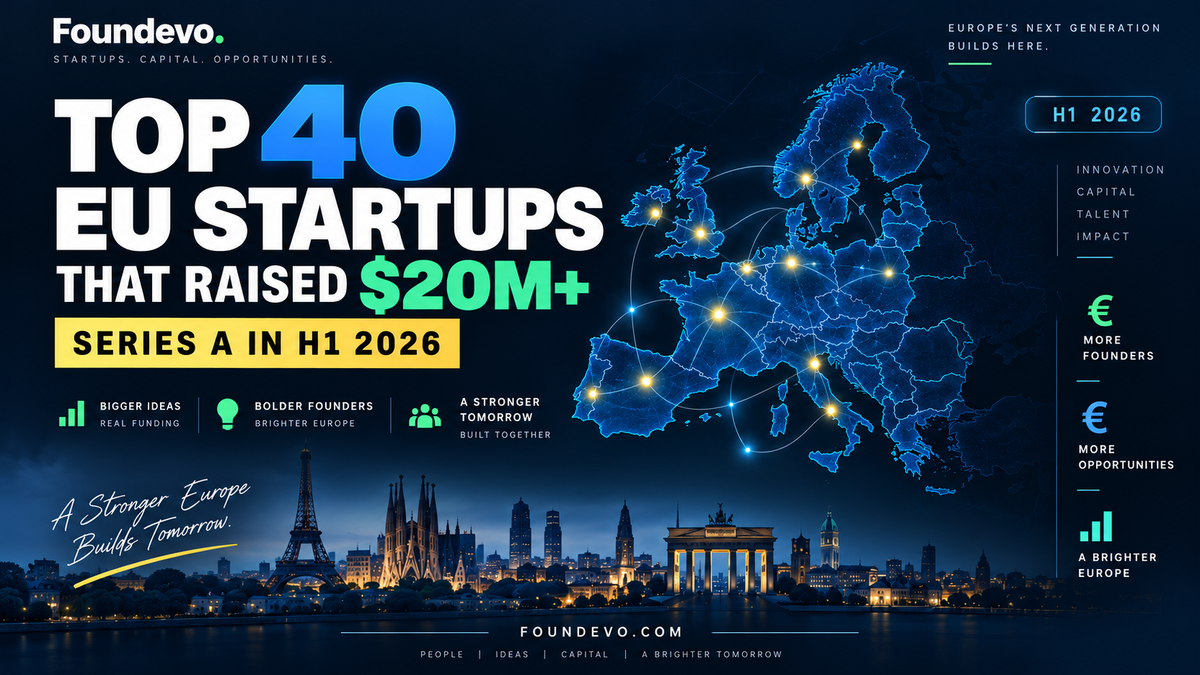
Top 40 EU Startups That Raised $20M+ Series A in H1 2026
Europe’s startup ecosystem is sending a clear signal in 2026: capital is moving toward deep technology, biotech, defence, energy, AI, and industrial innovation.
During the first half of 2026, 40 European startups in this list raised $20M+ or €20M+ Series A rounds, with several companies securing exceptionally large financings. Many are also expanding their teams, creating opportunities for engineers, researchers, product specialists, operators, and other startup talent.
France and Germany stand out as major funding hubs, while companies across Spain, Sweden, Ireland, the Netherlands, Denmark, Belgium, Estonia, Italy, Austria, and Lithuania are also attracting significant capital.
Here’s a closer look at where the money—and potentially the jobs—is flowing.
France and Germany Dominate the Funding Map
France and Germany appear repeatedly throughout the list, particularly among companies working on complex technologies.
The startups span areas including quantum computing, defence, energy, biotech, aerospace, enterprise software, and robotics.
Some of the largest rounds include:
- Focused Energy — $240M for laser fusion power plants
- Bionyra — $165M for biologics targeting inflammatory disease
- Coultreon Biopharma — $125M for autoimmune disease therapies
- HYNAERO — €117M for amphibious water bomber aircraft
- Quobly — €115M for silicon-based quantum computers
- THEKER Robotics — $85M for general-purpose factory robots
The size of these rounds highlights how investors are backing businesses tackling technically difficult and capital-intensive problems.
Hard Tech and Biotech Are Leading the Way
One of the clearest patterns is the concentration of funding in hard tech and biotech.
Eight of the top 10 companies on the list operate in areas such as fusion energy, biologics, aerospace, quantum computing, robotics, and defence.
For example, Quobly and eleQtron are developing different approaches to quantum computing, while THEKER Robotics is working on generalist robots for industrial environments.
Meanwhile, Bionyra, Coultreon Biopharma, and Aerska are developing new approaches to treating diseases, including inflammatory conditions, autoimmune disorders, and neurological diseases.
This is a different funding environment from one dominated purely by consumer apps or lightweight software products.
Investors are putting substantial capital behind companies attempting to solve difficult scientific and industrial problems.
Defence Is Becoming a Major Startup Category
Defence technology is another notable theme across the list.
Companies including Alta Ares, Comand AI, TYTAN Technologies, and Frankenburg Technologies are developing technologies ranging from anti-drone and interceptor systems to defence command software and missile defence.
The presence of several defence startups among large Series A rounds suggests that European investors are increasingly funding technologies connected to security, aerospace, autonomous systems, and military infrastructure.
For founders, this also points to a broader opportunity: government and defence-related markets can create demand for technologies that previously might have been considered too specialized for venture-backed startups.
AI Is Moving Into Specialized Industries
AI appears throughout the list, but often as part of a larger industry-specific product rather than as a generic AI application.
Biorce, for example, applies AI to clinical trial design.
Qevlar AI focuses on autonomous security operations investigations.
Solidroad uses AI for hiring and training.
Stacks automates financial close processes, while Kombo provides an API connecting HR and payroll systems.
The pattern is important: AI is increasingly being embedded into workflows where domain expertise, proprietary data, and operational complexity can create differentiation.
For founders building AI startups, the opportunity may not simply be to build another general-purpose AI product—but to solve an expensive, specialized business problem.
Energy and Climate Infrastructure Are Attracting Capital
Energy is another recurring theme.
Focused Energy is working on laser fusion power plants, while metiundo focuses on metering energy consumption.
Subra is developing superconducting power cables, SunLib offers solar through a subscription model, and Eclipse Automation is working on stationary energy storage.
Meanwhile, Mantle8 is exploring natural hydrogen, and constellr operates satellites designed to measure land heat.
These companies operate across very different parts of the energy ecosystem, but together they show how European startup capital is reaching beyond software into physical infrastructure and energy technology.
The 40 Startups to Watch
Want to discover the Top 40 EU startups that raised $20M+ in Series A funding in H1 2026?
Subscribe to Foundevo to get the full list of startups, funding details, industries, and the companies attracting capital across Europe. 👇
What This Means for Founders
The funding activity points to several themes worth watching.
1. Deep tech is becoming increasingly venture-backed.
Fusion, quantum computing, robotics, aerospace, advanced sensors, and energy infrastructure are attracting rounds that were historically difficult for early-stage companies to secure.
2. Defence technology is gaining momentum.
Anti-drone systems, autonomous defence technologies, missile defence, and defence software appear across multiple funded companies.
3. AI is becoming more vertical.
The strongest examples in this list apply AI to specific workflows such as clinical trials, cybersecurity, hiring, and financial operations.
4. Capital can translate into talent demand.
Large Series A rounds give startups resources to expand research, engineering, sales, operations, and product teams. For candidates, recently funded startups can therefore be useful companies to track when looking for opportunities.
5. Europe’s startup opportunity is geographically distributed.
While France and Germany feature heavily, meaningful funding is also reaching startups in Spain, Sweden, Ireland, the Netherlands, Denmark, Belgium, Estonia, Italy, Austria, and Lithuania.
The Bigger Picture
The most interesting takeaway isn't simply the size of the funding rounds.
It's where the capital is going.
European investors are backing companies attempting to build fusion power plants, quantum computers, industrial robots, defence systems, satellites, new medicines, energy infrastructure, and specialized AI platforms.
For founders, investors, and startup professionals, these companies offer a useful snapshot of the sectors attracting significant venture attention in Europe during H1 2026.
And for talent, they represent another opportunity: follow the funding to find the companies that may be building their teams next.
Want to track more startups, funding rounds, hiring opportunities, and emerging technology trends? Subscribe to Foundevo for startup and venture insights delivered to your inbox. 👇