144 Seed and Early-Stage Investors Founders Should Know

Raising your first institutional round is rarely just about finding investors with capital.
The harder part is finding investors whose stage, geography, check size, sector focus, and investment approach actually fit your startup.
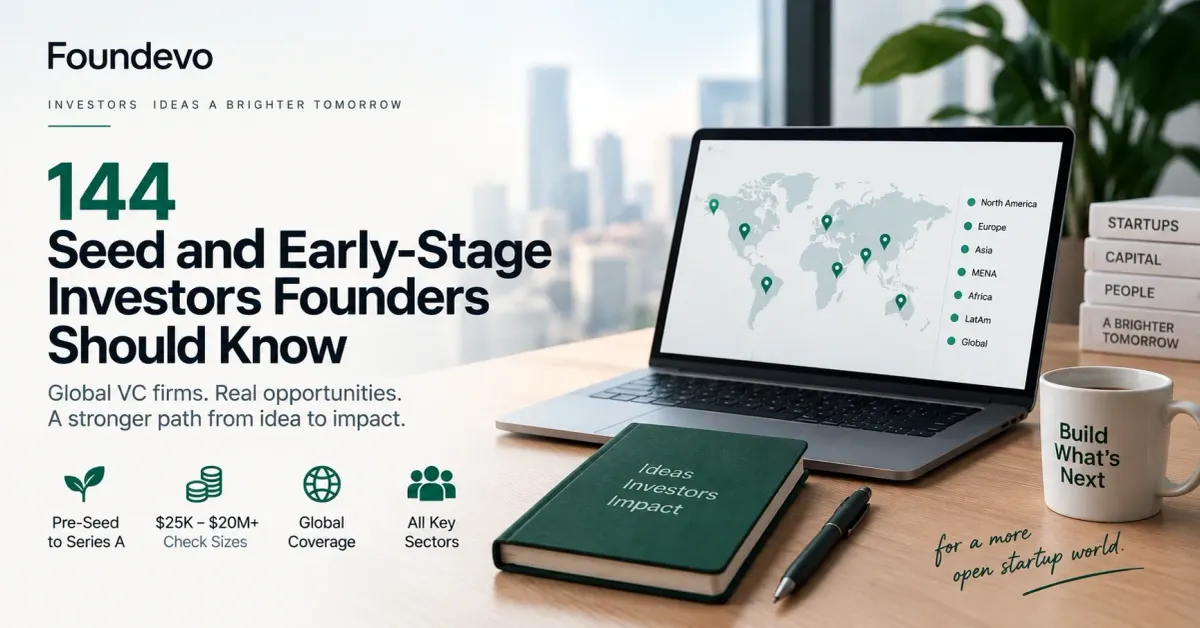
To make that process easier, Foundevo has compiled a curated list of 144 seed and early-stage investors covering markets across the US, Europe, Canada, Africa, Asia, MENA, and other startup ecosystems.
Why the Right Investor Matters
A startup can spend weeks reaching out to investors who were never a realistic fit.
Some funds focus heavily on pre-seed companies. Others concentrate on Seed or Series A rounds. Some write checks below $500K, while others can invest several million dollars or more.
The right investor match can therefore depend on much more than the fund's reputation.
Founders should look at four key factors:
Investment stage — Does the investor actively participate in Pre-Seed, Seed, Series A, or later rounds?
Check size — Does the typical investment range match the amount you're raising?
Geography — Does the investor invest in your country or region?
Sector and thesis — Does the fund understand your market, technology, or business model?
144 Investors Across Different Startup Stages
The database includes investors ranging from focused pre-seed specialists to large multi-stage venture capital firms.
Among the investors represented are names such as Accel, a16z crypto, Benchmark, First Round Capital, Founders Fund, General Catalyst, Index Ventures, Khosla Ventures, Sequoia Capital, True Ventures, Uncork Capital, and Unusual Ventures, alongside smaller and more specialized funds.
This mix gives founders the opportunity to look beyond the most visible VC firms and discover investors that may be more closely aligned with their current fundraising stage.
Pre-Seed and Seed Investors
For founders still validating an idea, launching an MVP, or building early traction, pre-seed and seed-focused investors can be particularly relevant.
The dataset includes investors with stated focus areas such as Pre-Seed, Seed, Seed–Series A, and early-stage investing.
Examples include investors such as Aions Ventures, Bellatrix, Bondstone, Collide Capital, Creator Fund, DFF Ventures, Firstpoint VC, Gateway Capital, Gutter Capital, Hallstone Ventures, Kindred Ventures, Newfund, Nucleo Ventures, Osney Capital, Passion Capital, Pitchdrive, Restive Ventures, Ridgeline, and Zero Shot Fund.
Check sizes vary significantly, making it important for founders to evaluate each investor against their actual fundraising requirements.
Investors for AI and Deep Tech Startups
AI and deep tech continue to attract specialist capital, but not every technology-focused fund has the same investment profile.
The list includes investors categorized around AI and deep technology, including firms such as a16z crypto, Compound, Decibel Partners, Engineering Capital, Gradient, Hyperplane, Lux Capital, Merantix Capital, Refactor, SignalFire, Wing Venture, and Zetta Venture.
For technical founders, sector alignment can be particularly useful because specialist investors may bring relevant networks, operating experience, and domain knowledge alongside capital.
Enterprise, SaaS and Fintech Investors
The database also includes investors associated with enterprise software, SaaS, fintech, and B2B technology.
Examples include Battery Ventures, Canaan, Costanoa Ventures, Crosslink Capital, Foundation Capital, General Catalyst, Menlo Ventures, Sierra Ventures, and Work Bench.
Founders building B2B products can use this type of categorization to narrow a broad investor universe into a more targeted fundraising pipeline.
Consumer and Brand-Focused Investors
Consumer startups often require investors who understand customer acquisition, brand building, marketplaces, community-driven growth, and changing consumer behavior.
The list includes investors categorized around consumer, brand, and culture, including Forerunner Ventures, Harlem Capital, Human Capital, Lerer Hippeau, Obvious Ventures, and Caffeinated Capital.
Rather than approaching every generalist VC, consumer founders can use sector alignment as an initial filter.
Operator-Led Investors
Some investors bring significant operating experience in addition to capital.
The dataset includes a group of investors categorized as operator-led investors, including Bling Capital, boldstart, defy.vc, Harpoon, Quiet Capital, Root Ventures, Tribe, and True Ventures.
For founders, operator experience can potentially be valuable when navigating product development, hiring, go-to-market strategy, and scaling challenges.
Global Investor Coverage
The investor list isn't limited to Silicon Valley.
The dataset includes investors covering regions such as:
United States and Canada
United Kingdom and Europe
Nordics and Baltics
Central and Eastern Europe
Middle East and North Africa
Africa
Israel
Japan and broader Asia
Global markets
This geographic diversity matters because startup ecosystems and investor networks are increasingly global.
A founder based outside the traditional US venture ecosystem may find relevant investors that specifically operate within their region or invest internationally.
Check Sizes Range From Smaller Seed Rounds to Multi-Million-Dollar Investments
Another important factor is check size.
The dataset includes investors with disclosed ranges starting from approximately $25K–$350K, while some investors list potential investments reaching $10M+, $20M, or more, depending on stage and strategy.
For founders, this makes check size one of the simplest ways to reduce an otherwise overwhelming investor list.
If you're raising $500K, for example, an investor primarily writing $10M+ checks may not be the most relevant first target.
Likewise, a startup raising a $10M growth round may need a very different investor profile from a company raising its first $300K.
How Founders Can Use the List
Don't treat a VC database as a mass-email list.
Instead, use it to build a targeted fundraising pipeline.
Start by defining your fundraising stage and target amount. Then filter investors based on their preferred stage and typical check size.
Next, look at geography and sector alignment.
Finally, research the investor's portfolio and partners before reaching out.
A smaller list of highly relevant investors can be more useful than hundreds of generic introductions.
Build Your Investor Pipeline
Fundraising becomes much easier to manage when founders have a structured pipeline.
For each investor, track:
Investor name
Preferred investment stage
Typical check size
Geographic focus
Sector or thesis
Relevant partner
Portfolio companies
Introduction source
Outreach status
Next step
This turns an investor database into an actual fundraising workflow.
Get the Complete Investor List
Finding potential investors is only the first step.
The real advantage comes from knowing who to approach, when to approach them, and why your startup fits their investment strategy.
Foundevo's curated database brings together 144 seed and early-stage investors so founders can start their research from a more focused list instead of searching the venture capital landscape from scratch.
Use the list as a starting point for your investor research, then validate each fund's current thesis, portfolio, stage focus, and investment criteria before beginning outreach.