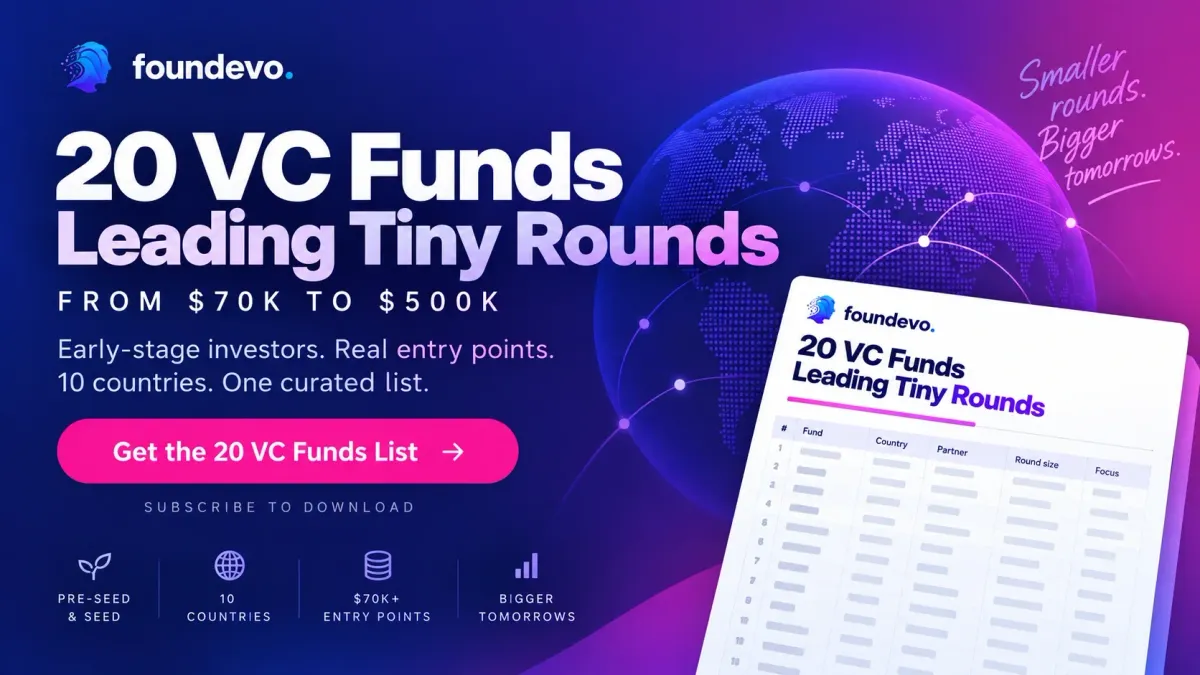
20 VC Funds Leading Tiny Rounds From $70K to $500K
Everyone hears about the $50 million funding round.
But for most early-stage founders, the more important question is much smaller:
Who will write the first meaningful check?
Foundevo reviewed 20 investors, VC funds and institutional funding programs active across 10 countries, with reported investment or funding ranges starting as low as $70K.
These investors span pre-seed, seed and early-stage opportunities across software, AI, IT, SaaS, healthcare, fintech, internet and other technology sectors.
The list includes traditional venture firms such as Accel, Kleiner Perkins and General Catalyst, alongside emerging and regional investors such as Titan Capital, Peak XV Partners and East Ventures.
It also includes public and development-focused capital providers, which can be particularly relevant for founders who are looking beyond conventional VC.
Important: Not every organization below is a traditional VC fund. Some are government agencies, development institutions or public funding programs. They are included because they can provide startup or business financing.
The 20 Investors and Funding Organizations 👇
The ranges above reflect the figures presented in the supplied Foundevo research graphic and should be treated as indicative rather than guaranteed check sizes.
1. Artesian VC Can Start at $70K
Artesian VC stands out with a reported entry point of approximately $70K, making it the smallest starting figure in this list.
Based in Australia, the investor has exposure to areas including software, AI and healthcare.
For founders still validating an idea or building early traction, the difference between a $70K entry point and a multi-million-dollar minimum can be significant.
2. Antler Starts Around $100K
Antler is another early-stage investor with a reported starting point around $100K.
Its presence across startup ecosystems makes it relevant to founders who are still in the early stages of company building.
The broader range shown in the research also demonstrates that early-stage participation does not necessarily mean an investor only participates in very small rounds.
3. SFC Capital Starts at $131K
UK-based SFC Capital has a reported starting range of around $131K, with investments extending into multi-million-dollar rounds.
Its focus includes:
- AI
- Software
- IT
For founders in the UK technology ecosystem, investors with relatively low entry points can provide another potential route to early funding.
4. Titan Capital Starts Around $255.8K
India's Titan Capital appears on the list with a reported starting point of approximately $255.8K.
The firm is associated with Kunal Bahl, co-founder of Snapdeal, and focuses on areas including software, internet and IT.
For Indian founders, this highlights an important part of the funding landscape: early-stage capital is not limited to global Silicon Valley firms.
5. East Ventures Starts Around $473K
East Ventures, listed in the research with Japan as its country, has a reported entry point of approximately $473K.
Its focus includes:
- Software
- IT
- Internet
The firm also appears with a much larger upper range, illustrating how an investor's capital deployment can extend considerably beyond the initial stage.
6. Enterprise Ireland Starts Around $494K
Enterprise Ireland has a reported starting point of approximately $494K.
Its focus includes software, IT and healthcare.
Unlike a conventional private VC fund, Enterprise Ireland is a state-backed organization supporting Irish businesses and startups. That makes it an example of why founders should consider government-backed capital alongside traditional venture firms.
7. Pear VC Starts at $500K
US-based Pear VC has a reported starting point of approximately $500K.
The firm focuses on software, AI and IT and is associated with Mar Hershenson.
Its presence on this list illustrates that a relatively small initial check can still come from an investor capable of participating in significantly larger financing rounds.
The Bigger Investors Are Also Starting Earlier
The interesting part of this list isn't only the seven investors with sub-$500K entry points.
Several well-known venture firms have reported investment ranges extending from early-stage checks to substantially larger rounds.
For example:
- Accel: $1.6M – $75M
- General Catalyst: $1.8M – $130M
- Kleiner Perkins: $5M – $120M
- IDG Capital: $3M – $310M
- Peak XV Partners: $1.7M – $70M
- True Ventures: $1.2M – $51M
- Mitsubishi UFJ Capital: $1.2M – $198.4M
- Mizuho Capital: $2M – $269.3M
The takeaway is not that founders should target the largest possible round.
Instead, it shows that investment size and investor capability are not always the same thing.
An investor can participate in an early round and potentially continue supporting companies as they mature.
Public and Institutional Capital Matters Too
One of the most overlooked parts of the list is the presence of public and development-focused organizations.
The research includes:
Bpifrance
France's Bpifrance appears with reported funding ranging from approximately $757.2K to $34M, covering areas such as software, IT and healthcare.
Enterprise Ireland
Enterprise Ireland appears with a reported range of approximately $494K to $12M, with a focus on software, IT and health.
U.S. Department of Agriculture
The USDA is included as a non-profit/program funding source, particularly around areas such as electrical and energy.
Government of Canada
The Government of Canada appears in the research with program funding connected to manufacturing and healthcare.
European Bank for Reconstruction and Development
The EBRD is included with a focus on finance, banking and energy.
These organizations don't fit neatly into the traditional VC category, but they highlight an important funding source founders can overlook:
Government and institutional capital.
Why Small Funding Rounds Can Matter
A startup doesn't necessarily need a huge round to reach its next milestone.
A smaller amount of capital can potentially help a company:
- Build an MVP
- Hire its first technical employees
- Validate product-market fit
- Acquire early customers
- Expand a pilot
- Develop an AI or software product
- Reach the metrics needed for a larger round
The appropriate amount depends on the company's stage, business model, capital requirements and milestones.
For an early-stage founder, the more useful question may therefore be:
"How much capital do I need to reach my next major milestone?"
rather than:
"How big can my funding round be?"
Founders Should Look Beyond the Headline Round
The startup funding conversation often focuses on spectacular numbers.
$10 million.
$50 million.
$100 million.
But the path to those rounds usually starts much earlier.
An investor willing to participate when a company is still small can become relevant long before the company has impressive revenue, large teams or international operations.
That's why early-stage founders should research:
- Minimum check size
- Typical investment stage
- Sector focus
- Geographic preferences
- Lead vs. follow participation
- Follow-on investment capacity
- Portfolio companies
- Partner-level investment interests
- Government or institutional funding eligibility
- Recent investment activity
The right investor isn't simply the one with the largest fund.
It's the one whose stage, check size, sector and investment approach match the company's current needs.
Final Takeaway
The biggest funding round isn't always the most important round for an early-stage company.
The first meaningful check can provide the capital needed to turn an idea into a product, a product into traction and traction into a company investors can back at a larger scale.
The research behind these 20 investors shows that early-stage funding opportunities can begin at $70K, while some of the same organizations participate in rounds worth tens or even hundreds of millions.
For founders raising capital, that creates a useful reminder:
Don't only search for investors who can write $50M checks. Search for investors willing to write the first check.
Smaller rounds. Bigger tomorrows.