How a Startup Got Its First 1,000 Users Without Marketing
Top 20 Most Valuable AI Startups in Europe
In This Edition:
- 🤖 AI Workflows Replacing Entire Teams
- 📈 How Top Companies Adopted AI
- 🏆 Europe's Most Valuable AI Startups
- 🛡️ Build Your IP Moat Early
- 🎯 How They Got 1,000 Users
- 🤝 OpenAI Launches $150M Partner Network
AI Workflows Replacing Entire Job Functions
The conversation around AI is shifting from task automation to workflow automation. Instead of assisting employees with individual tasks, modern AI systems are increasingly handling complete workflows—from customer support and lead qualification to data analysis, reporting, and administrative operations.
For founders, the key insight is that the greatest value lies in automating outcomes, not activities. Companies that redesign processes around AI can often achieve dramatic gains in speed, efficiency, and scalability. This creates opportunities for startups to deliver services that previously required entire teams.
Key Takeaways:
• AI is moving beyond task assistance to end-to-end workflow execution.
• Workflow automation can significantly reduce operating costs.
• Founders should focus on measurable business outcomes.
• Industries with repetitive, rules-based processes are especially vulnerable to disruption.
• Human oversight remains critical for strategy, judgment, and exception handling.
The next wave of AI innovation won't just make workers more productive—it will fundamentally reshape how work gets done.
Which job functions are most vulnerable to AI-driven workflow automation? Explore the emerging tools, industries, and business models redefining how work gets done—and what founders can do to stay ahead of the shift.
Top 20 Most Valuable AI Startups in Europe
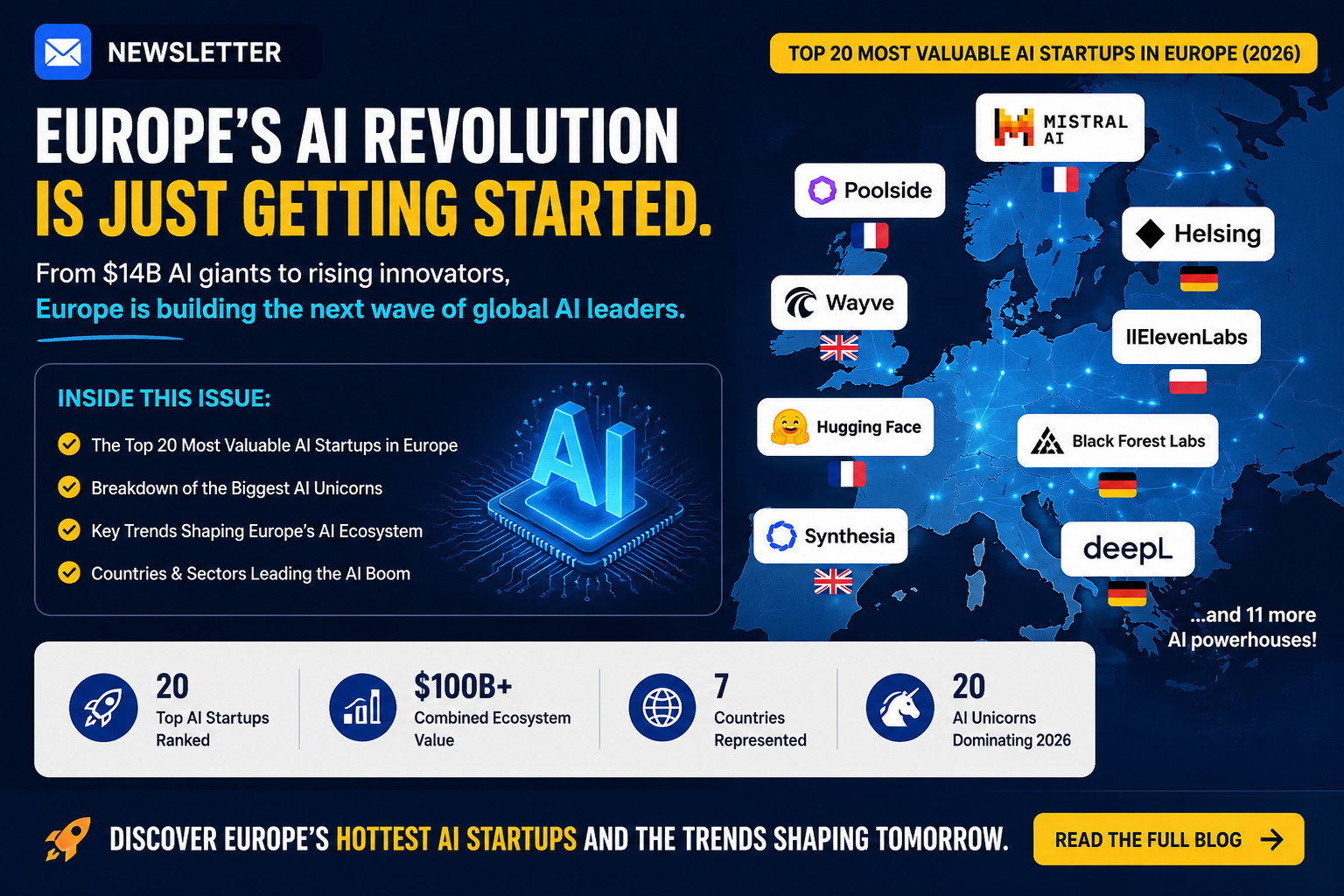
🚀 Europe’s AI startup ecosystem is exploding faster than expected.
From $14B AI giants like Mistral AI and Poolside AI to fast-rising companies in autonomous driving, AI defense, workflow automation, and generative media — Europe is quietly building the next generation of global tech leaders.
🇫🇷 France, 🇩🇪 Germany, and 🇬🇧 the UK are dominating the AI race with billion-dollar startups challenging Silicon Valley’s dominance.
Inside this report:
• Top 20 most valuable AI startups in Europe
• Biggest AI unicorns of 2026
• Hidden growth trends investors are watching
• AI sectors attracting massive funding
If you want to understand where the next wave of AI innovation is coming from, this list is impossible to ignore.
How Top 15 Companies Adopted AI
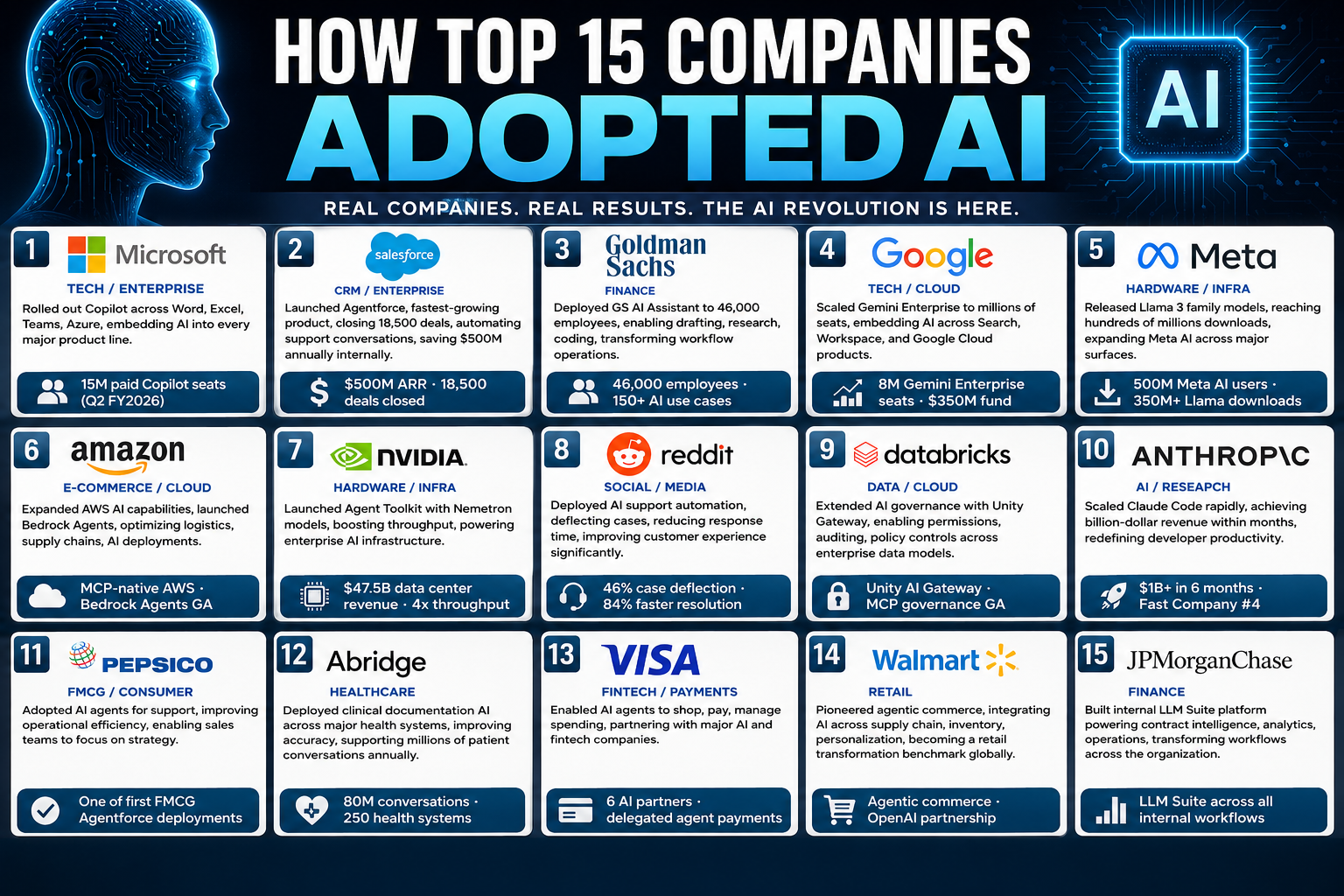
🤖 AI adoption is no longer experimental — the world’s biggest companies are rebuilding operations around AI-first systems.
From Microsoft’s AI copilots and Salesforce’s AI agents to NVIDIA’s AI infrastructure dominance, global enterprises are using AI to automate workflows, boost productivity, reduce costs, and transform decision-making at scale.
This deep dive breaks down how top companies are deploying AI in real business environments — and what founders, operators, and investors can learn from their strategies.
Inside:
• Real AI adoption case studies
• Enterprise AI workflow strategies
• AI agents, copilots & automation trends
• How companies are building AI-first operations
The companies winning with AI aren’t just adding features — they’re redesigning entire business systems around it.
Wall Street's Scared—You Should Be Buying
Markets are down, but smart money is circling.
In under 5 minutes, you’ll discover three battered but fundamentally strong picks with massive upside as conditions normalize.
These aren’t flavor-of-the-month names. They're backed by long-term trends, strong leadership, and ideal entry points created by panic selling.
The dip is real. The opportunity is rare. With AI, cyclical rebounds, and broad exposure, this report gives you an actionable edge. Get in before Wall Street catches on.
Download the FREE report and position yourself for the rebound.
This Week's Growth Hacks for Founders
⚙️ Build a Lean AI Stack by Stage
Pre-revenue: ChatGPT or Claude free + Canva free = your full content and strategy stack. Seed: add Cursor for AI-first dev and Notion AI for internal knowledge. Don't pay for overlapping tools — one tool per job. AI subscription sprawl kills runway quietly.
📊 Measure What Actually Drives Growth
Track CAC, retention curves, and profitable channels — not sign-ups. Tools like Supaboard surface AI-driven
insights without needing technical skills. Set automated alerts so problems surface before they compound into crises.
🚀 Ship Content Like a Team of 10
Solo founders using Jasper AI produce 20+ blog posts monthly vs. 4 manually. Pair with Grammarly for polish. Build your brand voice library in week one, then automate execution. Marketing compounding beats paid ads at early stages.
In a market where AI M&A faces geopolitical friction, defensible IP is your most valuable asset. Tools like CADChain enable early IP protection during iteration. Make compliance invisible infrastructure from day one — not an afterthought at Series A.
How a Startup Got Its First 1,000 Users Without Marketing
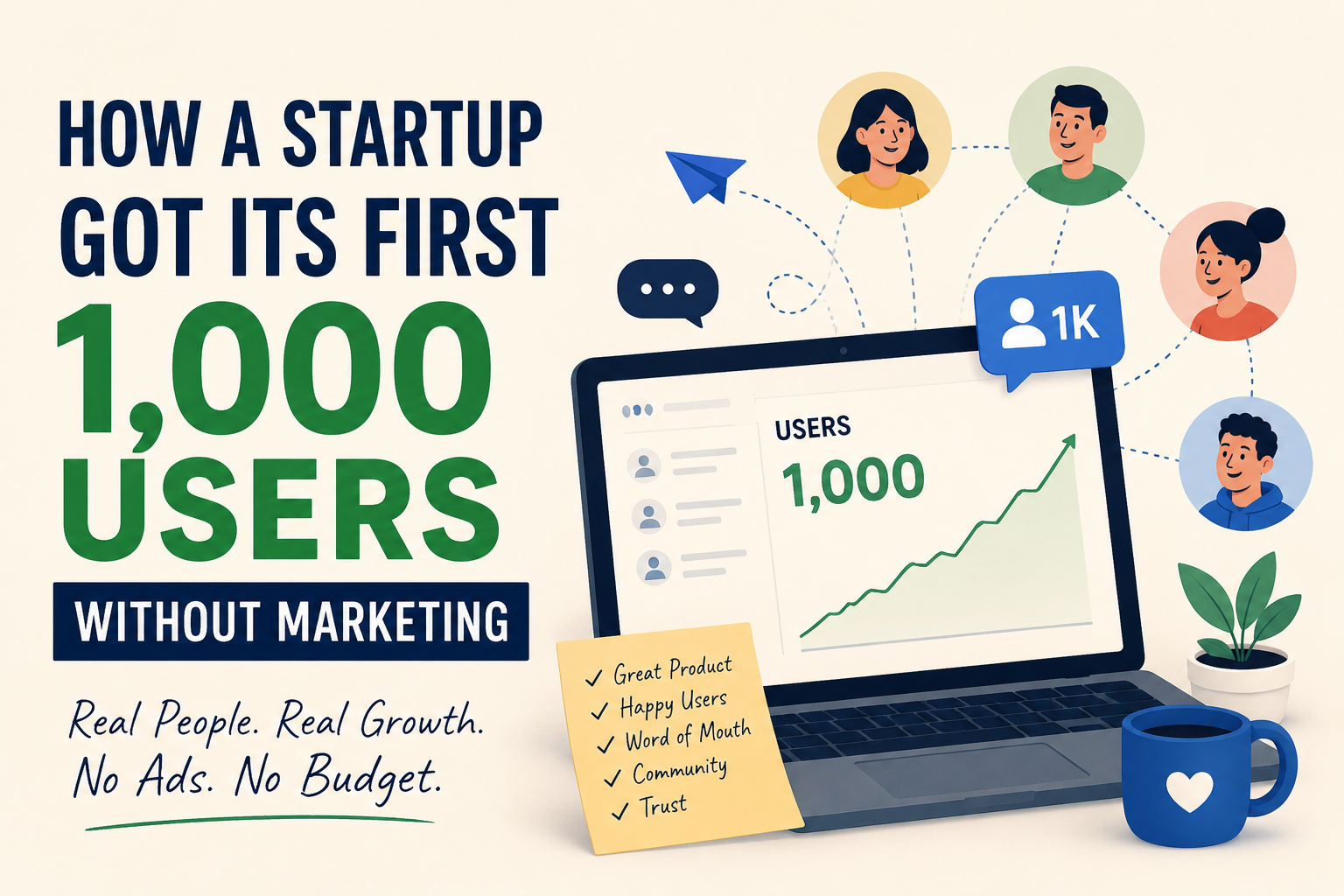
Many founders assume that acquiring users requires a large marketing budget, but some of the most successful startups reached their first 1,000 users through unconventional methods. Instead of investing heavily in advertising, they focused on solving a specific problem for a small group of users and creating experiences worth sharing.
Early growth often comes from direct outreach, community engagement, partnerships, referrals, and product-led adoption. By working closely with initial users, startups gain valuable feedback, improve retention, and generate word-of-mouth momentum that scales organically. In many cases, a highly engaged niche audience proves more valuable than broad but shallow exposure.
• Start with a clearly defined target audience.
• Prioritize user value over marketing spend.
• Leverage communities where your users already gather.
• Encourage referrals through exceptional product experiences.
• Use early feedback to refine and strengthen product-market fit.
The first 1,000 users are rarely won through advertising—they're earned through relevance, trust, and relentless customer focus.
Some of the most successful startups didn't buy their first users—they earned them through creative distribution, community engagement, and relentless customer focus. Discover the unconventional growth strategies founders used to reach their first 1,000 users and the lessons you can apply to your own startup.
WEB CLICK
🧠 DeepMind Maps the Road to Superintelligence
Researchers at DeepMind released a new paper outlining how AI could evolve from Artificial General Intelligence (AGI) to Artificial Superintelligence (ASI). The report highlights pathways including larger models, recursive self-improvement, novel architectures, and massive multi-agent systems working together.
🏛️ Anthropic Takes AI Access Talks to Washington
Anthropic reportedly dispatched senior leaders, including co-founder Tom Brown, to Washington to negotiate the restoration of access to its latest AI models. The move underscores how closely AI development is becoming tied to government relations and policy decisions.
📈 Satya Nadella Reveals AI's Real Competitive Advantage
Microsoft CEO Satya Nadella believes the future AI moat isn't the model itself—it's the proprietary data and feedback loops companies build over time. In his view, "token capital" may become more valuable than model performance alone.
♻️ Google's Unusual Datacenter Experiment
Google researchers are developing a datacenter powered by 2,000 retired Pixel smartphones. The project aims to reduce hardware waste and lower the environmental impact of traditional server infrastructure.
🤝 OpenAI Launches $150M Partner Network
OpenAI unveiled a $150 million partner program with consulting firms including Accenture, McKinsey, BCG, Bain, and PwC. The initiative aims to train 300,000 AI consultants, accelerating enterprise AI adoption worldwide.
Why Some Startups Grow Faster After Cutting Features
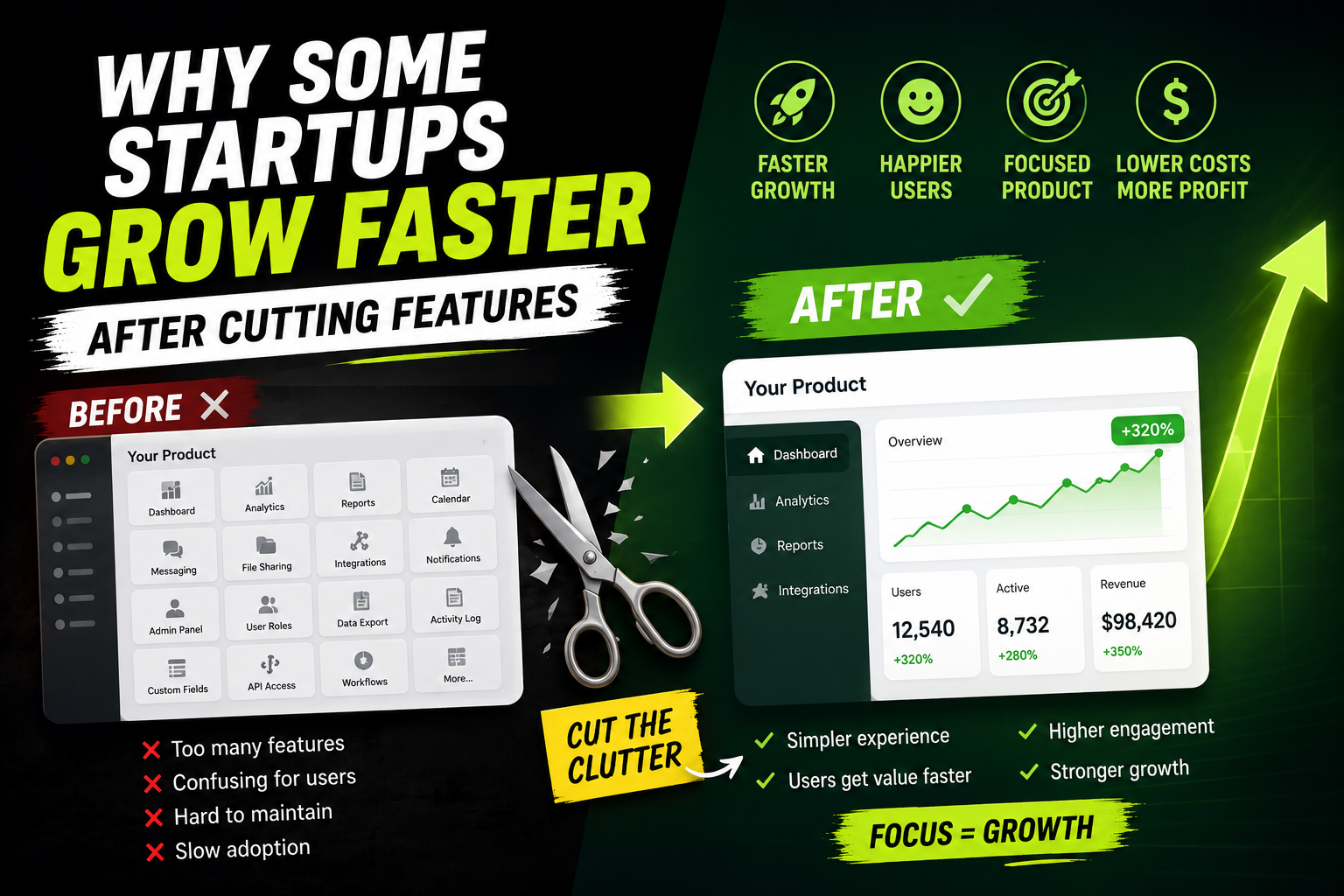
Conventional wisdom suggests that adding more features makes a product more competitive. Yet many successful startups have discovered the opposite: growth accelerates when they remove features and simplify the user experience. As products evolve, feature creep can create complexity, confuse users, and dilute the core value proposition.
By focusing on the few capabilities customers use and value most, startups often improve onboarding, increase engagement, and reduce support costs. Simplicity helps users achieve results faster, making products easier to adopt and recommend. It also enables teams to concentrate resources on refining what truly matters instead of maintaining underutilized functionality.
Key Takeaways:
• More features do not always create more value.
• Simplicity improves user adoption and retention.
• Feature creep can weaken product-market fit.
• Focus resources on the most impactful capabilities.
• Clearer products are easier to scale and support.
The strongest products aren't defined by how much they do—they're defined by how effectively they solve a customer's most important problem.
Many of the world's fastest-growing startups achieved growth not by adding features, but by removing distractions. Explore how product simplification improves adoption, retention, and scalability—and why less can often be more.