How Top 15 Companies Adopted AI in Business Operations: Real Examples That Actually Work

How Top Companies Are Using AI in Business Operations: Real Examples That Actually Work
Behind every AI headline sits a story of measurable returns, painful failures, and strategic bets. Fifteen Fortune 500 leaders reveal what really happens when artificial intelligence meets enterprise workflows.
The gap between AI adoption and actual impact is what separates the companies featured below from everyone else. They didn't just install AI tools. They restructured workflows, retrained teams, and rebuilt entire customer experiences around intelligent systems that genuinely move the needle.
This guide on how companies are using AI in business operations pulls back the curtain on fifteen of the world's most influential organizations. From Microsoft's deep integration of Copilot into daily office work to Walmart's pioneering moves in agentic commerce, each enterprise AI adoption example reveals something different about what success at scale actually looks like.
Reading through these real examples of AI in business offers more than inspiration. They expose the patterns, the missteps, and the strategic choices that determine whether AI becomes a productivity engine or another expensive experiment gathering dust in a procurement folder.
- Scale matters less than focus. Companies winning with AI deploy it surgically inside high-value workflows rather than spreading it thin.
- Internal adoption precedes external products. Most successful enterprises tested AI on their own employees before selling it externally.
- Measurable outcomes drive continued investment. Every leading company tracks specific metrics, from case deflection rates to revenue per seat.
- Governance is no longer optional. Platforms like Unity AI Gateway exist because compliance teams demanded visibility into model behavior.
- The best deployments are boring. Behind every headline-grabbing AI launch sits months of unglamorous data preparation and workflow redesign.
- Industry context shapes adoption speed. Finance, healthcare, and retail each face unique constraints that determine real implementation.
What Enterprise AI Adoption Actually Means
Enterprise AI adoption refers to the structured integration of artificial intelligence systems, including large language models, agents, and machine learning pipelines, into core business processes across an organization. It differs from consumer AI in three meaningful ways.
First, scale changes everything. A single ChatGPT subscription serves one person. Deploying AI to 46,000 Goldman Sachs employees requires identity management, audit logs, compliance reviews, and integration with existing systems that handle sensitive financial data.
Second, accountability runs deeper. When a consumer AI tool makes a mistake, the user shrugs. When an enterprise AI system mishandles a patient record or misroutes a payment, regulators get involved.
A widespread misconception treats AI adoption as a software purchase. It isn't. Real adoption involves change management, data infrastructure investment, role redefinition, and sometimes uncomfortable conversations about which jobs evolve and which disappear.
How Microsoft Uses AI in Business Operations
Tech / EnterpriseTech and enterprise software watchers have witnessed something unusual at Microsoft over the past two years. The company didn't bolt AI onto its products as a separate feature. Instead, Copilot became woven into Word, Excel, PowerPoint, Teams, and Azure with such intentional depth that removing it would require rebuilding the user interface itself.
What makes this strategy distinctive is the commitment to embedding intelligence at the point of work rather than asking users to switch contexts. A finance analyst building a quarterly forecast can summon Copilot inside Excel to draft formulas, while a project manager in Teams uses the same technology to summarize a thirty-minute meeting into three action items.
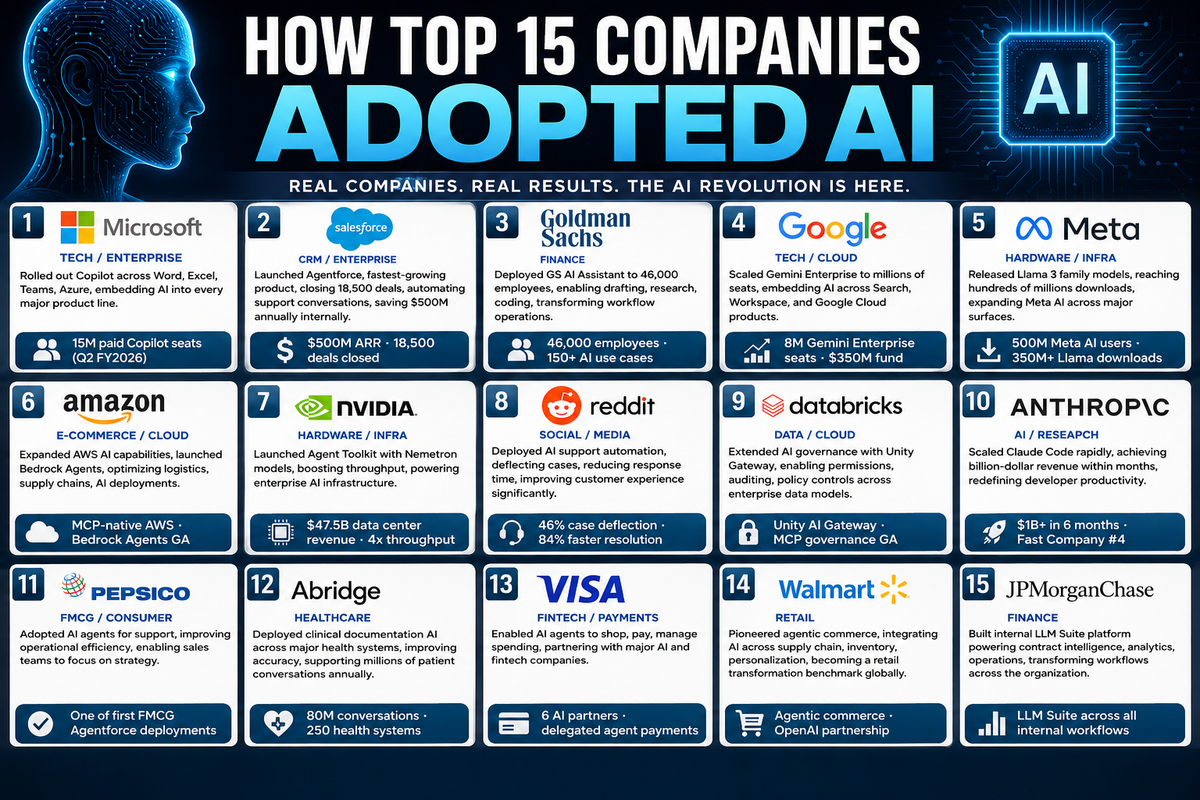
Recent quarterly figures show 15 million paid Copilot seats, a number that represents both a revenue line and a learning system. Every interaction generates feedback that refines how AI behaves inside Microsoft's product ecosystem. For organizations evaluating AI vendors, this scale advantage creates compounding benefits competitors find difficult to match.
How Salesforce Turned AI Agents Into Enterprise Revenue
CRM / EnterpriseCustomer relationship management software rarely produces dramatic stories, but Agentforce changed that narrative. Salesforce built its agent platform on a clear bet: businesses would pay for AI that could actually complete tasks, not just suggest them. The wager paid off faster than internal projections anticipated.
Within months of launch, Agentforce closed 18,500 deals and reached half a billion dollars in annual recurring revenue. The platform handles support conversations, qualifies leads, and automates the repetitive customer interactions that typically consumed entire teams. Internally, Salesforce reports saving $500 million per year by deploying the same agents that customers now license.
That dual use, building for self and selling to others, became a credibility marker that traditional sales pitches couldn't match. Mid-market companies that previously couldn't afford twenty-four-hour support coverage suddenly could. Enterprise clients reduced ticket backlogs from weeks to hours.
How Goldman Sachs Deploys AI Across 46,000 Employees
Finance / BankingInvestment banking culture historically resists automation. Senior partners built their reputations on judgment honed over decades, and the idea of AI drafting client memos struck many as professionally insulting. Goldman Sachs navigated that resistance with patience and a deployment strategy that prioritized assistance over replacement.
The GS AI Assistant now reaches 46,000 employees across the firm, covering more than 150 distinct use cases. Researchers use it to summarize earnings transcripts. Engineers use it to refactor code. Bankers use it to draft initial pitch decks before refining them with human expertise. The breadth matters because it normalized AI as a workplace tool rather than a specialized novelty.
Goldman's approach offers a template for regulated industries adopting AI. Every interaction sits inside the firm's secure environment, audit trails capture decisions, and outputs pass through human review when stakes warrant it.
How Google Embeds AI Into Cloud and Search
Tech / CloudFew companies have as much riding on AI as Google. Search advertising funds nearly everything else the company does, and generative AI fundamentally changes how people seek information. The response involved scaling Gemini Enterprise to 8 million seats while threading the technology into Workspace applications, Google Cloud infrastructure, and search results themselves.
Gemini Enterprise gives organizations access to the same models powering Google's consumer products, paired with privacy guarantees and enterprise admin controls. Workspace users see AI summaries in Gmail and writing assistance in Docs. Cloud customers build their own AI applications on Vertex AI.
A separate $350 million fund supports AI startups building on Google Cloud, ensuring the next generation of AI-native companies grows inside Google's ecosystem rather than competitors'. The combination of infrastructure, productivity tools, and venture capital creates surface area few companies can match.
How Meta Made Open Source AI a Competitive Strategy
Social / InfrastructureWhile most competitors guarded their best models behind paid APIs, Meta released the Llama family for anyone to download. That decision shaped the entire open-source AI movement. With 350 million-plus Llama downloads and 500 million users interacting with Meta AI across Facebook, Instagram, and WhatsApp, the strategy delivered both research influence and consumer reach.
The reasoning behind open release was strategic, not philanthropic. Free distribution accelerates third-party improvements, builds developer loyalty, and prevents any single competitor from establishing dominant control. Researchers improve the models. Startups build commercial products. Meta benefits from cumulative innovation without bearing all the costs.
Inside Meta's own products, Llama-derived models power features ranging from comment moderation to AR effects to content recommendations.
Vague claims about productivity don't survive in environments where executives demand quantifiable returns.
How Amazon Built AI Into Cloud Infrastructure
E-commerce / CloudAmazon Web Services treats AI as another primitive in its cloud toolkit, similar to compute or storage. Bedrock Agents reached general availability with full Model Context Protocol support, meaning developers can build AI agents that interact with hundreds of tools through standardized interfaces.
The retail side of Amazon uses these same capabilities to optimize logistics routes, forecast demand across millions of SKUs, and personalize search results for hundreds of millions of shoppers. Supply chain teams deployed AI to anticipate bottlenecks before they cascaded into delivery delays, an application that pays for itself many times over during peak shopping periods.
What separates Amazon's approach from flashier competitors is the willingness to expose AI as plumbing rather than product. Enterprise developers care about reliability, governance, and integration with existing AWS services.
How NVIDIA Powers Enterprise AI Infrastructure
Hardware / InfraHardware companies don't usually become household names during software revolutions, but NVIDIA's data center revenue hit $47.5 billion, reflecting the simple fact that nearly every AI breakthrough requires NVIDIA chips somewhere in the training pipeline.
The Agent Toolkit, paired with Nemotron models, delivers up to 4x the throughput on agent workloads, a performance jump that directly translates to lower operating costs for enterprise customers running production AI. Software optimization on top of hardware leadership creates a defensible position competitors can't replicate by simply shipping faster chips.
NVIDIA's strategy extends beyond selling silicon. By investing in training programs, partnerships with cloud providers, and reference architectures, the company makes adoption decisions easier for enterprises that lack deep AI engineering talent.
How Reddit Uses AI for Customer Support at Scale
Social / MediaOnline platforms struggle with support because the volume is unrelenting and the issues span everything from technical bugs to community disputes. Reddit deployed AI automation that achieved 46 percent case deflection and reduced resolution time by 84 percent, numbers that translate to millions of dollars in saved operational costs annually.
The implementation looks deceptively simple from the outside. Users submit support requests, AI classifies the intent, resolves common issues automatically, and routes complex cases to human agents with relevant context already gathered. Behind that surface sits careful training on Reddit's actual support data.
How Databricks Solved Enterprise AI Governance
Data / CloudData and analytics platforms face a quiet challenge as AI adoption accelerates: enterprises want intelligent systems acting on their data, but compliance teams need to see exactly what's happening. Databricks launched Unity AI Gateway to solve precisely that problem.
Unity Gateway provides permissions management, comprehensive auditing, and policy controls that work across enterprise data and AI models. MCP governance reached general availability, meaning organizations can deploy agents that access data while maintaining full visibility into what those agents do.
For data teams, the platform removes the painful choice between AI innovation and regulatory compliance. Permissions established for analytical workloads extend automatically to AI applications. Audit trails capture both human and agent activity in unified logs.
How Anthropic Scaled Claude Code to Billion-Dollar Revenue
AI / ResearchAnthropic scaled Claude Code from launch to over $1 billion in revenue within 6 months, a trajectory that earned the company a number four ranking on Fast Company's most innovative companies list. The story demonstrates how quickly AI products can find product-market fit when they solve real problems for technical users.
Claude Code targets developers who spend their days writing, debugging, and reviewing software. By integrating deeply into terminal workflows and offering capabilities that match how engineers actually work, the product became indispensable for thousands of teams rather than a novelty they tried once.
Anthropic's broader strategy emphasizes safety research alongside product development, an unusual combination that resonates with enterprise customers worried about AI risk.
How PepsiCo Brings AI Agents Into Consumer Goods
FMCG / ConsumerFast-moving consumer goods companies operate on margins that punish operational inefficiency. PepsiCo became one of the first FMCG companies to deploy Agentforce at scale, using AI agents to handle internal support and routine sales operations. The deployment freed human sales teams to focus on strategic accounts and relationship building.
What makes this case study instructive is the conservative industry context. PepsiCo doesn't need to chase AI trends for credibility. The company adopted agents because the return on investment was clear: every hour saved on routine support multiplied across thousands of employees translates to substantial operational savings.
When PepsiCo deploys Agentforce successfully, other consumer goods companies notice. Industry conferences feature case studies that ripple through procurement decisions at competing brands.
How Abridge Transforms Healthcare With AI Documentation
HealthcareClinical documentation consumes roughly two hours of physician time for every hour spent with patients, a ratio that contributes directly to burnout and reduced care quality. Abridge deployed AI documentation tools across 250 health systems, processing 80 million patient conversations annually.
The system listens to patient encounters, generates structured clinical notes that match each health system's specific documentation requirements, and integrates with electronic health records. Accuracy matters more than speed in this context, because clinical documentation affects diagnoses, billing, and legal records.
Healthcare adoption stories deserve careful attention because the constraints are real. Patient privacy, malpractice risk, and regulatory oversight create friction that doesn't exist in most other industries.
How Visa Enables AI Agents to Make Payments
Fintech / PaymentsPayment networks sit at the center of every commercial transaction, which makes Visa's AI strategy especially consequential. The company partnered with 6 major AI providers to enable delegated agent payments, allowing AI agents to shop, pay, and manage spending on behalf of consumers.
The implementation addresses a problem few consumers recognize until they try using AI for purchases. Without payment authorization frameworks, AI agents can recommend products but cannot complete transactions. Visa's partnerships create the trust layer that lets agents execute purchases within user-defined limits while maintaining security and fraud protection.
For merchants, the implications run deep. Agentic commerce changes how purchasing decisions get made, with AI evaluating options against user preferences rather than humans browsing websites.
How Walmart Pioneered Agentic Commerce at Retail Scale
RetailRetail giants don't usually pioneer technology, but Walmart's investment in agentic commerce represents one of the most ambitious AI deployments in any industry. Through partnerships including a major collaboration with OpenAI, Walmart integrated AI across supply chain operations, inventory management, customer personalization, and store-level operations.
The supply chain applications alone justify the investment. Walmart manages inventory across thousands of stores and distribution centers, with replenishment decisions affecting billions of dollars in working capital. AI models that predict demand more accurately translate directly to fewer stockouts, less waste, and faster inventory turnover.
Customer-facing applications add another dimension. Personalization that adapts to individual shopping patterns drives higher conversion and basket sizes.
How JPMorgan Chase Built an Internal AI Platform
Finance / BankingFinancial institutions face unique constraints when adopting AI, including strict regulatory requirements, data sensitivity, and operational complexity. JPMorgan Chase responded by building its own LLM Suite, an internal platform that powers contract intelligence, business analytics, and operational workflows across the entire organization.
The decision to build rather than buy reflects both scale and risk tolerance. At JPMorgan's size, custom infrastructure becomes economically rational, and keeping AI capabilities inside firewalls satisfies regulators who view third-party data sharing skeptically.
Contract intelligence applications save thousands of legal review hours by analyzing standard agreements automatically. Analytics applications give business leaders faster access to insights previously locked inside data warehouses.
Enterprise AI Adoption at a Glance
Compare deployment scale, use cases, and headline metrics across all 15 case studies in one view.
| Company | Industry | AI Use Case | Key Metric |
|---|---|---|---|
| Microsoft | Tech/Enterprise | Copilot across products | 15M paid seats |
| Salesforce | CRM/Enterprise | Agentforce platform | $500M ARR, 18,500 deals |
| Goldman Sachs | Finance | GS AI Assistant | 46,000 employees, 150+ use cases |
| Tech/Cloud | Gemini Enterprise | 8M seats, $350M fund | |
| Meta | Hardware/Infra | Llama 3 open source | 500M users, 350M+ downloads |
| Amazon | E-commerce/Cloud | Bedrock Agents | MCP-native, GA launch |
| NVIDIA | Hardware/Infra | Agent Toolkit | $47.5B revenue, 4x throughput |
| Social/Media | Support automation | 46% deflection, 84% faster | |
| Databricks | Data/Cloud | Unity AI Gateway | MCP governance GA |
| Anthropic | AI/Research | Claude Code | $1B+ in 6 months |
| PepsiCo | FMCG | Agentforce deployment | First FMCG at scale |
| Abridge | Healthcare | Clinical documentation | 80M conversations, 250 systems |
| Visa | Fintech | Agent payments | 6 AI partners |
| Walmart | Retail | Agentic commerce | OpenAI partnership |
| JPMorgan | Finance | LLM Suite platform | Firmwide deployment |
The Enterprise AI Adoption Playbook
Five recurring patterns across every successful AI deployment
Measurement Discipline
Every successful adopter tracks specific outcomes, whether case deflection rates at Reddit, deals closed at Salesforce, or throughput gains at NVIDIA.
Internal Before External
Salesforce ran Agentforce on its own support team before selling it. Microsoft used Copilot internally first. That sequencing builds credibility.
Governance Infrastructure
Companies like Databricks built dedicated platforms because customers couldn't move forward without them. Controls matter more than capability.
High-Volume Workflows
Customer support, document drafting, code generation, and supply chain optimization deliver compounding gains across millions of interactions.
Partnership Ecosystems
Visa partnered with 6 AI providers. Walmart works with OpenAI. No single company succeeds in AI alone, the most ambitious adopters design for leverage.
Challenges Companies Face When Adopting AI
Reading success stories obscures the difficulties these companies overcame. Data infrastructure problems consistently rank as the largest obstacle. AI models perform poorly on messy, inconsistent, or incomplete data, and most enterprises discover their data quality is worse than expected when AI projects begin.
Integration complexity creates the second major challenge. Modern enterprises run hundreds of software systems, and AI tools that don't integrate with existing workflows generate friction that kills adoption regardless of technical capability.
Talent shortages affect every industry. Demand for AI engineers, data scientists, and prompt engineers far exceeds supply, forcing companies to either pay premium salaries, partner with vendors, or develop talent internally.
Change management remains underappreciated. Employees worry about job security when AI enters their workflow, and skeptical adoption produces poor outcomes. Successful AI deployments invest in communication, training, and clear messages about how human roles evolve.
Measuring ROI proves harder than expected. Productivity gains spread across thousands of employees can be real without showing up in any single line item on financial statements.
Lessons for Businesses Planning Their AI Adoption Strategy
The case studies above suggest several practical principles for organizations starting their own AI journeys. Each principle reflects what actually worked at scale, not theoretical best practices.
1. Start With a Specific Problem
Identify workflows where intelligent automation would create real value, then deploy AI to address those specific opportunities. Searching for places to use AI rarely produces good outcomes.
2. Build Trust Infrastructure Early
Governance, audit logs, permissions management, and security controls feel like bureaucratic overhead during pilot phases, but become essential when scaling to production.
3. Invest in Data Quality Before Models
AI amplifies whatever data feeds it, including the errors and inconsistencies organizations have tolerated for years. Cleaning data ahead of AI projects produces better outcomes than rushing to deploy.
4. Pilot Internally Before External Commitments
Internal users provide honest feedback, tolerate rough edges, and build the institutional knowledge needed for successful external launches.
5. Plan for Evolution, Not Completion
AI capabilities improve quarterly. Successful deployments treat AI integration as ongoing work rather than a project with a defined end date.
6. Communicate Clearly With Employees
Workforce anxiety about AI runs deep, and silence amplifies fears that often exceed reality. Direct conversation about evolving roles produces better outcomes than vague corporate communications.
The most important question isn't which technology to adopt. It's whether the organization is ready to redesign work around intelligent systems that keep getting better.
Frequently Asked Questions About Enterprise AI Adoption
Where Enterprise AI Goes From Here
The companies profiled above didn't stumble into AI success. Each one made deliberate choices about which problems to solve, how to measure outcomes, and where to invest. Their experiences suggest that learning how companies are using AI in business operations has moved past the experimental phase into something more demanding: the period where execution discipline determines winners and losers.
Organizations watching from the sidelines face an increasingly stark choice. Waiting for the technology to mature ignores the compounding advantages that early adopters accumulate. Internal data improves with use, employee skills develop through experience, and customer expectations shift permanently once AI-powered experiences become familiar.
The next wave of adoption will likely focus less on whether to deploy AI and more on how to deploy it well. Governance frameworks, integration patterns, and workforce strategies will matter more than choosing between competing AI vendors. Companies that learn from the case studies above and apply those lessons will find themselves better positioned regardless of which AI provider eventually leads the market.
Ready to Build Your Enterprise AI Strategy?
The companies that win with AI start with focused pilots, measurable outcomes, and disciplined governance. Get expert guidance on where to begin your AI adoption journey.
Get a Free AI Strategy Consultation