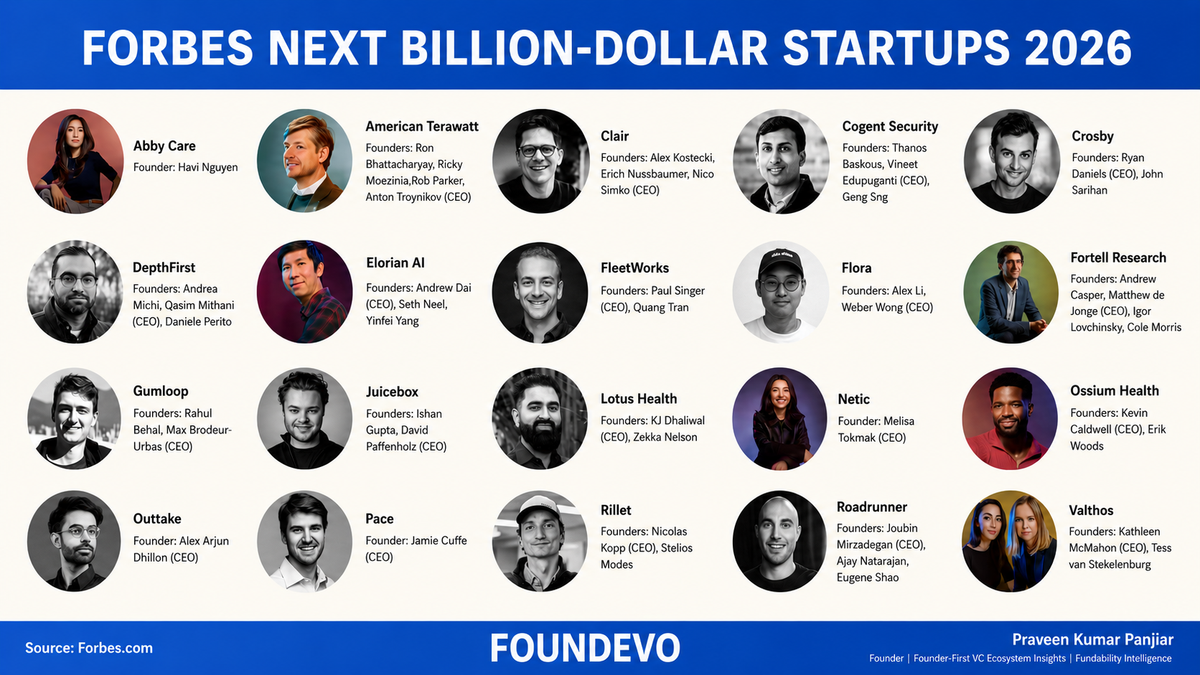
Forbes Named 20 Next Billion-Dollar Startups.
Here Are the 6 Signals Behind Them.
A Fundability Intelligence teardown of the Forbes / TrueBridge 2026 list
Once a year, Forbes tells you which private companies are most likely to be worth a billion dollars. It is easy to read that list the way you'd read a horoscope — a fun, low-stakes guess about the future.
That reading is wrong, and it costs you the most useful thing in the whole exercise.
On July 28, Forbes and TrueBridge Capital published the 2026 Next Billion-Dollar Startups list: 20 U.S. companies, none currently worth $1 billion, all judged likely to get there. Here is the number that should change how you read it. Of the 275 companies named to this list since 2015, 60% became unicorns. DoorDash came off this list. So did Duolingo and Rippling — years before you knew their names.
A 60% hit rate is not luck. It is a pattern being detected by people who do this for a living. And a pattern that repeats is something you can reverse-engineer.
That is what this issue does. The 20 names, the valuations, the cap tables — all of it is Forbes' reporting, and it's excellent. But the list answers who. The question we care about at Fundability Intelligence is the one it leaves unspoken: what do these companies share that made professional pickers bet on them — and how much of it is true of you?
We found six signals. Forbes and TrueBridge name three of them outright. The other three, they leave on the table for you to notice.
The three signals Forbes names
1. Capital efficiency is the moat now
The strongest companies on this list are worth far more than they have raised.
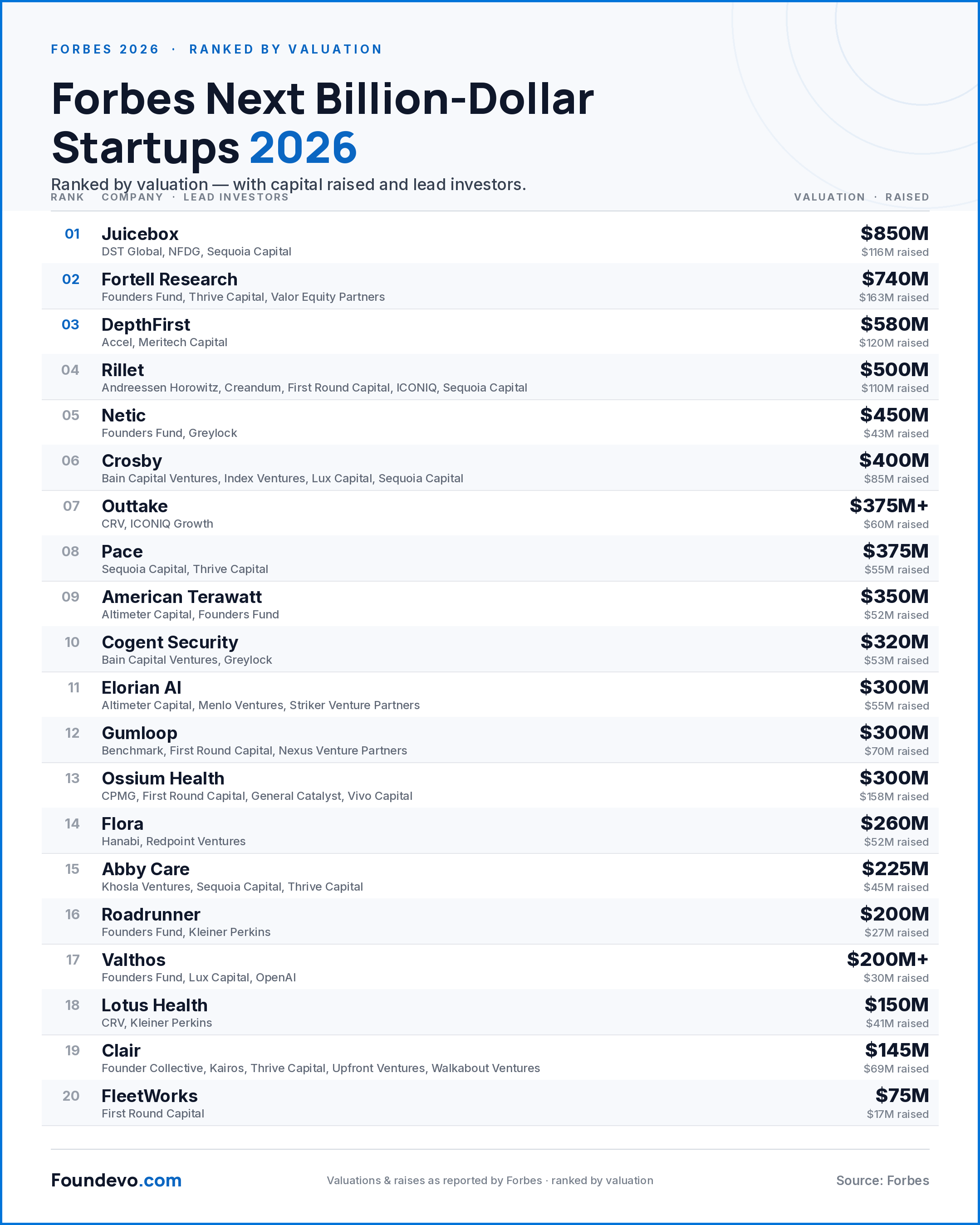
Netic — an AI dispatcher for plumbers and HVAC crews — is valued at $450M on just $43M raised. That's better than a 10x ratio. Roadrunner sits at $200M on $27M (roughly 7.4x). Juicebox, the most valuable company on the list at $850M, got there on $116M (about 7.3x).
Now look at the other end. Ossium Health, the frozen bone-marrow bank, is valued at $300M on $158M raised — barely 1.9x. Clair, the earned-wage-access business, is $145M on $69M, about 2.1x.
The lesson is not "raise less." It's that the ratio has to fit the machine. A software-agent business should compound — value should sprint ahead of capital. A physical, balance-sheet-heavy business earns a pass on the ratio, because it is buying something real with that money. What investors are pricing is discipline relative to the model, not thrift for its own sake.
Self-score: What is your valuation-to-raised ratio — and does your category actually justify the number you're carrying?
2. You're riding a decade, not a news cycle
Every durable pick here is exposed to a shift measured in years, not quarters.
AI is collapsing the cost of expert labor, and this list is a map of where: law (Crosby), accounting (Rillet), recruiting (Juicebox), sales operations (Roadrunner). One company is building for the bottleneck behind the AI boom itself — American Terawatt wants to wire data centers with direct-current grids because converting power the old way wastes too much of it. And a cluster is aimed at aging and healthcare access (Abby Care, Lotus Health, Fortell Research).
None of these needs 2026 specifically to be a good year. They need the next ten years to keep moving the direction they're already moving. That's the tell. A trend you're renting expires; a trend you're built on carries you.
Self-score: Is your tailwind a ten-year structural shift, or an eighteen-month hype cycle you happen to be inside right now?
3. One credible name already said yes
Validation on this list is never about how many logos. It's about whose.
OpenAI is a customer of Outtake and a backer of Valthos — and Valthos also counts the U.S. Department of Defense and Los Alamos among its clients. Flora has Nike, Netflix and Levi's using its design tools. Crosby reviews contracts for Cursor, Cognition and Clay.
The same concentration shows up on the cap tables. Founders Fund appears on 5 of the 20 companies. Sequoia is also on 5. Thrive Capital and First Round each show up on 4. Put plainly: a quarter of this list runs through one of two firms.
That is validation compounding. The right early yes — a marquee customer, a top-decile fund — makes the next yes cheaper, because credible names are willing to underwrite the risk that credible names have already taken.
Self-score: Is there one marquee, genuinely credible name already paying you or backing you — not a friend, not a pilot that never converted?
The three signals Forbes doesn't name
This is where the list stops reporting and starts revealing. These three aren't in the write-ups. They're in the pattern, if you line the 20 up side by side.
4. They chose boring on purpose
Read the list by what these companies actually do, and the glamour drains out fast.
Freight dispatch (FleetWorks). Plumbing and HVAC phone calls (Netic). Marking up NDAs (Crosby). Insurance claims (Pace). The accounting close (Rillet). Medicaid caregiving paperwork (Abby Care). Getting hourly workers part of their paycheck early (Clair).
Almost nothing here is something you'd demo at a dinner party. And that is the strategy, not an accident. These markets are enormous — American freight alone generated $900 billion last year — structurally underbuilt, and far less crowded than the consumer-facing, screenshot-friendly end of AI. The boring problem is the defensible one, because the people with taste are all fighting over the exciting one.
Self-score: Are you solving something expensive and tedious that a customer will quietly pay to make go away — or something impressive that demos well and sells hard?
5. The founder lived the problem
Look at who is building, and a second pattern surfaces: these are not market maps turned into companies. They are lives turned into companies.
Havi Nguyen managed Medicaid for her family while working the counter at her parents' nail salon — she built Abby Care around exactly that friction. KJ Dhaliwal grew up translating doctor's visits into Punjabi for his immigrant parents — he built Lotus Health. Matthew de Jonge watched his grandparents retreat into isolation as their hearing failed — he built Fortell. Melisa Tokmak got hit with a several-thousand-dollar electric bill and couldn't get a single tradesperson to call her back — she left Scale AI and built Netic.
Lived proximity to a problem is a shortcut. It tells you the problem is real, that it's urgent, and that someone will pay to end it — before you've spent a dollar finding out. Founders who were the customer start the race twenty yards ahead.
Self-score: Did you live this problem, or did you find it in a spreadsheet of attractive markets?
6. AI is the engine, never the identity
Here is the quiet punchline of the entire list. Nearly all 20 companies use AI. Which is precisely why "we use AI" tells an investor nothing — on this list, it's the floor, not the edge.
Not one of these companies made the cut for using AI. They made it for what AI does to an old cost structure. It's what lets Crosby charge per contract instead of per billable hour. It's what lets a hearing aid isolate one voice in a loud room. It's what lets a dispatcher work every hour of every night without a shift change. The AI is load-bearing and invisible at the same time.
The test writes itself: strip the acronym out of any of these pitches, and there is still a business standing there. That's the difference between a company that uses AI and a company that is a slide with "AI" on it.
Self-score: Delete the word "AI" from your pitch. Is there still a company underneath — a specific, expensive problem getting cheaper — or does the pitch collapse?
Now count
Six signals. Go back through your own company and count, honestly, how many you can claim.
Zero to two, and you have something that might work but that a professional picker has no particular reason to notice yet.
Four to six, and you look like the profile Forbes and TrueBridge have been betting on for eleven years running.
The uncomfortable part is the honestly. Most founders overcount by about two.
They mark "riding a decade" when they mean "in a category that's hot this year."
They mark "validation" when they mean "some friends signed up for the beta."
They mark "lived the problem" when they read a McKinsey report about it.
The signals only predict anything if you grade yourself the way an investor would — which is to say, looking for the reasons to say no.
So do it the hard way. Take the six, one at a time, and force a yes or no — no "sort of," no "we're getting there." Then look at the no's. That column is not a scorecard; it's a roadmap. Zero to two yeses, and you have work — but now you know exactly which signals to go build. Four to six, and you look like the profile Forbes and TrueBridge have bet on for eleven years running.
The names on the list will be different next year. These six won't be. Which means the useful move isn't to admire the twenty companies — it's to turn the lens around, mark your no's, and spend the next quarter converting one of them to a yes.
Forbes runs this list once a year. Fundability Intelligence reads the signals behind it — because the pattern is the part you can build toward starting Monday.
Forbes gives you the twenty companies. We'll keep giving you the reasons they're on there.
Source: Forbes / TrueBridge Capital, "Next Billion-Dollar Startups 2026," published July 28, 2026 (Richard Nieva). All company data — valuations, capital raised, and investors — is Forbes' reporting. Analysis, cross-cuts, and the six-signal framework are Fundability Intelligence's own.