Top 20 Most Valuable AI Startups in Europe

Europe's AI Revolution:
The 20 Most Valuable AI Startups Reshaping the World
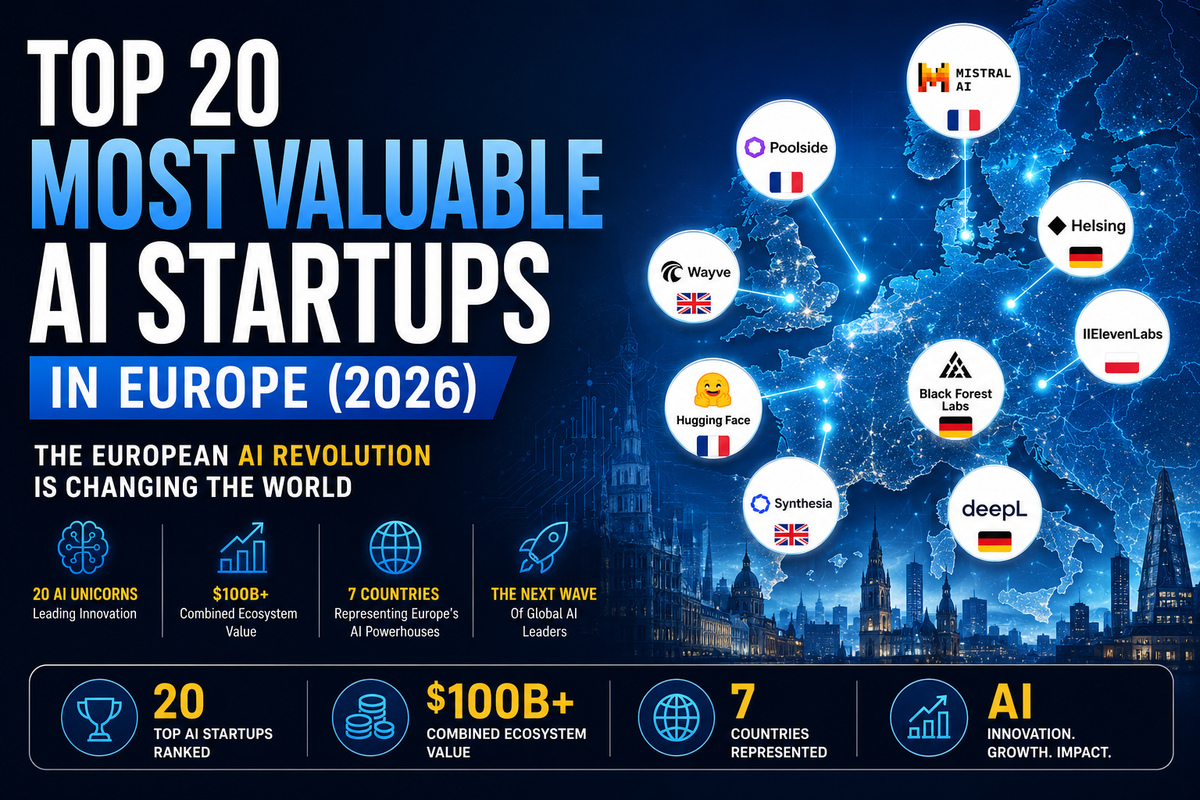
A data-driven, expert analysis of the companies, valuations, founders, and trends driving Europe's $100B+ artificial intelligence ecosystem — from Paris to Warsaw, Munich to Dublin.
For two decades, the global artificial intelligence narrative has been written almost entirely in American English — Silicon Valley campuses, Stanford PhDs, and Sand Hill Road term sheets. But between 2021 and 2026, something seismic has shifted. Europe has quietly, systematically, and now rather loudly built a world-class AI ecosystem that is no longer a footnote to the American story. It is a story.
The evidence is now undeniable. Mistral AI and Poolside AI are each valued at $14 billion, Helsing at $12 billion, and ElevenLabs at approximately $11 billion. Together, the 20 companies on this list represent a combined valuation exceeding $100 billion — an extraordinary figure for a region that many analysts were writing off as "over-regulated and under-funded" as recently as 2022.
This guide does not simply list names and numbers. It profiles each company in depth, analyses the structural trends powering European AI's rise, examines what investors and technologists need to understand right now, and answers the questions that matter most for anyone trying to navigate this landscape intelligently.
"Europe isn't catching up to Silicon Valley. It's building something genuinely different — and in several dimensions, something more durable. The combination of sovereign priorities, open-source culture, and deep research talent is producing companies that can't easily be replicated elsewhere."
Whether you are a founder considering your next venture, an investor deploying capital, a technologist tracking the frontier, a policy-maker shaping regulation, or simply a curious reader who wants to understand where the world is heading — this is the analysis you have been looking for.
Why Europe's AI Moment Is Different This Time
Europe has had false dawns before. The continent produced world-class research institutions, Nobel laureates, and technically brilliant founders — and then watched much of that talent emigrate to the United States. The 2010s saw promising European tech companies either acquired by American giants (DeepMind by Google, SwiftKey by Microsoft) or struggle to scale beyond regional relevance.
The 2020s are telling a fundamentally different story, driven by four structural changes that were not present in previous cycles.
1. The Capital Infrastructure Has Caught Up
Dedicated AI funds, sovereign wealth participation, pan-European vehicles like Balderton Capital, Index Ventures, and Atomico, plus aggressive participation from US funds opening European offices, have created a funding environment that can support companies from seed through to decacorn. Mistral's $600 million Series B — led by Andreessen Horowitz with participation from Nvidia, Salesforce, and French public investment bank BPIFrance — would have been unthinkable five years ago. Today it barely raised an eyebrow.
2. Regulatory Complexity Has Become a Moat
The EU AI Act, GDPR, and a constellation of sector-specific regulations that once seemed like pure headwinds are now functioning as competitive advantages for companies built to operate within them. Global enterprises — particularly in financial services, healthcare, and government — increasingly require AI partners that are demonstrably compliant, auditable, and EU-resident. European AI startups are born with that compliance DNA. Their American competitors must acquire it, often expensively and imperfectly.
3. The Talent Brain Drain Is Reversing
The founding teams at Mistral, Helsing, and Black Forest Labs are among the most technically credentialed AI researchers in the world. Crucially, they chose to stay in Europe and build European companies. A combination of competitive equity compensation, improved quality of life relative to San Francisco, proximity to world-class universities (INRIA, ETH Zurich, Technical University of Munich, Oxford), and a growing sense of European AI identity has reversed what once seemed like an inexorable talent exodus.
4. The Open-Source Ecosystem Has Matured
Hugging Face — itself a French-American company headquartered in Paris — has become the de facto GitHub of AI models. This has dramatically lowered the cost and complexity of building AI applications in Europe, removing one of the key advantages that proximity to US hyperscalers previously provided. European founders can now access, fine-tune, and deploy state-of-the-art models without a commercial relationship with OpenAI, Anthropic, or Google.
🗺️ The European AI Power Map
Number of Top-20 AI Startups by country — and their combined influence
The Definitive List: All 20 Ranked by Valuation
Rankings are based on the most recently reported funding rounds, secondary market data, and publicly confirmed valuations. All figures are in USD as of May 2026.
| # | Company | Focus Area | Country | Founded | Valuation |
|---|---|---|---|---|---|
| 1 | Mistral AI | Foundational LLMs | 🇫🇷 France | 2023 | $14B |
| 2 | Poolside AI | AI Code Generation | 🇫🇷 France | 2023 | $14B |
| 3 | Helsing | AI Defense Tech | 🇩🇪 Germany | 2021 | $12B |
| 4 | ElevenLabs | AI Voice Synthesis | 🇵🇱 Poland | 2022 | ~$11B |
| 5 | Wayve | Autonomous Driving | 🇬🇧 UK | 2017 | $8B |
| 6 | Lovable | AI Software Generation | 🇸🇪 Sweden | 2023 | $6.6B |
| 7 | Hugging Face | AI Model Hub | 🇫🇷 France | 2016 | $4.5B |
| 8 | Synthesia | Video Generation | 🇬🇧 UK | 2017 | $4B |
| 9 | Black Forest Labs | Generative Image Infra | 🇩🇪 Germany | 2024 | $3.25B |
| 10 | Parloa | Customer Service AI | 🇩🇪 Germany | 2017 | $3B |
| 11 | Quantexa | Decision Intelligence | 🇬🇧 UK | 2016 | $2.6B |
| 12 | n8n | AI Workflow Automation | 🇩🇪 Germany | 2019 | $2.5B |
| 13 | Framer | AI Web Design | 🇳🇱 Netherlands | 2019 | $2B |
| 14 | DeepL | Language AI | 🇩🇪 Germany | 2017 | $2B |
| 15 | Aleph Alpha | Sovereign Industrial AI | 🇩🇪 Germany | 2019 | ~$2B |
| 16 | Legora | AI Legal Workspace | 🇸🇪 Sweden | 2023 | $1.8B |
| 17 | AutogenAI | AI Tender Writing | 🇬🇧 UK | 2022 | $1.8B |
| 18 | Tines | Security Automation | 🇮🇪 Ireland | 2018 | $1.1B |
| 19 | Owkin | AI Medical Research | 🇫🇷 France | 2016 | $1B+ |
| 20 | Stability AI | Generative Media | 🇬🇧 UK | 2019 | $1B |
📊 Valuation Comparison: Top 10 at a Glance
Bar widths scaled proportionally to reported USD valuation
In-Depth Company Profiles: All 20 Analysed
Beyond the numbers, what makes each of these companies genuinely important? Here is a detailed profile of every startup on the list — covering founding story, technology differentiation, business model, and strategic significance.
Mistral AI is the closest Europe has yet produced to a true peer of OpenAI. Founded in April 2023 by Arthur Mensch, Guillaume Lample, and Timothée Lacroix — all former DeepMind and Meta AI Research scientists — the company went from zero to a $6 billion valuation within 18 months, eventually reaching $14 billion following its Series B in mid-2024, co-led by Andreessen Horowitz, General Catalyst, and Lightspeed Venture Partners.
What distinguishes Mistral from both American foundation model labs and most of its European peers is its aggressive open-source strategy combined with sophisticated commercial deployment. The company released Mistral 7B, Mixtral 8x7B, and subsequent iterations publicly, allowing developers worldwide to download, modify, and deploy models that rivalled GPT-3.5 and approached GPT-4 at a fraction of the compute cost. This created an enormous community flywheel — millions of developers using Mistral models — that translated directly into enterprise sales, partnerships, and strategic credibility.
The commercial offering — Mistral's "La Plateforme" API — targets enterprises that need high performance, European data residency, and models that can be fine-tuned on proprietary data without sharing that data with an American company. Major French and European financial institutions, public sector clients, and global multinationals with EU operations have become anchor customers. The company also secured a strategic partnership with Microsoft Azure, giving it global distribution while maintaining its independent identity.
Strategically, Mistral has been vocal about the importance of European AI sovereignty — positioning itself not merely as a product company but as a geopolitical actor in the global AI competition. CEO Arthur Mensch is among the most prominent voices in European tech policy circles, and the company has engaged actively with the EU AI Act development process.
Poolside AI occupies one of the most strategically important categories in all of artificial intelligence: AI that writes, reviews, and improves software code. Founded in 2023 by Jason Warner (former GitHub CTO) and Eiso Kant, the company has built a foundation model trained specifically and exclusively on code — a fundamentally different approach from general-purpose models that are subsequently fine-tuned for programming tasks.
The thesis is compelling: as AI capabilities advance, the leverage in software development will shift from writing individual functions to designing entire systems, and the quality gap between a model trained natively on code versus one that learned coding as a secondary skill will become commercially decisive. Poolside's model is trained on an unprecedented dataset of code and code-adjacent technical content, combined with reinforcement learning signals derived from actually running and testing the generated code — a feedback loop that general models cannot easily replicate.
The $14 billion valuation, achieved through a $500 million fundraise in late 2024 with investors including eBay, Nvidia, and several prominent US venture funds, reflects the market's belief that coding AI represents a durable, defensible category rather than a commodity feature that any large language model can absorb. With software developer costs running into the trillions globally, even modest productivity gains represent enormous addressable markets.
The Paris base — maintained despite founder Jason Warner's strong US connections — reflects a deliberate choice about talent access (particularly from École Polytechnique and INRIA), regulatory positioning, and the symbolic importance of keeping a flagship AI company on European soil.
Helsing is the company that most directly embodies the intersection of AI and European geopolitical reality. Founded in 2021 by Gundbert Scherf and Torsten Reil — both of whom left senior roles at McKinsey and AI research respectively — Helsing's founding premise was that European defense forces needed an indigenous AI partner they could trust with the most sensitive possible operational data, and that no such partner existed.
The company builds AI software for defense applications: real-time sensor fusion (combining radar, infrared, acoustic, and signals intelligence into coherent situational awareness), autonomous targeting assistance, electronic warfare, and decision-support systems for military command structures. These are capabilities that NATO member states urgently need but were previously only available through US defense contractors or, theoretically, through vulnerable procurement of US-origin AI platforms that carry significant data sovereignty concerns.
Helsing's valuation tripled between 2022 and 2024, reaching $12 billion — a trajectory directly correlated with Russia's invasion of Ukraine and the subsequent surge in European defense spending. Germany's commitment to the "Zeitenwende" (watershed moment in defense policy), combined with the UK and France's accelerated AI-in-defense programs, has created a spending environment uniquely favourable to what Helsing offers. The company counts the German Bundeswehr, the UK Ministry of Defence, and several undisclosed NATO members among its clients.
Critics and ethicists raise legitimate questions about AI's role in lethal military systems. Helsing's leadership engages openly with these questions, arguing that European AI in defense is categorically preferable to ceding this space to either American platforms (with attendant sovereignty concerns) or, worse, to adversaries whose systems operate without democratic oversight.
ElevenLabs is arguably the most improbable success story on this list — and possibly the most globally viral AI product to emerge from Central Europe in the modern era. Founded in Warsaw in 2022 by Mati Staniszewski and Piotr Dabkowski, both former Palantir and Google engineers, ElevenLabs set out to solve what seemed like a niche problem: making AI-generated voices indistinguishable from human speech. They succeeded so thoroughly that the product became genuinely disruptive to the voice-over, dubbing, audiobook, and interactive media industries within 18 months of launch.
The technology rests on a transformer-based text-to-speech architecture that captures not just phonetics but prosody, emotional inflection, pacing, and speaker identity from as little as one minute of reference audio. The result is a cloned voice that passes human detection tests with a reliability that has simultaneously delighted creators, alarmed ethicists, and generated intense media coverage globally. The company has responded proactively with detection tools, watermarking, and a responsible use framework — imperfect, but meaningfully ahead of the industry curve.
The commercial applications are vast: ElevenLabs' technology is used by publishers converting backlist books to audio at a fraction of traditional narration costs, by game studios generating hundreds of voiced characters from a small voice cast, by broadcasters creating multilingual versions of content without human dubbers, and by enterprise customer service operations replacing robotic IVR systems with voices indistinguishable from human agents. With a valuation of approximately $11 billion and investors including a16z and ICONIQ Growth, ElevenLabs has established Poland as a credible node in the global AI map.
Wayve takes a fundamentally different philosophical approach to autonomous driving compared to its US counterparts Waymo and Cruise. Rather than building exhaustive rule-based systems with hand-coded responses to millions of driving scenarios, Wayve uses end-to-end deep learning — feeding raw sensor data directly into a neural network that learns driving behaviour empirically, the way humans do, through experience and feedback rather than explicit programming.
This approach has significant implications for scalability: a rule-based AV system requires human engineers to manually specify responses to every conceivable road scenario, making global deployment extraordinarily expensive. An end-to-end learned system, in theory, can generalise across new geographies and scenarios with far less manual intervention, acquiring competence in Tokyo or São Paulo from experience gathered in London. Wayve's $1.05 billion Series C in 2024 — backed by SoftBank, Microsoft, and NVIDIA — validated this thesis with unusual force for a company that has operated primarily in European urban environments.
Founded by Amar Shah and Alex Kendall (both Cambridge PhDs), Wayve represents the applied commercialisation of world-leading Cambridge computer vision and machine learning research. The company's deployment in partnership with major UK retailers and logistics providers gives it real-world data that continues to strengthen its model advantage.
Lovable may be the most striking velocity story in European tech history. Founded in Stockholm in 2023, the company reached a $6.6 billion valuation in less than two years — a trajectory that few venture-backed companies anywhere in the world have matched. The product is elegantly simple in concept: describe a software application in natural language, and Lovable builds it, deploys it, and maintains it. No development environment, no dependencies, no debugging.
The category — sometimes called "vibe coding" or AI-native software development — has attracted intense investor interest because it speaks to an enormous latent demand: the hundreds of millions of people globally who have software ideas but lack the technical skills or resources to build them. Lovable's approach uses frontier language models to generate complete, functional React applications with backend integrations, authentication, and database connectivity, all from a conversational interface that feels closer to describing a business need to a colleague than programming a computer.
The implications for the software industry are genuinely profound. If high-quality software can be generated and maintained at near-zero marginal cost, the economics of custom software development — currently a multi-trillion-dollar global market — face structural disruption. Lovable's growth metrics reportedly showed month-over-month revenue growth exceeding 50% for multiple consecutive quarters, which is the underlying driver of a valuation that appears extraordinary by historical standards but may prove conservative in retrospect.
Hugging Face occupies a category almost entirely of its own creation. It is simultaneously a model repository (with over 500,000 publicly available models), a datasets platform, a community of over 1 million AI practitioners, a cloud inference service, and — increasingly — an enterprise AI infrastructure provider. Its valuation of $4.5 billion substantially understates its influence: Hugging Face is the plumbing through which an enormous fraction of global AI development flows.
Founded in Paris by Clément Delangue, Julien Chaumond, and Thomas Wolf, the company began as a conversational AI startup before pivoting to become the open-source hub for the AI community. The Transformers library — which Hugging Face maintains — has become the default framework for working with transformer-based neural networks worldwide, with download counts in the hundreds of millions annually. When Mistral releases a new model, Hugging Face hosts it. When a university research team publishes a new architecture, it lands on Hugging Face first.
The enterprise business — Hugging Face Enterprise Hub — offers private model hosting, fine-tuning infrastructure, and compliance features for companies that need to operate AI at scale without the overhead of building their own MLOps stack. With investors including Google, NVIDIA, AWS, Salesforce, and Intel, Hugging Face has achieved the remarkable feat of being strategically important to every major cloud provider simultaneously, none of whom can afford to let it fall into a competitor's hands.
Synthesia has built the leading enterprise platform for AI-generated video content, allowing organisations to create professional training, communications, and marketing videos using photorealistic AI avatars without cameras, studios, or human presenters. The company's platform hosts over 230 pre-built AI avatars speaking 140+ languages, and allows enterprises to create custom avatars from a brief recording session — producing a digital presenter that can be scripted, updated, and deployed in minutes rather than the days or weeks required for traditional video production.
The enterprise use case is particularly compelling for global corporations managing L&D (learning and development) at scale. Producing compliance training updates across 30 languages with traditional video would require coordinating dozens of voice artists, translators, and production teams. With Synthesia, the same workflow requires a script update and a few minutes of render time. Customers including Heineken, BSH, and Zoom have publicly credited Synthesia with reducing video production costs by 80% or more.
Founded by Victor Riparbelli, Steffen Tjerrild, and academic co-founders from UCL and Stanford, Synthesia has consistently navigated the ethical complexities of deepfake-adjacent technology more successfully than its competitors — with robust consent frameworks, watermarking, and a policy stance that has earned it credibility with enterprise procurement teams who are acutely sensitive to reputational risk.
Black Forest Labs may be the most impressive example of experienced founders accelerating straight to significant valuation on reputation and technical track record alone. The company was founded in August 2024 by Robin Rombach and colleagues — the same team responsible for Stable Diffusion while at Stability AI — and reached a $3.25 billion valuation within months of incorporation, based primarily on the release of the FLUX family of image generation models.
FLUX.1 Pro, FLUX.1 Dev, and FLUX.1 Schnell have been widely benchmarked as the highest-quality open-source image generation models available, surpassing Stable Diffusion XL and competing directly with Midjourney's proprietary systems on several objective quality metrics. The combination of an exceptionally experienced team (the Stable Diffusion paper has been cited thousands of times), clear commercial momentum, and investor enthusiasm for generative media infrastructure produced a funding and valuation trajectory that is extraordinary even by AI startup standards.
The Freiburg base — a mid-sized university city in southwest Germany rather than Berlin or Munich — reflects the founders' academic roots and their preference for a research environment over a startup-culture one. It also demonstrates that European AI talent concentration is not purely a capital-city phenomenon.
Companies #10–20: Profiles & Strategic Significance
Parloa has built an enterprise-grade AI platform specifically for customer service automation — the phone call, chat, and messaging channels that represent the single largest cost centre in most consumer-facing businesses. Unlike generic chatbot platforms, Parloa's architecture is designed around the specific requirements of telephony and contact centre operations: real-time speech recognition with low latency, seamless handoff between AI and human agents, CRM integration, and compliance frameworks for regulated industries including banking, insurance, and healthcare.
The $3 billion valuation reflects the scale of the addressable market: global contact centre software spending exceeds $50 billion annually, and Parloa is positioned as the AI-native replacement for legacy IVR and routing systems from incumbents like Genesys, Avaya, and Cisco that are structurally disadvantaged in an AI-first world. Major German and European enterprises including Deutsche Telekom, Allianz, and Lufthansa are among Parloa's disclosed customers — clients that validate both the enterprise-readiness of the platform and the commercial reality of the customer service AI opportunity.
Quantexa has carved a highly defensible niche in "decision intelligence" — the application of AI and graph analytics to help financial institutions, government agencies, and telcos make better decisions from complex, fragmented data. Its flagship use cases include financial crime detection (identifying money laundering networks that span multiple institutions and jurisdictions), credit risk assessment using non-traditional data signals, and customer intelligence for financial services.
What differentiates Quantexa technically is its Entity Resolution and Network Analytics technology, which can link disparate records across massive datasets to build accurate pictures of individuals, organisations, and their relationships — even when data is incomplete, inconsistently formatted, or deliberately obfuscated. HSBC, Standard Chartered, Dun & Bradstreet, and several national governments use Quantexa's platform, making it one of the most substantively deployed AI companies on this list in terms of real-world critical infrastructure.
n8n (pronounced "n-eight-n", short for "nodemation") has become the go-to workflow automation platform for technical teams who need more power and flexibility than Zapier provides but don't want to build custom integrations from scratch. Founded by Jan Oberhauser as a fair-code, open-source project, n8n distinguishes itself through its self-hostable architecture (critical for data privacy compliance), its code-extensible node system, and — increasingly — its AI workflow capabilities that allow teams to orchestrate multi-step AI processes involving LLMs, vector databases, and external APIs.
The $2.5 billion valuation represents a remarkable outcome for a company that was primarily a developer tool until AI workflow orchestration emerged as a genuine enterprise need. The rise of agentic AI — AI systems that don't just answer questions but take actions, make decisions, and chain together complex processes — has dramatically expanded n8n's addressable market and given its technical architecture unexpected strategic relevance.
Framer ($2B) has transformed from a beloved prototyping tool into a full AI-powered website builder, generating production-quality websites from natural language descriptions. Its Amsterdam roots and design-community heritage give it authentic credibility in a market crowded with technically competent but aesthetically mediocre competitors. The AI layer — which can generate entire site layouts, write copy, and produce images from a brief — has made Framer one of the fastest-adopted tools in the creative professional stack.
DeepL ($2B) has been quietly dominating professional translation since 2017, building a product that linguists, lawyers, and international corporations consistently rate more accurate than Google Translate for European language pairs. The Cologne-based company's deep specialisation in European languages — Germanic, Romance, and Slavic language families where training data quality matters enormously — is a genuine technical moat that scale-first American competitors have struggled to replicate. Enterprise features including glossary management, tone control, and API integration have made DeepL a standard component of multinational corporate workflows.
Aleph Alpha (~$2B) occupies the most politically significant position on this list. The Heidelberg-based company has positioned itself as the sovereign AI infrastructure provider for European governments and corporations — a provider that operates exclusively on European soil, under European law, and with a governance model designed to satisfy the most stringent public-sector procurement requirements. Its Luminous model family and "PHARIA" enterprise AI platform target institutional buyers for whom the phrase "your data stays in Europe" is not a marketing claim but a legal requirement. Aleph Alpha has received significant backing from German public investment and several major German corporations.
Legora ($1.8B) is the Swedish startup redefining the legal workspace for law firms and in-house legal teams. Built on top of frontier language models with extensive legal-domain fine-tuning, Legora's platform handles contract review, legal research, document drafting, and matter management in a unified interface designed to feel native to how lawyers actually work. The legal industry's combination of highly document-intensive workflows, extreme accuracy requirements, and massive billable-hour economics makes it one of the highest-value verticals for AI deployment — Legora is positioned to capture a substantial share of that value in the European market.
AutogenAI ($1.8B) addresses a narrow but extremely valuable niche: bid and tender writing. The UK government alone publishes over £300 billion in public procurement contracts annually; global procurement spending runs into the tens of trillions. Companies competing for these contracts spend enormous resources writing proposals. AutogenAI's platform uses AI to accelerate and improve that process — analysing the tender requirements, pulling relevant past proposals and company data, drafting responses, and iterating based on reviewer feedback. The ROI case is straightforward: winning one additional government contract typically justifies the subscription cost many times over.
Tines ($1.1B) is the Dublin-born security workflow automation platform that has become a standard tool for enterprise security operations centres. By enabling security analysts to build automated response playbooks — without requiring programming expertise — Tines dramatically reduces mean time to respond (MTTR) for security incidents, a metric that directly correlates with breach cost and severity. The company's integration library covers hundreds of security tools, and its AI layer can now suggest automated response workflows based on the nature of an incoming alert, making it one of the most practically impactful AI applications in the cybersecurity space.
Owkin ($1B+) is perhaps the most scientifically important company on this list. The Paris-based startup applies machine learning and federated learning to medical and biological data to accelerate drug discovery, improve cancer diagnosis, and generate biomedical insights that no single research institution could produce alone. The federated learning approach — where models train across multiple hospital datasets without any patient data leaving individual institutions — is a genuine technical breakthrough that has enabled Owkin to build partnerships with major research hospitals that would never share data through conventional means. Partnership agreements with pharmaceutical giants including Sanofi and Pfizer validate both the technology and the commercial model.
Stability AI ($1B) has had a turbulent few years — a highly public founder departure, significant restructuring, and revenue challenges — but remains on this list because its contribution to the AI landscape is indelible. Stable Diffusion, released openly in 2022, democratised image generation in a way that permanently changed the creative industries and established the precedent that frontier generative models could and should be open. The company's current valuation reflects the aftermath of its difficulties, but its strategic importance — as a precedent-setter, as an open-source pioneer, and as a brand with extraordinary developer recognition — remains meaningful.
Sector Analysis: Where Is European AI Strongest?
Looking at the 20 companies as a portfolio reveals clear patterns of European strength, strategic concentration, and emerging gaps.
📂 Breakdown by Sector Category
European AI strength is most concentrated in enterprise software and developer tools — categories where the combination of strong engineering talent, clear B2B sales motions, and existing enterprise relationships in industries like financial services, manufacturing, and professional services creates structural advantages. The emergence of credible European players in foundation models (Mistral, Aleph Alpha) and defense AI (Helsing) represents a more recent and strategically significant development.
The notable relative gaps in the European landscape include: consumer AI products with mass-market scale, AI-native semiconductor companies (no European equivalent to Cerebras or SambaNova), and hyperscale cloud infrastructure — the latter being perhaps the most consequential long-term constraint on European AI independence.
The 6 Structural Trends Defining European AI's Future
European enterprises and governments increasingly require AI partners that operate under EU jurisdiction. This is not preference — it is GDPR, EU AI Act, financial regulation, and in some sectors, national security law. Companies like Aleph Alpha and Helsing that have built their entire stack around this requirement will see demand accelerate as compliance pressure increases over 2026–2027.
Five of the top 20 were founded in 2022 or 2023 and already command multi-billion valuations. Lovable's trajectory from founding to $6.6B took less than two years. This compression of the value-creation timeline reflects both the enormous productivity unlocked by AI tools and the willingness of capital markets to price transformative potential at unprecedented multiples.
Counter-intuitively, giving away the model is proving to be a powerful commercial strategy. Mistral, Hugging Face, Black Forest Labs, and Stability AI all gave foundational technology away and built commercial businesses on the community, trust, and enterprise features that open-source generates. The community is both a distribution channel and a quality-improvement engine that proprietary competitors cannot easily replicate.
The most defensible European AI companies tend to be deeply vertical: Owkin in medical research, Legora in law, AutogenAI in procurement, Parloa in contact centres, DeepL in professional translation. Vertical specialists can develop domain-specific training data, fine-tuned models, and workflow integrations that horizontal platforms cannot match — creating switching costs and data advantages that compound over time.
ElevenLabs at $11B and Synthesia at $4B represent the leading edge of a category that is still in early-majority adoption. The vast majority of corporate video and audio content is still produced through traditional means. As AI-generated voice and video quality continues to improve and costs continue to fall, the addressable market for these platforms expands dramatically — and European companies lead the field.
With 6 of the top 20 companies, Germany has overtaken the UK in terms of AI startup count, and its representation spans the full range from foundation models (Aleph Alpha, Black Forest Labs) to defense (Helsing) to enterprise SaaS (Parloa, DeepL, n8n). The combination of world-class research universities, a large industrial base hungry for AI solutions, and significant public investment is producing an ecosystem that will likely yield more breakout companies in the next five years.
What Investors Need to Know About European AI in 2026
The Valuation Multiple Question
Several companies on this list are valued at revenue multiples that would have been considered extraordinary even in the peak 2021 venture market. Lovable at $6.6 billion on reported ARR that is estimated below $200 million implies a multiple that only makes sense if one believes the company is on an exponential growth curve that will continue for several more years. That belief may be well-founded — or it may reflect AI enthusiasm outpacing commercial reality. Both outcomes are plausible, and the gap between them is where investment risk lives.
The more defensible valuations, arguably, are those anchored to actual enterprise contracts with proven ROI: Quantexa, DeepL, Parloa, and Owkin all have revenue profiles that justify their valuations with more conventional assumptions. The lesson from previous technology cycles is that the market tends to over-value platforms and under-value infrastructure in the short term, and then correct.
The Consolidation Question
How many of these 20 companies will be independent in five years? Historical technology cycles suggest that periods of rapid startup formation are typically followed by consolidation — acquisitions, mergers, and some failures — that concentrate value among a smaller number of larger players. The candidates for acquisition by large European corporates (SAP, Siemens, LVMH, Deutsche Telekom) or US hyperscalers (Microsoft, Google, Amazon) are multiple. Regulatory scrutiny — particularly the EU's oversight of tech acquisitions — may slow but will not prevent this process.
The Missing Infrastructure Layer
Every investor with a European AI portfolio should be thinking about the infrastructure dependency risk. Training and serving these models requires substantial cloud compute, and the dominant providers of that compute are AWS, Microsoft Azure, and Google Cloud — all US companies subject to US law and commercial priorities. A geopolitical rupture, a policy change, or a commercial dispute could, in principle, affect European AI companies' access to the compute they need. This is not a hypothetical concern; it is a structural vulnerability that smart European founders are increasingly aware of, and that European public policy is beginning to address through initiatives like the European AI Factories programme.
Frequently Asked Questions
Conclusion: Europe's AI Era Has Begun — And It Won't Stop Here
The $100 billion combined valuation of Europe's top 20 AI startups is a milestone, but it is also a floor. Several companies on this list have the revenue trajectory, technical moat, and market positioning to double or triple in value within two years. New entrants — many of them emerging from European research institutions and spin-outs of the companies profiled here — will add to the list. The geography of AI is shifting, and the shift is durable.
Three things stand out when viewing this landscape as a whole.
First, quality over quantity. European AI has not produced 200 mediocre startups; it has produced a smaller number of genuinely exceptional ones. Mistral's models are world-class. ElevenLabs' voice synthesis is unmatched. Wayve's approach to autonomous driving is intellectually rigorous in ways that many competitors are not. Black Forest Labs' FLUX models are the honest answer when developers ask which open-source image generator they should use. Quality compounds.
Second, the structural advantages are self-reinforcing. Every year that European AI companies win enterprise contracts on the basis of compliance and sovereignty, they accumulate proprietary training data, customer relationships, and domain expertise that makes them harder to displace. The moats are widening, not narrowing.
Third, the talent pool is now locally self-sustaining. The engineers who built Mistral, who shipped FLUX, who scaled ElevenLabs from a Warsaw flat to an $11 billion company — they are now experienced AI founders and builders who will start or join the next generation of European AI companies. Ecosystems of this kind become self-perpetuating. Europe's AI ecosystem has crossed that threshold.
🔑 The Single Most Important Takeaway
Europe is not catching up to Silicon Valley. It is building something different — structurally, culturally, and commercially. The next decade of AI will have a distinctly European chapter, and the 20 companies profiled here are writing its opening pages.
Stay Ahead of the European AI Landscape
This space moves fast. New valuations, new entrants, new policy developments. Subscribe to receive our next deep-dive report the moment it publishes — and never miss a major European AI development.