38 Early-Stage VC Funds to Know Before LA Tech Week
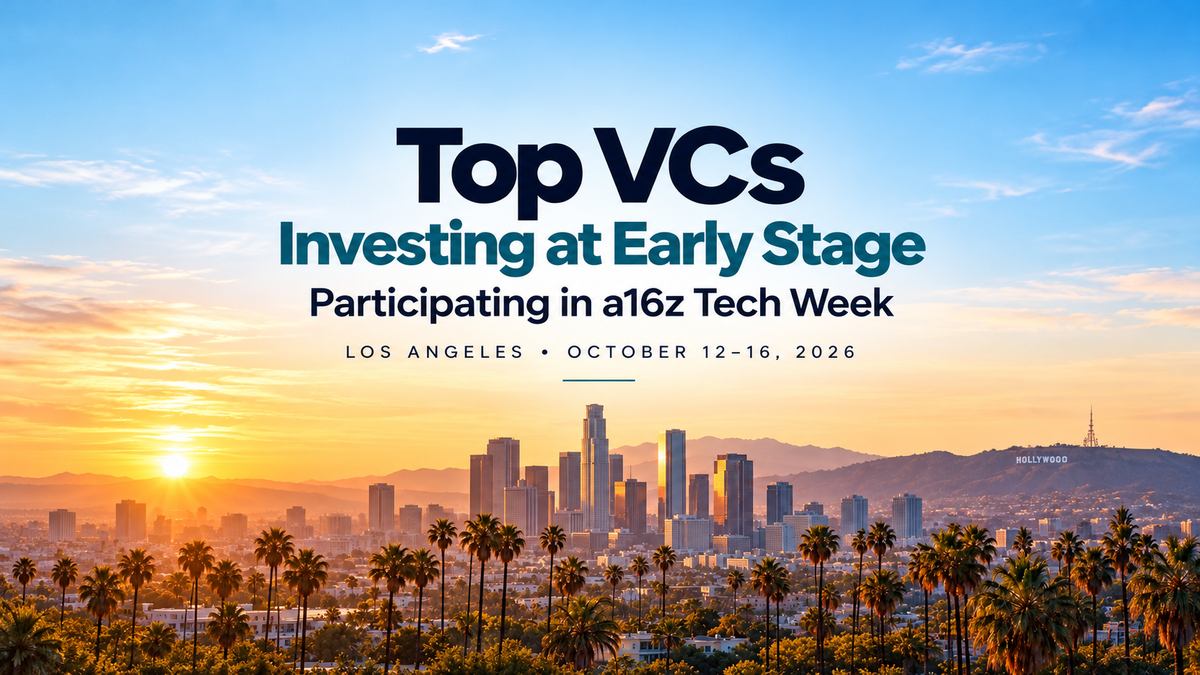
LA Tech Week puts a lot of investors within walking distance of a lot of founders. That sounds great until you're standing at a crowded happy hour with 40 minutes and no idea who is worth talking to.
This guide groups 38 early-stage venture funds by what they invest in, so you can narrow the field before you arrive. It also covers how to decide who deserves your limited time, and where the risks are.
A note on the list: it was compiled from LinkedIn company pages and general descriptions of each firm's focus. We haven't confirmed which funds are hosting or attending specific events, and we have no commercial relationship with any firm listed. Check the official LA Tech Week schedule and each fund's website before you plan around anyone. Focus areas and check sizes change, and a one-line label can't capture how a firm actually decides.
Start with fit, not fame
Most founders do this backwards. They chase the best-known logo and hope the pitch lands. A better approach is to ask three questions about every fund:
- Does it invest in my sector? A consumer fund rarely backs a defense hardware company, however good the pitch is.
- Does it invest at my stage? Many firms write seed checks, but some mainly lead later rounds and only occasionally invest early. Look at their recent portfolio announcements.
- Is there a plausible reason they'd care about my company now? A relevant portfolio gap or a thesis they've written about is a much better opener than "we're disrupting X."
With that in mind, here's the list.
Generalist funds
Generalists invest across sectors, so your sector matters less. Your traction, team, and the size of the opportunity matter more. That can make them easier to approach and harder to stand out with.
- Bessemer Venture Partners
- Greycroft
- Upfront Ventures
- Uncork Capital
- Antler
- Draper Dragon
- Mucker Capital
- A26 Ventures
- Fika Ventures
- TenOneTen Ventures
- Reveille VC
- Wedbush Ventures
- Y·US Ventures
"Generalist" doesn't mean "invests in anything." Every firm has patterns in what it funds, so read its portfolio page before you approach it. Antler is also a little different from a traditional fund, since it works with founders at a very early stage, sometimes before a company exists. Check how its program works before assuming it fits.
Deep tech, hardtech, space, and defense
These investors back companies built on science or engineering: hardware, advanced materials, aerospace, national security. These companies tend to need more capital and take longer to prove out, so investors in this category usually care about technical credibility and a realistic path to funding.
- Lux Capital (deep tech)
- Actuate Ventures (deep tech)
- Riot Ventures (defense, aerospace, industrial)
- Discipulus Ventures (hardtech)
- Multiball Capital (defense and deep tech)
- Fulcrum Venture Group (defense and deep tech)
- LifeShip Ventures (space)
- Voice Capital (deep tech and media)
LA has a long aerospace and defense history, so it's reasonable to expect a stronger showing in this category here than at many other tech weeks. That's an inference about the local ecosystem, not a guarantee about who will be in the room.
AI, enterprise software, and B2B
If you sell to businesses, these funds will understand your sales cycles, pricing, and the difference between a pilot and real revenue.
- March Capital (AI and enterprise software)
- Forum Ventures (B2B SaaS)
- Bonfire Ventures (B2B and enterprise)
- B Capital (health and fintech)
- 645 Ventures (B2B software, fintech, and healthtech)
- Untapped Ventures (AI and fintech)
For this group, come ready with specifics: who your customers are, how long deals take, and what you've learned from them. "Our market is $50 billion" is much weaker than "three mid-size logistics companies are paying us to run this workflow."
Consumer, media, and entertainment
LA's entertainment roots show in this group. These investors are often looking for audience pull, brand, and distribution as much as product.
- Comcast Ventures (media and consumer)
- Wonder Ventures (consumer)
- Connect Ventures (media)
- Everybody Ventures (media and consumer)
- BAM Ventures (consumer)
- Legendary Ventures (entertainment and consumer)
- Flyer One Ventures (consumer)
- Capitalize VC (consumer)
- Musa Capital (consumer)
- DVRGNT Ventures (consumer)
Consumer investors tend to ask about retention, not just signups. If you have cohort data showing whether users come back, bring it.
Sustainability and impact
- Obvious Ventures (sustainability and impact)
It's the only fund in this list with a primary focus on sustainability and impact, so if that's your space, it's worth prioritizing. Several deep tech funds above may also be relevant for climate hardware.
How to use your time at the event
Build a short list of five to eight. Pick the funds that match your sector and stage, then read their latest portfolio additions and any writing from their partners.
Prepare two versions of your pitch. One should take 30 seconds and one should take about two minutes. Most conversations at events never get to a third minute.
Ask something real. "What are you seeing in this space right now?" gets a more useful answer than "Are you investing?" and shows you've done your homework.
Follow up within a day or two. Reference something specific from the conversation, and keep it short. A casual chat at a networking event is not a commitment from either side, and few deals close from a single meeting.
Risks and trade-offs to keep in mind
- Events reward visibility, not fit. The loudest room isn't always the best investor for your company. A smaller meeting with the right fund can be worth more than ten brief intros.
- Labels are rough. "Generalist" and "deep tech" are shorthand. Check portfolios and recent announcements rather than relying on a single descriptor.
- Warm introductions still matter. Many investors prioritize referrals from founders they know. Use the event to meet people, but also ask your network for introductions.
- Time is finite. Chasing every fund on a list of 38 usually leads to shallow conversations. Depth with a few beats breadth with many.
Before you go
Check the official LA Tech Week schedule for current events and hosts, since programming changes. Then pick your short list, read up on those funds, and decide what you want from each conversation, whether that's feedback, an intro, or a follow-up meeting. Most of the work that makes the week useful happens before you arrive.