75+ VCs Investing in HealthTech and Digital Health Founders Should Know
For a HealthTech founder, finding investors is rarely as simple as searching for firms that have "healthcare" somewhere on their website.
Healthcare startups operate differently from many conventional software businesses. Depending on the company, founders may need to deal with clinical validation, regulation, reimbursement, healthcare procurement, provider adoption, long sales cycles and complex stakeholder relationships.
That makes investor fit especially important.
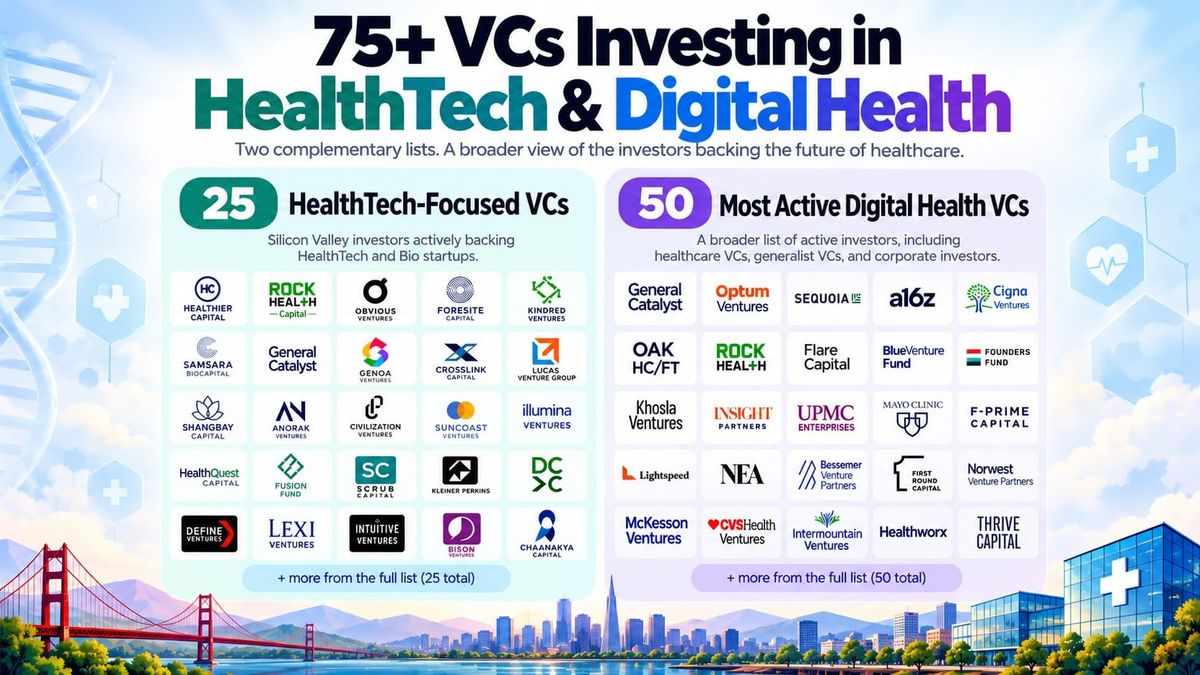
Two recent VC datasets offer a useful way to understand the market. One is a curated list of 25 Silicon Valley investors actively investing in HealthTech and Bio. The other is a data-driven analysis of the 50 most active digital health investors in the U.S.
Taken together, they provide a useful starting point for founders researching healthcare investors.
But there's an important distinction: these aren't two versions of the same ranking, and they shouldn't be treated as a definitive list of the "best" healthcare VCs.
Here's what founders can actually learn from them.
Why the right healthcare investor matters
A healthcare investor can potentially contribute much more than capital.
The right partner may understand your market, know how healthcare buyers make decisions, have experience with regulatory milestones, or introduce you to people who can help the company reach its next stage.
Consider two hypothetical HealthTech startups.
The first is developing a clinical device that requires regulatory approval and hospital adoption.
The second sells workflow software to employers.
Both operate in healthcare, but their fundraising requirements can be completely different.
The first may benefit from investors with medical-device, clinical and regulatory experience. The second may be better matched with an investor experienced in enterprise SaaS, benefits or employer healthcare.
This is why a long VC list is only useful when it helps you identify the right investors for your particular company.
Two VC lists, two different approaches
The first dataset is a curated list published by James Gee identifying 25 Silicon Valley VCs actively investing in HealthTech and Bio. It is specifically aimed at founders building in Health and Bio.
The second comes from healthcare investor and Rock Health founder Halle Tecco's September 2026 analysis. Her research created a digital health VC database and examined which firms had the largest digital health portfolios.
The distinction is important.
The first list essentially asks:
Which investors are worth knowing if you're building a HealthTech or Bio company?
The second asks:
Which investors have been particularly active across digital health?
Those questions overlap, but they're not identical.
What the 25-investor HealthTech list tells founders
The curated HealthTech list is particularly useful for identifying investors with an obvious connection to healthcare, biotechnology or healthcare technology.
It includes a mixture of specialist funds and larger technology investors.
That mixture is valuable.
A specialist healthcare fund may bring deep domain expertise. A large technology-oriented fund may bring experience scaling companies, recruiting senior talent and raising later rounds.
For founders, the lesson isn't that one type is automatically better.
It's that different investors can solve different problems.
If your company is still proving clinical or commercial viability, domain knowledge could be especially useful.
If you've found product-market fit and are preparing to scale, experience building large technology businesses may become more important.
And if you're approaching commercialization, an investor's healthcare network can become particularly valuable.
What the 50 most active digital health investors tell us
The second dataset provides a broader view of the digital health investment landscape.
According to Tecco's analysis, the database covered 152 venture firms and 3,638 deals involving 2,247 unique company names. The research focused on U.S. digital health and healthcare investments and used VC websites alongside PitchBook to improve coverage.
The 50 most active firms had a median of 41 digital health investments, compared with 18 across the overall database.
General Catalyst alone had backed 112 U.S. health-tech startups in the dataset.
That's a useful signal for founders.
An investor with dozens of relevant investments has likely seen a wide range of fundraising situations, business models and market challenges.
But portfolio size should be treated as evidence of activity, not proof of investment quality.
Generalist VCs vs healthcare specialists
One of the more interesting findings from the research concerns a question founders often ask:
Should I approach a healthcare specialist or a large generalist VC?
There isn't a universal answer.
In Tecco's dataset, generalist funds had a higher unicorn hit rate than healthcare specialists. Generalists recorded a 16.1% unicorn rate across 2,136 digital health investments, compared with 10.3% across 1,501 investments by healthcare specialists.
That statistic is interesting, but it needs context.
The generalist funds in the dataset were substantially larger than the specialist funds. When the analysis controlled for fund size, the difference became much smaller; among mid-sized funds, generalists and healthcare specialists were essentially tied.
There's another important issue.
A firm can be classified as a generalist while having individual partners who specialize heavily in healthcare.
So don't stop your research at the firm's homepage.
Research the actual partner who could lead your investment.
That's often much more informative.
Why fund size matters
The analysis also found that large funds were heavily represented among the most active digital health investors.
Funds managing more than $5 billion in assets under management were overrepresented in the Top 50. The median Top 50 fund managed approximately $4 billion, compared with about $770 million for the remaining firms.
That isn't surprising.
Larger funds generally have more capital available and can participate in larger rounds and later-stage investments.
But this creates an important trap for founders.
A large fund may have impressive healthcare statistics but still be a poor fit for a pre-seed company.
Before putting a major fund on your target list, check:
- Does it invest at your stage?
- What is its typical initial check?
- Does it lead or follow?
- Does it invest in companies like yours?
- Which partner handles your sector?
- Does it reserve capital for follow-on rounds?
A famous name isn't a substitute for stage fit.
Strategic healthcare investors can offer something different
The broader digital health landscape also includes corporate and strategic investors.
For a HealthTech company, these investors can sometimes be particularly interesting because their value may extend beyond traditional venture capital.
Depending on the organization, a strategic investor may provide access to:
- Healthcare providers
- Payers
- Enterprise buyers
- Clinical networks
- Distribution channels
- Industry expertise
- Potential pilot opportunities
But founders should evaluate these relationships carefully.
A strategic investor's industry position can be an advantage, but it can also create commercial considerations that don't exist with a traditional VC.
Before accepting an investment, founders should understand whether the relationship could affect partnerships, customers, future investors or strategic flexibility.
The question should therefore be:
"What can this investor help us accomplish?"
not simply:
"How much money can they invest?"
How to choose the right HealthTech VC
A practical investor-selection process can save founders a tremendous amount of time.
1. Start with sector fit
Don't treat "healthcare" as one category.
Identify whether the investor has experience with your specific area:
- Digital health
- Healthcare SaaS
- Medical devices
- Diagnostics
- Biotechnology
- Digital therapeutics
- Consumer health
- Provider technology
- Healthcare infrastructure
- AI in healthcare
The narrower the match, the more meaningful the investor's experience may be.
2. Check investment stage
A firm can be highly active in healthcare and still be irrelevant to your current round.
Look at its historical investments and current strategy.
A seed-stage founder should prioritize investors who regularly write seed checks.
A Series B company needs a different group of potential partners.
3. Study the portfolio
Don't just count healthcare investments.
Look for similarity.
Ask:
- Has the investor backed a company like mine?
- Does it understand my customer?
- Has it invested in my business model?
- Does it understand my regulatory environment?
- Has it supported companies through my stage of growth?
Ten highly relevant portfolio companies may tell you more than 100 unrelated healthcare investments.
4. Research the partner
This is one of the most overlooked steps in VC research.
Find the partner who actually invests in your category.
Study their portfolio.
Look at their previous investments.
Read their writing and interviews.
Then tailor your pitch accordingly.
A firm may have dozens of healthcare investments, but only one or two partners may actually be relevant to your company.
5. Look beyond the check
Ask what happens after the investment.
Can the investor help with:
Capital → Hiring → Customers → Partnerships → Follow-on funding → Strategic introductions
The answer can be more important than the size of the initial check.
6. Talk to founders
Whenever possible, speak with founders who have worked with the investor.
Ask questions that a VC website won't answer:
- Is the partner responsive?
- How involved are they?
- What happens when things go wrong?
- Do they help with recruiting?
- Are introductions genuinely useful?
- How do they behave during difficult fundraising periods?
- Do they support follow-on rounds?
This is where real-world experience becomes particularly valuable.
Don't confuse activity with investment performance
This deserves emphasis.
A VC appearing near the top of an activity ranking doesn't mean it is automatically a better investor.
Tecco explicitly warns that her database is not a ranking of which VCs are "best." The dataset does not capture important information such as the valuation at which an investor entered a company, how much ownership it received, whether it maintained that ownership, or the actual returns generated from an investment.
Imagine two investors backing the same company.
Investor A invests at the seed stage when the company is valued at $10 million.
Investor B invests years later when the company is valued at $1.5 billion.
If that company eventually exits for $2 billion, both investors receive credit for backing a billion-dollar company in a simple portfolio analysis.
But their actual investment outcomes could be dramatically different.
For founders researching VCs, that's an important distinction.
Portfolio activity is a useful research signal. It isn't an investment-performance score.
The limitations founders should understand
No VC database is perfect.
Tecco's research is unusually transparent about its limitations.
The team initially attempted to use AI to build the dataset but found the results incomplete and error-prone. They then manually reviewed VC websites and cross-checked the information against PitchBook.
Even then, the researchers note that VC portfolio pages don't necessarily show every investment. Companies can disappear from portfolio pages, creating survivorship bias.
The analysis also focuses on U.S.-based deals, so it isn't a comprehensive picture of global digital health venture capital.
That's important if you're a founder outside the U.S.
A U.S.-focused investor database can be an excellent starting point, but international founders should also research regional healthcare investors, government-backed funds, local strategic investors and investors with experience entering their target markets.
How founders can turn a VC list into an actual fundraising strategy
The mistake is to take a large list and start sending the same email to everyone.
Instead, create three groups.
Tier 1: Strong fit
These investors match your:
- Sector
- Stage
- Geography
- Business model
- Funding requirement
- Partner profile
These deserve personalized outreach.
Tier 2: Strategic fit
These investors may offer particularly valuable:
- Healthcare relationships
- Distribution
- Clinical expertise
- Enterprise access
- Strategic partnerships
They can be especially valuable when you're approaching commercialization.
Tier 3: Broader fit
These are larger generalist or multi-stage funds that invest in healthcare but may not have an obvious direct connection to your company.
They can still be excellent targets, but your pitch needs a clear reason for why your company fits their investment thesis.
A better way to think about the 75+ investor landscape
The most useful takeaway isn't the number of investors.
It's the range of investor types represented.
You have:
Healthcare specialists
Deep sector knowledge and healthcare networks.
Generalist technology investors
Broad scaling experience and access to larger pools of capital.
Corporate venture investors
Potential strategic relationships and industry access.
Multi-stage funds
Potential support from early rounds through later financing.
Emerging specialist funds
Potentially deeper attention at earlier stages.
A strong fundraising strategy can include several of these categories rather than relying entirely on one.
What should a HealthTech founder do next?
Start with your company, not the VC list.
Write down:
- What healthcare problem are you solving?
- Who pays for the product?
- Who uses it?
- What regulatory hurdles exist?
- What stage is the company at?
- How much are you raising?
- What type of investor can materially accelerate the business?
Then use the VC research to find investors that match those answers.
That approach is far more effective than simply approaching the firms with the biggest names.
A founder raising a seed round for a clinical product may need a completely different investor from a Series C healthcare SaaS company expanding internationally.
The investor should fit the company — not the other way around.
Final thoughts
The HealthTech and digital health VC landscape is much broader than a list of famous venture firms.
There are specialist healthcare investors, technology-focused generalists, corporate venture groups and strategic healthcare organizations — each with different strengths and incentives.
The two datasets discussed here are valuable because they highlight different parts of that ecosystem.
One provides a targeted view of HealthTech and Bio investors.
The other shows where significant digital health investment activity is concentrated.
Neither should be treated as a definitive ranking.
For founders, the real work begins after finding the names.
Find the partner. Study the portfolio. Check the stage. Understand the investor's value beyond capital. Talk to founders. Then decide whether the relationship makes sense.
That is how a long VC list becomes a useful fundraising strategy.