100 Best Generative AI Consumer Apps Transforming Digital Life
Top 100 Gen AI Consumer Apps
Generative AI has moved far beyond the early hype of chatbot demos and experimental image generators. Today, it powers the tools that hundreds of millions of people rely on every single day — from drafting emails and editing videos to composing music and building software without writing a single line of code. The pace of adoption has been unlike anything seen in consumer technology in decades, and the products leading this shift are not just attracting curious early adopters anymore. They are becoming essential utilities embedded into the workflows of students, professionals, and creatives worldwide.
What makes this moment particularly significant is the sheer breadth of the transformation. AI consumer applications are no longer limited to standalone chatbot interfaces. They have become deeply integrated into platforms that people already use — from Canva and Notion to CapCut and Grammarly — redefining what it means to be an AI-powered product. Understanding which tools are gaining traction, why users keep returning to them, and what trends are reshaping the category is essential for anyone trying to navigate the future of technology, whether as a consumer, builder, or investor.
What Are Generative AI Consumer Apps
Generative AI consumer apps are software products — available on web, mobile, or desktop — that use large language models, image generation systems, or multimodal AI to produce content, automate tasks, or enhance creative work on behalf of everyday users. Unlike enterprise AI tools, which are typically deployed and managed by companies for internal workflows, consumer AI applications are designed to be accessible directly by individuals without technical expertise or organizational infrastructure. The outputs they generate include text, images, audio, video, code, and increasingly, completed multi-step tasks.
What distinguishes the current generation of these tools from their predecessors is the quality and versatility of the underlying models. Early AI apps were narrow by design — a grammar checker did grammar, a photo filter did photo filters. Today's generative AI consumer apps are capable of understanding nuanced natural language instructions, generating photorealistic imagery, producing full musical compositions, writing and debugging functional code, and engaging in extended conversations that feel surprisingly coherent. This breadth of capability in a single interface is what has fueled mainstream adoption at a scale previously reserved for social platforms.
It is also worth noting that the boundaries of what qualifies as a "generative AI consumer app" are expanding. Platforms like CapCut — a video editor with hundreds of millions of monthly active users — now rely on AI for their most popular features: background removal, auto-captions, AI-driven effects, and text-to-video generation. Canva has built its entire growth engine around its Magic Suite of AI tools. These are not AI-first companies in the original sense, but AI has become so central to their user experience that any honest categorization must include them in the consumer AI landscape.
Why Consumer AI Applications Are Growing Rapidly
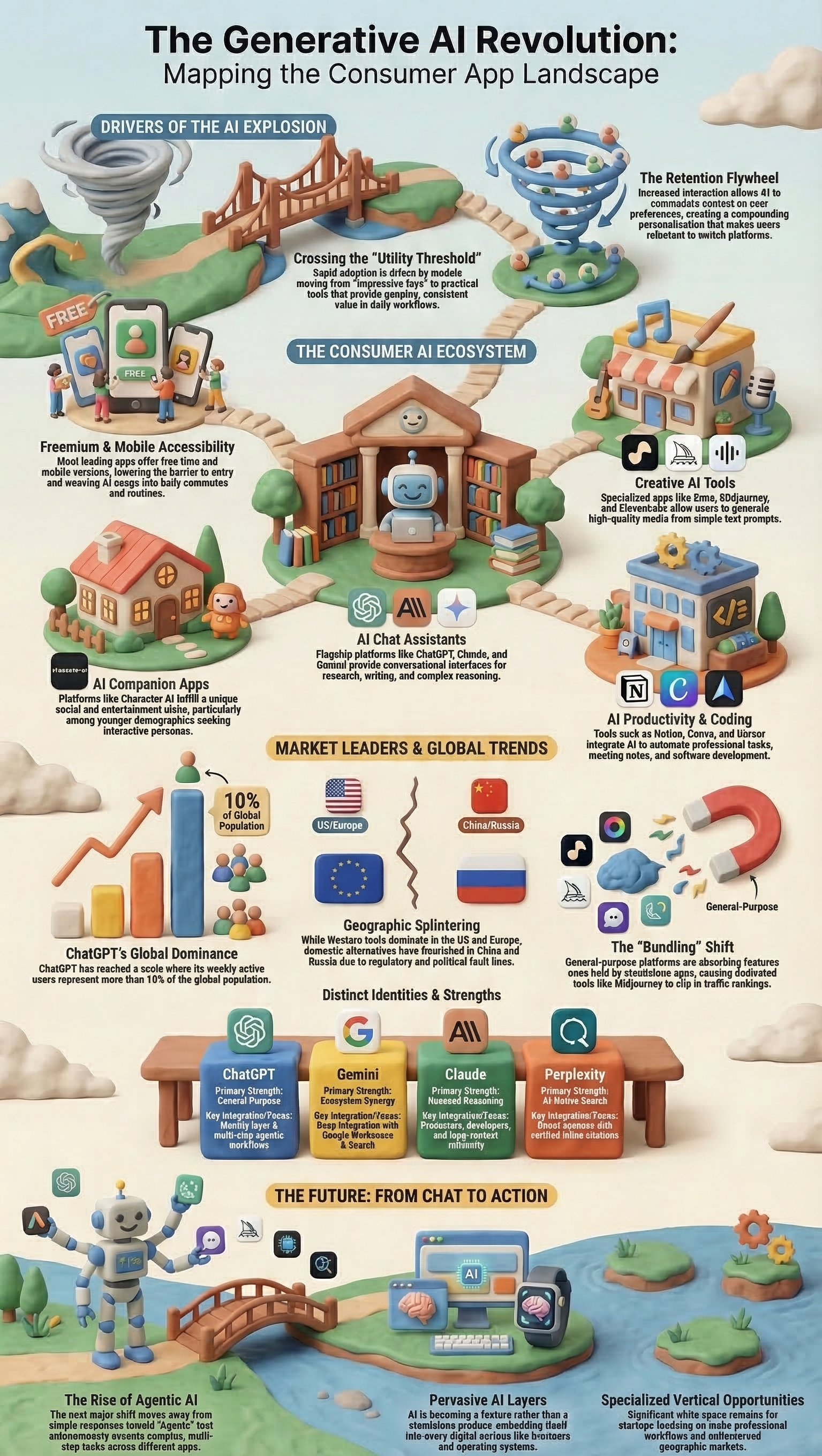
The most fundamental driver of growth in AI consumer applications is the dramatic improvement in model quality over a short period of time. When ChatGPT launched, it surprised users not because conversational AI was a new concept, but because the quality of its responses crossed a threshold that made it genuinely useful rather than merely entertaining. That threshold effect — where a product goes from impressive toy to practical tool — is what unlocks sustained, habitual usage. Subsequent model improvements have continued to push that line, with each generation of underlying technology enabling new categories of consumer applications that simply were not viable before.
Accessibility has played an equally important role. The majority of popular generative AI consumer apps offer free tiers that allow users to experience meaningful functionality without a financial commitment. This freemium structure dramatically lowers the barrier to trial, which is critical for any product trying to build mainstream awareness. Mobile availability has amplified this further. A significant portion of AI app usage now occurs on smartphones, where session frequency tends to be higher and usage is woven more naturally into daily routines. The ability to pull up an AI assistant between meetings, generate an image while commuting, or have a voice conversation while walking has fundamentally changed how people integrate these tools into their lives.
The infrastructure powering consumer AI has also matured to support scale in ways that were not possible even two years ago. Cloud computing costs for inference have dropped substantially, making it economically feasible to offer AI features at low or no cost to consumers. API ecosystems have simplified the process of embedding AI capabilities into existing apps, which is why so many non-AI-native platforms have been able to add meaningful generative features without rebuilding from scratch. This infrastructure accessibility has created a rising tide across the entire category.
Perhaps the most underappreciated driver is the compounding nature of personalization. The more a user interacts with an AI assistant, the more context the system accumulates about their preferences, communication style, and recurring tasks. This context makes the product more useful over time, which increases usage, which generates more context — a classic retention flywheel. Platforms that can build this kind of compounding utility early will find their users increasingly reluctant to switch, even as competitors improve. This dynamic is already visible in retention data for the leading AI consumer apps, where paid subscriber retention is tracking at levels comparable to the best subscription software businesses.
Categories of Popular Consumer AI Tools
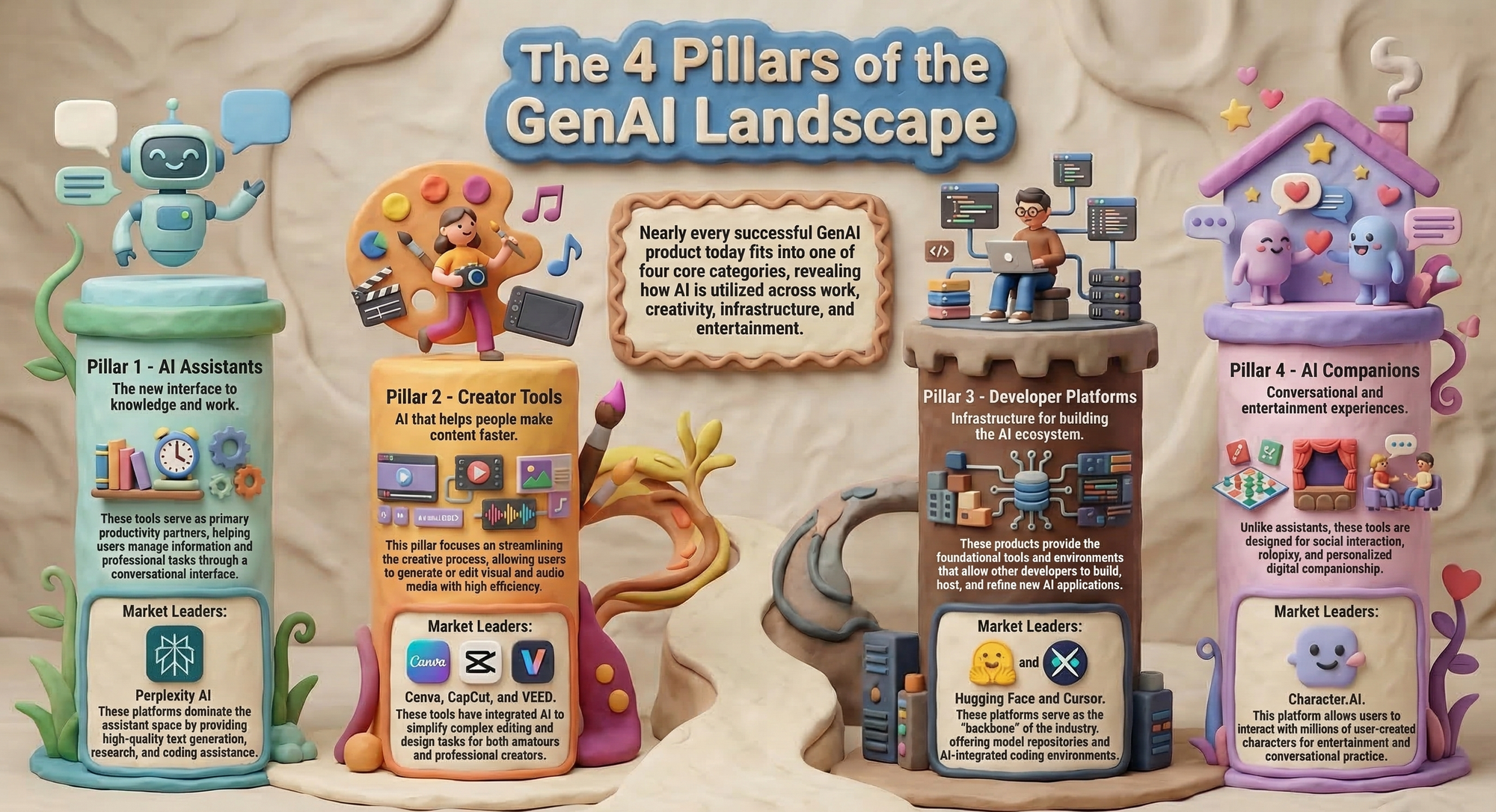
The consumer AI ecosystem has organized itself into several distinct categories, each serving different user needs with different underlying technologies.
AI Chat Assistants
These are the flagship products of the generative AI era — conversational interfaces powered by large language models that can answer questions, help with writing, explain complex topics, assist with research, and engage in extended dialogue. ChatGPT, Gemini, Claude, and Perplexity each occupy this space with different strengths and user demographics. ChatGPT remains the dominant platform by nearly every measure. Claude has built a reputation for nuanced reasoning and is growing its subscriber base rapidly, particularly among professionals and developers. Gemini benefits from deep integration with Google's ecosystem. Perplexity has carved out a niche as an AI-native search experience that cites sources inline.
Creative AI Tools
Image generation was the original creative AI category, with Midjourney and DALL-E introducing millions of users to the idea that artificial intelligence could produce visually striking artwork from a text description. The category has since diversified into video, music, and voice. Tools like Suno allow users to generate full songs in specific styles with nothing more than a text prompt. Kling AI, Hailuo, and Pixverse have emerged as serious contenders in AI video generation. Leonardo AI serves creative communities with specialized image generation features. ElevenLabs has built a durable position in voice cloning and audio production, with capabilities specialized enough to resist commoditization.
AI Productivity Tools
This category covers tools that help users accomplish professional and organizational tasks more efficiently. Notion, Grammarly, and Canva have each integrated AI deeply enough to qualify as AI productivity platforms. AI meeting notetakers — including Fireflies, Fathom, Otter, and Granola — have accumulated tens of millions of users by reducing the cognitive overhead of capturing and organizing meeting content. Coding tools like Cursor, Lovable, Replit, and Claude Code represent a specialized but rapidly growing productivity segment, enabling both professional developers and non-technical users to build functional software through natural language.
AI Companion Apps
Character AI pioneered this category by allowing users to create and interact with custom AI personas. These products fulfill a distinct need — not for task completion, but for social interaction, entertainment, and sometimes emotional support. The category has attracted substantial user engagement, particularly among younger demographics, and continues to grow even as general-purpose chatbots become more capable.
AI Search Tools
Perplexity represents the clearest example of a purpose-built AI search experience, returning answers with citations rather than lists of links. Google's integration of AI Overviews into standard search results, and the launch of Google Labs experiments, reflect the pressure that AI search tools have placed on traditional search paradigms. This category will likely see continued product development as the competition between AI-native search and incumbent search giants intensifies.
Key Insights From the Top AI Consumer Apps Research
One of the most telling findings from recent analysis of the top generative AI consumer apps is just how dominant a small number of platforms have become. ChatGPT has reached a scale that puts it in rare company among consumer internet products — with weekly active users representing more than ten percent of the global population. That kind of penetration, sustained over multiple years of rapid competitive development, suggests the product has crossed from novelty into genuine utility for a broad swath of users. The gap between ChatGPT and the next largest consumer AI platforms remains substantial, though competitors are closing it at meaningful speed.
The geographic distribution of AI adoption reveals a market that is splintering along political and regulatory fault lines as much as cultural or economic ones. Western AI tools — ChatGPT, Claude, Gemini, Perplexity — share a remarkably similar user base concentrated in the United States, India, Brazil, the United Kingdom, and Indonesia. None of these platforms has meaningful penetration in China or Russia, where policy decisions have created conditions for domestic alternatives to flourish. DeepSeek occupies a unique position as a model with genuine cross-regional reach. Russia has emerged as a distinct pole in the global AI landscape, with local products filling the gap created by sanctions in a compressed timeframe that parallels what happened in China over the prior decade.
The creative tools segment reveals something important about the dynamics of bundling in AI. When standalone image generators first appeared, they attracted enormous traffic precisely because they offered a capability that general-purpose tools did not. As the image generation capabilities embedded in ChatGPT and Gemini have improved, the traffic advantage of dedicated image tools has narrowed. Midjourney, which once ranked in the top ten, has slipped considerably in the rankings. The products that have retained their positions tend to serve specific creative communities with specialized features rather than competing on general capability. Meanwhile, the gaps in video, music, and voice have been filled by new entrants who have found more defensible territory precisely because the large platforms have not yet focused their resources there.
Perhaps the most significant structural shift visible in the current consumer AI landscape is the emergence of agentic AI — products that do not merely respond to prompts but execute multi-step tasks autonomously on the user's behalf. Early indicators of this trend appeared with vibe coding tools like Lovable, Cursor, and Bolt, which built things on behalf of users rather than just answering questions. More recently, horizontal agents capable of handling open-ended tasks across multiple applications have begun to attract mainstream attention. This shift from conversational AI to action-oriented AI represents a fundamental change in what consumer AI applications are designed to do, and it will likely drive the next wave of product development across the category.
Examples of Popular Generative AI Consumer Apps
ChatGPT
OpenAI's ChatGPT remains the defining product of the generative AI consumer era. Powered by the GPT series of large language models, it handles an extraordinary range of tasks: answering complex questions, drafting and editing documents, writing and debugging code, generating images, conducting web searches, and increasingly, executing multi-step agentic workflows through its GPT connector ecosystem. Its scale — measured in hundreds of millions of weekly active users — reflects both early mover advantage and consistent product improvement. OpenAI's ambition for ChatGPT extends well beyond chat: the company has signaled intentions to build it into an identity layer and super-app that serves as the starting point for everyday consumer transactions.
Google's Gemini has benefited from deep integration with the company's existing ecosystem — Gmail, Google Docs, Google Photos, YouTube, and Search — allowing it to offer a level of personal context that standalone AI assistants cannot easily replicate. Its creative models have generated significant attention, including image generation features that brought millions of new users to the platform in short bursts. Gemini's paid subscriber base is growing at a rate comparable to the fastest-growing subscription products in the consumer software market, and its usage patterns suggest that users increasingly treat it as a complement to rather than a replacement for ChatGPT.
Anthropic's Claude has established a distinct identity in the consumer AI market, particularly among professionals, knowledge workers, and developers who prioritize nuanced reasoning, long-context handling, and reliability. Claude's paid subscriber growth has been among the fastest in the category. Its connector ecosystem skews toward professional and technical use cases — financial data, developer infrastructure, scientific research — reflecting Anthropic's focus on the prosumer and enterprise segment. Products like Claude Code, which reached a billion dollars in annualized revenue in six months, demonstrate the commercial potential of serving high-intensity professional users.
Perplexity reimagines search as an AI-native experience. Rather than returning a list of links, it synthesizes information from multiple sources and presents a direct answer with inline citations that users can verify. This approach has attracted users who find traditional search results too fragmented and who value accuracy alongside convenience. Perplexity has also moved into adjacent territory with AI browser development, though the standalone browser category remains competitive and unproven at scale.
Character AI occupies a category that general-purpose chatbots have struggled to replicate: AI companions and interactive personas. The platform allows users to create custom characters and engage with them in extended conversations that can be entertaining, emotionally resonant, or simply playful. Its user engagement metrics, particularly among younger demographics, are impressive, and the product has demonstrated that the demand for social and companionship-oriented AI experiences is real and durable.
Midjourney played a foundational role in establishing image generation as a mainstream creative activity. Its distinctive aesthetic and community-oriented development approach built a loyal user base that has persisted even as the competitive landscape intensified. While its ranking among consumer AI apps has declined as image generation has been bundled into general-purpose platforms, Midjourney continues to serve creative professionals who prefer its specific style and the control it offers over the generation process.
Suno has demonstrated that AI music generation can be a genuinely engaging consumer product rather than a technical novelty. Users provide a text description of the style, mood, or lyrical theme they want, and Suno produces a complete song — including instrumentation, vocals, and production — in seconds. Its place on the top AI consumer app rankings reflects both the quality of its outputs and the accessibility of the creation experience, which requires no musical training or technical knowledge.
Leonardo AI serves a more specialized creative community than general-purpose image generators. Its platform is built around the needs of game designers, concept artists, and creative professionals who require precise control over image styles, consistent character design, and specialized generation workflows. By building depth for a specific user segment rather than breadth for the mainstream, Leonardo has maintained a position in the market even as general-purpose image generation has been commoditized.
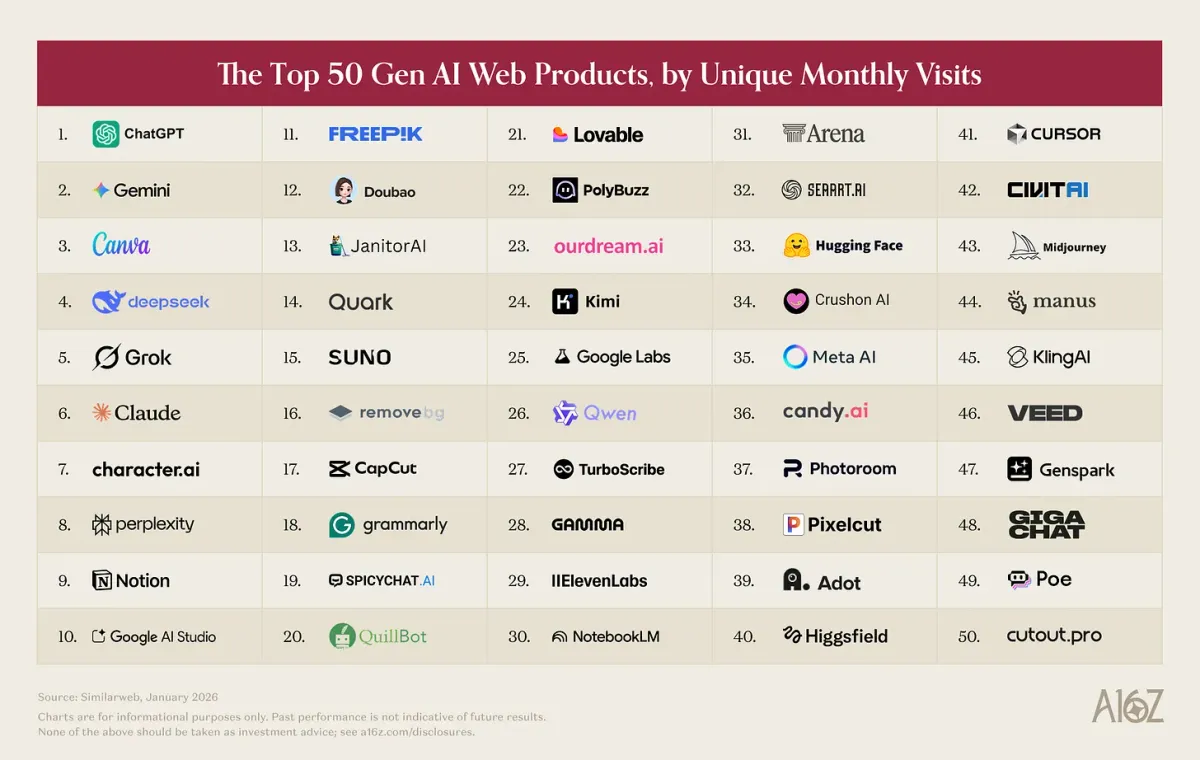
Top 50 Gen AI Web Products — by Unique Monthly Visits
Source: Similarweb, January 2026 • Data via a16z
| # | Product | Category |
|---|---|---|
| #1–10 — Top Tier | ||
| 1 | GP ChatGPT | AI Chat |
| 2 | GM Gemini | AI Chat |
| 3 | CV Canva | Creative |
| 4 | DS DeepSeek | AI Chat |
| 5 | GK Grok | AI Chat |
| 6 | CL Claude | AI Chat |
| 7 | CA Character AI | Companion |
| 8 | PX Perplexity | AI Search |
| 9 | NT Notion | Productivity |
| 10 | GA Google AI Studio | Dev Tools |
| #11–20 | ||
| 11 | FP Freepik | Creative |
| 12 | DB Doubao | AI Chat |
| 13 | JA JanitorAI | Companion |
| 14 | QK Quark | AI Search |
| 15 | SN Suno | Music |
| 16 | RB Remove.bg | Photo |
| 17 | CC CapCut | Video |
| 18 | GR Grammarly | Productivity |
| 19 | SP SpicyChat AI | Companion |
| 20 | QB QuillBot | Productivity |
| #21–30 | ||
| 21 | LV Lovable | Coding |
| 22 | PB PolyBuzz | Companion |
| 23 | OD OurDream.ai | Companion |
| 24 | KM Kimi | AI Chat |
| 25 | GL Google Labs | Creative |
| 26 | QW Qwen | AI Chat |
| 27 | TS TurboScribe | Voice |
| 28 | GM Gamma | Productivity |
| 29 | EL ElevenLabs | Voice |
| 30 | NL NotebookLM | Productivity |
| #31–40 | ||
| 31 | AR Arena | AI Chat |
| 32 | SE SeaArt.ai | Creative |
| 33 | HF Hugging Face | Dev / Models |
| 34 | CR Crushon AI | Companion |
| 35 | MA Meta AI | AI Chat |
| 36 | CD Candy.ai | Companion |
| 37 | PR Photoroom | Photo |
| 38 | PX Pixelcut | Photo |
| 39 | AD Adot | AI Search |
| 40 | HG Higgsfield | Video |
| #41–50 | ||
| 41 | CS Cursor | Coding |
| 42 | CI CivitAI | Creative |
| 43 | MJ Midjourney | Creative |
| 44 | MN Manus | Agent |
| 45 | KL Kling AI | Video |
| 46 | VD VEED | Video |
| 47 | GS Genspark | Agent |
| 48 | GC GigaChat | AI Chat |
| 49 | PO Poe | AI Chat |
| 50 | CP Cutout.pro | Photo |
Top 50 Gen AI Mobile Apps — by Monthly Active Users
Source: Sensor Tower, January 2026 • Data via a16z
| # | App | Category |
|---|---|---|
| #1–10 — Top Tier | ||
| 1 | GP ChatGPT | AI Chat |
| 2 | CC CapCut | Video |
| 3 | GM Gemini | AI Chat |
| 4 | CV Canva | Creative |
| 5 | AG AI Gallery | Creative |
| 6 | PA Picsart | Photo |
| 7 | DB Doubao | AI Chat |
| 8 | ME Microsoft Edge | Browser |
| 9 | MT Meituan | Lifestyle |
| 10 | YX Yandex | Browser |
| #11–20 | ||
| 11 | RM Remini | Photo |
| 12 | QQ QQ Browser | Browser |
| 13 | DS DeepSeek | AI Chat |
| 14 | CI Cici | AI Chat |
| 15 | PX Perplexity | AI Search |
| 16 | LR Adobe Lightroom | Photo |
| 17 | BD Baidu AI Search | AI Search |
| 18 | GK Grok | AI Chat |
| 19 | VN VN | Video |
| 20 | ED Edits (Instagram) | Video |
| #21–30 | ||
| 21 | MA Meta AI | AI Chat |
| 22 | MU Meitu | Photo |
| 23 | CP Copilot | AI Chat |
| 24 | HY Hypic | Photo |
| 25 | SK Seekee | AI Search |
| 26 | NT Notion | Productivity |
| 27 | PM Photomath | Education |
| 28 | GT Gauth | Education |
| 29 | LA Learna AI | Education |
| 30 | WK Wink | Photo |
| #31–40 | ||
| 31 | FM Facemoji | Creative |
| 32 | CA Character AI | Companion |
| 33 | MB Microsoft Bing | AI Search |
| 34 | FA FaceApp | Photo |
| 35 | NV NOVA | AI Chat |
| 36 | YC YouCut | Video |
| 37 | PL Polish | Photo |
| 38 | B6 B612 | Photo |
| 39 | PR Photoroom | Photo |
| 40 | PV PixVerse | Video |
| #41–50 | ||
| 41 | HT HiTranslate | Translate |
| 42 | BC BeautyCam | Photo |
| 43 | PP Papago | Translate |
| 44 | BR Brainly | Education |
| 45 | PZ PolyBuzz | Companion |
| 46 | AM AI Mirror | Photo |
| 47 | MV MIVI | Video |
| 48 | SW SNOW | Photo |
| 49 | VC VivaCut | Video |
| 50 | BP BeautyPlus | Photo |
Data from a16z Top 100 Gen AI Consumer Apps report (March 2026). Sources: Similarweb & Sensor Tower, January 2026.
Sources: a16z
How Consumer AI Tools Are Changing Everyday Work and Creativity
The clearest immediate impact of consumer AI tools is the compression of the time required to produce first drafts of almost any kind of content. A marketing professional who once spent two hours drafting campaign copy can now generate a dozen variations in minutes and spend their remaining time refining and selecting rather than creating from scratch. A developer who previously spent hours debugging an obscure error can get a diagnosis and suggested fix in seconds. A designer who needed specialized illustration skills to visualize a concept can now generate reference images from a text description. Across knowledge work and creative work alike, the cognitive bottleneck is shifting from production to judgment.
This shift is not just about speed. It is reshaping the skills that matter most in professional contexts. The ability to give precise, effective instructions to an AI system — what practitioners sometimes call prompt engineering, though the term understates its importance — is becoming a genuine professional competency. Users who can clearly articulate what they want, recognize quality in AI outputs, and iterate effectively on unsatisfactory results are getting disproportionately more value from these tools than those who approach them with vague requests and accept the first result they receive. This suggests that the productivity gains from consumer AI are not uniformly distributed — they flow most powerfully to users who invest in understanding how to use the tools well.
The creative implications are equally significant and somewhat more complex. AI tools have genuinely democratized access to creative production — someone with no prior design experience can now produce professional-quality visual content, someone with no musical training can compose a full-length song, and someone with no coding background can build a functional web application. This lowers the barrier to creative expression in ways that have meaningful cultural consequences. At the same time, it creates new pressures on people whose livelihoods depend on skills that AI can now partially replicate. The equilibrium that emerges from this tension — between expanded creative access and disrupted creative labor markets — is still being worked out, and the outcome will depend significantly on how AI tools evolve and how the people who use them adapt.
Opportunities for Startups in the Consumer AI Ecosystem
The consolidation of the market around a small number of dominant platforms does not mean that opportunities for new entrants have disappeared. If anything, the establishment of large platform ecosystems creates conditions that are historically favorable for specialized vertical applications. Just as the smartphone operating system wars produced a long tail of successful app businesses that the platform owners themselves never built, the emergence of AI assistant ecosystems is likely to produce a similar pattern. The categories where ChatGPT and Claude have few or no integrations — niche professional workflows, specialized creative communities, underserved geographic markets — represent genuine white space for founders who can build products with deep, specific utility.
The agentic AI category is particularly open. Horizontal agents that can execute multi-step tasks across applications are still in early development, and the user experience challenges involved in making them accessible to non-technical consumers are substantial. There is significant room for products that solve specific high-value workflow problems using agentic capabilities — scheduling, research synthesis, contract review, customer communication — in ways that do not require users to understand the underlying technology. These products will face competition from the general-purpose AI assistants as they expand their capabilities, but they have the advantage of being able to move faster and build deeper domain expertise in their target verticals.
The voice and audio category also presents underexplored opportunities. While text-based AI interfaces have attracted the majority of investment and user attention, voice is a natural interface for a wide range of contexts where text is impractical — while driving, exercising, or doing household tasks, for instance. The meeting notetaker segment has already demonstrated that voice-based AI can build substantial user bases through focused utility. Extending similar logic to other contexts where voice is the most natural mode of interaction — language learning, accessibility tools, ambient computing environments — points to a category with meaningful untapped potential.
Future Trends in Consumer AI Applications
The trajectory of consumer AI applications points toward a world where AI becomes less a destination and more a pervasive layer embedded across every digital surface. The current model — where users navigate to a dedicated AI app, type a prompt, and receive a response — is already giving way to integrations that bring AI capabilities directly into the tools people already use. Word processors, spreadsheets, email clients, browsers, and operating systems are all becoming AI-native in ways that will make the distinction between "AI apps" and "apps" increasingly meaningless. The measurement challenge this creates is significant: as AI moves from a product to a feature, the user counts and traffic figures that define today's rankings will capture a shrinking fraction of actual AI usage.
The shift from conversational AI to agentic AI represents the next major evolution in how these products create value. The products that will define the next phase of consumer AI are not those that answer questions most accurately, but those that can reliably execute complex, multi-step tasks on the user's behalf with minimal supervision. This requires not just better models, but new interaction paradigms, more sophisticated permission systems, and the kind of trust-building that only comes from consistent performance over time. The companies that successfully navigate this transition — from helpful assistant to reliable agent — will be positioned to capture a fundamentally larger share of user value than anything currently on the market.
Personalization at depth is the third defining trend. The most compelling long-term vision for consumer AI is a system that knows a user well enough to provide genuinely bespoke assistance — one that understands professional context, communication preferences, ongoing projects, and personal history well enough to act as a true thought partner rather than a sophisticated autocomplete. Building this kind of deep personalization requires solving hard problems around data access, privacy, and model memory. The companies that crack these problems first — and do so in ways that users trust — will have a structural advantage that is very difficult for competitors to replicate, because the accumulated context itself becomes a barrier to switching.
Frequently Asked Questions
What are the most popular generative AI consumer apps available today?
The most widely used generative AI consumer apps include ChatGPT, Google Gemini, Claude, Perplexity, Character AI, Suno, and Leonardo AI. Platforms like CapCut, Canva, and Notion have also become major AI consumer products by deeply integrating generative features into their core experiences. ChatGPT leads by a significant margin across both web traffic and mobile active users, though competitors are growing their subscriber bases rapidly and the market continues to diversify.
How are AI consumer apps different from traditional software applications?
Traditional software applications execute predefined functions — a photo editor applies filters, a spreadsheet performs calculations. Generative AI consumer apps produce novel outputs in response to open-ended natural language inputs, meaning the same tool can write an essay, generate an image, compose a song, or debug code depending on what the user asks. This flexibility makes them qualitatively different from their predecessors, as the scope of what they can do is defined by the user's imagination and the underlying model's capabilities rather than by the developer's predefined feature set.
Why are some AI consumer apps available for free while others require subscriptions?
Most consumer AI apps use freemium models because lowering the barrier to trial is essential for building mainstream awareness and adoption. Free tiers typically offer limited usage or reduced model quality, with paid subscriptions unlocking higher usage limits, more capable models, and advanced features. The cost of serving AI responses — particularly from high-quality large language models — remains significant, which is why unlimited free access is rarely economically sustainable. Premium subscribers often get access to faster response times, multimodal capabilities, and priority access to new features.
What is agentic AI and how does it differ from traditional AI chatbots?
Agentic AI refers to systems that can execute multi-step tasks autonomously on a user's behalf, rather than simply responding to individual prompts. A traditional chatbot answers a question and waits for the next one. An agentic AI system can receive an open-ended goal — "book me a flight to London next Tuesday within this budget and add it to my calendar" — and complete the entire workflow without requiring the user to manage each individual step. Agentic AI tools are earlier in their development than conversational AI tools, but they represent the direction in which the most ambitious consumer AI products are headed.
Which countries are leading in consumer AI adoption?
Per-capita AI adoption data suggests that the United States — despite producing most of the leading AI tools — is not the top market by this measure. Singapore, the UAE, Hong Kong, and South Korea rank higher on combined web and mobile AI usage per capita. The global AI market is also splintering geographically, with Western tools dominant in North America, Europe, and parts of Asia and Latin America; Chinese platforms dominant domestically and in some adjacent markets; and Russian products filling a gap created by restricted access to Western AI tools.
Conclusion
The generative AI consumer app landscape is one of the most dynamic sectors in technology, defined by extraordinary growth, accelerating product development, and a competitive environment that rewards both scale and specialization. The leading platforms have built user bases and retention characteristics that are historically unusual, and the structural dynamics — compounding personalization, connector ecosystems, and platform lock-in — suggest the category leaders are building durable positions. At the same time, the category remains young enough that meaningful disruption is possible, particularly as the shift from conversational AI to agentic AI creates new vectors for competition.
For consumers, the practical implication is that the tools available today are among the least capable versions of what will exist in the near future, and investing time in learning to use them effectively is worthwhile regardless of which specific products prove dominant. For builders and investors, the landscape points to a category that is simultaneously consolidating at the top and creating new opportunities at the vertical and niche level. The defining products of the next phase of consumer AI will almost certainly do things that seem difficult or impossible today — and understanding where the current market is heading is the best available guide to where those opportunities will emerge.