
30 Tech Startups to Watch: AI-Driven Innovation Reshaping the Enterprise

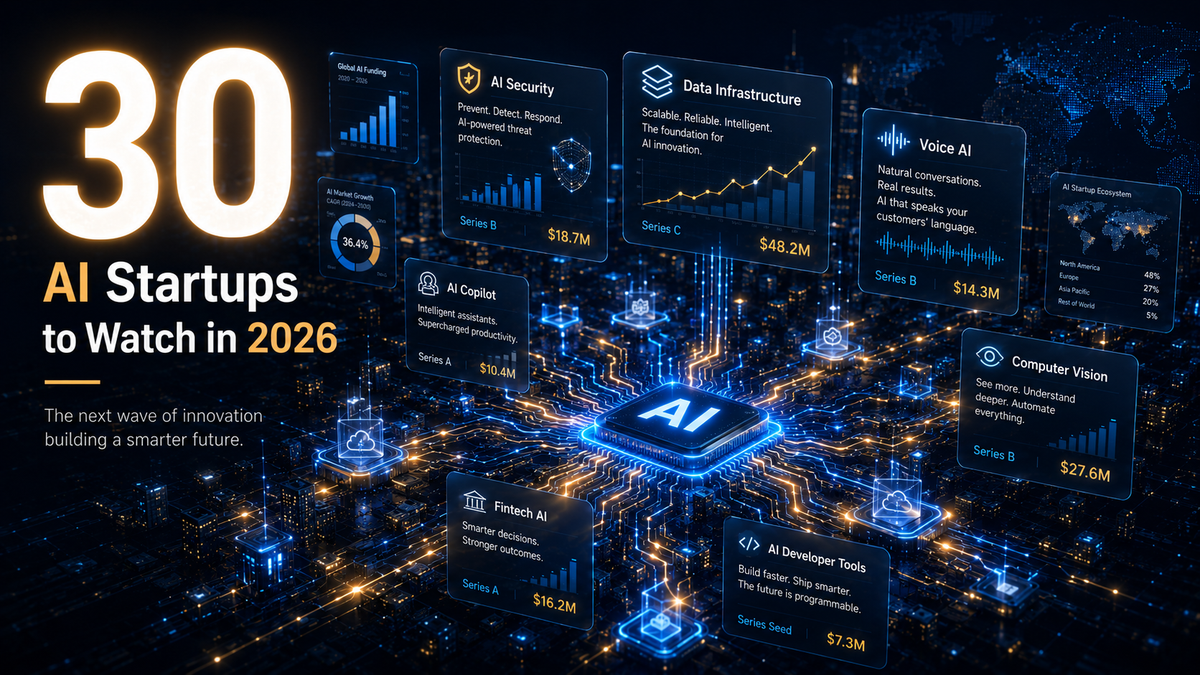
30 Tech Startups to Watch: AI-Driven Innovation Reshaping the Enterprise
A deep-dive guide to the most promising early-stage and growth companies redefining AI security, data infrastructure, voice technology, quantum computing, and beyond.
The New Era of Startup Innovation: Why This Moment Is Different
Venture capital is not merely flowing into artificial intelligence — it has been redirected there with historic force. According to Crunchbase, AI captured 80 percent of all venture dollars in the most recent quarter, with $242 billion going to AI-focused startups. Four of the five largest venture capital rounds in history closed in that same period alone. That number should stop anyone who follows the startup ecosystem in their tracks — not because it signals irrational exuberance, but because it marks a genuine inflection point in how technology gets built, funded, and deployed at scale.
For founders, investors, enterprise technology buyers, and curious observers, the question is no longer whether AI will transform business — it already has. The more pressing question is which companies are doing the most consequential work, and why those specific bets deserve attention now rather than later.
This guide profiles 30 startups across AI security, data infrastructure, voice technology, quantum computing, observability, and more. Rather than naming winners prematurely, it focuses on what each company is solving, who benefits most, and what makes their approach genuinely differentiated in a crowded and well-funded market.
Understanding the Startup Landscape: Stakes, Odds, and the Characteristics of Companies That Survive
Building a startup has never been a safe bet, and the statistics have not improved much over time. Research consistently shows that roughly 90 percent of startups fail, and the technology sector — despite producing the most unicorns globally — carries a failure rate of approximately 63 percent. The highest-risk window is between years two and five, when initial funding has been consumed and the business must prove a sustainable revenue model on its own merits.
The startups that reach durable growth tend to share a recognizable set of characteristics: deep product-market fit, comprehensive operational foundations, rapid scalability, adaptable teams, and — in most cases — two or more co-founders. Research shows that teams with co-founders attract 30 percent more investment and achieve three times the customer growth rate compared to solo founders.
"Only 1% of startups become unicorns. The ones that break through have found the intersection of urgent market need, the right timing, and a team that refuses to stop iterating."
— CB Insights Research, 2026Security has become one of the most active categories in the venture-backed startup world. The rapid adoption of AI agents, non-human identities, and autonomous workflows has introduced entirely new threat surfaces that legacy security tools were never designed to handle.
Insider threats have historically been one of the hardest security problems to solve because traditional tools rely on rigid rules and predefined policies that cannot keep pace with constantly shifting behavior. Above Security deploys a fleet of specialized AI investigators that continuously analyze both human and AI behavior within an organization, surfacing genuine risk without requiring manual configuration, rules engines, or behavioral baselines set by administrators.
Security teams no longer need to wait for a breach to trigger an alert — the platform surfaces risk signals in real time. As enterprises adopt more AI tools that interact with sensitive data, the ability to monitor both human users and AI agents in the same unified system becomes a significant operational advantage.
- Monitors both human users and AI agents without requiring predefined rules or policies
- Proactive risk surfacing reduces mean time to detection for insider threats
- Particularly valuable for enterprises scaling AI tooling that touches sensitive data
The rise of AI-assisted coding has introduced a new category of risk: vulnerable code generated faster than security reviews can catch it. Apiiro's Guardian Agent integrates into AI coding workflows and prevents problematic code from being generated in the first place — a left-shift approach that is especially important as development teams lean heavily on tools like GitHub Copilot.
- Secures AI-generated code at the moment of generation, not after the fact
- Guardian Agent integrates directly with AI coding assistants and development pipelines
- Critical for teams that have adopted AI-assisted development without a security layer
One of the least visible and most dangerous attack surfaces in modern enterprises is the proliferation of non-human identities — API keys, service accounts, OAuth tokens, and increasingly, AI agents granted access to sensitive systems. Astrix makes these invisible actors visible, identifies excessive privilege grants, and responds to real-time threats. Its secure-by-design guardrails give enterprises a practical path to adopting agentic AI without creating uncontrolled access sprawl.
- Provides full visibility into AI agents and NHIs that traditional tools miss
- Addresses excessive privilege — one of the most common enterprise misconfigurations
- Enables safe, scalable agentic AI adoption without sacrificing security posture
Vibe coding — writing software primarily through AI prompts and natural language interactions with LLMs — has created a new security reality: AI generates code faster than manual review can catch it, and that output can contain vulnerabilities, licensing issues, and compliance violations. Backslash provides visibility across the entire AI development ecosystem and delivers real-time governance and protection without slowing development velocity.
- Specifically designed for security risks introduced by AI-assisted and vibe coding workflows
- Real-time governance without slowing development pipeline velocity
- Covers compliance, licensing, and vulnerability detection across the AI dev ecosystem
Most enterprise security programs struggle with employee engagement — security tools designed to restrict and monitor create adversarial dynamics. Nudge Security applies behavioral science to make security a natural part of how modern work gets done. Its discovery capabilities surface unauthorized SaaS and shadow AI tools, while behavioral nudges guide employees toward better decisions without creating the friction that leads people to work around policies.
- Uses behavioral science principles to make security collaborative rather than adversarial
- Discovers unauthorized SaaS and shadow AI tools across the organization
- Reduces security incidents caused by human behavior rather than technical vulnerabilities
As enterprises deploy more AI applications — internally built or from third-party vendors — governance has emerged as one of the most pressing and least solved problems in the space. Singulr AI helps security and compliance teams understand what AI is being used, how it is behaving, what data it is accessing, and whether it is operating within policy boundaries. For regulated industries, a purpose-built AI governance layer has become essential rather than optional.
- Centralizes AI governance across all enterprise AI applications and use cases
- Particularly valuable for regulated industries where AI compliance is a legal requirement
- Provides the visibility and controls needed to scale AI adoption without losing oversight
Token Security focuses on AI agents as first-class security subjects. Its platform discovers what agents are operating across the enterprise, understands their context and risk profile, and enforces policies governing exactly what they can access and do. The Know Your Agent framework mirrors the Know Your Customer principles that have governed financial services for decades — adapted for a world where autonomous agents act with real credentials and real access.
- Applies KYC-like rigor to AI agent governance through a Know Your Agent framework
- Covers discovery, risk assessment, and policy enforcement for enterprise AI agents
- Addresses a gap that traditional IAM tools were not built to handle
Security operations centers are drowning in alert volume. Torq automates repetitive triage and response workflows that consume analyst capacity, freeing human operators to focus on the highest-complexity incidents. For enterprise SOC teams working in environments that generate tens of thousands of alerts per day, this kind of orchestration platform has become critical infrastructure.
- Automates security event triage and response, dramatically reducing analyst workload
- Designed for the alert volumes and complexity of modern multi-cloud enterprise environments
- Enables SOC teams to close the gap between detection and meaningful response
AI models are only as good as the data they run on. Enterprises that cannot govern, version, and observe their data pipelines are building AI on unstable foundations. These startups are solving the foundational data problems that make enterprise AI possible.
Shipping an AI application to production is the beginning of the work, not the end. Braintrust provides the infrastructure to measure performance, understand failures, catch regressions, and leverage real user data to continuously improve AI applications. The platform enables side-by-side model comparison and systematic prompt iteration — the difference between a production AI that improves and one that quietly degrades.
- Provides the measurement and evaluation infrastructure that production AI applications require
- Enables systematic prompt improvement and model comparison based on real production data
- Fills a critical gap between AI development and ongoing production quality assurance
Collate turns metadata into shared meaning — a semantic foundation enabling both people and AI systems to work from the same understanding of what data means, where it came from, and whether it can be trusted. Applied across discovery, lineage, quality, observability, and governance, it enables the explainable AI and automated governance that regulators and enterprise risk teams increasingly require.
- Creates a semantic metadata foundation usable by both humans and AI systems
- Covers discovery, lineage, quality, observability, and governance in a unified platform
- Enables explainable AI by ensuring AI systems know what data they are consuming
Enterprise data volumes are growing faster than organizations can manage them cost-effectively. The traditional approach of sending all data to every destination creates unsustainable costs and latency. Cribl gives enterprises choice, control, and flexibility over their data pipelines — enabling them to route, filter, enrich, and transform data in transit rather than after the fact, without introducing delays.
- Solves enterprise-scale data routing cost and complexity without adding latency
- Particularly valuable for security and observability pipelines at high data volumes
- Gives organizations genuine control over what data goes where and in what form
lakeFS brings Git-like version control to data — a highly scalable system that manages the data lifecycle, governance, and unified access to AI-ready data. For machine learning teams, versioning datasets alongside code makes experiments reproducible, tracks what data a given model was trained on, and prevents the silent data drift that degrades model performance over time.
- Git-like version control for data pipelines makes ML experiments reproducible and auditable
- Prevents data drift by precisely tracking data at every stage of the AI lifecycle
- Particularly valuable for organizations with data lineage requirements in regulated environments
Revefi has built RADEN, an AI agent that gives enterprise data teams a unified view of cost, data operations, and observability across their entire stack. Rather than requiring data engineers to manually investigate pipeline failures or runaway query costs, RADEN automates discovery and resolution at machine speed — combining cost optimization and observability in a single AI-driven interface.
- Unifies cost optimization and data observability in a single AI-driven platform
- RADEN automates pipeline issue discovery before they affect downstream systems
- Significantly reduces the operational overhead of enterprise data platform management
WALT AI deploys a crew of AI agents that build, operate, and evolve an entire data platform — from ingestion and transformation through analytics and governance — without requiring large teams of specialized data engineers. Rather than optimizing one layer of the data stack, the platform covers the full lifecycle, enabling smaller teams to operate with the data sophistication of much larger organizations.
- Automates the full data platform lifecycle from ingestion to governance using AI agents
- Reduces the headcount required to build and maintain enterprise-grade data infrastructure
- Enables smaller teams to compete on data sophistication with much larger organizations
AI is rapidly expanding beyond text. Voice interfaces, visual intelligence, and multi-agent research platforms represent the next wave of enterprise AI adoption — and the startups in this section are building the infrastructure that makes these capabilities possible at scale.
Unlike startups that build voice features on top of commodity speech-to-text APIs, Deepgram builds its own foundational models — giving it unique control over accuracy, latency, and language support. As organizations build AI assistants, automated call handling, and voice-driven data entry, access to high-quality, low-latency speech foundations becomes a competitive necessity. Deepgram positions itself as the infrastructure layer beneath a growing ecosystem of voice-enabled applications.
- Builds foundational speech AI rather than wrapping commodity APIs — superior accuracy and latency
- Powers a growing ecosystem of voice-enabled enterprise and consumer applications
- Positioned at the infrastructure layer of the voice AI stack, which provides durable leverage
IVR systems are universally disliked — rigid, slow, and unable to handle anything beyond scripted interactions. Flip is purpose-built to replace these systems with a voice AI platform that autonomously resolves customer service calls end-to-end, without routing customers through menu trees. Designed specifically for retail, healthcare, and transportation, Flip eliminates the IVR model entirely rather than merely modernizing it.
- Resolves customer service calls end-to-end autonomously — not just routes them
- Vertical-specific design for retail, healthcare, and transportation creates genuine depth
- Eliminates the IVR model rather than incrementally improving it
Paradigm AI enables anyone to launch thousands of AI agents running in parallel to automate complex, multi-step research workflows. Pharmaceutical companies can accelerate literature reviews. Consulting firms can automate market research. Investment teams can conduct due diligence faster and more comprehensively. Paradigm AI makes this kind of research automation accessible without requiring specialized engineering teams.
- Enables organizations to run thousands of parallel AI agents on complex research tasks
- Dramatically reduces time and cost of research-intensive workflows across industries
- Makes sophisticated research automation accessible without specialized engineering
The premise behind Replit is one of the most significant in the startup landscape: software creation should not require knowing how to write code. Users describe what they want to build in plain language, and the system generates, iterates on, and deploys working software. For non-technical founders, small business owners, and educators, Replit represents a genuinely transformative capability that dramatically expands who can bring ideas to life through software.
- Removes the technical barrier to software creation through natural language interfaces
- Serves a large and underserved population of potential builders without coding backgrounds
- Agentic architecture handles iterative development, not just initial code generation
Memories.ai has developed the world's first Large Visual Memory Model (LVMM) — giving AI systems human-like visual memory: the ability to see, understand, and recall visual experiences across unlimited timeframes. Applications span industrial inspection, surveillance analytics, retail intelligence, and medical imaging. Most vision AI systems work on individual frames; Memories.ai enables systems that reason about what they have seen over much longer time horizons.
- First-of-its-kind LVMM enables AI to recall visual experiences across unlimited timeframes
- Enables a category of visual AI applications not previously possible with frame-level models
- High potential across industrial, medical, retail, and security domains
The internet has a fundamental identity problem: verifying who someone is almost always requires revealing private data. Humanity's Proof-of-Trust network enables anyone to verify identity, eligibility, or access without disclosing the underlying private information. As data privacy regulation tightens globally, solutions that enable verification without data exposure will become increasingly foundational across Web3, finance, and healthcare.
- Enables identity verification without requiring disclosure of private data
- Addresses the fundamental privacy-versus-access tradeoff that most identity systems fail to resolve
- Relevant across Web3, financial services, healthcare, and regulated access contexts
Haiqu operates from the thesis that near-term, commercially viable quantum applications are achievable with the right software, even on current hardware. By developing software that extracts maximum value from today's noisy quantum hardware rather than waiting for future generations, Haiqu is pursuing a pragmatic path to commercial relevance in chemistry, logistics, and financial optimization.
- Pursues commercially viable quantum applications on current hardware
- Software-first strategy enables near-term value in chemistry, logistics, and finance
- Pragmatic differentiation from quantum startups dependent on unproven hardware timelines
Amberd has built a private, LLM-native platform that gives senior leaders a single, decision-ready answer synthesized from all their enterprise data — without sacrificing privacy, governance, or control. Executives cannot put confidential strategic information into consumer AI tools, and many existing AI solutions are not viable for C-suite use cases. Amberd has built specifically for those constraints.
- Synthesizes structured and unstructured enterprise data into single decision-ready insights
- Privacy-first architecture makes it viable for C-suite use cases consumer AI tools cannot serve
- Addresses the information synthesis problem that makes executive decision-making slow
Sybilion enriches decision-making on a global scale using cutting-edge AI to democratize the deep strategic insight previously accessible only to the largest organizations. The platform empowers leaders to act with foresight, precision, and sustainability — recognizing that short-term optimization often creates long-term vulnerabilities.
- Democratizes access to sophisticated global decision intelligence across organization sizes
- Integrates foresight and sustainability into strategic analysis
- Addresses the complexity of global system interactions that simpler analytics tools cannot model
Cloud infrastructure costs have become one of the largest and fastest-growing line items in enterprise technology budgets, yet most tools are built for engineers rather than finance leaders. Cloud Capital has built a platform purpose-designed for CFOs, enabling financial leaders to engage directly with infrastructure spending decisions and closing the gap between budget approvers and the technical drivers of cloud costs.
- Designed for CFOs rather than engineers, closing the finance-to-infrastructure gap
- Enables meaningful cloud cost forecasting without requiring technical expertise
- Addresses one of the fastest-growing and least-governed cost categories in enterprise tech
When cloud platforms experience outages, most organizations have no financial protection against resulting losses. Mantas provides tailored cloud outage insurance combined with predictive analytics that help businesses anticipate and mitigate cloud downtime risk before it materializes. The combination creates a compelling value proposition: rather than simply compensating after a loss, Mantas helps reduce the probability and severity of disruptions proactively.
- Provides financial protection against cloud outages most insurance products do not cover
- Combines predictive analytics with insurance for proactive risk reduction
- Particularly valuable for businesses with significant revenue dependence on cloud availability
Vector databases have emerged as critical infrastructure for AI applications that need to find semantically similar content — from recommendation systems and semantic search to retrieval-augmented generation for LLMs. Qdrant delivers cutting-edge vector search software available both as open-source and scalable cloud services, giving developers and businesses options suited to their scale and requirements.
- High-performance vector search infrastructure critical for semantic AI applications
- Open-source availability accelerates developer adoption while cloud services serve enterprise scale
- Well-positioned for the growing RAG use case that depends on vector search quality
Risotto is an autonomous AI ITSM platform built to resolve support tickets instantly for IT, HR, and revenue operations — without routing requests through slow manual workflows. The platform handles the full resolution lifecycle, not just initial triage. For IT and HR teams spending significant resources on predictable tier-one requests, Risotto provides genuine automation rather than chatbot-style deflection that leaves users unsatisfied.
- Resolves support tickets autonomously rather than deflecting through chatbot menus
- Applicable across IT, HR, and revenue operations enabling multi-department deployment
- Addresses one of the highest-volume and most repetitive workflows in enterprise operations
One of the most persistent limitations of production AI is that models degrade over time as the world changes around them. Striveworks delivers AI-powered analysis through models that learn and adapt to their environment at machine speed. Particularly relevant in defense and intelligence environments where the cost of a stale model is measured in operational outcomes rather than revenue, Striveworks offers a meaningful advance over static AI systems requiring manual retraining cycles.
- Enables AI models to adapt to changing conditions at machine speed, reducing degradation
- Particularly valuable in defense and intelligence environments where model staleness has serious consequences
- Addresses the retraining bottleneck that limits the practical value of deployed AI systems
Unleash reduces the risk of releasing new software features by enabling teams to control exactly who sees what — testing changes with specific user segments before full rollout and disabling problematic features instantly without a deployment. The revenue optimization dimension comes from persistent experiments that optimize user experience for business outcomes, rather than simply A/B testing and moving on.
- Reduces release risk through granular feature control and progressive delivery
- Drives revenue by enabling persistent UX optimization through controlled experimentation
- Valuable for teams that ship frequently in environments where downtime has real costs
Building high-performing computer vision models is as much a data problem as a modeling problem. Voxel51 empowers hundreds of thousands of AI builders to unlock insights from their visual data, helping teams understand what datasets actually contain, identify gaps and biases, and make targeted improvements to data quality that translate directly into model performance gains. The quality of the data pipeline determines the ceiling on model quality.
- Helps AI builders understand and improve visual data to unlock better model performance
- Serves hundreds of thousands of practitioners across the computer vision community
- Addresses the data quality bottleneck that limits computer vision application performance
Comparison Table: 30 Startups at a Glance
Use the table below to quickly identify which companies are most relevant to your organizational context, investment thesis, or area of technical interest. Each startup is mapped by focus area, key technology, ideal user profile, and standout feature.
| Startup | Focus Area | Key Technology | Best For | Standout Feature |
|---|---|---|---|---|
| Above Security | Security | AI Behavior Analysis | Enterprises | Proactive risk without rules |
| Apiiro | Security | Agentic AI Guardrails | Dev Teams | Blocks vulnerable code at generation |
| Astrix Security | Security | Real-time Threat Detection | Large Enterprises | Secure-by-design guardrails |
| Backslash Security | Security | AI Dev Ecosystem Visibility | Dev/SecOps | Governs AI-generated code |
| Nudge Security | Security | AI Risk Insights | Security Teams | Behavioral science approach |
| Singulr AI | Security | Enterprise AI Security | Compliance Teams | Streamlines AI at scale |
| Token Security | Security | Policy Enforcement | Enterprise SecOps | Governs AI agent access |
| Torq | Security | Event Detection at Scale | SOC Teams | Precise response at scale |
| Braintrust | Data | Evaluation & Prompt Mgmt | AI Teams | Production model comparison |
| Collate | Data | Semantic Metadata Layer | Data Teams | Unified discovery + lineage |
| Cribl | Data | Data Routing & Control | Enterprises | Choice, control, flexibility |
| lakeFS | Data | Scalable Data Lifecycle | Data/ML Teams | AI-ready data governance |
| Revefi | Data | RADEN AI Agent | Data Ops Teams | Cost + observability unified |
| WALT AI | Data | Full-stack AI Agents | Data Engineers | End-to-end platform ops |
| Deepgram | Voice AI | Foundational Speech Models | Developers | Human-to-machine voice |
| Flip | Voice AI | Autonomous Call Resolution | Retail/Healthcare | Replaces IVR end-to-end |
| Paradigm AI | AI Platform | Multi-agent Workflows | Researchers | Thousands of AI agents |
| Replit | AI Platform | Natural Language Coding | Non-developers | Build apps without code |
| Memories.ai | Visual AI | Large Visual Memory Model | AI Builders | Unlimited visual recall |
| Humanity | Identity | Proof-of-Trust Network | Web3/Enterprises | Privacy-preserving identity |
| Haiqu | Quantum | Near-term Quantum Apps | Research/Enterprise | Viable on current hardware |
| Amberd | Decision AI | LLM-native Data Platform | C-Suite | Single decision-ready answer |
| Sybilion | Decision AI | Global AI Analytics | Leaders/Analysts | Foresight at global scale |
| Cloud Capital | Cloud | CFO-focused Forecasting | Finance/IT | Cloud spend optimization |
| Mantas | Cloud | Predictive Analytics | SMBs/Enterprises | Cloud outage insurance |
| Qdrant | Infrastructure | High-dimensional Data | Developers | Open-source + cloud scale |
| Risotto | Operations | Autonomous Ticket Resolution | IT/HR | Instant support resolution |
| Striveworks | Trustworthy AI | Adaptive ML Models | Defense/Analytics | Machine-speed learning |
| Unleash | Dev Tools | Feature Flag Platform | Dev/Product Teams | Revenue via UX optimization |
| Voxel51 | Visual AI | Data Insight Tooling | AI Builders | Maximizes model performance |
Cross-Cutting Trends: What These 30 Startups Reveal About the Future
Taken individually, each of these companies is interesting. Taken together, they reveal a set of recurring themes that point to where the enterprise technology landscape is heading and which problems are receiving the most concentrated innovation attention.
Agentic AI Is Becoming the Default Architecture
These startups are not building tools that humans use — they are building systems where AI agents act autonomously on behalf of organizations. Above Security deploys AI investigators. WALT AI operates entire data platforms. Risotto resolves tickets without human intervention. This shift from AI as a tool to AI as an actor is the defining architectural change of the current period.
Security Is Being Rebuilt From Scratch
Eight of thirty companies in this guide operate in security, and several more treat it as a significant secondary concern. Every new AI capability introduces new attack surfaces and identity types. The security industry is not merely growing — it is being rebuilt around a threat model that legacy tools were never designed for.
Data Governance as Competitive Advantage
Data governance has moved from compliance obligation to competitive infrastructure — the foundation that makes reliable AI possible. As organizations discover that AI output quality is directly determined by data pipeline quality, the strategic value of this layer has increased dramatically and compounds as AI programs scale.
Voice Is the Next Major Interface Frontier
Both Deepgram and Flip represent a broader pattern of startups treating voice as a serious enterprise interface. As LLMs improve the naturalness of voice interactions and customers expect conversational experiences across all service channels, voice AI infrastructure is moving from early-adopter technology to a mainstream enterprise requirement.
Vertical Specificity Wins Over Horizontal Generality
Flip in retail and healthcare, Striveworks in defense analytics, Mantas in cloud risk insurance — these companies chose deep vertical focus over broad applicability. In the AI era, where models can be fine-tuned on domain-specific data and workflows are deeply idiosyncratic, vertical focus is becoming an increasingly durable moat.
Infrastructure Over Applications
A striking number of companies in this guide are building infrastructure layers — vector databases, data versioning, observability, identity verification, voice foundations. Infrastructure companies tend to be harder to displace than application-layer products, and the current AI wave is creating demand for new infrastructure categories that simply did not exist three years ago.
How to Evaluate These Startups for Your Own Context
Whether you are an enterprise technology buyer, an investor conducting diligence, or a founder benchmarking the competitive landscape, the criteria for evaluating early-stage and growth-stage AI companies are worth making explicit.
For Enterprise Technology Buyers
- Problem depth: Does the company deeply understand the specific workflow problem it is solving?
- Integration realism: How does the product fit into your existing technology stack?
- Data handling: What data does the product require access to, and how is it handled?
- Team credibility: Does the founding team have genuine domain expertise?
- Roadmap alignment: Does product direction align with your strategy over two to three years?
For Investors and Market Observers
- Market timing: Is the problem becoming more urgent or has it stalled without a buyer base?
- Competitive moat: Is advantage in technology, data, distribution, or network effects?
- Revenue quality: Is the company capturing revenue from the value it creates?
- Team resilience: Has the team demonstrated ability to adapt when initial thesis proved wrong?
- Capital efficiency: Is the company building compounding advantage per dollar spent?
Final Perspective: Building for What Comes Next
The 30 companies profiled in this guide are not building for the world as it exists today — they are building for the world that AI is creating. Security tools designed for human actors will not protect environments where AI agents outnumber human users. Data governance systems built for batch pipelines will not support real-time AI inference at enterprise scale. Voice interfaces designed for phone trees will not meet the expectations of customers who interact with AI assistants every day.
What unites the most compelling companies in this guide is a shared orientation: they have identified a structural shift in how enterprise technology works and built specifically for that shift rather than incrementally improving what already exists. That orientation — toward structural change rather than incremental improvement — is the most reliable predictor of which startups will matter five years from now rather than just today.
The venture capital concentration in AI is real, the competitive pressure is intense, and the failure rates remain as brutal as they have always been. But within those constraints, the companies in this guide are asking the right questions, building for the right structural shifts, and executing with the urgency that the moment demands. For anyone who wants to understand where enterprise technology is going — not just where it has been — these are the companies worth watching.
Read more
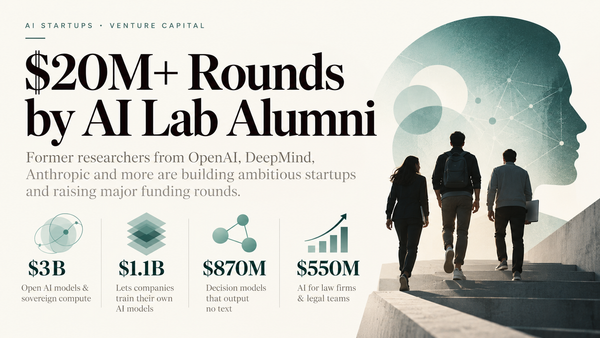
25 AI Startups Founded by Lab Alumni, Ranked by Funding Raised
The 25 startups on this list were all founded by AI lab alumni, and each raised $20M or more in 2026, for about $10.4B combined. Three companies took 55% of that total, the US has the most companies, and Nvidia backed at least 11 of them. The headline number
18 New York Startups Just Raised a Series A
Some of the most interesting startup opportunities are emerging in industries that have traditionally relied on manual processes, complex software and specialized expertise. From warehouse robots and AI-powered creative tools to legal technology, healthcare automation and financial software, startups are finding new ways to solve problems that businesses face
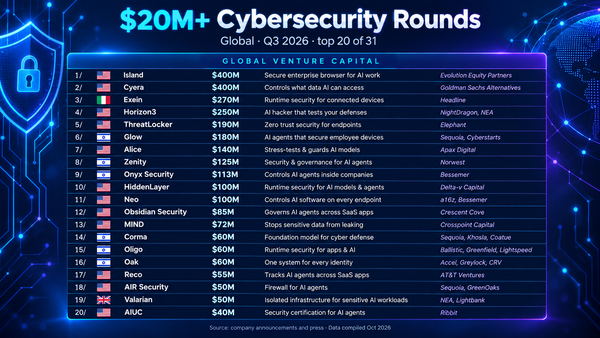
31 Cybersecurity Startups That Raised $20M+ in Q3 2026
Thirty-one cybersecurity startups closed rounds of $20 million or more between July and September 2026. Together, the 29 rounds reported in US dollars add up to roughly $3.08 billion, before counting a €28M round in France and a £24M round in the UK. The headline number is less

38 Early-Stage VC Funds to Know Before LA Tech Week
LA Tech Week puts a lot of investors within walking distance of a lot of founders. That sounds great until you're standing at a crowded happy hour with 40 minutes and no idea who is worth talking to. This guide groups 38 early-stage venture funds by what