CB Insights AI 100 2026: 100 AI Startups Reshaping Every Industry

100 AI Startups That Are Quietly Changing Everything — And Most People Have Never Heard of Them
CB Insights just dropped its 10th annual AI 100. The winners reveal three tectonic shifts: autonomous agents with no rulebook, robots learning to work in fleets, and vertical AI companies whose data is an unbreakable moat.
- Why the AI 100 actually matters
- The 2026 cohort — by the numbers
- Trend 1: AI agents have no identity — and that's dangerous
- Trend 2: Robotics is going from single units to coordinated fleets
- Trend 3: Data moats are the new competitive advantage
- Full winner breakdown by category
- What this means for you
Why Should You Actually Care About the AI 100?
Every year, thousands of AI startups launch with bold claims. Most fade. A handful reshape industries. But how do you tell the difference before it's obvious?
That's exactly what CB Insights' annual AI 100 attempts to answer — and after a decade of doing it, the methodology has earned serious credibility. The list factors in market traction, investor quality, talent signals, and proprietary predictive scores to identify the most promising early-stage AI companies across the full stack.
This year marks the 10th annual edition, and the 2026 cohort is arguably the most consequential yet. The question for AI has fully shifted from "does it work?" to "how fast can we deploy, govern, and scale it?" — and these 100 companies are the ones leading that charge.
Selected from a pool of over 40,000 companies, they span everything from enterprise workflow automation to physical robots learning to work in coordinated fleets. Here's what the winners reveal about where AI is actually headed.
The 2026 Cohort — By the Numbers
Before diving into the trends, here's a snapshot of the cohort at a glance:
Biggest Sub-Categories by Company Count
AI Agents Are Running Enterprise Workflows — But Nobody Knows Who's Responsible When They Go Wrong
Here's a fact that should stop you cold: AI agents are now autonomously handling millions of high-stakes enterprise tasks — without any framework for who they are, what they're allowed to do, or who gets blamed when something breaks.
This isn't hypothetical. Two companies on this year's list have already crossed extraordinary scale milestones:
Prophet Security
Ran over 1 million SOC investigations in just six months — fully autonomously, no human sign-off per step.
Bretton AI
Completed 1.2 million financial crime cases — at enterprise scale, touching real money and real regulatory exposure.
"The best security analysts in the world are still spending most of their day doing work that humans were never meant to do in the first place. 7AI deploys agents that take on that non-human work autonomously so analysts can focus on the things that matter."
— Nathan Burke, CMO at 7AIThe problem? These agents operate on enterprise systems but exist in a total governance vacuum. They have:
- No persistent identity
- No verifiable owner
- No scoped authority
- No audit trail tied to a principal
The companies stepping into this gap — and building what might be called Know Your Agent (KYA) infrastructure — are among the most strategically important on this year's entire list:
The companies building the AI agent rulebook:
Keycard — Identity & Credentialing
Replaces static API keys with dynamic tokens scoped to individual agent tasks. If an agent is compromised, it physically cannot act beyond its assigned scope.
Geordie AI — Behavioral Verification
Won RSAC 2026's Innovation Sandbox for its real-time risk mitigation engine. Monitors what agents actually do — not just what they're told to do.
Virtue AI — Pre-Deployment Assurance
Claims 30x faster model behavior oversight with 50+ production testing environments. Catches problems before they hit production.
Straiker — Adversarial Readiness
Grew 8x in six months by combining adversarial testing with runtime protection. Stress-tests agents the way pen testers stress-test software.
Physical AI Is No Longer a Prototype — It's Scaling From Single Robots to Coordinated Fleets
Physical AI — the category of systems that perceive, decide, and act in the real world — just became a standalone category in the AI 100 for the first time ever. That's not symbolic. It means the infrastructure to deploy autonomous systems commercially has, for the first time, matured enough to compete alongside enterprise software.
The sector raised a record $78 billion in 2025. The 11 Physical AI winners on this year's list span autonomous warships, general-purpose robots, and industrial humanoids.
"We've built our alpha robot in around seven months from design to a functional prototype. Just one year after founding, we are already testing robots in real-world use cases with partners. We have 34,000 pre-orders and seven successful pilots with tier-one companies."
— Humanoid (AI 100 Winner, 2026)The emerging frontier: fleet coordination
Most enterprise robot deployments today are still single-unit. But the companies on this list are already solving the next problem: getting multiple heterogeneous robots to work together toward a shared objective.
InOrbit
Vendor-agnostic robot orchestration. Grew customer base 200% in the past year. The "OpenRobOps" open-source fleet manager.
FieldAI
Risk-aware framework explicitly enables "multiple agents or robots to operate cohesively." Raised a $314M Series A at a $2B valuation.
Gravis Robotics
"Remote Orchestration" lets one operator supervise multiple machines. Already deployed across 7 countries.
Blue Water Autonomy
Autonomous warships operating in unstructured maritime environments at commercial scale.
The Vertical AI Winners Are Defined by Their Data — Not the Sector They're In
This is perhaps the most counter-intuitive insight from the 2026 cohort. You might expect the strongest vertical AI companies to be the ones with the deepest domain expertise, the best sales team, or the slickest product. The CB Insights analysis tells a different story:
The durable businesses are the ones with data that nobody else can replicate — regardless of what sector they serve.
Three distinct patterns emerge:
Pattern 1: Non-textual data that generic AI can't touch
Where the underlying data is molecular structures, CAD geometry, or materials properties, general-purpose models like GPT or Gemini cannot natively represent it. Companies in this space have to build their own models — which becomes the moat itself.
"The ones that are going to survive are solving a very specific problem for specific people. We have a moat because we are digesting data which is super niche within a niche. The chances that Google or OpenAI will design an AI tool that can understand mechanical design data are very, very low."
— Maor Farid, CEO at Leo AIChai Discovery built its own antibody design model and grew from a $150M to $1.3B valuation in just 15 months. Leo AI reports 96% accuracy on mechanical engineering questions versus 46% for generic tools.
Pattern 2: Switching costs baked into critical workflows
In financial services, companies like Bretton AI, Further AI, and Salient build on top of existing models — but they embed so deeply into compliance workflows and lending systems that replacing them becomes genuinely painful.
Salient's Numbers
0% customer churn and 100% pilot conversion rate — the clearest possible evidence of workflow lock-in.
What it means
When AI becomes the operating system for compliance, lending, or fraud detection, the cost to switch exceeds the cost to stay — by a wide margin.
Pattern 3: Rare datasets that cannot be replicated
Where data is text-based but hard to acquire — regulated patient records, licensed databases, institutional knowledge — the dataset itself is the moat. Two standout examples:
- Atomic Canyon trained on the NRC's 53-million-page regulatory database — a corpus that no competitor can simply "also train on."
- Assort Health has encoded 125M+ patient interactions without building its own foundation model. The data differentiates, not the architecture.
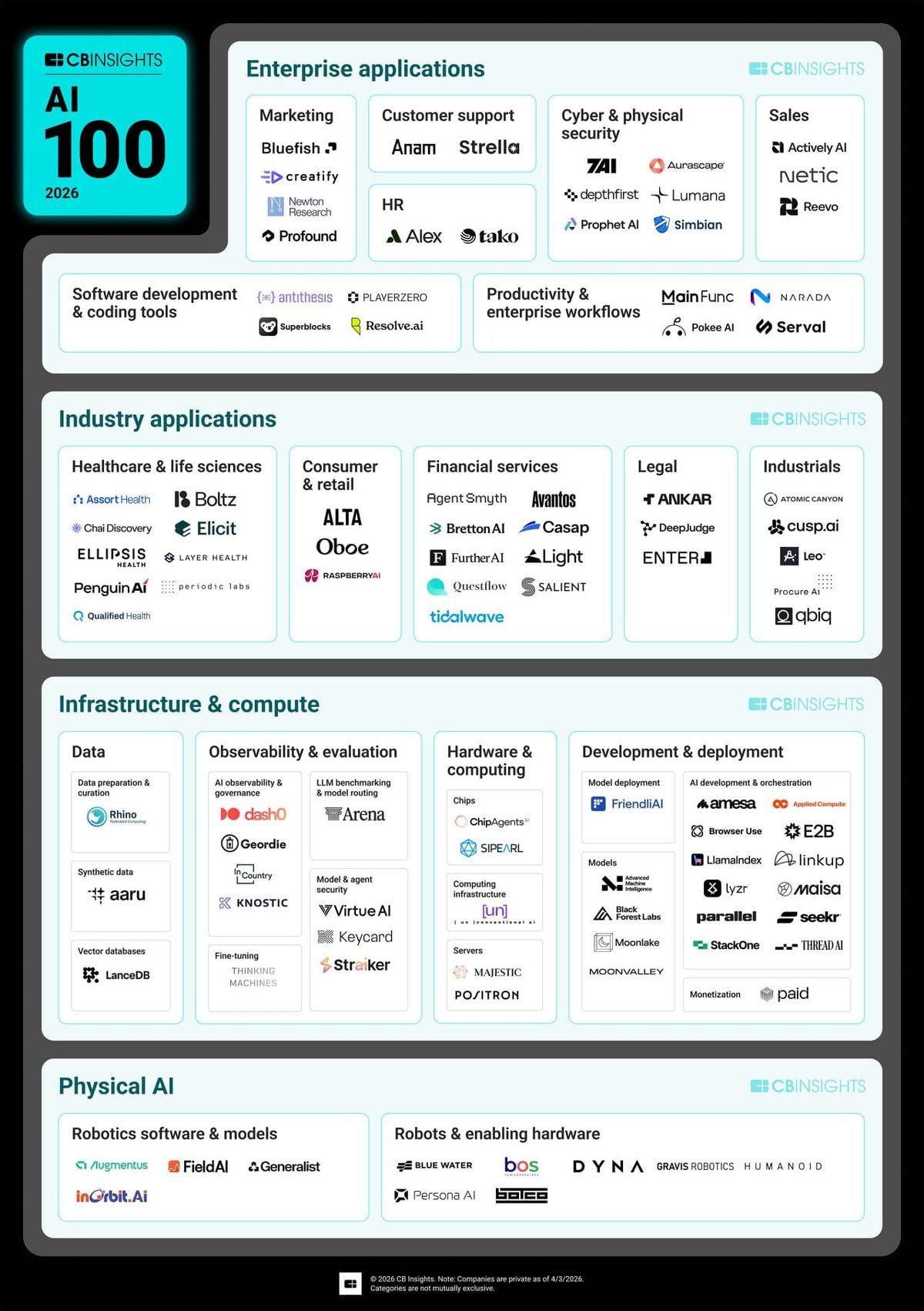
Full 2026 AI 100 Winner Breakdown
Here's the complete cohort, organized by category and sub-category:
Enterprise Applications
Customer Support
Cyber & Physical Security
HR
Marketing
Productivity & Enterprise Workflows
Sales
Software Development & Coding Tools
Industry Applications
Financial Services
Healthcare & Life Sciences
Industrials
Legal
Consumer & Retail
Infrastructure & Compute
Data
AI Dev & Orchestration
Models & Deployment
Hardware & Computing
Observability & Evaluation
Physical AI (New Category 2026)
Robotics Software & Models
Robots & Enabling Hardware
What This All Means for You
The 2026 AI 100 isn't just a list of interesting startups. It's a map of where power is accumulating in the AI economy — and the patterns are clearer than they've ever been.
Three things are worth taking away regardless of what role you play:
If you're a business leader
AI agents are already running high-stakes workflows at scale. The question isn't whether you should adopt them — it's whether you have governance infrastructure to do it safely. The KYA (Know Your Agent) category is where the risk gets managed.
If you're building an AI product
Your data strategy matters more than your model strategy. The vertical AI companies pulling ahead are the ones sitting on data that general-purpose models cannot natively replicate, regardless of how powerful GPT-N becomes.
If you're watching the investment landscape
Physical AI has arrived commercially — not as a pilot project, but as a full stack ready for fleet-scale deployment. The $78B invested in 2025 is beginning to produce real companies with real revenue and real competitive dynamics.
Want the Full CB Insights AI 100 Report?
The complete report includes detailed company profiles, investor data, and the full interactive market map. Access it directly from CB Insights.
Read the Full AI 100 Report →Source: CB Insights AI 100 2026 Report. All statistics, company names, and category classifications are drawn directly from the official CB Insights report. This post is an editorial summary for informational purposes.