25 Most Valuable GenAI Startups in 2026

The 25 Most Valuable GenAI Startups in 2026: A Complete Ranking of the Companies Reshaping Artificial Intelligence
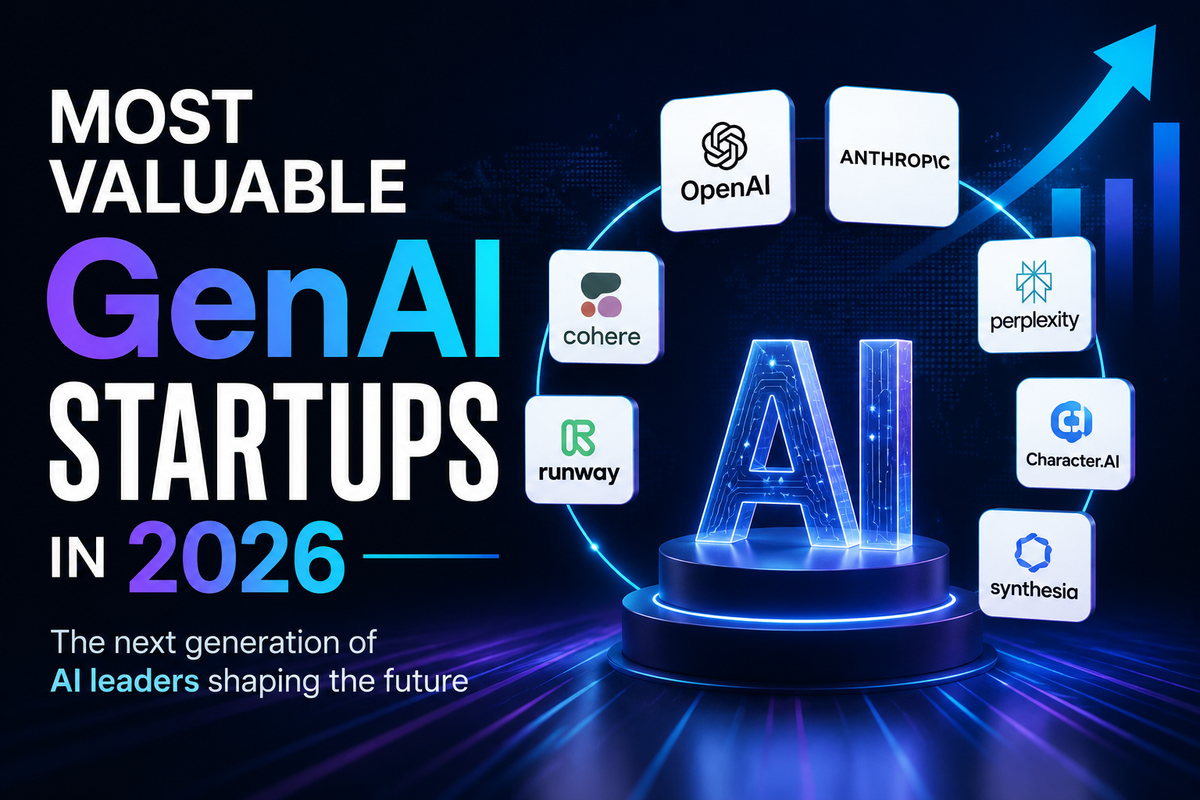
The generative AI funding environment has not just matured — it has become one of the most concentrated wealth-creation events in the history of private capital markets. The top ten companies on the 2026 generative AI startup rankings carry a combined valuation exceeding $1.74 trillion — a figure that surpasses the GDP of most nations. What follows is a complete, factual examination of the 25 most valuable private generative AI companies in 2026, ranked by their latest known valuations.
Why this list matters in 2026: In the first months of 2026 alone, at least five companies on this list raised major funding rounds, collectively bringing in more than $51 billion of fresh capital in a matter of weeks — not speculation, but commercial revenue backing every dollar.
What Are the Most Valuable GenAI Startups in 2026?
The most valuable GenAI startups in 2026 are ranked by their latest known private valuations as of March 2026. OpenAI leads at $840 billion following the largest private funding round in recorded history. The top 25 span eight countries and sectors including foundation models, legal AI, voice synthesis, AI coding agents, enterprise search, and video generation. Together, these companies represent the financial and technological backbone of the current generative AI revolution — with some founded as recently as 2023 already valued in the billions.
Why Generative AI Company Valuations Tell a Bigger Story
Private valuations are not simply scorecards. They reflect the aggregate judgment of sophisticated investors about a company's revenue trajectory, the defensibility of its technology, and its probability of becoming a dominant platform. The commercialization of leading LLM companies is now measurable, scalable, and attracting capital that historically flows only toward proven infrastructure businesses.
"The top 10 GenAI companies in 2026 are valued at over $1.74 trillion combined — surpassing the GDP of most nations on Earth."
📊 Valuation Infographic: Top 10 GenAI Startups
Top 10 by Valuation (March 2026, USD)
🗺️ Global AI Map: Which Countries Are Winning?
The 2026 ranking is genuinely multinational — spanning 8 countries across 3 continents. Here's the geographic breakdown of AI startup power:
The Complete Ranking: All 25 Companies
OpenAI
OpenAI is the developer of the GPT series of language models, the o3 reasoning model, and the Sora text-to-video platform. ChatGPT became the fastest consumer application to reach 100 million users in history and remains the highest-traffic AI application globally. In February 2026, OpenAI closed the largest private funding round ever recorded — $110 billion at an $840 billion valuation — with Amazon committing $50 billion, Nvidia $30 billion, and SoftBank $30 billion.
OpenAI has successfully translated research leadership into recurring revenue across enterprise contracts, API consumption, and subscription products, creating a diversified commercial base that justifies its valuation on fundamental grounds. Its position at the top of this ranking is not simply a function of its head start — it is the result of consistent commercial execution at a scale no competitor has yet replicated.
Anthropic
Anthropic is an AI safety company and the developer of the Claude family of large language models. Founded in 2021 by former OpenAI researchers including Dario Amodei and Daniela Amodei, the company raised a $30 billion Series G round in early 2026, bringing its valuation to $380 billion. Annualized revenue has reached $14 billion — more than doubling year-over-year. Claude Code alone generates $2.5 billion in annualized recurring revenue.
Among leading LLM companies, Anthropic holds a distinctive position because its safety research is embedded directly in its training pipeline through Constitutional AI techniques. This technical differentiation matters increasingly to enterprise customers in regulated industries, where model behavior predictability is a procurement requirement.
xAI
xAI is the AI company founded by Elon Musk in 2023 and the developer of the Grok family of large language models. Grok is deeply integrated into the X platform, giving xAI a distribution channel of hundreds of millions of users. A landmark event reshaped xAI's story in 2026: SpaceX acquired xAI entirely, valuing the combined entity at $1.25 trillion and ascribing approximately $250 billion to xAI specifically.
The strategic logic of the SpaceX-xAI merger points to a broader trend: the convergence of AI with physical infrastructure. SpaceX's Starlink provides global compute distribution, and integrating an AI frontier lab with that infrastructure creates compounding advantages in both training costs and deployment latency. No other company in this ranking achieved this scale in under three years.
DeepSeek
DeepSeek is a Chinese AI lab that gained international attention when its DeepSeek-R1 and DeepSeek-V3 models demonstrated performance competitive with frontier closed-source models at a fraction of the reported training cost — reportedly using constrained GPU budgets due to US export restrictions. This efficiency achievement challenged prevailing assumptions about capital requirements for frontier AI and sent shockwaves through semiconductor markets globally.
Thinking Machines Lab
Thinking Machines Lab is an AGI research organization founded in 2025 — its presence at a $50 billion valuation after less than a year of operation is one of the most striking data points in this entire ranking. The lab is built around foundational research into AI systems capable of reasoning at levels approaching or exceeding human expert performance. $50 billion for a year-old research-first organization is a historic first.
Perplexity
Perplexity is an AI-powered conversational search engine that synthesizes real-time web information into cited, readable answers — a direct challenger to traditional keyword search. With a $18 billion valuation, it is a proxy bet on the structural decline of traditional search advertising. The shift from retrieval to reasoning as the core search value proposition is a template dozens of vertical AI companies are now following.
Moonshot AI
Moonshot AI, developer of the Kimi AI assistant, rose 11 positions in this year's ranking — one of the most dramatic upward moves on the list. Kimi is known for its exceptionally long context window capabilities, making it particularly popular in research, legal, and financial applications where document volume is high. The 11-position rise signals that the generative AI market is not winner-take-all.
Mistral AI
Mistral AI is Paris-based and the leading European developer of open-weight large language models. Founded by former DeepMind and Meta researchers, its Mistral and Mixtral model families are widely adopted for on-premise deployments where data privacy is required. At $13 billion, it is the clear leader among European AI startups. European data sovereignty regulations are a structural tailwind for Mistral that no US-based competitor can easily replicate.
Poolside
Poolside builds reinforcement learning-based coding agents designed to write, debug, review, and maintain software at an experienced-engineer level. Its RL methodology — where models learn from the actual results of running code, not just static datasets — creates a fundamentally different kind of programming intelligence. Valued at $12 billion, it targets enterprise-scale software engineering workflows rather than individual developer tooling.
Harvey
Harvey is an AI platform built specifically for legal professionals — contract analysis, legal research, document drafting, due diligence, and regulatory compliance. It has embedded itself within major global law firms and rose three positions to reach $11 billion. Harvey exemplifies the vertical AI specialization trend: going deep into one high-value, regulation-sensitive industry creates switching costs and data advantages that horizontal tools cannot match.
ElevenLabs
ElevenLabs specializes in text-to-speech synthesis and voice cloning, offering natural speech in dozens of languages. It rose 8 positions — one of the most significant upward moves on the list — to reach $11 billion. Its API is among the most widely integrated voice generation services globally, serving content creators, gaming studios, enterprise customer service, and accessibility developers simultaneously.
Cognition AI
Cognition AI is the company behind Devin — widely recognized as the first AI software engineer capable of autonomously completing entire software engineering tasks from specification to deployment. It also operates Windsurf, a developer productivity platform. Valued at $10.2 billion, Cognition AI's story is instructive: the speed at which a novel capability can go from differentiator to contested category is now measured in months, not years.
Mercor
Mercor matches human experts with AI companies needing specialized knowledge to train and evaluate their models — a critical position in the AI value chain. It rose 10 positions to reach $10 billion. Every dollar that OpenAI, Anthropic, or any frontier lab spends on RLHF flows at least partially through platforms like Mercor. As models become more sophisticated, the quality of human feedback used to align them becomes more important, not less.
Reflection AI
Reflection AI is an open-source model developer and research lab founded in 2024 — already at $8 billion, one of the fastest value-creation stories in the entire ranking. Its open-source orientation distinguishes it from most highly valued AI labs, holding a distinctive commercial position as enterprises weigh trade-offs between closed APIs and open models they can deploy on their own infrastructure.
Together AI
Together AI provides the infrastructure for training, fine-tuning, and deploying open-source AI models at scale. Valued at $7.5 billion, it benefits from a platform dynamic: every new open-source model release from Meta, Mistral, or others expands the catalog of models enterprises want to run through Together AI's optimized infrastructure. Growth is correlated with the entire open-source AI ecosystem's expansion.
Glean
Glean is an AI-powered enterprise search platform connecting Slack, Google Drive, Salesforce, Confluence, email, and dozens of other enterprise tools simultaneously. At $7.2 billion, it continues to win large enterprise accounts despite intensified competition. Information fragmentation across enterprise tools exists at virtually every large organization — a structural market that will not disappear regardless of which AI model is trending.
Cohere
Cohere specializes in enterprise-grade LLMs, founded by researchers including Aidan Gomez — one of the original co-authors of the Transformer paper. At $7 billion, its most defensible asset is founding team depth in transformer architecture research. Organizations making multi-year AI infrastructure commitments want a provider with genuine technical credentials, not just a polished API layer over someone else's base model.
Zhipu AI
Zhipu AI is the developer of the GLM model series, spun out of Tsinghua University. It is one of the few publicly traded AI companies on this list, with a market valuation of $6.7 billion. Its presence provides a rare window into how public markets price generative AI companies at scale — offering benchmarks that inform how private investors think about valuations for comparable private companies.
Lovable
Lovable enables non-technical founders to create full-stack web applications through natural language prompts — often called "vibe-coding." Rose 6 positions to reach $6.6 billion. Lovable is the democratization layer of the AI stack: the point at which frontier AI capabilities become accessible to people who could never previously participate in software creation. This represents one of the most significant economic effects of the entire generative AI wave.
Legora
Legora builds a collaborative AI workspace for law firms where lawyers and AI work side by side. In March 2026 it raised $550 million in a Series D, tripling its valuation since October 2025 — one of the fastest appreciation curves in this entire ranking. Over 800 law firms across 50+ markets now use the platform. Both Harvey and Legora being multi-billion-dollar legal AI companies confirms the legal market is large enough to support multiple major winners.
Runway
Runway is one of the oldest companies on this list and among the first to bring AI-powered video generation to a broad creative audience. Its Gen series of video generation models have appeared in major film productions and advertising campaigns. At $5.3 billion, advertising production, media localization, and entertainment pre-visualization are all categories where its enterprise transition is just beginning.
MiniMax
MiniMax is a Chinese multimodal AI company building text, video, audio, and music generation under one platform. Its 2026 financial story is extraordinary: it listed on the Hong Kong Stock Exchange in January 2026 with a pre-IPO valuation of ~$4 billion, then shares surged 109% on debut day — pushing market cap to $13.7 billion. MiniMax holds the distinction of being the fastest AI company ever to go from founding to public markets.
Inflection AI
Inflection AI is the developer of Pi — a personal AI assistant designed for emotionally intelligent, supportive personal dialogue rather than pure task completion. Founded by Mustafa Suleyman and Reid Hoffman, Pi has a loyal user base with unusually high engagement and retention. At ~$4 billion, the question remains whether relationship-oriented AI can sustain an independent multi-billion-dollar business or will be absorbed into larger platform ecosystems.
Decart AI
Decart AI is the Israeli developer of Mirage — a system generating real-time interactive AI video environments that adapt dynamically to user inputs, not pre-generated static clips. This real-time interactivity opens gaming, simulation, and training environment applications that static video tools cannot address. At $3.1 billion, Decart AI's technology represents a distinct evolution beyond the first generation of video generation.
Replit
Replit is a browser-based development environment that successfully transformed itself around AI capabilities — one of the oldest companies on this list at nearly a decade old. Valued at ~$3 billion, its unusually broad user base spans educational, amateur, and professional developer tiers simultaneously. Developers who learn to code on Replit bring those habits into professional environments — an organic distribution channel paid acquisition cannot replicate.
What the Top GenAI Startups in 2026 Have in Common
Vertical Wins
Legal AI produced two multi-billion-dollar companies: Harvey and Legora. Going deep into one high-value industry creates switching costs that horizontal tools cannot match.
Global Reach
8 countries. 3 continents. The AI startup ecosystem is genuinely multinational — shaped by talent clusters, regulation, and language-specific market opportunities.
Unprecedented Speed
Companies founded in 2023 are already valued at $6–18B. Thinking Machines Lab hit $50B in under a year. Value creation timelines are unlike anything seen before.
Two Winning Layers
Foundation model companies own the underlying technology. Application layer companies own the workflows. Both are capturing enormous value with different but real moats.
The founding year distribution across the top 25 is perhaps the most striking quantitative signal in the entire list. Companies founded in 2023 — Moonshot AI, Poolside, Cognition AI, Mercor, Lovable, Legora, DeepSeek — are already valued between $6 billion and $18 billion. Thinking Machines Lab was founded in 2025 and is valued at $50 billion. This pace is without historical precedent.
Frequently Asked Questions
OpenAI leads at $840 billion, established in February 2026 following a $110 billion funding round — the largest private capital raise in recorded history — backed by Amazon ($50B), Nvidia ($30B), and SoftBank ($30B). This places OpenAI within range of the largest publicly traded technology companies globally.
All 25 companies qualify as unicorns — with the lowest valuation sitting at approximately $3 billion. The term "unicorn" significantly understates the scale of the top companies; OpenAI at $840 billion is sometimes described as a "centicorn." The concentration of ultra-high valuations in a single technology category is historically unprecedented.
The United States dominates with the majority of companies including the top three. China is second with four companies (DeepSeek, Moonshot AI, Zhipu AI, MiniMax). France contributes Mistral AI and Poolside. Sweden contributes Lovable and Legora — most represented European nation per capita. Canada, Poland, and Israel each contribute one company.
Multiple competitors depending on metric: MiniMax is the fastest AI company ever to reach public markets (5 years). Moonshot AI rose 11 ranking positions. Legora tripled its valuation in 5 months. Anthropic doubled annualized revenue year-over-year to $14 billion. Thinking Machines Lab hit $50 billion in under a year of existence.
Two companies have public listings. Zhipu AI is publicly traded with a ~$6.7 billion market cap. MiniMax completed its Hong Kong Stock Exchange IPO in January 2026 — closing debut day at $13.7 billion market cap, up 109% from its listing price. All other companies remain privately held as of March 2026.
The Bottom Line: Still Early Innings
The 2026 ranking of the most valuable GenAI startups is, at its core, a document about diversity. Diversity of geography — 8 countries across 3 continents. Diversity of technical approach — open-source and closed-source both generating multi-billion-dollar outcomes. Diversity of application domain — legal, voice, video, search, coding, and education all producing companies valued at multiple billions.
The signals worth watching: MiniMax's Hong Kong IPO success will encourage other Asian AI companies toward regional public listings. Harvey, ElevenLabs, and Mercor appear on trajectories that could push them meaningfully higher next year if revenue growth rates hold. The gap between the top three and the rest is enormous — and compounds with each training run.
What does not change is the underlying dynamic: enterprises and consumers are finding genuine, recurring, measurable value in generative AI tools. That conversion from experimental to essential is what separates the current moment from every prior AI investment cycle — and what gives these valuations a fundamentally different character than speculation. The most valuable GenAI startups in 2026 are not just the best-funded — they are increasingly the most deeply embedded in the way the world works.