Who Invests in Fintech Startups? What 29 VC Firms Reveal About Stage, Fit, and Where to Pitch
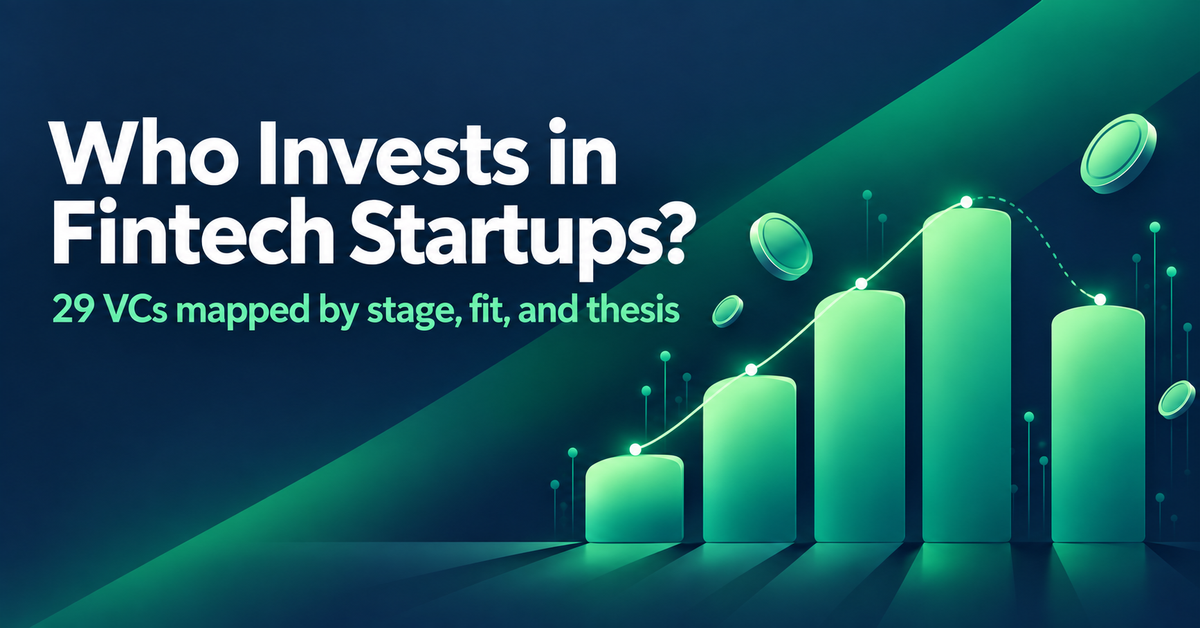
Most founders build their fintech investor list the same way. They screenshot a “top fintech VCs” graphic, paste the names into a spreadsheet, and start sending emails.
We took two lists like that and did the unglamorous work. We merged them, checked each firm’s stage focus and thesis against public sources, and tagged how central fintech really is to each fund. The result is 29 firms, and the interesting part is where the lists were wrong or misleading.
Fintech investor lists blur three things that decide whether your outreach lands: the stage a firm invests at, how much fintech is actually its mandate, and what kind of investor it is. This piece breaks down all three, profiles every firm in the dataset, and flags where the data runs out, because that matters just as much.
Key Findings
Series A is the most crowded door. 23 of 29 firms (79%) invest at Series A, against 20 at seed (69%), 15 at Series B (52%), 14 at Series C+ or growth (48%), and just 9 at pre-seed (31%).
Pre-seed is where fintech-focused capital thins out. Of the 9 firms that invest at pre-seed, only 2 are rated Core fintech. Six are Partial, meaning fintech is one sector among many.
Specialists show up later. Seven of the 10 Core fintech firms invest at Series B and seven invest at growth. Of the 11 Partial firms, only 3 invest at Series B and 2 at growth.
The A-to-B step is a real cliff. 9 of the 23 Series A investors in the dataset don’t list Series B at all.
Stage labels on public lists are unreliable. Of the 29 firms, 9 needed their stage tags adjusted after research, one name was corrected, and one stage profile couldn’t be confirmed. Among firms taken from the shared graphic, 8 of 19 needed adjustments.
Generalists dominate. 13 of 29 firms (45%) are generalist VCs. Only 7 (24%) are dedicated fintech specialists. The rest are 6 thematic funds and 3 corporate VCs.
Detailed Analysis
What does the fintech funding landscape look like by stage?
|
Stage |
Firms investing |
Share of 29 |
|
Pre-seed |
9 |
31% |
|
Seed |
20 |
69% |
|
Series A |
23 |
79% |
|
Series B |
15 |
52% |
|
Series C+ /
Growth |
14 |
48% |
Pre-seed to seed is the biggest jump, from 9 firms to 20. Series A to Series B is the biggest drop, from 23 to 15. If you’re early, your options multiply quickly once you have a product and traction. If you’re past Series A, your options narrow, and you should know that before you start raising.
Breadth varies a lot. Nine firms span four stages, including fintech specialists Fin Capital, Clocktower Technology Ventures, Nyca Partners, and Portage. At the other end, five firms invest at a single stage: Outside VC (pre-seed), StarChain Ventures and Uncork Capital (seed), and NewView Capital and Princeville Capital (growth).
Why is pre-seed fintech funding harder to map?
Only nine firms in the dataset invest at pre-seed, and just one, Outside VC, is a pre-seed-only fund. It focuses on financial inclusion, meaning products for people outside the top 10% of earners, and is usually the first institutional check.
The rest of the pre-seed group is mostly generalists and thematic funds: Blumberg Capital, Bouken Capital, Defy.vc, Kindred Ventures, L’Attitude Ventures, Luminar Ventures, and Sentinel Global, plus fintech specialist TTV Capital.
Two caveats apply. Bouken Capital’s profile rests on a single source and is flagged as provisional. Sentinel Global’s stage profile is marked unconfirmed, because the firm only calls itself multi-stage.
For a pre-seed founder, the practical consequence is that your investor is probably not a fintech-only fund. You’ll be pitching someone who invests across sectors and has to be persuaded that fintech deserves their attention.
How far does a seed investor follow you?
Seed investors in this dataset tend to stay with you. Of the 20 seed firms, 18 also invest at Series A. Only StarChain Ventures and Uncork Capital are seed-only.
Seven firms run from pre-seed through Series A and stop there: TTV Capital, Blumberg Capital, Bouken Capital, Defy.vc, Kindred Ventures, L’Attitude Ventures, and Luminar Ventures. They can carry a company a long way, but not past the A.
What happens after Series A?
Of the 23 Series A investors, 14 also invest at Series B. The other 9 don’t: Anthemis, TTV Capital, Blumberg Capital, Informed Ventures, Bouken Capital, Defy.vc, Kindred Ventures, L’Attitude Ventures, and Luminar Ventures.
Series B and growth look similar in size (15 and 14 firms). Twelve firms invest at both. Three invest at B but not growth (BDev Ventures, Canvas Ventures, and Conductive Ventures), and two invest only at growth (NewView Capital and Princeville Capital).
Seven firms skip pre-seed and seed entirely and only come in at Series A or later: Intuit Ventures, R136 Ventures, Canvas Ventures, Index Ventures, Conductive Ventures, NewView Capital, and Princeville Capital.
Does “fintech investor” mean the same thing for every firm?
No, and the sheet’s relevance tags show why. Each firm was rated Core (fintech is the mandate, or one of at most two pillars), Significant (a named focus with a visible track record), or Partial (fintech deals happen, but it’s one sector among many). Ten firms are Core, 8 Significant, and 11 Partial. That rating is the compiler’s own assessment, not a sourced fact. Still, it reveals a pattern:
|
Fintech
relevance |
Firms |
Pre-seed |
Seed |
Series A |
Series B |
C+/Growth |
|
Core |
10 |
2 |
7 |
8 |
7 |
7 |
|
Significant |
8 |
1 |
5 |
7 |
5 |
5 |
|
Partial |
11 |
6 |
8 |
8 |
3 |
2 |
The funds most committed to fintech are spread fairly evenly across stages. The funds least committed to it cluster early and fade out later.
One data point shows how loose the “fintech list” label can be. The notes on Uncork Capital say plainly that fintech is not a stated focus. It’s a seed-stage B2B SaaS, developer tools, and infrastructure investor. A fintech founder might still fit, but only by pitching the infrastructure angle.
How do the four investor types differ?
Fintech specialist: fintech is the fund’s whole mandate.
Generalist VC: invests across sectors, with fintech as one of them.
Thematic VC: a narrow thesis, such as a sector pair, a technology, or a founder group, in which fintech is one part.
Corporate VC: the venture arm of an operating company, investing for strategic fit as well as return.
Generalists make up 13 of the 29 firms and account for 5 of the 9 pre-seed investors. Thematic funds contribute the sharper angles: L’Attitude Ventures backs US Latino founders, Sentinel Global lists AI trust infrastructure and programmable money, and Informed Ventures spans digital health, fintech, and vertical AI.
The 3 corporate VCs (Intuit Ventures, Visa Ventures, and BDev Ventures) have no pre-seed activity in the data. Intuit invests from its own balance sheet for strategic fit with its products. BDev is a minority investor that wants roughly $0.5M or more in recurring revenue and offers its lead-generation platform to portfolio companies.
What does the geography tell us?
Mostly that this list is Bay Area-heavy. Counting the cities as listed, 18 of 29 firms have a Bay Area headquarters (San Francisco, Menlo Park, Mountain View, Woodside, Portola Valley, Burlingame, and others). Two more list the Bay Area alongside another city. Only Portage (Toronto) and Luminar Ventures (Stockholm) list a single non-US headquarters, and one firm’s HQ couldn’t be confirmed.
HQ location isn’t the same as who a firm backs, though. Several have clear geographic or founder focus: Luminar on the Nordics, Clocktower on cross-border and emerging markets, R136 and Blumberg on the US and Israel, BDev on the US and Latin America, and Informed on the US and Asia. For part of the list, HQ details came from general knowledge and weren’t re-checked.
How reliable are public investor stage lists?
Not very, which may be the most useful finding for anyone building an outreach list. After checking each firm against firm websites, press releases, and investor directories, 18 firms’ stage tags held up as given. Nine were adjusted. Some examples:
Visa Ventures was shown as pre-seed and seed. Pre-seed was removed and Series A through growth added. Kindred Ventures and Bouken Capital had Series B removed, while Canvas Ventures and Conductive Ventures had Series B added. TTV Capital was listed as seed, but research showed pre-seed through Series A, including a pre-seed lead in June 2026.
Even correct tags hide nuance. Kindred Ventures, L’Attitude Ventures, and Luminar Ventures all describe Series A as occasional or follow-on. A yes/no stage column flatters how often they write that check.
The 29 Fintech-Relevant VCs, Profiled
The patterns above are useful, but you can’t email a pattern. Here is each firm in the dataset, grouped by investor type. Core, Significant, and Partial are the fintech relevance ratings from the sheet. As always, confirm stage and thesis on each firm’s own website before reaching out.
Fintech Specialists (7)
Anthemis
Fintech relevance: Core
Invests at seed and Series A with an embedded finance and insurtech thesis. Based in London and New York, it is described as one of the earliest embedded-finance specialists.
Clocktower Technology Ventures
Fintech relevance: Core
Invests from seed through growth, with a macro-informed fintech thesis. Based in the Los Angeles area, it is known for cross-border and emerging-market bets.
Fin Capital
Fintech relevance: Core
Invests from seed through growth in B2B fintech, with a focus on infrastructure and software rather than consumer apps. Based in San Francisco.
Nyca Partners
Fintech relevance: Core
Fintech-only, investing from seed through growth. Based in New York and led by Hans Morris, former president of Visa.
Outside VC
Fintech relevance: Core
A pre-seed fund focused on financial inclusion, meaning products for people outside the top 10% of earners. A solo-GP fund run by Ethan Austin, founded in 2022 and based in Denver, with a North America focus. It is usually the first institutional check, with occasional seed follow-ons in its own portfolio.
Portage
Fintech relevance: Core
A global fintech investor from seed through growth. It has Canadian roots (Toronto) and now invests across North America, Europe, and beyond.
TTV Capital
Fintech relevance: Core
Fintech-only and one of the longest-running fintech-focused funds (founded 2000). Based in Atlanta with a primarily North American focus. The sheet's research shows it investing from pre-seed through Series A, including a pre-seed lead in June 2026 and Series A deals in spring 2026.
Generalist VCs (13)
Andreessen Horowitz
Fintech relevance: Significant
Invests from seed through growth and runs a dedicated fintech practice inside a generalist firm. Based in Menlo Park, with a broad fintech portfolio across payments, crypto, and consumer finance.
Bain Capital Ventures
Fintech relevance: Significant
A generalist with a deep fintech bench, investing from seed through growth. Based in Boston and San Francisco, with a strong track record backing enterprise and B2B fintech.
Blumberg Capital
Fintech relevance: Significant
Invests from pre-seed through Series A, focusing on early-stage B2B software with fintech as a named focus. Founded in 1991 and based in San Francisco, with offices in Miami, New York, and Tel Aviv, and a focus on the US and Israel. It usually leads or co-leads and is often the first institutional investor.
Bouken Capital
Fintech relevance: Partial
Multi-sector, covering AI, fintech, payments, blockchain, SaaS, and deep tech, and investing from pre-seed to Series A. Treat this entry as provisional: its headquarters could not be confirmed, and the only profile found was a single investor-directory listing.
Conductive Ventures
Fintech relevance: Partial
Invests at Series A and B in capital-efficient software, hardware, and tech-enabled services. Launched in 2018 with Panasonic as its sole LP, it is based in the Bay Area, focuses on North America with an Asia expansion angle, and looks for companies with early revenue. Its portfolio includes fintech names such as Self.
Defy.vc
Fintech relevance: Partial
An early-stage generalist covering enterprise SaaS, fintech, AI, healthcare, and marketplaces, investing from pre-seed through Series A. Based in Woodside and investing in the US from a $300M third fund, with a core deal of $3M to $10M for a seed-plus or small Series A. Note that the original graphic showed it as “Devy.vc.” The name was corrected based on matching name, alphabetical position, and stage tags, so confirm it if this entry matters to you.
Index Ventures
Fintech relevance: Significant
A generalist based in London and San Francisco, listed as investing at Series A and later. It backed Revolut. The sheet notes that Index also runs dedicated seed funds, which were not re-checked.
Kindred Ventures
Fintech relevance: Partial
A generalist first-check investor where fintech and crypto are among its themes. Led by Steve Jang and Kanyi Maqubela and based in San Francisco, its core is pre-seed and seed, with Series A as an occasional follow-on. It was an early backer of Coinbase.
Lightspeed
Fintech relevance: Significant
A Menlo Park generalist investing from seed through growth, with a long-running fintech portfolio alongside its broader thesis.
Luminar Ventures
Fintech relevance: Partial
Backs Nordic digital startups across several sectors, with fintech as one of them. Based in Stockholm and focused mainly on Sweden, it describes itself as a pre-seed and seed fund, with Series A as occasional. It leads seed rounds of roughly EUR 0.5M to 2.5M, and its portfolio includes Insurely, Mynt, and Open Payments.
NewView Capital
Fintech relevance: Significant
A growth-stage investor in enterprise software and fintech, based in Burlingame. It was spun out of NEA in 2018 and invests through primary rounds, secondaries, or a mix. Its portfolio includes Plaid.
Princeville Capital
Fintech relevance: Partial
Invests at the growth stage in software and internet companies, and runs a separate climate-tech fund. Based in San Francisco with offices in Hong Kong and Berlin, it helps companies expand internationally. Fintech is one of several sectors.
Uncork Capital
Fintech relevance: Partial
A seed-stage investor in B2B SaaS, developer tools, and infrastructure. Formerly SoftTech VC and seed-focused since 2004, it is based in San Francisco, leads seed rounds, and raised $300M across two funds in May 2025. The sheet is explicit that fintech is not a stated focus.
Thematic VCs (6)
Canvas Ventures (now Canvas Prime)
Fintech relevance: Significant
Invests at Series A and B in fintech, digital health, and AI. Several profiles now list it as Canvas Prime following a 2025 restructuring under co-founder Rebecca Lynn. Based in Portola Valley and typically leads rounds.
Informed Ventures
Fintech relevance: Significant
Invests at seed and Series A across digital health, fintech, and vertical AI. Led by Richard Lim and based in Menlo Park, it focuses on the US and Asia. One profile describes it as handling GSR Ventures' US activity, and sources disagree on its founding year. Its late-2025 deals were seed and Series A.
L'Attitude Ventures
Fintech relevance: Partial
Backs US Latino-founded, tech-enabled companies, with fintech and payments as one sector. Based in San Diego, it closed a $100M fund in 2022 anchored by JPMorgan. It invests from pre-seed through Series A (Series A is occasional), leads rounds, and takes board seats.
R136 Ventures
Fintech relevance: Core
Invests at Series B and growth in growth-stage B2B software and fintech, with checks of roughly $2M to $20M. Formerly Fort Ross Ventures and based in Woodside, it focuses on the US and Israel and closed its third fund in November 2025. It also invests at late Series A.
Sentinel Global
Fintech relevance: Partial
An enterprise-technology investor whose themes include AI trust infrastructure and programmable money. Founded in 2022 by Jeremy Kranz (formerly of GIC) and based in San Francisco, it closed a $213.5M first fund in June 2025 and relaunched its team in February 2026 ahead of a planned fundraise. Its stage profile is unconfirmed: the firm only calls itself multi-stage, and the source graphic skips seed, which looks like a data gap.
StarChain Ventures
Fintech relevance: Partial
A small, emerging seed fund applying AI and blockchain to finance, healthcare, and supply chain. Led by Jorden Woods and Radhika Iyengar and based in Silicon Valley. It is not the same as Starchain Capital, a crypto hedge fund.
Corporate VCs (3)
Intuit Ventures
Fintech relevance: Core
Invests at Series A, Series B, and growth in B2B fintech, consumer fintech, and apps for small businesses. Based in Mountain View, it is US-led but invests globally. Launched in 2021, it invests from Intuit's balance sheet for strategic fit with Intuit's products. Intuit's own blog states Series A to C, while its 2021 launch release said primarily B and C.
Visa Ventures
Fintech relevance: Core
Invests from seed through growth in payments, commerce infrastructure, and embedded finance, with a global scope. Established in 2007 and based in San Francisco, it invests for strategic fit with Visa and also runs a $100M generative AI fund announced in 2023. Recent tracked deals include a Series A and a Series C.
BDev Ventures
Fintech relevance: Partial
The venture arm of BairesDev, investing from seed through Series B in post-revenue B2B software, with fintech as one target area. Based in Mountain View, it focuses on the US and Latin America. A minority investor that wants roughly $0.5M or more in recurring revenue and offers its lead-generation platform to portfolio companies.
Some entries are thinner than others, and that’s deliberate. Bouken Capital rests on one directory listing, Sentinel Global’s stage mix is unconfirmed, and Index Ventures’ seed activity wasn’t re-checked. Check sizes appear only where research found them.
What This Means for Founders
Your target list should start with stage, then thesis, then type. A firm that loves fintech but doesn’t invest at your stage is a dead end. A firm that invests at your stage but has no fintech interest means a longer, harder pitch.
Pre-seed founders should expect to pitch generalists. With only 2 Core-fintech firms at pre-seed in this dataset, you’ll likely be introducing fintech to investors who see it as one option among many. Your narrative, market sizing, and “why now” matter more than domain jargon.
Series A investors may not follow you to Series B. In this dataset, 9 of 23 don’t list B. That’s not a flaw. It means your Series A round should include a plan for who leads your next one.
Corporate VCs are a strategy choice, not just a check. Intuit Ventures, Visa Ventures, and BDev Ventures all invest for strategic fit. That can bring distribution or credibility. It can also complicate future rounds, so understand what the relationship is meant to do before you take it.
Thesis fit can beat fund size. Outside VC, L’Attitude Ventures, Luminar Ventures, and Clocktower Technology Ventures each have a specific angle (financial inclusion, Latino founders, the Nordics, cross-border and emerging markets). If you match, you stand out. If you don’t, it’s a wasted pitch.
Actionable Takeaways
1. Verify before you send. Check each firm’s own site and recent deals for stage focus. Treat any third-party list, including this one, as a starting point.
2. Build three tiers. Group firms into those that match your stage and thesis, those that match your stage only, and those worth a later relationship.
3. Read the notes, not just the tags. Phrases like “occasional follow-on” or “leads rounds” tell you more than a checkmark in a stage column.
4. Use size signals where they exist. Where research found check sizes: R136 Ventures at roughly $2M to $20M, Defy.vc at $3M to $10M for seed-plus or small Series A, and Luminar Ventures at roughly EUR 0.5M to 2.5M for seeds. Coverage was uneven, so ask directly for other firms.
5. Look for first-check roles. Blumberg Capital, Kindred Ventures, and Outside VC are described as often being the first institutional investor.
6. Pitch to the fund you’re actually pitching. A generalist wants market-size logic. A specialist wants product depth. A corporate VC wants strategic fit.
7. Plan the next round early. If your Series A lead doesn’t write B, start building those relationships while you’re raising the A.
Conclusion
The headline isn’t “here are 29 names.” It’s that the shape of the list matters more than the names on it. Capital is plentiful at Series A and thin at pre-seed. Fintech specialists tend to arrive later, generalists and thematic funds carry the early stages, and corporate VCs add a strategic angle that isn’t for every company.
The most practical lesson is also the least glamorous. Investor lists drift, stage tags are wrong more often than you’d expect, and “fintech investor” can mean anything from a fund that does only fintech to one that says fintech isn’t a stated focus. Do the checking before you send the email.
Frequently Asked Questions
How many fintech investors are in this analysis?
29 firms. Ten came from one list and 19 from a shared graphic. Two entries from that graphic were held back: Constellation Software Inc., because it acquires companies rather than investing in funding rounds, and Capra, because the fund couldn’t be identified.
Which stage has the most fintech investors?
Series A, with 23 of 29 firms (79%). Seed follows with 20, then Series B with 15, Series C+/growth with 14, and pre-seed with 9.
Are there dedicated pre-seed fintech funds?
In this dataset, Outside VC is the only firm that invests only at pre-seed. Eight other firms also list pre-seed, mostly as part of a broader range of stages.
Do most VCs on a fintech list focus only on fintech?
No. Only 7 of 29 are fintech specialists. Thirteen are generalists, 6 are thematic, and 3 are corporate VCs. By the sheet’s own rating, 10 are Core fintech, 8 Significant, and 11 Partial.
Do corporate VCs invest at pre-seed?
Not in this dataset. Intuit Ventures, Visa Ventures, and BDev Ventures invest at seed or later. BDev looks for roughly $0.5M or more in recurring revenue.
Can I trust public stage tags on investor lists?
Treat them as provisional. Nine of 29 firms needed adjustments after research, and one more was unconfirmed.
What are the limits of this data?
It’s a 29-firm research list, not a market census. Fintech relevance is the compiler’s own assessment. A claim in one source that all its listed funds were writing fintech checks in 2026 was not verified fund by fund. Some profiles lean on third-party directories, check sizes are patchy, and part of the HQ data came from general knowledge. The research date is 5 October 2026. This isn’t investment or fundraising advice, so confirm each firm’s stage and thesis on its own site before reaching out.