Forbes AI 50 List 2026: The World's Most Promising AI Companies, Fully Analyzed

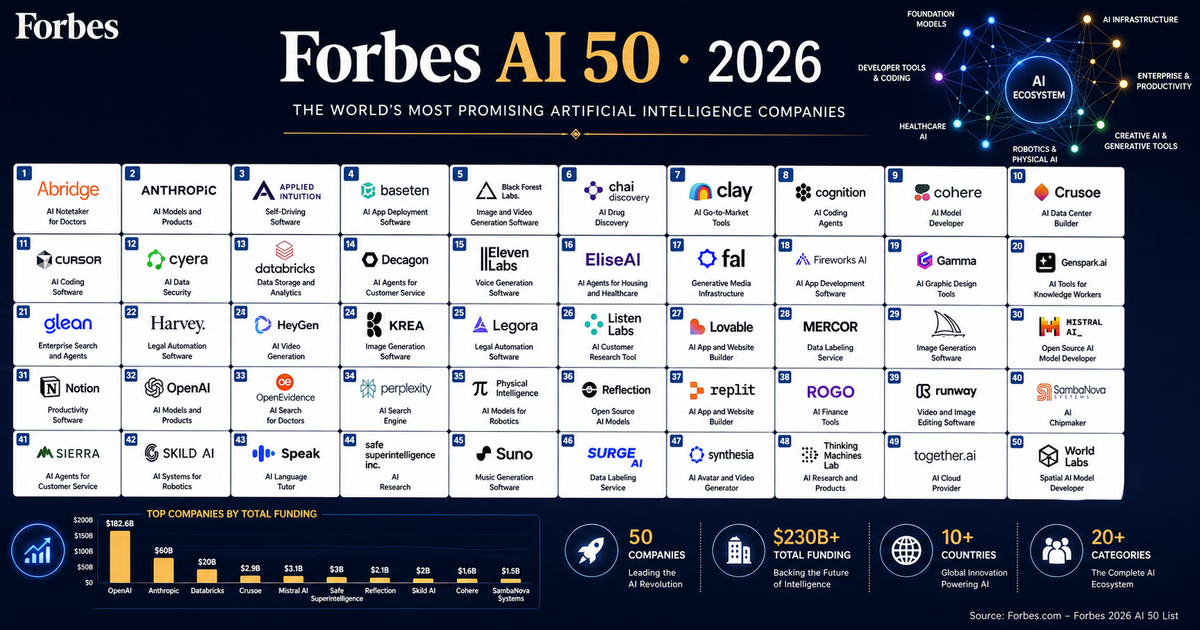
Three years into the most consequential technology shift in a generation, artificial intelligence is no longer a promise — it is a market. The companies building it are now raising money at scales that dwarf previous tech cycles, serving hundreds of millions of users, and, in many cases, generating revenues that rival decade-old software businesses. Forbes' eighth annual AI 50 list, released in 2026, captures exactly where that market stands: who is leading it, who is accelerating into it, and who is quietly building the infrastructure that makes the rest possible.
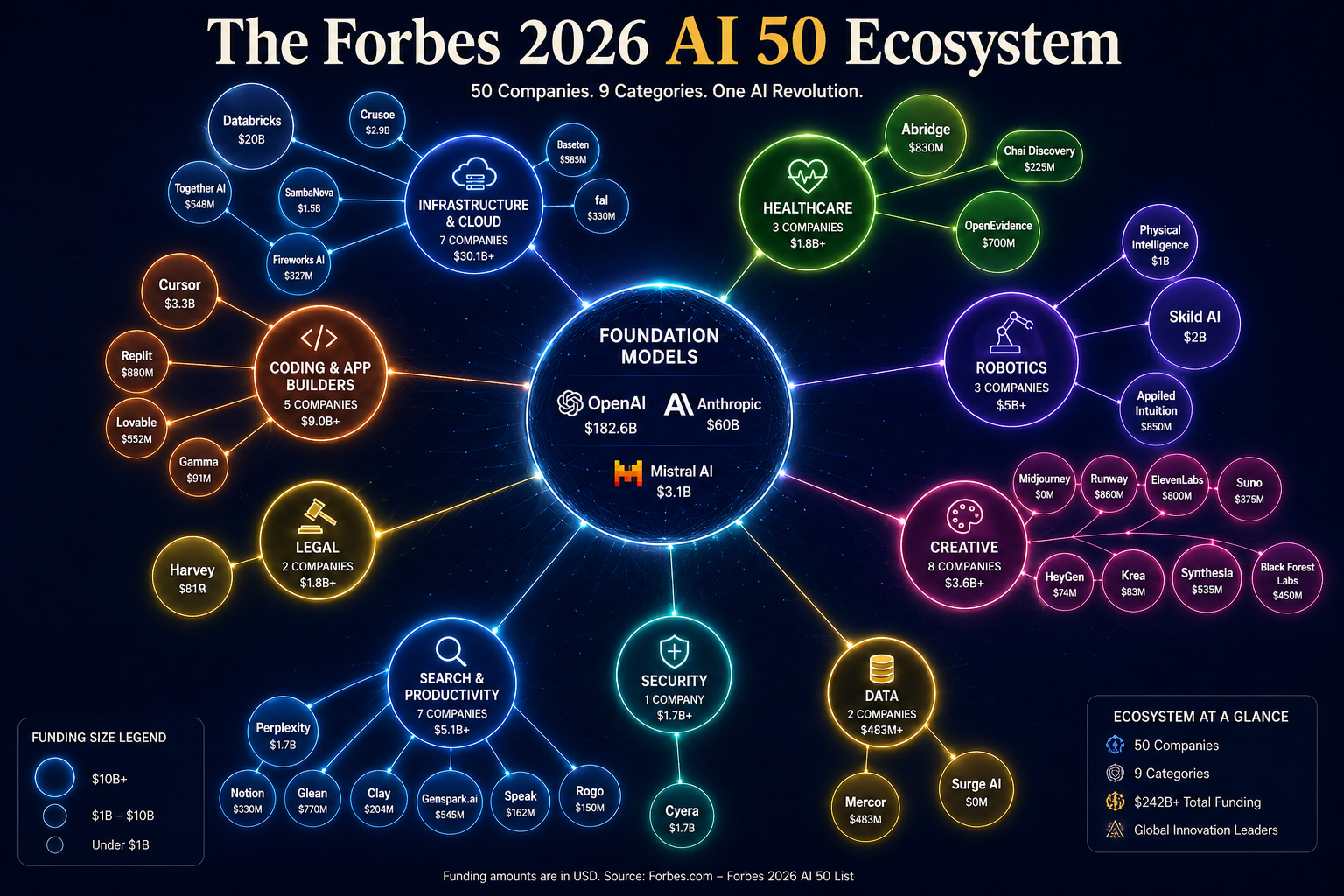
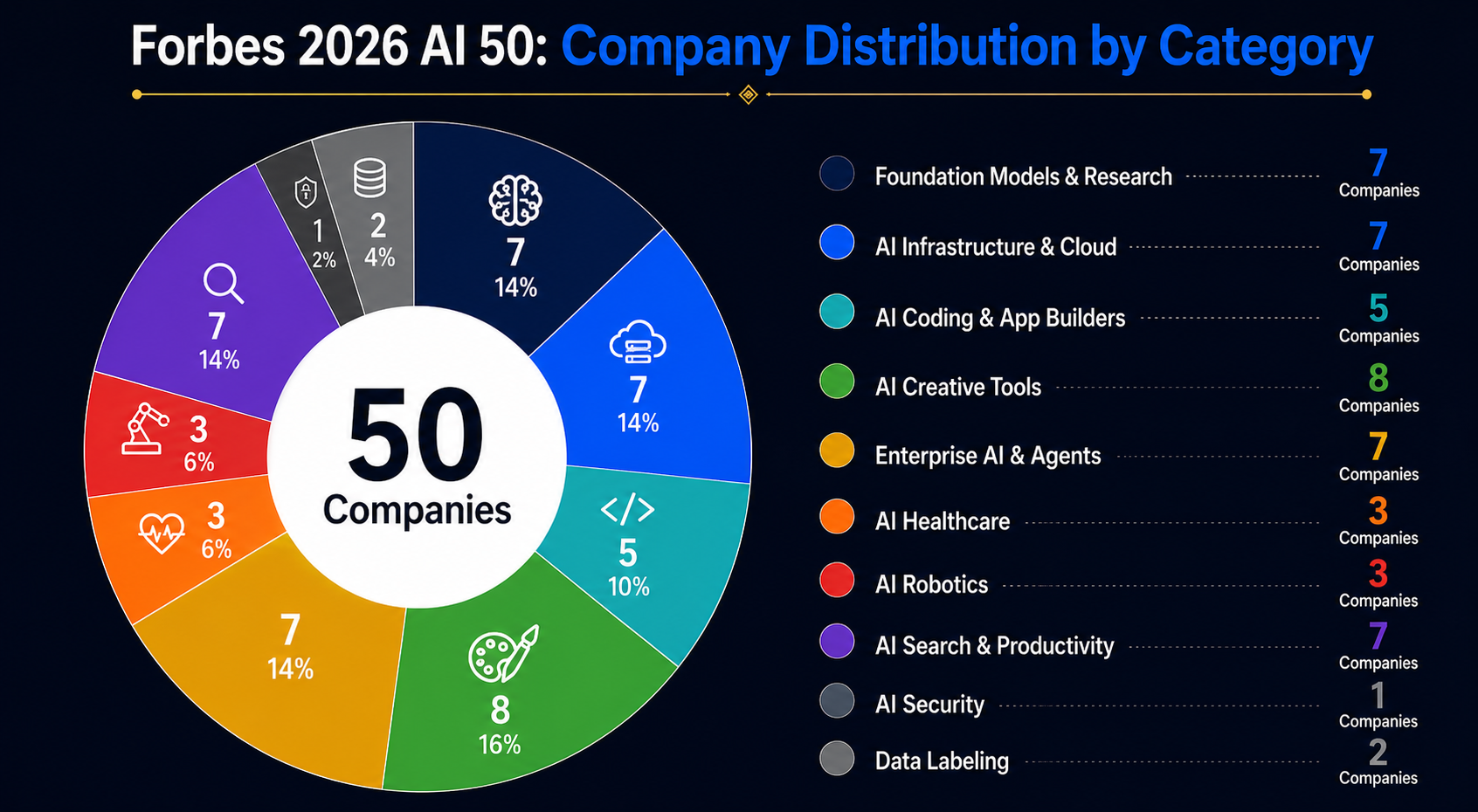
The 50 privately-held companies on this year's list have collectively raised more than $305 billion in venture funding. They span foundation model labs, enterprise automation platforms, robotics startups, creative AI tools, healthcare intelligence systems, and the cloud infrastructure underpinning all of it. Taken together, they represent the most comprehensive single-page snapshot of where serious capital and serious talent are meeting serious market demand in AI.
What follows is a complete, category-by-category breakdown of all 50 companies — covering what each does, why it matters, its competitive advantage, and the growth signal that earned it a place on the most competitive AI ranking in publishing.
What Is the Forbes AI 50 List?
The Forbes AI 50 is an annual ranking of the most promising privately-held artificial intelligence companies in the world. Now in its eighth edition, it is widely regarded as the gold-standard benchmark for tracking momentum in the global AI industry. Companies do not pay to be considered. Selection is based on business promise, technical talent, and depth of AI integration — evaluated through a quantitative algorithm and qualitative judging panels composed of investors, operators, and domain experts.
To qualify, companies must be privately-held, must use AI as a core part of their product or business model, and must demonstrate credible evidence of commercial traction or transformative technical capability. The result is a list that mixes household-name juggernauts like OpenAI with under-the-radar technical builders like Black Forest Labs and Fal — companies that sophisticated insiders know well but that most business audiences are only beginning to discover.
The 2026 edition received hundreds of applications. Twenty companies appear for the first time, signaling the speed at which the competitive field is refreshing. Forbes also launched a companion "AI 50 Brink" list this year highlighting 20 early-stage companies on the rise — a recognition that the pipeline of serious contenders has never been deeper.
Why These 50 Companies Matter to Founders, Investors, and Operators
For founders, the AI 50 functions as a landscape map. It shows which categories have already attracted dominant players, where the white space remains, and which business models are converting investment into revenue at scale. For investors, it is a signal aggregator — a curated shortlist of where the strongest teams are building the most durable businesses. For operators and enterprise buyers, it is a sourcing tool for the AI vendors most likely to still exist, and still lead, in five years.
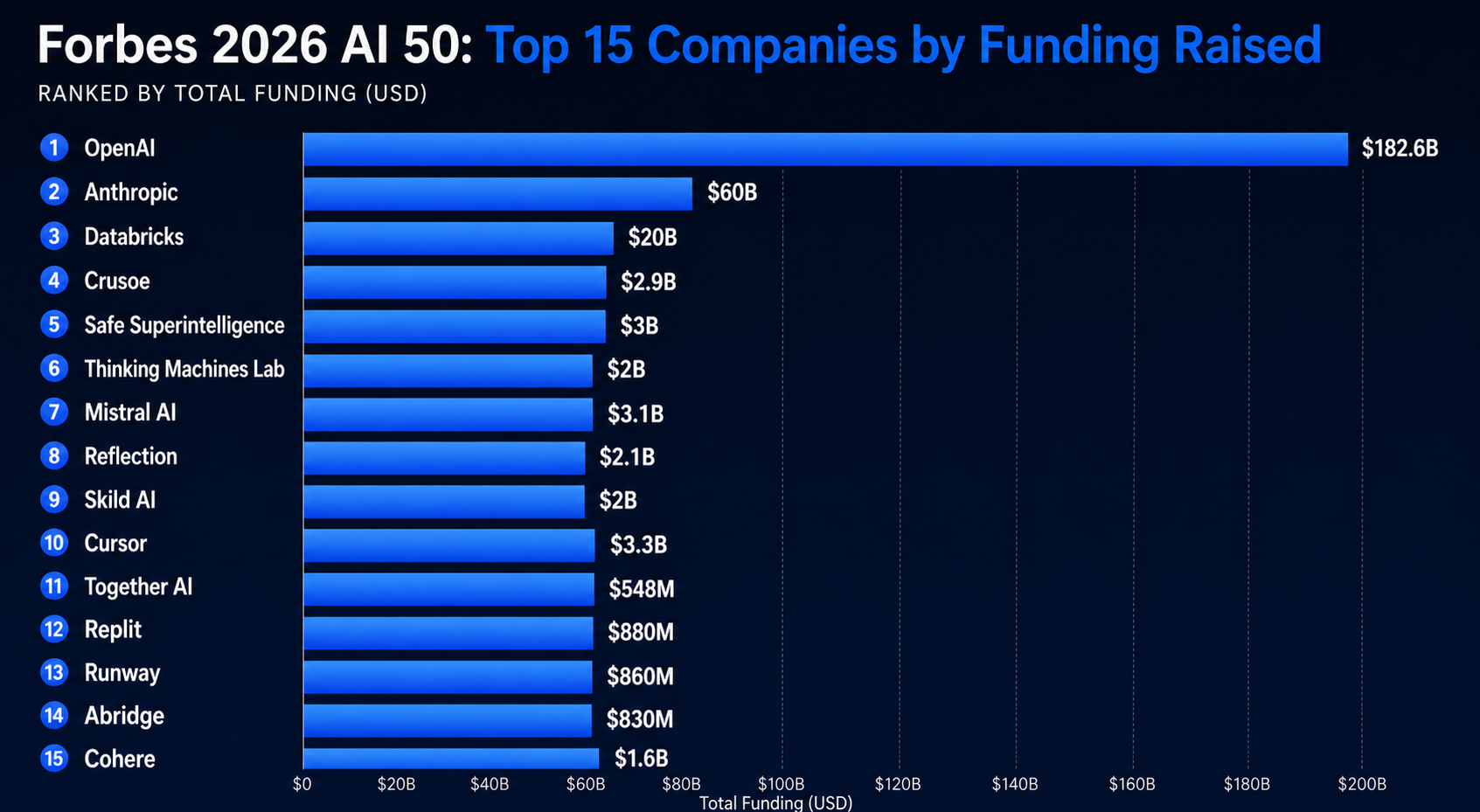
The funding dynamics on this year's list are striking. OpenAI and Anthropic alone account for roughly 80 percent of the $305.6 billion total raised by all 50 companies — a concentration that reflects both the capital intensity of frontier model development and the extraordinary commercial traction that the two labs have achieved. OpenAI reported more than $25 billion in annualized revenue as of early 2026; Anthropic crossed a $30 billion revenue run rate shortly after. Both companies are widely expected to pursue public offerings.
Yet the list is not just a story about two labs. It is a story about the entire ecosystem that has grown up around foundational AI capabilities — the specialized model builders, the vertical SaaS platforms, the infrastructure providers, the creative tools, and the healthcare and robotics applications that are translating raw AI capability into industry-specific value. Understanding each layer of that ecosystem is increasingly essential for anyone operating in, investing in, or building alongside the AI economy.
Master Comparison Table: All 50 Companies at a Glance
The table below covers every company on the Forbes 2026 AI 50, organized by category with funding and key competitive strength.
| Company | Category | Funding | Founded | Key Strength |
|---|---|---|---|---|
| OpenAI | Foundation Models | $182.6B | 2015 | Consumer scale + enterprise API dominance |
| Anthropic | Foundation Models | $60B | 2021 | AI safety + enterprise trust + Claude Code |
| Mistral AI | Foundation Models | $3.1B | 2023 | Open-weight models + European sovereign AI |
| Cohere | Foundation Models | $1.6B | 2019 | Enterprise-first LLMs + privacy focus |
| Reflection | Foundation Models | $2.1B | 2024 | Open-source rival to Chinese AI labs |
| Safe Superintelligence | AI Research | $3B | 2024 | Long-horizon safety research |
| Thinking Machines Lab | AI Research | $2B | 2025 | Mira Murati-led research and products |
| Databricks | AI Infrastructure | $20B | 2013 | Unified data + AI lakehouse platform |
| Crusoe | AI Infrastructure | $2.9B | 2018 | Sustainable AI data centers |
| SambaNova | AI Chips + Infra | $1.5B | 2017 | Purpose-built AI chips + full-stack infra |
| Together AI | AI Cloud | $548M | 2022 | Open-source model serving cloud |
| Baseten | AI App Deployment | $585M | 2019 | Production-grade model deployment platform |
| Fireworks AI | AI Dev Tools | $327M | 2022 | Fast, cheap frontier model access |
| Fal | Generative Media Infra | $330M | 2021 | Serverless media generation infrastructure |
| Cursor | AI Coding | $3.3B | 2022 | Best-in-class AI code editor |
| Cognition | AI Coding Agents | $1B | 2024 | Autonomous software engineering agent |
| Replit | AI App Builder | $880M | 2016 | Collaborative cloud AI coding + deployment |
| Abridge | AI Healthcare | $830M | 2018 | Clinical AI notetaking at scale |
| Chai Discovery | AI Drug Discovery | $225M | 2024 | AI-accelerated protein and drug modeling |
| OpenEvidence | AI Healthcare | $700M | 2022 | Evidence-based AI search for clinicians |
| Physical Intelligence | AI Robotics | $1B | 2024 | Foundation models for physical robots |
| Skild AI | AI Robotics | $2B | 2023 | Generalist robot AI systems |
| Applied Intuition | Self-Driving Software | $850M | 2017 | Autonomous vehicle simulation + tooling |
| Perplexity | AI Search | $1.7B | 2022 | Answer-first AI search engine |
| Glean | Enterprise Search | $770M | 2019 | AI search across enterprise data silos |
| Notion | Productivity Software | $330M | 2013 | AI-native workspace + docs + databases |
| Genspark.ai | AI Knowledge Tools | $545M | 2023 | AI for knowledge workers at enterprise scale |
| Gamma | AI Design Tools | $91M | 2020 | AI presentation builder with $100M+ ARR |
| Listen Labs | AI Customer Research | $100M | 2023 | Automated qualitative customer interviews |
| Speak | AI Language Learning | $162M | 2016 | Conversational AI language tutoring |
| Harvey | Legal AI | $1B | 2022 | AI legal research and drafting for law firms |
| Legora | Legal AI | $815M | 2023 | European legal AI platform |
| Sierra | AI Customer Service | $635M | 2023 | Brand-native AI customer agents |
| Decagon | AI Customer Service | $481M | 2023 | Autonomous AI support agents |
| EliseAI | AI Vertical Agents | $392M | 2017 | AI agents for housing and healthcare ops |
| Rogo | AI Finance | $150M | 2022 | AI analyst for 25,000+ bankers and investors |
| Clay | AI Go-to-Market | $204M | 2017 | AI-enriched outbound sales and prospecting |
| Midjourney | AI Image Generation | $0M | 2021 | Profitable bootstrapped creative AI leader |
| ElevenLabs | AI Voice | $800M | 2022 | Most realistic AI voice synthesis platform |
| Runway | AI Video Generation | $860M | 2018 | Professional AI video editing and generation |
| Synthesia | AI Video Avatars | $535M | 2017 | AI avatar video for enterprise training |
| HeyGen | AI Video | $74M | 2022 | Personalized AI video at scale |
| Black Forest Labs | Image + Video Generation | $450M | 2024 | FLUX image models, fastest quality iteration |
| Krea | AI Image Generation | $83M | 2022 | Real-time AI image generation for creators |
| Suno | AI Music Generation | $375M | 2022 | Full-track music generation from text prompts |
| Cyera | AI Data Security | $1.7B | 2021 | AI-powered cloud data security platform |
| Lovable | AI App Builder | $552M | 2023 | Natural language app and website creation |
| World Labs | Spatial AI | $1B | 2023 | Spatial intelligence models (Fei-Fei Li) |
| Mercor | Data Labeling | $483M | 2023 | AI-powered talent and data labeling platform |
| Surge AI | Data Labeling | $0M | 2020 | High-quality human-in-the-loop AI training data |
Foundation Models: The Engines Powering the AI Era
The most consequential companies on the Forbes 2026 AI 50 list are those building foundation models — the large-scale, general-purpose AI systems that underpin applications across every industry. These companies set the pace for the entire field, and their funding levels reflect the sheer capital intensity of training at the frontier.
OpenAI
Founded: 2015 | Headquarters: San Francisco, CA | Funding: $182.6 billion
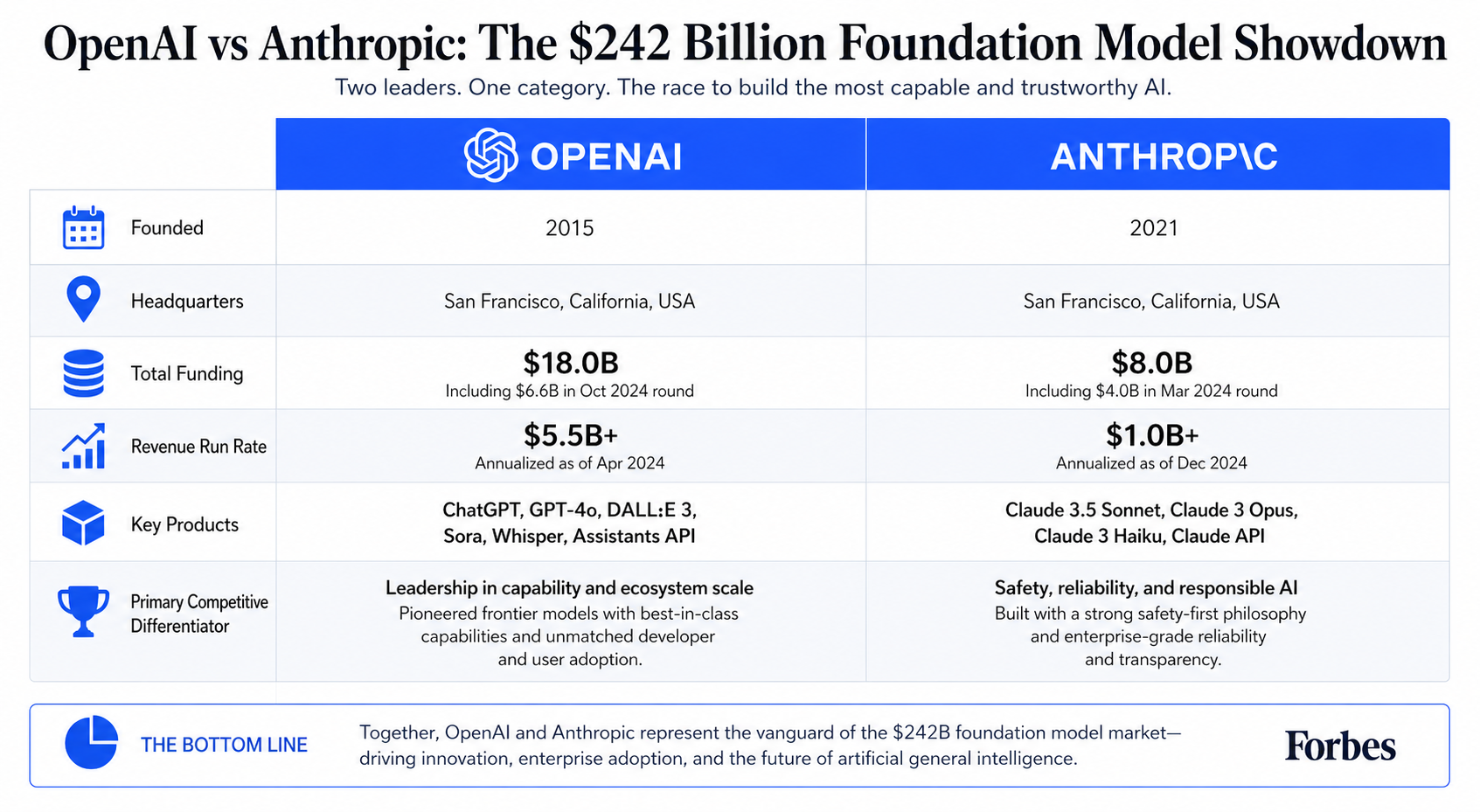
OpenAI is the single largest company on this year's list by a vast margin. Its GPT model family and ChatGPT consumer product have defined what the general public understands AI to be. With more than $25 billion in annualized revenue reported as of early 2026, OpenAI has translated early-mover advantage into a commercial position that is difficult to replicate. Its Codex product is simultaneously expanding its reach into professional developer tooling, creating a direct line of competitive pressure on coding-focused startups that now must outperform OpenAI on its own ground. An IPO is widely expected, and the resulting public market scrutiny will test whether the company's growth trajectory can sustain its extraordinary valuation.
Key Takeaways
- $182.6 billion raised makes OpenAI the most heavily funded private AI company in history.
- $25B+ in annualized revenue demonstrates that foundation model scale can produce enterprise-grade commercial outcomes.
- OpenAI is expanding directly into developer tooling categories, increasing competitive pressure across the AI 50 ecosystem.
Anthropic
Founded: 2021 | Headquarters: San Francisco, CA | Funding: $60 billion
Anthropic occupies a unique position in the AI landscape: it is the only frontier lab with AI safety as a foundational design principle rather than a retrofitted constraint. Founded by former OpenAI researchers, Anthropic has translated that safety-first positioning into extraordinary commercial traction, with a $30 billion revenue run rate reported in early 2026. The Claude model family — spanning Claude Haiku, Sonnet, and Opus — serves developers, enterprises, and consumers. Claude Code has emerged as a serious challenger in the agentic coding category, placing Anthropic in direct competition with specialized tools like Cursor. The company's forthcoming IPO will be one of the most closely watched public offerings in technology history.
Key Takeaways
- Anthropic's AI safety positioning is a durable competitive differentiator, particularly for regulated enterprise buyers.
- The $30B revenue run rate demonstrates that safety-first AI can produce category-leading commercial results.
- Claude Code represents the lab's push beyond chat into agentic AI, expanding its total addressable market considerably.
Mistral AI
Founded: 2023 | Headquarters: Paris, France | Funding: $3.1 billion
Mistral AI is the flagship of European AI ambition. Its open-weight models have attracted enterprise customers ranging from Cisco to European government agencies, for whom Mistral's French roots and local compliance capabilities are a meaningful differentiator in an era of heightened data sovereignty concern. Mistral's decision to release models openly is both a technical and strategic bet: it builds developer trust, accelerates adoption, and positions the company as an alternative to American AI dominance for institutions that require provenance transparency. With $3.1 billion raised and a growing enterprise customer base, Mistral is demonstrating that the open-source model can sustain a serious commercial operation.
Key Takeaways
- European data sovereignty concerns are a structural tailwind that Mistral is uniquely positioned to benefit from.
- Open-weight models create a developer ecosystem that proprietary competitors cannot easily replicate.
- Government contracts in Europe represent a recurring revenue base with long contract cycles and high retention.
Cohere
Founded: 2019 | Headquarters: Toronto, Canada | Funding: $1.6 billion
Cohere occupies the enterprise lane of the foundation model market with conviction. While OpenAI and Anthropic serve the full spectrum from consumers to enterprises, Cohere has oriented almost entirely toward large business customers who require private deployment, data residency guarantees, and models that can be fine-tuned on proprietary data without exposing that data to a third-party cloud. This focus has allowed Cohere to build deep relationships with financial services firms, healthcare systems, and other regulated industries where data control is non-negotiable.
Key Takeaways
- Enterprise-only focus reduces consumer go-to-market costs while enabling premium pricing for data privacy guarantees.
- Regulated industries represent a high-value, sticky customer base with long sales cycles and high renewal rates.
- Cohere's Canadian origin provides neutral-country positioning that appeals to non-US enterprise buyers.
Reflection, Safe Superintelligence, and Thinking Machines Lab
Three newer entrants round out the foundation model and AI research tier. Reflection (founded 2024, $2.1B raised) is building open-source models positioned as a competitive alternative to Chinese AI labs, including DeepSeek. Safe Superintelligence (founded 2024, $3B raised) is taking a longer-horizon view, focused on the research required to eventually develop AI systems that are reliably safe at the level of artificial general intelligence. Thinking Machines Lab (founded 2025, $2B raised), led by former OpenAI CTO Mira Murati, is one of the most-watched new labs, leveraging Murati's deep experience at the frontier to pursue both research and applied AI products.
Key Takeaways
- New AI labs can attract billion-dollar funding within months of founding when backed by credentialed frontier researchers.
- Open-source AI research is increasingly positioned as a geopolitical and competitive counter to proprietary Chinese models.
- Long-horizon safety research, once considered academically separate from commercial AI, is now attracting substantial venture capital.
AI Infrastructure and Cloud: The Layer Beneath Everything
Every AI application runs on infrastructure. The companies building that infrastructure — from data storage and compute to model deployment and serving — represent some of the most durable businesses on the AI 50 list because their revenue is structural rather than application-specific. Regardless of which foundation models win the consumer market, infrastructure providers grow as overall AI usage grows.
Databricks
Founded: 2013 | Headquarters: San Francisco, CA | Funding: $20 billion
Databricks is the oldest company on the list and one of its most valuable. It has spent more than a decade building the data storage, analytics, and processing infrastructure that enterprises use to manage their most valuable asset: their data. Its unified "lakehouse" platform has become the default architecture for companies that need to store and process data at scale before feeding it into AI systems. As enterprise AI adoption accelerates, Databricks sits upstream of every workload — collecting, storing, and serving the data that AI models consume.
Key Takeaways
- Databricks benefits from all AI adoption regardless of which applications or models win at the surface layer.
- A 12-year moat in enterprise data infrastructure makes it one of the most defensible businesses on the list.
- Its $20B in funding reflects investor confidence that data platforms will compound in value as AI scales.
Crusoe, SambaNova, Together AI, Baseten, Fireworks AI, and Fal
Crusoe (2018, Denver, $2.9B) is building AI data centers powered by sustainable energy sources, positioning itself as the compute provider of choice for organizations with ESG commitments alongside serious AI workloads. SambaNova (2017, San Jose, $1.5B) has gone further than any other AI infrastructure company by building purpose-built AI chips alongside a full-stack deployment platform — a vertically integrated bet on the idea that the best AI performance requires purpose-built silicon, not general-purpose GPUs.
Together AI (2022, San Francisco, $548M) has built an AI cloud specifically optimized for running open-source models, serving the growing developer community that wants to access Llama, Mistral, and other open-weight models without managing the underlying infrastructure themselves. Baseten (2019, San Francisco, $585M) specializes in production-grade model deployment — the critical but often unglamorous work of getting AI models running reliably at scale in real applications. Fireworks AI (2022, San Mateo, $327M) targets developers who need fast, cost-effective access to frontier models without managing the backend complexity. Fal (2021, San Francisco, $330M) provides serverless infrastructure for generative media workloads specifically — enabling developers to build image, video, and audio generation features without provisioning dedicated GPU infrastructure.
Key Takeaways
- AI infrastructure is fragmenting into specialized layers: compute, model serving, media generation, and enterprise deployment.
- Sustainable compute (Crusoe) and purpose-built silicon (SambaNova) represent differentiated bets on AI's physical infrastructure future.
- Open-source model clouds (Together AI, Fireworks AI) are growing fast as enterprises seek flexibility and avoid vendor lock-in.
AI Coding and Developer Tools: The Software Development Revolution
Software development is the professional category most visibly transformed by AI in 2026. AI coding tools have moved from novelty to necessity among professional developers, and the startups leading this shift have attracted some of the most aggressive funding on the entire AI 50 list.
Cursor
Founded: 2022 | Headquarters: San Francisco, CA | Funding: $3.3 billion
Cursor is the most highly funded specialized AI coding tool on the list, valued at approximately $29.3 billion. Its AI-native code editor has won extraordinary loyalty among professional developers who rely on it as their primary development environment. Cursor's challenge is also its defining competitive dynamic: it operates on top of frontier models from OpenAI and Anthropic — the same organizations now building directly competing coding tools. Its survival and growth depend on delivering a user experience so substantially superior to native AI lab offerings that developers choose it despite the overlap. Early evidence suggests it is succeeding: developer adoption and retention metrics have been among the strongest in the category.
Cognition and Replit
Cognition (2024, San Francisco, $1B) is building what it calls an autonomous software engineering agent — AI that can not only assist developers but independently plan and execute complete software engineering tasks. Cognition acquired the remaining assets of Windsurf after Google hired that company's cofounders, making it a consolidator in the agentic coding space at the outset of its lifecycle. Replit (2016, Foster City, $880M) has built a collaborative cloud coding environment that has evolved into an AI-native app and website builder — democratizing software creation for non-traditional developers.
Key Takeaways
- Cursor's $3.3B raised reflects investor conviction that a best-in-class developer experience can survive direct competition from frontier labs.
- Agentic coding — AI that completes full engineering tasks autonomously — represents the next frontier beyond AI-assisted coding.
- Replit's evolution from coding environment to AI app builder illustrates how AI is eroding the boundary between developer and non-developer.
AI Healthcare Companies: Transforming Clinical and Drug Discovery Workflows
Abridge
Founded: 2018 | Headquarters: San Francisco, CA | Funding: $830 million
Abridge is solving one of the most chronic problems in clinical medicine: documentation burden. Its AI notetaker listens to patient-physician conversations and automatically generates structured clinical notes — reducing the time physicians spend on administrative tasks and allowing them to focus on patient care. The $830 million raised reflects the scale of the market opportunity: with hundreds of thousands of physicians in the United States alone spending hours each day on documentation, the potential for AI to reclaim clinical time is enormous. Abridge has secured partnerships with major health systems, giving it access to the clinical data and institutional relationships required to validate and scale its product.
Chai Discovery and OpenEvidence
Chai Discovery (2024, San Francisco, $225M) is applying AI to the early stages of drug development — modeling protein structures and molecular interactions to identify drug candidates faster and at lower cost than traditional laboratory methods. Founded only in 2024, it is already valued at approximately $1.3 billion, reflecting investor confidence in AI's ability to compress the discovery phase of pharmaceutical R&D. OpenEvidence (2022, Miami, $700M) is building an AI search engine specifically designed for clinicians — surfacing evidence-based medical literature and clinical guidance in response to point-of-care questions that previously required time-consuming manual searches.
Key Takeaways
- Clinical documentation (Abridge) and drug discovery (Chai) represent two distinct but equally large healthcare AI opportunities.
- AI drug discovery startups can reach unicorn valuations within a year of founding when backed by strong scientific teams.
- Evidence-based clinical AI (OpenEvidence) addresses physician information overload at the point of care — a problem that grows as medical literature expands.
AI Robotics: Bringing Intelligence into the Physical World
Physical Intelligence
Founded: 2024 | Headquarters: San Francisco, CA | Funding: $1 billion
Physical Intelligence is training foundational models for robots — AI systems that can enable physical robots to generalize across tasks rather than requiring specific programming for each action. The company collects training data by having human teleoperators control humanoid robots in realistic environments, building a dataset that teaches robots how humans naturally navigate and interact with physical spaces. This approach mirrors how language models learned from human text, but for the physical world.
Skild AI and Applied Intuition
Skild AI (2023, Pittsburgh, $2B) is also pursuing generalist AI systems for robotics — training models that can transfer learning across different robot hardware and task categories. The company's Pittsburgh location signals a deep connection to Carnegie Mellon's robotics research ecosystem. Applied Intuition (2017, Sunnyvale, $850M) focuses on the simulation and software tooling required to develop and validate autonomous vehicle systems — a category that requires thousands of simulated driving hours before real-world deployment can safely occur.
Key Takeaways
- Foundation models for robotics (Physical Intelligence, Skild AI) are applying the same scaling laws that worked for language AI to the physical world.
- Generalist robot AI — models that work across multiple hardware platforms and task types — is the strategic prize in this category.
- Autonomous vehicle software tooling (Applied Intuition) benefits from a long development cycle that creates durable customer relationships.
AI Search, Productivity, and Knowledge Tools
The way professionals find, process, and act on information is being fundamentally redesigned. Several AI 50 companies are building the tools that knowledge workers will use to navigate information overload in an era of AI-generated content abundance.
Perplexity
Founded: 2022 | Headquarters: San Francisco, CA | Funding: $1.7 billion
Perplexity has built the most compelling AI-native alternative to traditional web search available today. Rather than returning a list of links, Perplexity synthesizes answers directly from web sources, cites its references, and enables conversational follow-up. It is one of the clearest examples of a product that a pre-ChatGPT world could not have built — and that the post-ChatGPT world increasingly prefers. With $1.7 billion raised, Perplexity has the resources to challenge Google's two-decade search dominance in ways that no prior search challenger has achieved.
Glean, Notion, Genspark.ai, Gamma, Listen Labs, and Speak
Glean (2019, Palo Alto, $770M) has built AI-powered enterprise search that connects across an organization's fragmented data silos — Slack, Google Drive, Salesforce, Confluence, and hundreds of other tools — to surface relevant information when employees need it. Notion (2013, San Francisco, $330M), one of the oldest companies on the list, has evolved its widely adopted productivity platform into an AI-native workspace where notes, databases, and documents interact intelligently. Genspark.ai (2023, Palo Alto, $545M) targets knowledge workers with AI tools designed specifically for enterprise-scale information processing. Gamma (2020, San Francisco, $91M) is perhaps the most capital-efficient company on the list — it has crossed $100 million in annualized revenue with just 50 employees by replacing traditional presentation software with an AI-native design tool. Listen Labs (2023, San Francisco, $100M) automates customer research through AI-conducted interviews, reducing the cost and time required for qualitative research. Speak (2016, San Francisco, $162M) delivers AI-powered language tutoring through conversational practice — competing with Duolingo by focusing on the speaking and comprehension skills that conventional language apps underserve.
Key Takeaways
- Perplexity's $1.7B funding signals serious investor belief that AI-native search can displace Google for a meaningful segment of queries.
- Gamma proves that deep AI integration into a specific workflow (presentations) can generate $100M+ ARR with minimal headcount.
- Enterprise knowledge search (Glean) and consumer productivity (Notion) are converging as AI reduces the distinction between internal and external information retrieval.
Enterprise AI Platforms: Automating the Work of Knowledge Professionals
The largest commercial opportunity in AI may be vertical automation — AI systems that replace or augment specific high-value professional workflows. Legal work, financial analysis, customer service, and sales are among the first professional categories experiencing this transformation at scale.
Harvey and Legora
Harvey (2022, San Francisco, $1B) has built the leading AI platform for legal professionals — covering contract drafting, legal research, due diligence, and litigation support. It works with law firms, corporate legal departments, and legal service providers who need AI tools that understand legal reasoning, citation norms, and the specific formatting requirements of legal documents. Legora (2023, Stockholm, $815M) is pursuing the same legal automation opportunity from a European base, with an advantage in jurisdictions where local law and language nuance make American legal AI tools less effective.
Sierra, Decagon, EliseAI, Rogo, and Clay
Sierra (2023, San Francisco, $635M) and Decagon (2023, San Francisco, $481M) are both building autonomous AI agents for customer service — but with different strategic orientations. Sierra emphasizes brand-native agents that reflect a company's specific tone and policy knowledge; Decagon focuses on the speed and resolution rate of autonomous support. EliseAI (2017, New York, $392M) has built specialized AI agents for housing management and healthcare operations — two industries with high-volume, repetitive customer communication needs. Rogo (2022, New York, $150M) has built an AI analyst used by more than 25,000 bankers and investors, demonstrating that financial AI can achieve broad professional adoption even at an early funding stage. Clay (2017, New York, $204M) has become the default AI tool for go-to-market teams building and enriching prospect lists for outbound sales.
Key Takeaways
- Vertical AI for legal workflows (Harvey, Legora) can command premium pricing because legal errors carry real financial and reputational risk.
- Customer service AI (Sierra, Decagon) is one of the first AI categories where ROI is easily measured and purchasing decisions are relatively fast.
- Rogo's 25,000-user adoption illustrates that financial AI tools can achieve meaningful professional penetration before heavy marketing investment.
AI Video, Voice, and Creative Tools: Remaking the Creative Economy
Generative AI has compressed the cost and time required to produce creative content — images, video, music, and voice — by orders of magnitude. The companies building generative creative tools represent one of the fastest-moving categories on the Forbes 2026 AI 50 list, with innovation cycles measured in months rather than years.
Midjourney
Founded: 2021 | Headquarters: San Francisco, CA | Funding: $0 (bootstrapped)
Midjourney is the most unusual business model on the entire AI 50 list: it has raised zero external funding and is profitably sustaining one of the most widely used AI image generation platforms in the world. Its Discord-native distribution model, subscription revenue, and tight product focus have produced a capital-efficient operation that demonstrates AI creative tools do not require billions in venture backing to reach massive scale. Midjourney's continued presence on the list — despite competing against well-funded alternatives — is a testament to the quality and community loyalty its products have built.
ElevenLabs, Runway, Synthesia, HeyGen, Black Forest Labs, Krea, and Suno
ElevenLabs (2022, New York, $800M) has built the most realistic AI voice synthesis platform available, enabling content creators, publishers, and enterprises to generate natural-sounding voices in dozens of languages and accents. Runway (2018, New York, $860M) is the professional-grade AI video editing and generation platform of choice among film and media creatives — its tools are used in commercial productions and have become a proving ground for what AI-generated video can achieve at production quality. Synthesia (2017, London, $535M) has focused its AI avatar and video capabilities on enterprise use cases like training and internal communications, where the ability to produce professional-quality video without cameras or actors creates significant operational efficiency. HeyGen (2022, Los Angeles, $74M) enables personalized video generation at scale — allowing sales teams and marketing departments to send individually tailored video messages to thousands of prospects. Black Forest Labs (2024, Freiburg, $450M) is the creator of the FLUX family of image generation models, which have rapidly become some of the highest-quality open image generation models available. Krea (2022, San Francisco, $83M) offers real-time AI image generation optimized for creative professionals who want iterative, fast visual exploration. Suno (2022, Cambridge, $375M) is building music generation AI that can create complete, high-quality tracks from text descriptions — a direct challenge to the conventional music production pipeline.
Key Takeaways
- Midjourney's profitable bootstrapped model proves that high-quality AI creative tools can sustain large user bases without external funding.
- Video (Runway, Synthesia, HeyGen) and voice (ElevenLabs) are the fastest-moving creative categories, with enterprise adoption accelerating rapidly.
- Music generation (Suno) is the newest creative frontier, with the potential to disrupt content creation economics across advertising, entertainment, and social media.
AI Data Security
Cyera
Founded: 2021 | Headquarters: New York, NY | Funding: $1.7 billion
Cyera has built an AI-powered data security platform that helps enterprises understand where their sensitive data lives, who has access to it, and whether that access creates compliance or security risk. As AI adoption increases the volume of data processed and the number of systems that touch sensitive information, the attack surface for data exposure grows correspondingly. Cyera's $1.7 billion funding reflects investor recognition that data security is a structural beneficiary of AI expansion — the more AI is deployed in the enterprise, the more urgent data governance becomes.
Key Takeaways
- AI data security grows in urgency proportionally to enterprise AI adoption — making Cyera's market a structural beneficiary of the broader AI trend.
- Compliance requirements in regulated industries create non-discretionary demand for data governance tools at scale.
- At $1.7B raised, Cyera is building the war chest required to become the default data security layer for the AI-powered enterprise.
AI App Builders and Spatial Intelligence
Lovable, Replit, and World Labs
Lovable (2023, Stockholm, $552M) is building natural-language software creation for non-technical users — allowing anyone to describe an app or website in plain language and receive a working product. Its Stockholm base places it alongside Legora as evidence that European AI startups are increasingly competitive at the frontier. Replit (2016, Foster City, $880M) has evolved from a collaborative coding environment into an AI-native platform where code generation, running, and deployment are unified into a single experience. World Labs (2023, San Francisco, $1B+), founded by Stanford computer science professor Fei-Fei Li, is pursuing spatial intelligence — AI models that understand and generate representations of three-dimensional physical environments. This research area sits at the intersection of robotics, augmented reality, and autonomous systems.
Key Takeaways
- Natural-language app builders (Lovable, Replit) are eroding the barrier between software developers and end users — potentially expanding the total population of software creators by orders of magnitude.
- World Labs' spatial intelligence research may underpin the next generation of robotics, AR, and autonomous systems.
- Fei-Fei Li's academic credibility illustrates how academic AI research leaders are increasingly making the transition to venture-backed company building.
Data Labeling and Training Infrastructure
Mercor and Surge AI
Mercor (2023, San Francisco, $483M) has built a platform that combines talent sourcing with AI training data operations — enabling AI labs and enterprises to rapidly access qualified workers for data labeling, model evaluation, and RLHF (reinforcement learning from human feedback) tasks. Surge AI (2020, San Francisco) is a bootstrapped data labeling service that has focused on producing the highest-quality human-annotated training data in the market — prioritizing annotation quality over cost, which makes it the preferred choice for frontier model labs where data quality directly affects model performance.
Key Takeaways
- Data labeling is the unsexy but essential foundation of all AI model training — demand grows in proportion to the number of models being developed.
- Both Mercor and Surge AI demonstrate that data quality infrastructure can reach the Forbes AI 50 even at capital-efficient scale.
- Human feedback (RLHF) remains a critical input into model quality, ensuring sustained demand for human annotation services.
Key Investor Insights and Funding Patterns
The funding distribution across the 2026 AI 50 reveals several structural patterns that are important for investors and founders to understand. First, capital concentration at the foundation model layer is extreme: the top two companies (OpenAI and Anthropic) account for approximately $242.6 billion of the $305.6 billion total raised across all 50 companies. This is not merely a size difference — it reflects the fundamental economics of training frontier models, which require compute budgets that are inaccessible without sovereign-wealth-fund-scale capital.
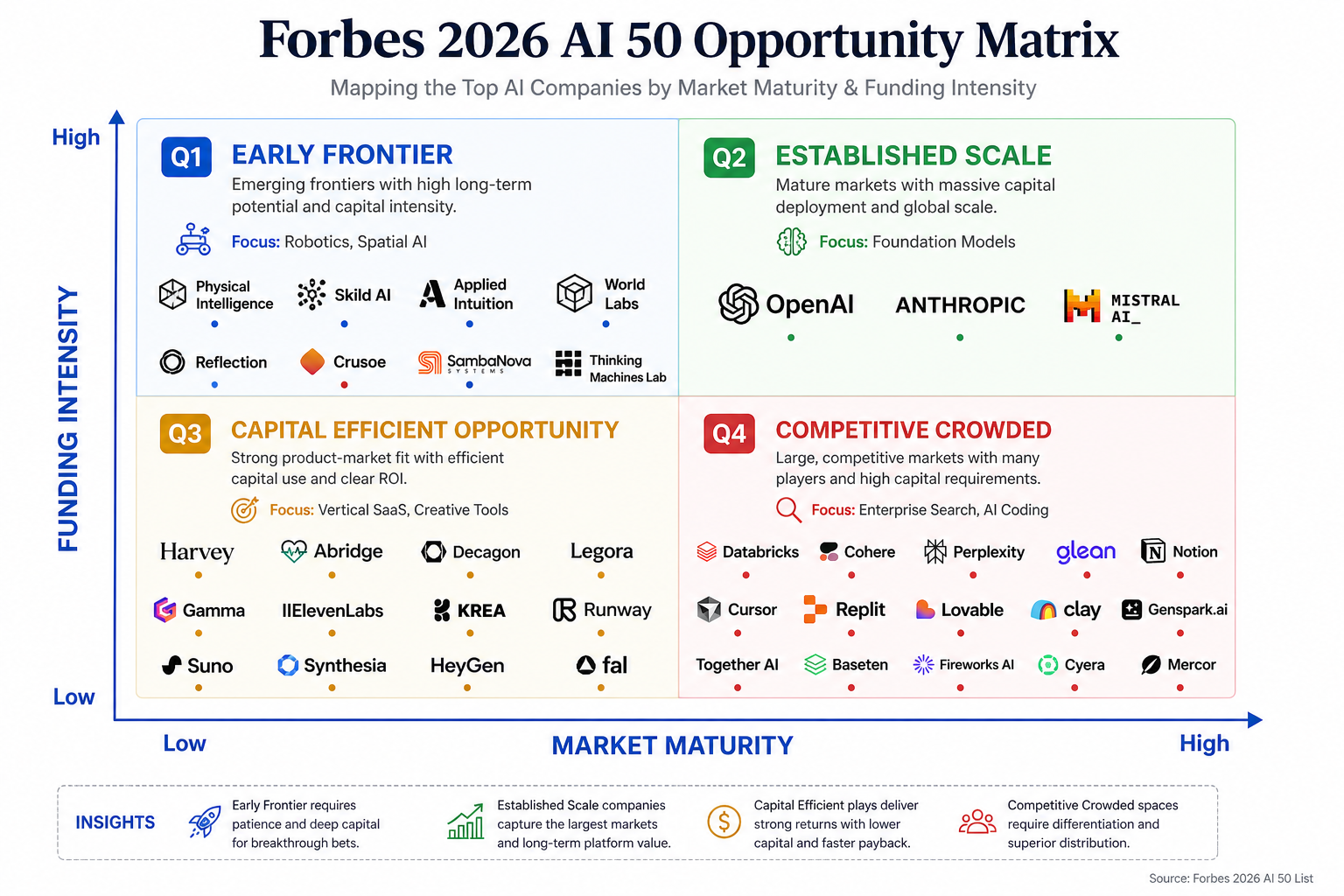
Second, the vertical application layer is where capital efficiency is most visible. Gamma reached $100 million in ARR with just $91 million raised and 50 employees. Rogo gained 25,000 professional users at relatively modest funding. Midjourney built a profitable global creative platform without raising a dollar. These data points suggest that the competitive moat in vertical AI applications can be built on product quality and distribution rather than capital superiority — a very different dynamic from the foundation model tier.
Third, geography is diversifying. The 2026 AI 50 includes companies headquartered in Stockholm (Legora, Lovable), Paris (Mistral), Freiburg (Black Forest Labs), London (Synthesia), Toronto (Cohere), Cambridge (Suno), and Pittsburgh (Skild AI) — evidence that the AI startup ecosystem has expanded well beyond the San Francisco Bay Area, even if California retains the largest concentration of companies on the list.
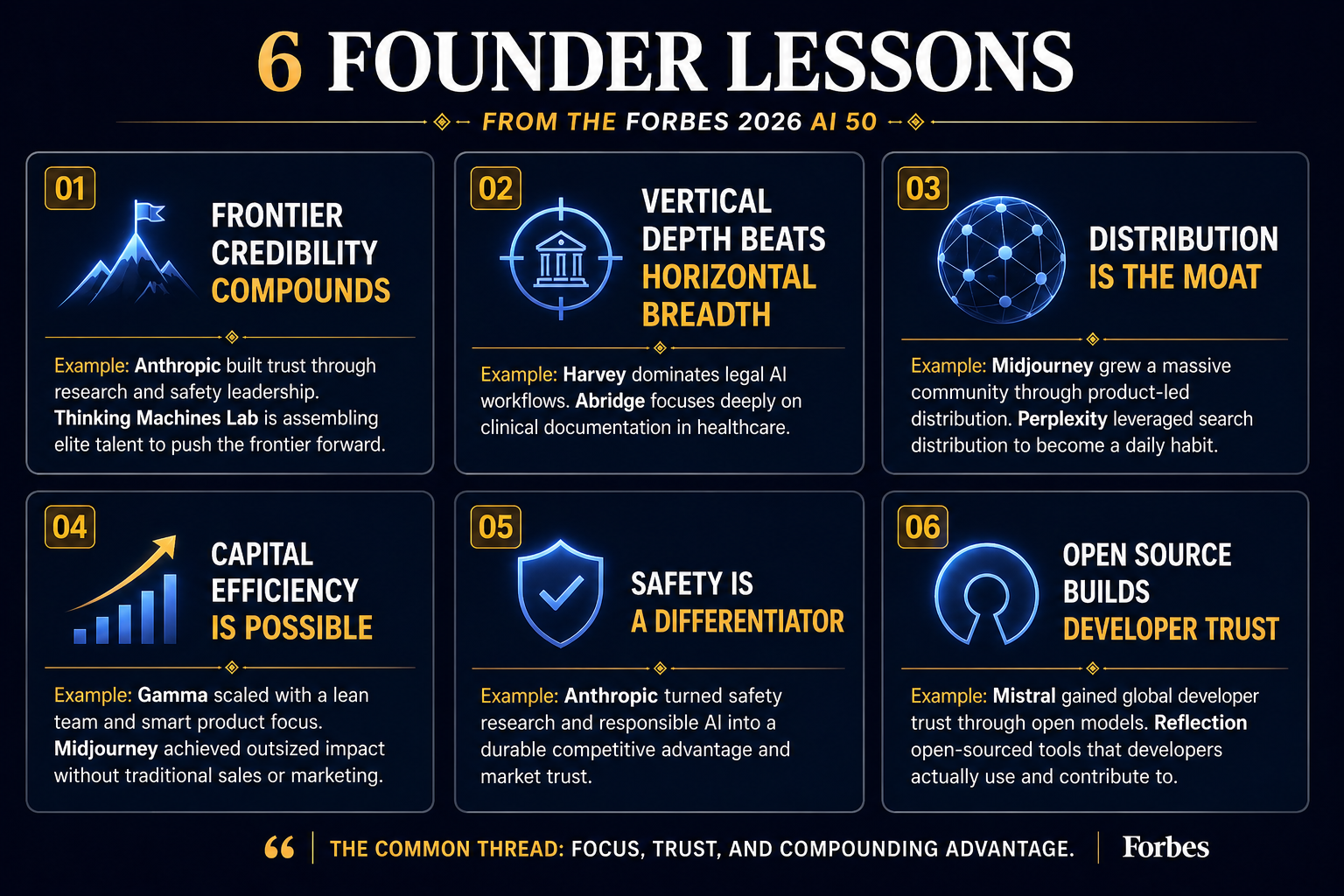
Founder Lessons from the Forbes AI 50
Several recurring patterns emerge when examining what the founders behind these 50 companies have in common. Many come from previous frontier AI organizations — Anthropic's founding team came from OpenAI, Thinking Machines Lab is led by a former OpenAI CTO, and World Labs is founded by a researcher whose work on ImageNet helped launch the modern deep learning era. Research credibility at the frontier is the most valuable form of founder capital in 2026 AI, and it is compounding in its effects.
The most successful vertical AI founders have identified a specific professional workflow — legal drafting, clinical documentation, financial analysis — that is high-value, highly repetitive, and deeply underserved by generic AI tools. Specificity has been rewarded. The companies that tried to build horizontal AI platforms for everyone have faced more competitive crowding than the companies that picked a professional category and went deep.
Distribution strategy has separated winners from near-winners at similar product quality levels. Midjourney won with Discord. Perplexity won with search intent. Clay won with the PLG motion among sales teams. ElevenLabs won by making high-quality voice synthesis accessible enough that individual content creators became its marketing channel. In each case, the distribution insight was as important as the product insight.
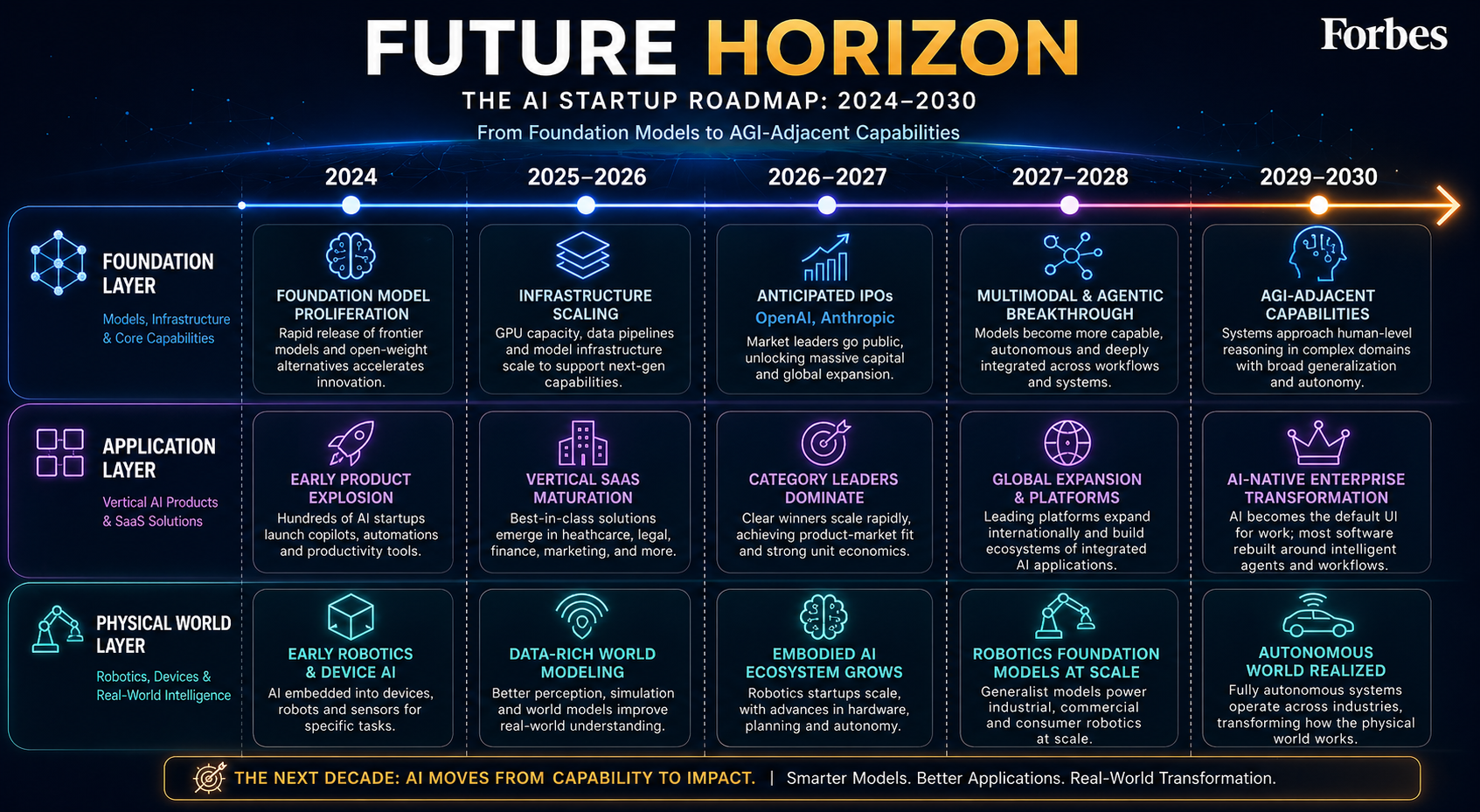
Future Predictions for the AI Startup Landscape
Looking at the structural dynamics that produced the Forbes 2026 AI 50, several predictions for the near-term trajectory of the AI startup landscape can be made with reasonable confidence.
IPOs will reshape the market. The anticipated public offerings of OpenAI and Anthropic will be among the most significant financial events of the decade. Their public market performance will directly influence how venture capital flows to every other company on this list — and to AI startups more broadly. Strong IPO performance will further accelerate investment; disappointing performance could trigger a recalibration of private market valuations.
Consolidation will accelerate. The acquisition of Windsurf's talent by Google and xAI's combination with SpaceX are early signals of a consolidation wave. As the AI 50 list shows, there are now multiple companies in many of the same sub-categories — legal AI, customer service AI, image generation, voice synthesis. Not all of them will survive independently. M&A activity will increase as strategic buyers accumulate AI capabilities and as some well-funded startups discover that distribution is harder to build than their technology.
The physical world is the next frontier. The three robotics companies on this year's list — Physical Intelligence, Skild AI, and Applied Intuition — represent the early wave of AI moving from software into hardware and the physical environment. As foundation models for robotics mature and humanoid hardware costs decline, the pace of physical AI deployment will accelerate. The Forbes 2027 AI 50 will almost certainly include a larger robotics category than this year's list.
Frequently Asked Questions
What is the Forbes AI 50 list?
The Forbes AI 50 is an annual ranking of the most promising privately-held artificial intelligence companies in the world, now in its eighth edition. Companies are evaluated on business promise, technical talent, and depth of AI integration, and they do not pay fees to be considered.
Which company has raised the most funding on the Forbes 2026 AI 50?
OpenAI has raised the most funding at $182.6 billion, followed by Anthropic at $60 billion. Together, the two companies account for approximately 80 percent of the $305.6 billion total raised by all 50 companies on the list.
How many new companies are on the Forbes 2026 AI 50?
Twenty companies appear on the Forbes 2026 AI 50 for the first time, reflecting the speed at which the global AI startup competitive field continues to refresh.
Are any companies on the Forbes 2026 AI 50 profitable without external funding?
Yes. Midjourney and Surge AI have both made the list without raising external venture capital, demonstrating that capital-efficient, profitable AI businesses are achievable in specific categories.
Which AI companies on the Forbes 2026 list are headquartered outside the United States?
Seven companies are headquartered outside the US: Mistral AI (Paris, France), Black Forest Labs (Freiburg, Germany), Legora (Stockholm, Sweden), Lovable (Stockholm, Sweden), Synthesia (London, UK), Cohere (Toronto, Canada), and World Labs (founded with Fei-Fei Li's Stanford roots, San Francisco-based).
What is Cursor AI and why is it on the list?
Cursor is an AI-native code editor that has become the preferred development environment for a large and growing community of professional software developers. It has raised $3.3 billion and is valued at approximately $29.3 billion, making it one of the most highly valued specialized AI coding tools.
What are the fastest-growing categories in the Forbes 2026 AI 50?
The fastest-growing categories by new entrant count and funding velocity are AI robotics (Physical Intelligence, Skild AI), AI legal automation (Harvey, Legora), AI customer service agents (Sierra, Decagon), and AI video generation (Runway, Synthesia, HeyGen, Black Forest Labs).
Conclusion: What the Forbes 2026 AI 50 Tells Us About Where AI Is Heading
The Forbes 2026 AI 50 is more than a list of well-funded startups. It is a map of where human intelligence is being augmented, automated, and amplified at scale — and where the economic value of that transformation is accruing. The companies on it are building the infrastructure, models, applications, and data pipelines that will define how knowledge work, creative production, healthcare delivery, software development, and physical automation operate for decades.
For founders, the list presents a dual message. On one hand, the categories with the largest and most established players — foundation models, AI coding, enterprise search — are the most competitively intense. On the other hand, the list also shows that capital efficiency and vertical depth remain powerful levers: Gamma's $100M ARR on $91M raised, Midjourney's profitability without external funding, Rogo's 25,000 users without massive marketing spend. The window for building durable AI businesses is open, but it requires genuine product and distribution insight rather than just model access.
For investors, the list suggests the next wave of returns may come from the intersection of AI with physical systems (robotics, autonomous vehicles, spatial intelligence) and from the international expansion of AI application businesses that have proven themselves in the US market. The geographic diversification of the 2026 list — with serious companies now emerging from Stockholm, Paris, Freiburg, London, and Toronto — is an early signal of the globalization of AI startup quality.
The AI era is no longer a future scenario. It is the present operating environment. The 50 companies profiled here are not waiting for the future to arrive — they are the primary agents building it.