24 Best Startup Accelerators and Fellowships for Founders
A Complete Guide to the Top Programs, Fellowships, and Communities Worldwide
Finding the right startup accelerator or fellowship program can be the single most important decision a founder makes before raising a first round. The global ecosystem has expanded rapidly, offering programs for builders at every stage — from founders who have not yet settled on an idea to those scaling a venture-backed product. Knowing where to apply, and more importantly which startup accelerator program fits your specific goals, separates founders who grow fast from those who spin in place.
The programs listed in this guide vary significantly in structure, funding, equity requirements, geographic focus, and industry preference. Some are cohort-based accelerators that take equity and provide hands-on mentorship over a fixed period. Others are fellowships, residencies, or communities that offer access, network, and support without diluting ownership. Understanding the differences early saves months of misaligned effort.
This guide covers 24 of the most recognized and relevant startup programs globally. Each entry explains what the program offers, who it suits best, and how to apply. At the end, a comparison table helps narrow down the right fit based on stage, geography, and goals.
What Is a Startup Accelerator
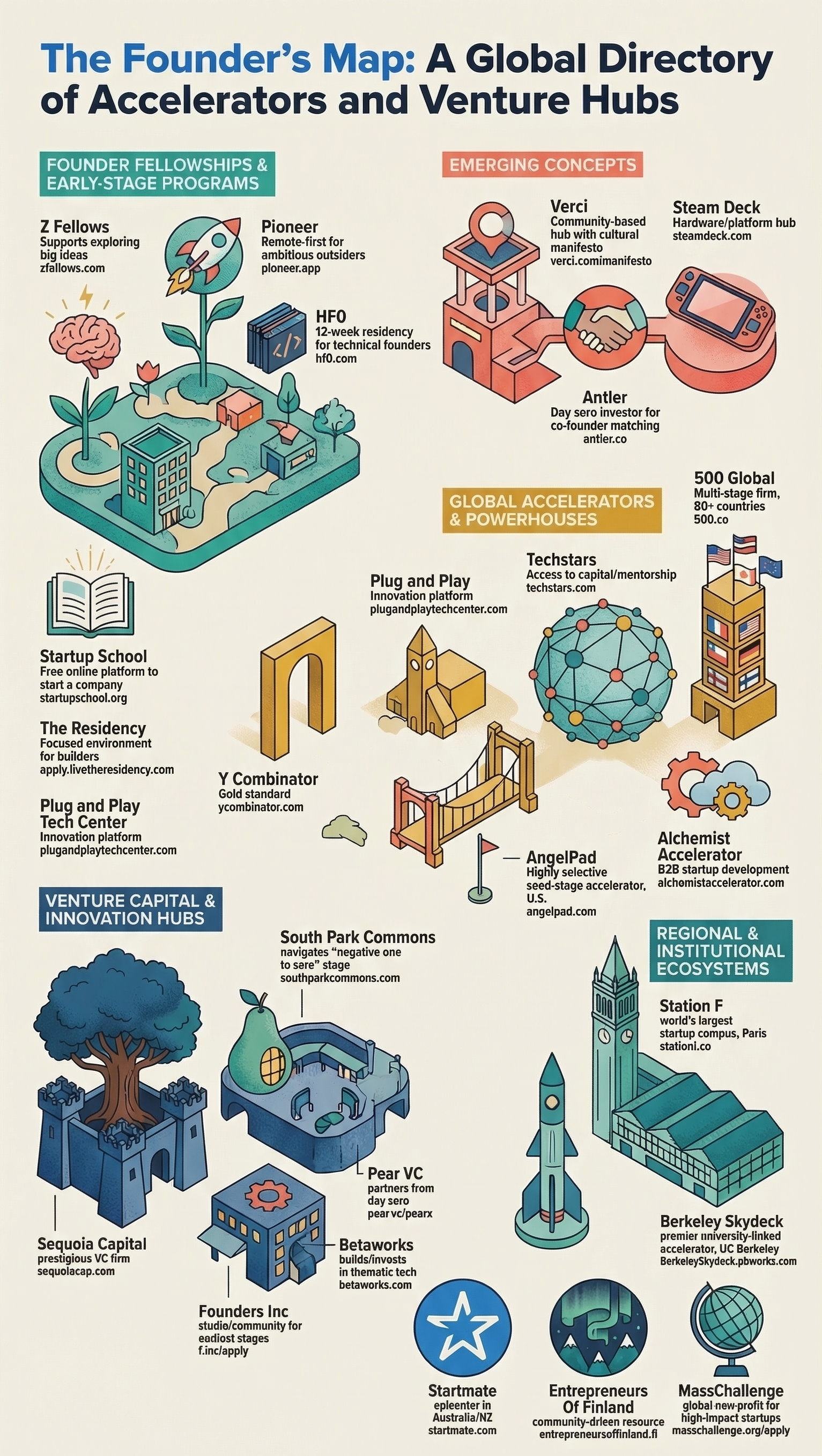
A startup accelerator is a fixed-term program, usually three to six months, that provides early-stage companies with funding, mentorship, workspace, and access to a network of investors and operators. In exchange, the program typically takes a small equity stake in the company. Accelerators are designed to compress years of learning and network-building into a single intensive period, ending with a demo day where startups pitch to a curated audience of investors.
The best startup accelerator programs are defined not just by the funding they provide, but by the quality of their alumni network, the depth of mentor relationships, and the signal value they send to future investors. Getting accepted to a top program like Y Combinator or Techstars often de-risks a startup in the eyes of institutional investors.
What Is a Startup Fellowship
A startup fellowship is a program that supports founders, researchers, or early-stage builders with resources, community, or funding — typically without taking equity. Fellowships are often more selective than traditional accelerators and tend to focus on the individual rather than the company. They are well-suited to founders who are still exploring ideas, building alone, or who want support without giving up ownership at a very early stage.
Programs like Z Fellows and Pioneer operate in this space, offering stipends, peer networks, and structured accountability without the formality or equity requirements of a traditional accelerator. For pre-product founders, a fellowship is often the right first step before applying to a more structured program.
The Programs: A Complete Breakdown
The following section covers each program in detail. Entries are grouped loosely by type — fellowships and early-stage programs first, followed by global and corporate accelerators — though the comparison table at the end allows for cross-category evaluation.
The Residency
Best for: Early-stage founders who want a structured, immersive living and working environment alongside other builders.
The Residency is an immersive startup program built around the idea that environment shapes output. Founders accepted into the program live and build together, sharing physical space, routines, and momentum. Rather than a traditional cohort model with scheduled workshops, The Residency creates conditions for natural collaboration and accountability. It is particularly valuable for founders who find remote work isolating or who want to accelerate the early formation period of a company through proximity to other motivated builders. The application is available at apply.livetheresidency.com.
The program is well-suited to those in the early stages of product development who benefit from real-time feedback, in-person iteration, and a built-in peer group. The structure is deliberately informal enough to allow for genuine exploration while still maintaining enough accountability to keep momentum high.
Z Fellows
Best for: Ambitious students and young builders who want to skip traditional paths and dive straight into building a startup.
Z Fellows targets some of the most driven young builders in the world — specifically those who are willing to drop or defer conventional career paths to pursue startup ambitions. The fellowship provides a stipend, access to a network of accomplished founders and investors, and the legitimacy that comes with being selected by a highly competitive program. It is deliberately designed for people who are ready to move fast and do not need a traditional structure to stay motivated. More details and the application are at zfellows.com.
Unlike equity-based accelerators, Z Fellows does not take ownership. This makes it particularly attractive for founders who are still validating ideas and want external validation and community without committing equity at a stage where company value is uncertain. The program has produced founders who have gone on to raise significant venture rounds.
Founders Inc
Best for: Technical founders and indie hackers looking for a tight-knit community with resources to build and scale products fast.
Founders Inc, accessible via f.inc/apply, is a community-driven program that focuses on builders who are deeply technical and product-oriented. It prioritizes quality over scale, keeping cohorts small and relationships meaningful. The program offers shared resources, introductions to relevant investors, and a peer community of founders who are building seriously. It is especially relevant for solo founders or small teams who want collaborative energy without a formal accelerator structure.
The program does not take equity, which aligns well with its community-first philosophy. Founders Inc treats its members as long-term relationships rather than portfolio companies, which creates a different kind of value — one based on trust, honesty, and shared ambition rather than transactional mentorship.
Y Combinator
Best for: Startups at any stage that are ready to move fast, pitch investors, and plug into the most powerful startup network in the world.
Y Combinator is the most well-known and arguably the most influential startup accelerator program in the world. Founded in 2005, it has backed companies including Airbnb, Stripe, Dropbox, and thousands of others. The program runs twice a year in batches, providing selected startups with funding upward of $500,000, intensive mentorship, weekly dinners with top operators, and access to a global alumni network that spans every major industry. The application is at ycombinator.com.
YC takes approximately 7 percent equity in exchange for its investment. For most founders, the network access, the credibility signal, and the quality of the program make this trade worthwhile. Getting into YC is extremely competitive — acceptance rates hover below two percent — but the alumni community alone makes the application effort justified for almost any serious early-stage startup. YC is arguably the gold standard for startup accelerator programs for early-stage founders globally.
Verci
Best for: Mission-driven founders building companies with a strong philosophical or values-based foundation from day one.
Verci, found at verci.com/manifesto, takes a different approach than most programs in this list. Rather than focusing purely on growth metrics or investor readiness, Verci centers its philosophy around intentionality in company-building. It attracts founders who are thinking carefully about the kind of company they want to build and the values that will underpin it. The manifesto itself is worth reading for any founder who has wrestled with the tension between moving fast and building something lasting.
The program is best understood as a community and framework for thoughtful founders rather than a traditional accelerator. It does not follow a fixed demo-day model and is not primarily oriented around fundraising. For founders who want to think deeply about mission, culture, and product philosophy early in their journey, Verci offers a rare kind of intellectual and strategic support.
HF0
Best for: AI-focused founders and researchers who want to build cutting-edge products with deep technical mentorship and peer collaboration.
HF0 is a residency program specifically designed for technical founders building in artificial intelligence and adjacent fields. It offers a live-in experience where accepted teams share a physical space and work intensively on their products over a defined period. The program provides funding, computational resources, and access to mentors who have deep technical expertise — not just generalist startup advice. The application is at hf0.com.
What sets HF0 apart is the caliber of peers. Being in a room with other highly technical AI founders accelerates learning in ways that traditional mentorship cannot replicate. For researchers transitioning from academia to company-building, or for engineers who have identified a deep technical problem, HF0 provides an environment specifically tuned to that kind of work.
Techstars
Best for: Startups across industries that want mentorship-driven acceleration, global network access, and seed funding to grow fast.
Techstars is one of the largest and most globally distributed startup accelerator networks in the world. With programs running in dozens of cities across multiple continents, it offers founders the chance to go through a structured three-month acceleration experience with access to over 10,000 mentors and a global alumni network. Each accepted company receives $120,000 in funding in exchange for approximately six percent equity. The program is at techstars.com.
Techstars has a strong track record across generalist and vertical-specific programs, including dedicated tracks for healthcare, retail, agriculture, and defense. The mentor-driven model is a genuine differentiator — every team is paired with a small group of mentors who give direct, candid feedback over multiple sessions. For founders who want structured mentorship and global credibility, Techstars is one of the most proven programs available.
Antler
Best for: Aspiring founders who do not yet have a co-founder or idea and want a structured program to form a team and validate a concept.
Antler is unique in the accelerator world because it operates at the very beginning of the company formation process. Rather than accepting pre-formed teams with existing products, Antler accepts talented individuals — operators, engineers, designers, and domain experts — and facilitates co-founder matching and idea generation as part of the program. Participants spend the first several weeks exploring ideas and forming teams before committing to a venture to build. More information is at antler.co.
For professionals who are serious about starting a company but have not yet found the right co-founder or problem to solve, Antler offers a structured and low-risk path into entrepreneurship. The program has expanded rapidly across Europe, Asia, Australia, and North America, making it one of the most globally accessible early-stage startup programs for first-time founders.
Pioneer
Best for: Solo founders and remote builders anywhere in the world who are working on ambitious projects and need early-stage support.
Pioneer is a fully remote early-stage program that identifies and supports the most driven founders anywhere in the world, regardless of geography. Participants compete in weekly tournaments where progress and project quality are rated by peers and an expert panel. The top-ranked founders receive funding, introductions to investors, and access to a global network of mentors. The application is at pioneer.app.
Pioneer's model is built on the premise that great founders exist everywhere, not just in San Francisco or London. By removing geographic requirements entirely, it democratizes access to early-stage support. The competitive ranking system is also a useful forcing function — founders must show weekly progress, which builds discipline and momentum. For remote builders with ambitious projects, Pioneer is one of the best no-equity programs available globally.
Sequoia Capital
Best for: High-growth startups with strong traction that are ready to work with one of the most prestigious venture capital firms globally.
Sequoia Capital is one of the most storied venture capital firms in Silicon Valley, with a portfolio that includes Apple, Google, Oracle, WhatsApp, and hundreds of other category-defining companies. While it is primarily known as a VC firm rather than an accelerator, Sequoia runs scout programs and early-stage initiatives that give exceptional founders access to its network and resources before a formal funding round. More details are at sequoiacap.com.
For startups that are past the very early stage and have meaningful traction, being in Sequoia's ecosystem is an enormous signal and strategic advantage. The firm's pattern recognition across decades of successful companies provides a level of insight that most accelerators cannot match. The bar is extremely high, but for the right startup at the right stage, Sequoia's involvement can transform a company's trajectory.
South Park Commons
Best for: Experienced operators, researchers, and founders in the exploration phase who want community and support before committing to an idea.
South Park Commons is not an accelerator in the traditional sense. It is a community for experienced people — former operators at major tech companies, researchers, and repeat founders — who are in the exploration phase of figuring out what to build next. It provides a structured environment to explore ideas, connect with similarly qualified peers, and develop conviction around a new venture without the pressure of a demo day or investor pitch cycle. The application is at southparkcommons.com/apply.
For founders who have domain expertise and track records but want time to think carefully before committing to a new company, South Park Commons offers something rare: intellectual community without pressure. Many members go on to raise significant venture rounds with strong conviction and well-formed theses, which is a testament to the value of having adequate exploration time.
500 Global
Best for: Startups from emerging markets and underrepresented founders who want global exposure, capital, and a diverse investor network.
500 Global, formerly known as 500 Startups, is a global venture capital firm and startup accelerator with a strong emphasis on geographic and demographic diversity. The program has backed over 2,500 companies across 77 countries, with a particular focus on emerging markets and founders from underrepresented backgrounds. Accepted companies receive $150,000 in exchange for approximately six percent equity and participate in a four-month acceleration program. More at 500.co.
500 Global's investor network is one of the most geographically diverse in the world, making it particularly valuable for startups that want to build globally from day one or that are based in markets underserved by Silicon Valley firms. The program runs tracks in multiple regions, including Southeast Asia, Latin America, and the Middle East, reflecting its commitment to supporting great founders everywhere.
Pear VC
Best for: Pre-seed and seed-stage startups in enterprise software, consumer tech, and deep tech looking for hands-on venture support from day one.
Pear VC's PearX program is a pre-seed accelerator run by the Pear VC team, which has backed companies including DoorDash, Guardant Health, and Branch. The program is designed for companies at the earliest stages and provides hands-on support on product, hiring, and go-to-market strategy. PearX accepts a small cohort of companies each cycle and works with them intensively over several months. The program is at pear.vc/pearx.
What differentiates PearX is the direct involvement of the Pear VC partners, who bring both operational experience and deep investor relationships to each cohort company. For startups that want a venture firm as a true day-one partner rather than a later-stage investor, PearX offers a compelling and founder-friendly entry point into the Pear ecosystem.
Launch House
Best for: Builders and founders who thrive in community-first environments and want co-living and co-working experiences with peers at a similar stage.
Launch House is a community and residency program built around the idea that founder networks compound over time. The program brings together builders, founders, and operators in shared physical and virtual spaces, creating conditions for organic collaboration, co-founding, and mutual accountability. It has become known for its strong community culture and the quality of its members. The website is at launchhouse.com.
Launch House does not take equity and is not structured around a fixed demo day. It is better understood as a high-quality founder network with infrastructure — events, housing, and programming — designed to accelerate relationships and ideas. For founders who believe that their network and environment are primary inputs to their success, Launch House offers a compelling and relatively accessible path into a strong startup community.
AngelPad
Best for: Seed-stage startups that want intensive, personalized mentorship from a small cohort program known for producing high-value exits.
AngelPad is consistently ranked among the top startup accelerators in the United States despite — or perhaps because of — its deliberately small cohort size. Founded by former Google employees, the program accepts only a handful of companies per batch and provides each team with intensive, personalized mentorship. The small size means more attention per company and a tighter alumni network. AngelPad takes approximately seven percent equity and provides $120,000 in funding. More at angelpad.com.
AngelPad alumni have gone on to raise hundreds of millions of dollars and produce multiple billion-dollar outcomes. The program's reputation is built almost entirely on the quality of its results rather than marketing, which is itself a signal. For seed-stage startups that prioritize depth of mentorship over the size of the cohort network, AngelPad is one of the strongest choices available.
Betaworks
Best for: Founders building at the intersection of technology and culture, especially in media, AI tools, and consumer internet products.
Betaworks is a New York-based studio and accelerator that has been at the frontier of consumer internet and media technology since the mid-2000s. It has incubated and accelerated companies in areas including social media, AI tools, data, and media infrastructure. The Betaworks model blends studio-style company building with accelerator programming, making it particularly suited to founders who are building products at the cultural edge of technology. Details are at betaworks.com.
The program runs themed camps focused on specific technology verticals, which means each cohort has deep contextual relevance for its participants. Betaworks' New York location and its roots in media and culture make it an especially strong fit for consumer-facing products, creative tools, and AI applications in content and communication.
MassChallenge
Best for: Startups at any stage that want equity-free support, especially those in healthcare, food, energy, and social impact sectors.
MassChallenge is one of the largest equity-free accelerators in the world, with programs running across the United States, Europe, and beyond. The program does not take equity from any of the startups it accepts, which makes it accessible to a much wider range of founders and funding structures. Instead of equity, MassChallenge awards cash prizes to top-performing companies at the end of the program. The application is at masschallenge.org/apply.
MassChallenge has strong vertical programs in healthcare, food and agriculture, energy, and social impact — areas where traditional venture capital is often slower to engage. For mission-driven startups, non-dilutive funding opportunities, and founders in regulated industries where equity structures require careful management, MassChallenge is a particularly strong option.
Startup School
Best for: First-time founders and anyone in the earliest ideation or pre-product stage who wants free, structured startup education.
Startup School is Y Combinator's free online program for founders at the earliest stages of their journey. It provides structured curriculum, weekly accountability check-ins, and access to a global community of co-founders and first-time builders. Unlike YC's main batch, Startup School does not take equity and is open to anyone anywhere in the world. It is the most accessible entry point into the YC ecosystem. The program is at startupschool.org.
For founders who are not yet ready for a competitive accelerator application but want structured learning, peer accountability, and exposure to YC's frameworks for company-building, Startup School is an outstanding resource. Many founders have used it as a preparation ground before applying to YC's main batch or other top programs. The curriculum is also genuinely useful for experienced founders revisiting fundamentals.
Entrepreneurs Of Finland
Best for: Nordic and European founders who want access to Finland's startup ecosystem, local networks, and region-specific growth resources.
Entrepreneurs of Finland is a program and community designed to strengthen the Finnish and Nordic startup ecosystem by supporting founders with resources, connections, and advocacy. Finland has produced several world-class startups — including Rovio, Supercell, and Wolt — and the broader ecosystem has matured significantly over the past decade. This program provides a structured pathway for founders who want to grow within that ecosystem or use Finland as a launchpad for European expansion. The website is at entrepreneursoffinland.fi.
For founders based in Scandinavia or those looking to enter the European market through a well-connected regional ecosystem, this program offers both community and credibility. Finland's strong engineering culture, access to EU funding structures, and multilingual business environment make it a strategically interesting base for B2B startups with European ambitions.
Berkeley SkyDeck
Best for: UC Berkeley-affiliated founders and global startups that want access to university research, Silicon Valley investors, and academic networks.
Berkeley SkyDeck is the official startup accelerator of the University of California, Berkeley. It supports both UC Berkeley-affiliated startups and top teams from around the world. Accepted companies receive up to $250,000 in funding, access to Berkeley's faculty and research infrastructure, co-working space in the heart of the Bay Area, and introductions to a curated network of Silicon Valley investors. The application is at skydeck.berkeley.edu/apply.
SkyDeck is particularly strong for deep tech, biotech, and research-driven startups that can benefit from proximity to Berkeley's academic departments. The combination of university resources and Silicon Valley network creates a distinctive environment that is hard to replicate elsewhere. For startups with scientific or technical foundations, SkyDeck's access to faculty, lab infrastructure, and research talent is a genuine competitive advantage.
Alchemist Accelerator
Best for: Enterprise-focused startups with B2B models that need help navigating long sales cycles, corporate customers, and institutional investors.
Alchemist Accelerator is one of the most respected programs in the United States for enterprise and B2B startups. Founded with support from major technology companies, Alchemist specializes in helping startups that sell to businesses rather than consumers — a domain with different challenges, longer sales cycles, and different investor expectations. The program provides funding, mentorship, and introductions to enterprise customers and institutional investors. More at alchemistaccelerator.com.
Alchemist's focus on enterprise go-to-market strategy is its core differentiator. Many accelerators are oriented toward consumer products and fast growth metrics, but B2B startups require a different playbook. Alchemist's network of enterprise buyers, corporate development contacts, and experienced B2B operators gives its portfolio companies an edge that is directly relevant to their specific challenges.
Startmate
Best for: Australian and New Zealand founders who want regional mentorship, funding, and a pathway into the Asia-Pacific startup ecosystem.
Startmate is the leading startup accelerator in Australia and New Zealand, with a strong reputation for producing high-quality companies across the Asia-Pacific region. The program provides AUD $120,000 in funding in exchange for equity and runs an intensive mentor-driven cohort model. Startmate's alumni network includes some of the most successful Australian startups, and its mentor community spans founders, operators, and investors across the region. Details are at startmate.com.
For founders based in or building for the Asia-Pacific market, Startmate offers regional relevance that global programs cannot match. It understands the specific challenges of building in Australian and New Zealand markets — from talent density to investor appetite — and provides mentorship that is directly applicable to those conditions. The program also has strong connections into global markets for founders looking to scale beyond the region.
Station F
Best for: European and international startups that want to be based in Paris and access one of the largest and most diverse startup campuses in the world.
Station F is the world's largest startup campus, located in Paris. The facility houses over 1,000 startups at any given time, running more than 30 different programs from partner organizations including Facebook, Microsoft, L'Oreal, and Vente-Privee. Station F is not a single accelerator but a platform that hosts multiple programs across industries, making it one of the most diverse and resource-rich environments for startups globally. The website is at stationf.co.
Being based at Station F provides access to shared infrastructure, a dense founder community, corporate partners, and the French and European startup ecosystems simultaneously. For international startups that want a European base and for French startups building globally, Station F offers a compelling combination of scale, diversity, and legitimacy within the European startup landscape.
Plug And Play Tech Center
Best for: Startups seeking corporate partnerships, pilot opportunities, and global expansion through an innovation platform with Fortune 500 connections.
Plug and Play Tech Center is a global innovation platform that connects startups with large corporations looking for emerging technology partners. Unlike traditional accelerators, Plug and Play's primary value proposition is its network of over 500 corporate partners, which creates direct pipeline opportunities for startups that are ready to run pilots, sign enterprise contracts, or explore strategic partnerships. The platform operates in dozens of locations globally. More at plugandplaytechcenter.com.
Plug and Play does not take equity, which makes it accessible to startups at various stages without the dilution concern. It is particularly powerful for B2B startups in sectors like fintech, health tech, smart cities, and supply chain, where Fortune 500 companies are active buyers of innovation. The platform has facilitated partnerships that have transformed early-stage companies into enterprise vendors almost overnight.
How to Choose the Right Program for Your Startup
Choosing between a startup fellowship program, a traditional accelerator, or a community depends on several factors: the stage of the company, whether equity can be given up, the industry vertical, geographic location, and whether the founder needs structured programming or simply a strong network. The following breakdown helps map those variables to the right type of program.
Equity-free programs including MassChallenge, Pioneer, Z Fellows, Startup School, Founders Inc, Launch House, Plug and Play, and Entrepreneurs of Finland are best suited to founders in the very earliest stages — those who are still exploring ideas, have not yet raised any external capital, or are building bootstrapped products. These programs provide real value without permanent dilution.
Equity-based accelerators like Y Combinator, Techstars, Antler, AngelPad, 500 Global, and Alchemist are better suited to startups that have enough conviction about their idea to accept dilution in exchange for a structured program, funding, and investor signal. The equity trade is almost always worth it for the right program at the right stage, because the network and credibility effects compound significantly over time.
Cohort-based programs with fixed demo days work best for founders who are ready to raise immediately after the program ends. Remote-first programs like Pioneer and Startup School work best for founders outside major startup hubs who cannot or do not want to relocate. Geographic programs like Startmate, Entrepreneurs of Finland, and Station F work best for founders building specifically within those regional ecosystems.
Industry-specific programs are underused by many founders. If a startup is B2B enterprise, Alchemist Accelerator will likely provide more relevant mentorship than a generalist program. If it is AI-focused, HF0 may be a stronger fit than YC at the very early stage. Matching program specialization to company type often matters more than prestige alone.
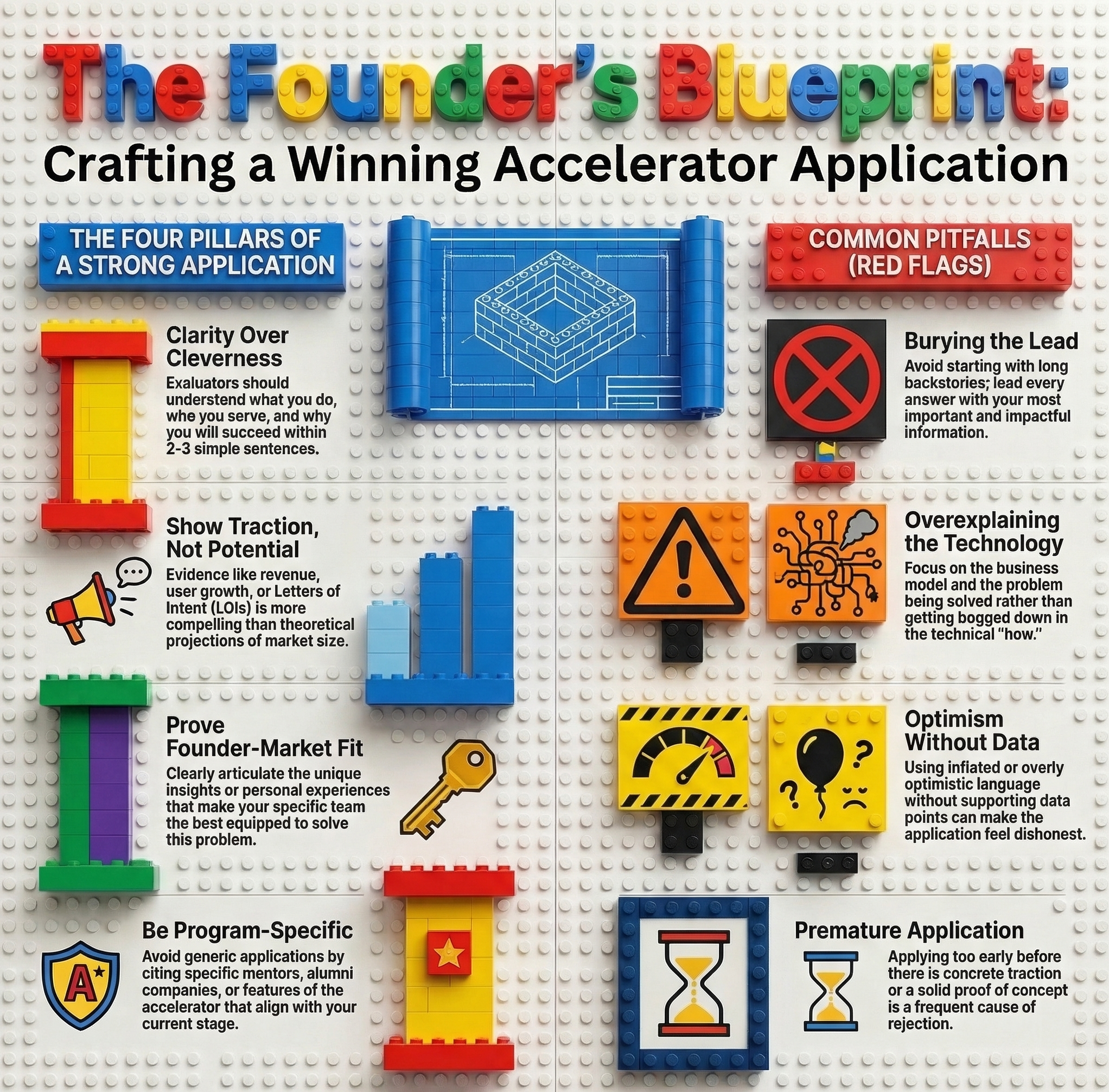
How to Write a Strong Accelerator or Fellowship Application
The quality of an accelerator application is often the difference between acceptance and rejection, even for strong companies. Program evaluators read thousands of applications per cycle and make fast judgments. A few principles consistently separate strong applications from weak ones.
Clarity over cleverness. Evaluators want to understand exactly what a startup does, who it serves, and why it will succeed in two to three sentences. Founders who cannot explain their company simply often reveal a lack of clarity about the business itself. Lead every answer with the most important information, not with context or backstory.
Show traction, not potential. Every founder believes their idea has enormous potential. What evaluators actually want to see is evidence that the market agrees — through revenue, user growth, letters of intent, waitlists, or any other signal that the problem is real and people are willing to pay for a solution. Even modest traction is more compelling than theoretical projections.
Demonstrate founder-market fit. Why are these specific founders the right people to solve this specific problem? Programs invest in teams as much as ideas. Applicants who can explain their unique insight, relevant experience, or personal connection to the problem they are solving are far more compelling than those who have simply identified a large market.
Be specific about why this program. Generic applications are immediately apparent. Mentioning specific mentors, alumni companies, or program features that are relevant to the startup's current stage shows genuine research and increases the probability that the fit is real.
Common mistakes include burying the lead, overexplaining the technology instead of the business, using overly optimistic language without supporting data, and applying too early before there is anything concrete to demonstrate. The strongest applications are honest, specific, and confident without being inflated.
Comparison Table: All 24 Programs at a Glance
The table below compares each program across key dimensions to help narrow the selection based on what matters most for a specific founder's situation.
|
Program |
Type |
Equity |
Funding |
Stage |
Industry Fit |
Location |
Apply |
|
The Residency |
Residency |
Undisclosed |
Limited |
Early-stage |
Generalist |
USA |
apply.livetheresidency.com |
|
Z Fellows |
Fellowship |
No |
Stipend |
Pre-idea / Early |
Tech / Generalist |
Global (Remote) |
zfellows.com |
|
Founders Inc |
Community |
No |
None |
Early-stage |
Tech / Indie |
USA |
f.inc/apply |
|
Y Combinator |
Accelerator |
~7% |
$500K+ |
Pre-seed / Seed |
Generalist |
USA / Global |
ycombinator.com |
|
Verci |
Fellowship |
No |
None |
Pre-idea / Early |
Mission-driven |
Global |
verci.com/manifesto |
|
HF0 |
Residency |
No |
Yes |
Early-stage |
AI / Deep Tech |
USA |
hf0.com |
|
Techstars |
Accelerator |
~6% |
$120K |
Seed |
Generalist |
Global |
techstars.com |
|
Antler |
Co. Builder |
Yes |
Yes |
Pre-idea |
Generalist |
Global |
antler.co |
|
Pioneer |
Remote Acc. |
No |
$10K+ |
Pre-seed |
Generalist |
Global (Remote) |
pioneer.app |
|
Sequoia Capital |
VC / Scout |
Yes |
Varies |
Seed / Growth |
High-growth Tech |
USA / Global |
sequoiacap.com |
|
South Park Commons |
Community |
No |
Grants |
Exploration |
Tech / Research |
USA |
southparkcommons.com/apply |
|
500 Global |
Accelerator |
~6% |
$150K |
Pre-seed / Seed |
Generalist / Emerging |
Global |
500.co |
|
Pear VC (PearX) |
Accelerator |
Yes |
Yes |
Pre-seed / Seed |
Enterprise / Consumer |
USA |
pear.vc/pearx |
|
Launch House |
Community |
No |
None |
Early-stage |
Generalist |
USA |
launchhouse.com |
|
AngelPad |
Accelerator |
~7% |
$120K |
Seed |
Generalist |
USA |
angelpad.com |
|
Betaworks |
Studio / Acc. |
Yes |
Yes |
Early-stage |
Media / AI / Consumer |
USA (NY) |
betaworks.com |
|
MassChallenge |
Accelerator |
No |
Prizes |
Any stage |
Impact / Health / Food |
Global |
masschallenge.org/apply |
|
Startup School |
Online Program |
No |
None |
Pre-product / Seed |
Generalist |
Global (Remote) |
startupschool.org |
|
Entrepreneurs of Finland |
Network |
No |
Limited |
Early-stage |
Generalist |
Finland / Europe |
entrepreneursoffinland.fi |
|
Berkeley SkyDeck |
Accelerator |
Yes |
$250K |
Pre-seed / Seed |
Deep Tech / Research |
USA (Bay Area) |
skydeck.berkeley.edu |
|
Alchemist Accelerator |
Accelerator |
~5% |
$25K+ |
Seed |
Enterprise B2B |
USA / Global |
alchemistaccelerator.com |
|
Startmate |
Accelerator |
Yes |
AUD $120K |
Pre-seed / Seed |
Generalist |
Australia / NZ |
startmate.com |
|
Station F |
Campus / Programs |
Varies |
Varies |
Any stage |
Generalist / European |
France (Paris) |
stationf.co |
|
Plug and Play |
Corp. Acc. |
No |
Varies |
Seed / Growth |
Enterprise / B2B |
Global |
plugandplaytechcenter.com |
Finding the Right Program Changes Everything
The startup programs listed here represent some of the best infrastructure available to founders at every stage, in every geography, and across every industry. None of them are a substitute for product, team, and market insight — but the right program at the right moment can compress years of learning, unlock relationships that would otherwise take a decade to build, and provide the kind of external validation that changes how investors, customers, and potential co-founders perceive a company.
The decision of which program to pursue is worth serious research. Read the alumni stories. Talk to founders who have gone through each program. Understand what each one actually provides versus what it advertises. The best startup accelerator programs for early-stage founders are the ones that match the current stage and specific needs of the company — not just the ones with the highest brand recognition.
The startup ecosystem rewards those who move with precision, not just speed. Choosing the right program is one of the clearest expressions of that principle.
Frequently Asked Questions
The following questions are among the most commonly asked by founders who are researching startup accelerator programs, fellowships, and early-stage communities for the first time or returning to the process after a previous application cycle.
What is the difference between a startup accelerator and a startup fellowship?
A startup accelerator is a structured, time-limited program that typically takes equity in exchange for funding, mentorship, and access to an investor network. It is designed to rapidly scale a company that already has a product or early traction. A startup fellowship, by contrast, is usually equity-free and focuses on supporting the individual founder rather than the company entity. Fellowships tend to be better suited to founders who are still validating ideas, exploring problems, or building in isolation without a formal company structure in place. Programs like Z Fellows and Pioneer are fellowships, while Y Combinator and Techstars are classic accelerators.
Do startup accelerators take equity from every company they accept?
Not all accelerators take equity. Programs like MassChallenge, Plug and Play Tech Center, Startup School, Z Fellows, and Pioneer accept companies or founders without requiring any equity stake. These equity-free programs provide value through access, mentorship, community, or cash prizes rather than investment. Traditional accelerators such as Y Combinator, Techstars, AngelPad, and 500 Global do take equity — typically between five and seven percent — in exchange for a cash investment and structured programming. For very early-stage founders who are uncertain about their company structure or valuation, starting with an equity-free program is often the most practical first step before taking on dilution.
What stage should a startup be at before applying to Y Combinator?
Y Combinator accepts startups at a wide range of stages — from pre-product ideas to companies with meaningful revenue. However, the most competitive applicants tend to have at least a working prototype, some evidence of user interest, and a clear articulation of the problem they are solving. YC values founder quality, team composition, and the size of the opportunity as much as current traction. Solo founders are accepted, though teams of two or three are common. The single most important signal in a YC application is genuine insight into a problem that others have overlooked, combined with the ability to execute quickly. Founders who have been through Startup School or a fellowship program before applying are often better prepared.
Can founders apply to multiple accelerator programs at the same time?
Yes, and many experienced founders do exactly that. There is no standard rule against applying to multiple programs simultaneously, and most accelerators are aware that strong teams will explore several options at once. The key consideration is time — each application requires genuine customization to be competitive, and a generic application sent to ten programs will underperform a focused application sent to three well-matched ones. If accepted to multiple programs, founders will need to choose one, as equity-based programs will not allow a company to participate in two competing accelerators at the same time. Some founders participate in a fellowship or community program first, then apply to a formal accelerator once the product and team are further along.
Are startup accelerator programs worth it for non-technical founders?
Accelerator programs are valuable for non-technical founders, though the priorities may differ. For a non-technical founder, the most valuable outputs from a program are often the co-founder matching opportunities (particularly at programs like Antler), the access to technical mentors, and the investor network that can help fund the hiring of a technical lead. Programs like Antler and South Park Commons are explicitly designed for founders who are still assembling their team or refining their idea, making them well-suited to non-technical builders. The key is finding a program that does not assume deep technical expertise as a prerequisite for participation, and focusing the application on domain expertise, market insight, and the strength of the vision rather than on product depth.
What happens after a startup accelerator program ends?
Most cohort-based accelerator programs culminate in a demo day, where accepted companies pitch to a curated audience of investors, journalists, and operators. Demo day is not the end of the relationship — for programs like YC and Techstars, the alumni network and ongoing investor access continue indefinitely. After the program, the expectation is that companies will use the momentum of demo day to close a seed or Series A round, hire aggressively, and accelerate growth. Some companies raise their first institutional round directly from demo day. Others use the program primarily for the network and continue bootstrapping. The value of the alumni community — access to hiring pipelines, warm introductions, co-investor networks, and peer advice — is often more valuable over the long term than the initial funding received during the program itself.
Which startup accelerator program is best for AI startups?
Several programs stand out specifically for AI-focused founders. HF0 is the most purpose-built option, offering a live-in residency specifically designed for technical AI builders with access to compute resources and technically sophisticated peers. Y Combinator has also become one of the most AI-dense accelerators in the world, with a significant portion of recent batches focused on AI products and infrastructure. Betaworks runs themed cohorts that have included AI-specific tracks for consumer and media applications. For AI startups with enterprise applications, Alchemist Accelerator provides strong B2B go-to-market support. The right choice depends on whether the startup is building AI infrastructure, AI-powered consumer products, or AI tooling for enterprise customers, as each requires a different kind of network and mentorship.
How competitive is it to get into a top startup accelerator?
Competition varies significantly across programs. Y Combinator receives tens of thousands of applications per cycle and accepts fewer than two percent, making it among the most selective programs in the world. AngelPad is similarly selective due to its small cohort size. Programs like Techstars and 500 Global accept a higher number of companies across multiple simultaneous cohorts, making acceptance somewhat more accessible but still highly competitive. Equity-free programs like Startup School and Pioneer have more open access models, with Pioneer using a competitive ranking system rather than a single application gate. The best strategy is to apply to several programs that match the current stage, customize every application meaningfully, and treat rejection as data rather than a final verdict — many successful companies were rejected from top programs before eventually being accepted or finding success through a different path.
Is it possible to participate in a startup program without relocating?
Yes. Several programs listed in this guide are fully remote or location-agnostic. Pioneer is entirely remote and accepts founders from anywhere in the world. Startup School operates online without any physical requirement. Z Fellows does not require relocation. Entrepreneurs of Finland operates regionally but has flexible participation models. Many programs that were previously in-person — including Y Combinator — have expanded to accommodate remote participants in certain cohorts. That said, in-person programs consistently produce stronger outcomes in terms of co-founder relationships, investor introductions, and peer learning. Founders who can relocate even temporarily for the duration of a cohort typically extract more value from the experience than those participating remotely, particularly in programs built around shared physical space like The Residency, HF0, and Launch House.
What do startup accelerators look for in an application?
While criteria differ by program, most top accelerators evaluate applications on a consistent set of factors. Team quality is almost always the primary signal — evaluators want to see founders with relevant expertise, genuine complementarity between co-founders, and evidence of the ability to execute under pressure. Market size matters significantly; programs funded by venture capital are looking for startups that can become very large businesses. Problem clarity is another key factor — founders who can articulate exactly what problem they solve, for whom, and why now tends to outperform those with vague or overcomplicated pitches. Traction, even at a modest scale, provides social proof that the market has validated the hypothesis. Finally, founder-market fit — the specific reason why these founders are uniquely positioned to win in this space — is a differentiator that strong applicants address explicitly rather than leaving it implicit.
Which programs are best suited to founders outside the United States?
Several programs in this guide are explicitly built for international founders or operate with a strong global lens. 500 Global has one of the most geographically diverse portfolios in the world and actively prioritizes founders from emerging markets. Antler operates in more than two dozen cities across multiple continents, making it one of the most globally accessible options for early-stage team formation. Pioneer is entirely remote and accepts founders from anywhere. Station F in Paris is the natural home for European and internationally mobile founders who want to be in a major startup hub outside the United States. Startmate serves founders in Australia and New Zealand specifically. Entrepreneurs of Finland and Berkeley SkyDeck both have international intake programs. Y Combinator and Techstars also regularly accept international companies, though they may require presence in the United States during the program period.
How long do most startup accelerator programs last?
The duration varies by program type. Traditional cohort-based accelerators like Y Combinator run for approximately three months per batch. Techstars programs also run on a roughly three-month model. 500 Global runs a four-month program. Residency programs like HF0 and The Residency are more variable in duration, with some running for two to three months and others operating on a rolling basis. Fellowship programs like Z Fellows and Pioneer are ongoing rather than fixed-term, with participants maintaining involvement over a longer continuous period. Company builder programs like Antler operate on a longer formation timeline — often four to six months — because they include the co-founder matching and idea validation phases as part of the program itself. Online programs like Startup School can be completed at any pace and are not time-restricted.