Will AI wipe out jobs—or create
more of them?
|
|
The headlines are loud, the Twitter
threads are louder, and the
predictions range from apocalyptic
to dismissive. On one end, the
doomers claim AI will unleash
universal unemployment, with 10–20%
jobless rates and half of all
entry-level white-collar jobs
vanishing in five years. On the
other end, the
hype dismissers argue AI is
overblown, insisting it’s not “real”
Artificial General Intelligence
(AGI) and won’t fundamentally
transform the economy.
|
|
Both are wrong. History, industry
data, and basic economics suggest
something different:
AI will transform the economy,
but not destroy it.
|
|
|
The Radiologist Paradox: A Case
Study in Failed Predictions
|
|
Back in 2016, Geoffrey Hinton—one of
the godfathers of AI—predicted we
should stop training radiologists
because deep learning would replace
them within five years. Fast forward
a decade: the demand for
radiologists is higher than ever.
|
|
This isn’t because AI failed. Quite
the opposite—AI now detects and
classifies hundreds of diseases with
speed and accuracy. Yet instead of
disappearing, radiologists are more
valuable because AI made imaging
cheaper and more powerful,
unleashing latent demand.
|
The Core Mechanism: Jevons
Paradox and Latent Demand
|
|
Economist William Stanley Jevons
observed in the 19th century that
when technology makes something
cheaper and more efficient,
consumption doesn’t shrink—it
skyrockets.
|
|
AI is doing the same thing today. By
making tasks like analyzing MRIs,
drafting contracts, or writing code
faster and cheaper, it doesn’t
eliminate demand. It reveals massive
unmet demand.
|
|
Just like:
|
-
Containerization
(1960s):
Cheaper shipping crushed dock
jobs at first—but global trade
exploded, creating
billion-dollar logistics
industries.
-
Cloud Computing (2010s):
IT got 10x cheaper.
Traditional admins became
cloud architects and DevOps
engineers, managing at new
scales.
-
AI GPUs (2020s):
Algorithmic efficiency made
inference cheaper, and instead
of demand dropping, GPU demand
exploded—NVIDIA stock went
stratospheric.
|
|
Efficiency creates more demand.
That’s the paradox.
|
|
|
|
YC’s Garry Tan
captures this
dynamic perfectly
in his video “This 19th
Century
Theory
Explains
Why AI
Won’t Kill
Jobs.”
He explains that
history and
economics
repeatedly show
the same pattern:
technology doesn’t
eliminate people,
it redefines what
they can do. From
coal engines in
Jevons’ time to
today’s AI
systems,
efficiency gains
don’t shrink
opportunities—they
expand them, often
creating entire
industries that
didn’t exist
before.
|
|
|
|
|
The Future of Work: Humans
Still in the Loop
|
|
Here’s the shift: AI won’t erase
humans, it will
refactor jobs.
|
-
Expertise becomes more
valuable:
AI drafts the contract, but
lawyers advise on strategy. AI
analyzes the scan, but
radiologists decide on
treatment. AI writes the code,
but engineers design systems
and supervise agents.
-
Rote work gets
automated:
As Andrej Karpathy puts it, AI
takes on the boring,
repetitive jobs first—data
entry, customer service,
paperwork.
-
Roles evolve into
supervision:
Instead of doing every task
manually, workers will
supervise fleets of AI agents.
Think less “do the grunt work”
and more “direct the
orchestra.”
|
|
Examples already emerging:
|
-
Aoka (YC): AI sales
agents free up service
industry workers for
higher-value conversations.
-
Tenor: Automates
healthcare paperwork, shifting
admin roles into care
coordination and complex case
management.
|
|
The result? Fewer frustrating,
low-value tasks. More engaging,
higher-level work.
|
|
|
Conclusion: What This Means for
Builders
|
|
Yes, the AI transformation is real.
No, it won’t collapse the job market
or leave us all reliant on universal
basic income. What’s happening is
bigger:
AI is the next internet-level
shift.
|
|
The opportunities are massive—but
only for those who see beyond the
hysteria.
|
|
The question isn’t whether AI will
take jobs. It’s:
Will you be one of the founders,
builders, or early adopters who
creates the future while others
get stuck in the past?
|
|
Watch the full video breakdown here
and see how you can seize the AI
opportunity. ️
|

|
|
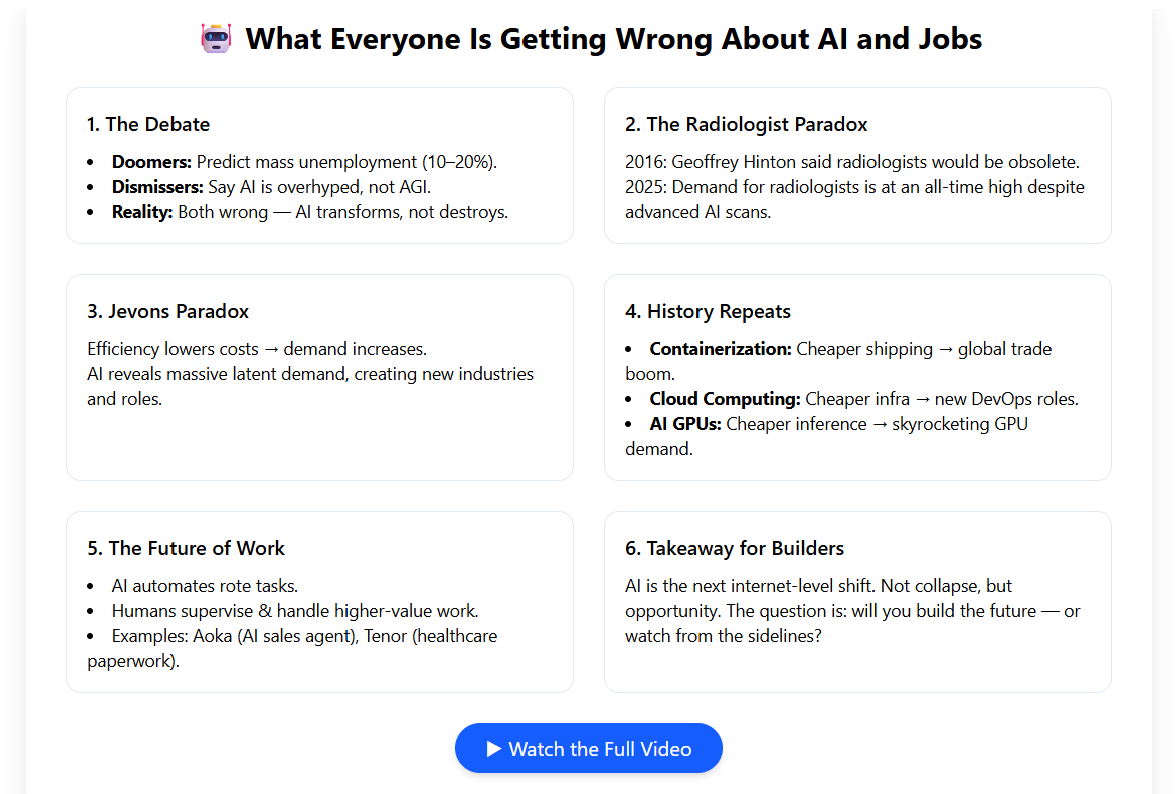
What Everyone Is
Getting Wrong
About AI And Jobs
|
|
|
|