Which AI Startups Are Winning with Google Cloud and Why It Matters for Enterprise Buyers

Key statistics about AI startups using Google Cloud
Major cloud platforms have fundamentally shifted from being passive infrastructure vendors to active participants in how AI-powered SaaS startups grow, sell, and scale. Rather than simply offering compute and storage at a price, hyperscalers now co-invest in startup go-to-market motions, embed their own AI models into partner products, and use their enterprise sales channels to give early-stage companies access to customers they could not reach independently. For enterprise technology buyers, this shift is significant: the cloud provider a startup chooses increasingly determines the quality of the AI models it can access, the speed at which it can deploy proof-of-concept projects, and the long-term support infrastructure behind its product roadmap.
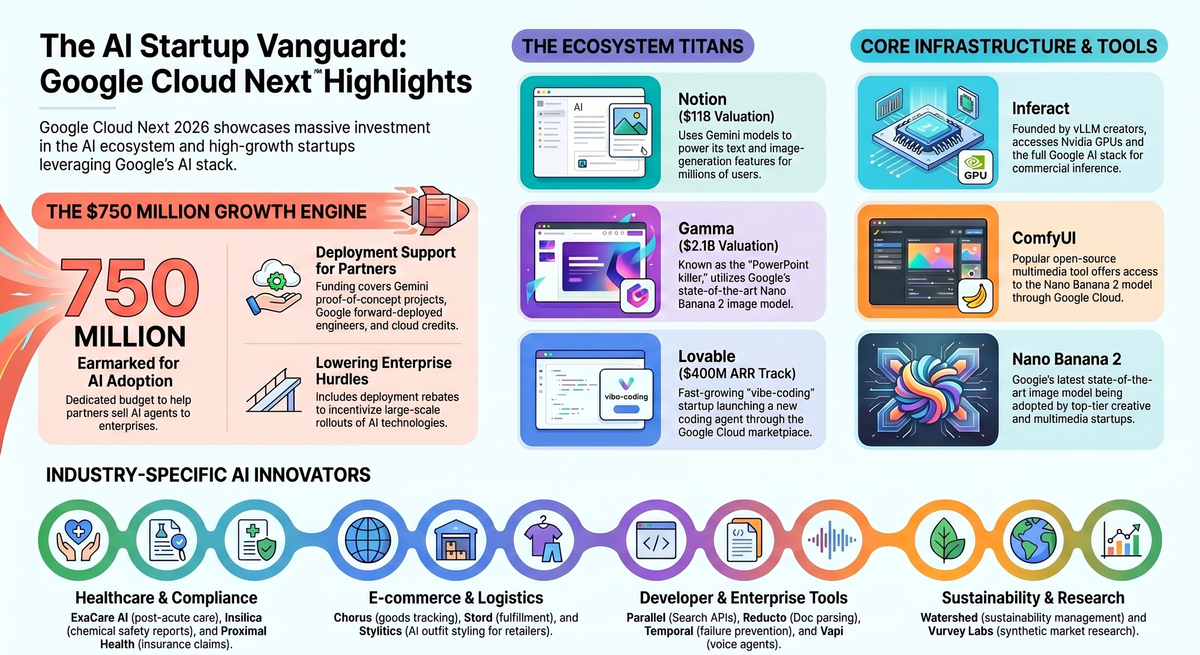
At a recent Google Cloud Next conference held in Las Vegas, the company made its startup ambitions explicit. Google committed a $750 million fund specifically to help cloud partners, ranging from early-stage AI companies to large consulting firms, sell AI agents into enterprise accounts. The fund covers Gemini proof-of-concept costs, cloud credits, forward-deployed Google engineers, and deployment rebates. This announcement arrived alongside a showcase of more than twenty AI startups either newly signed to Google Cloud or expanding their existing footprint, spanning verticals from healthcare and retail to developer tooling and sustainability. What follows is a comprehensive breakdown of those companies, the technologies they are using, and what the broader pattern means for enterprise buyers evaluating AI startup partnerships.
The cloud-startup partnership model: how it actually works
Cloud providers have developed increasingly sophisticated programs to recruit and retain AI startups on their platforms, and understanding the mechanics of these arrangements matters before evaluating any individual company. The core structure typically involves three interlocking mechanisms: cloud credits that reduce a startup's infrastructure costs during the early growth phase, co-sell arrangements where the cloud provider's enterprise sales team actively promotes the startup's product to its existing customer base, and proof-of-concept funding that helps de-risk the initial deployment for a potential enterprise client. Each of these levers reduces friction at a different stage of the enterprise sales cycle, which historically has been slow and expensive for startups without established brand recognition.
Forward-deployed engineering support, where the cloud provider assigns its own engineers to help a startup integrate more deeply with the platform, adds a fourth dimension that is less often discussed publicly but arguably the most valuable. When a startup's product is architecturally entangled with a cloud provider's AI stack, switching costs rise significantly for both the startup and the enterprise customer. Cloud-native AI companies that build on proprietary model APIs, specialized accelerators, and managed data pipelines become deeply embedded in a cloud ecosystem over time. Enterprise buyers considering generative AI tools for businesses should factor this dependency into their vendor evaluation, since it has implications for portability, pricing leverage, and long-term support continuity.
Standout AI startups using Google Cloud: the five to watch
Five standout AI startups spotlighted at Google Cloud Next
Lovable
~$400M ARR run-rate
Launching coding agent via Google enterprise marketplace
Notion
$11B valuation
Gemini powers text and image generation features
Gamma
$2.1B valuation
Uses Imagen 3 and Google Cloud infrastructure
Inferact
vLLM creators
Accessing Nvidia GPUs and Google AI stack via Cloud
ComfyUI
Open source leader
Imagen 3 access and full Google Cloud feature suite
Lovable is one of the fastest-growing companies in the vibe coding startup category, reporting an annualized revenue run-rate of approximately $400 million as of early 2025. The company is expanding its Google Cloud footprint by launching a new coding agent directly through Google's enterprise application marketplace, giving it access to a distribution channel that reaches thousands of corporate IT buyers without a direct sales force of its own. For a product that competes in a crowded AI-powered development tools market, embedding inside a marketplace trusted by enterprise procurement teams is a structural advantage that organic growth alone would take years to replicate.
Notion is the Silicon Valley-rooted document productivity platform most recently valued at approximately $11 billion, and it has integrated Google's Gemini models to power both text and image generation features across its product suite. The choice to build on Gemini rather than competing model providers signals confidence in Google's multimodal capabilities and likely reflects favorable commercial terms negotiated as part of the cloud partnership. For enterprise customers already running their collaboration stack on Notion, this integration means AI writing and visual content tools arrive natively without requiring a separate vendor relationship or additional API key management.
Gamma is an AI-powered presentation builder that competes directly with traditional slide creation software, carrying a reported valuation of $2.1 billion. The company uses Google's state-of-the-art image generation model alongside other Google Cloud infrastructure to deliver photorealistic and stylized visuals inside its presentation workflow. This partnership matters for Gamma's competitive position because image quality is the primary differentiator between AI-generated slides that look polished and those that read as generic, making access to frontier image models a genuine product advantage.
Inferact is the commercial inference company built by the team behind vLLM, one of the most widely adopted open-source projects for serving large language models at scale. By accessing Nvidia GPU capacity through Google Cloud rather than building out owned hardware, Inferact can scale inference workloads elastically while focusing its engineering resources on the software layer where its proprietary advantages actually sit. The Google AI stack integration positions the company to serve enterprise inference customers who have already standardized their data and compute environments on Google Cloud.
ComfyUI is a widely used open-source tool for creating AI-generated images and multimedia content, with a developer community that spans both hobbyist creators and professional production pipelines. The platform has gained access to Google's image generation model alongside a broader set of Google Cloud features, which extends its commercial offering beyond the open-source core and gives enterprise users a managed deployment path. For a project that built its reputation on flexibility and modularity, the Google Cloud relationship provides a credibility signal that supports the transition from community tool to enterprise software product.
More AI startups building on Google Cloud
The following companies received recognition at Google Cloud Next for their use of Google Cloud infrastructure and AI capabilities. Each operates in a distinct niche, and together they illustrate how broadly the AI-powered SaaS startup ecosystem has extended across industries.
Directory of 15 additional AI startups building on Google Cloud
Chorus
AI-powered smart tags for real-time goods condition and movement tracking
Emergent AI
Vibe-coding platform for rapid AI-assisted application development
ExaCare AI
AI software for post-acute medical care facility management
Insilica
AI-generated regulatory-compliant chemical safety documentation
Parallel
Web search and research APIs purpose-built for AI agent workflows
Proximal Health
Automates insurance claims adjudication for healthcare payers
Reducto
AI-powered document parsing for complex unstructured data
Stord
E-commerce fulfillment and parcel operations platform
Stylitics
AI image generation for retail outfit styling and product bundles
Temporal
Developer cloud environment engineered to prevent workflow failures
Vapi
Dev tools for building conversational voice agent applications
Vurvey Labs
Synthetic market research conducted via AI agent panels
Wand
In-game AI assistant for single-player PC gaming experiences
Watershed
Enterprise software for sustainability reporting and carbon management
ZenBusiness
All-in-one back-office platform with AI chat assistant for small businesses
Chorus makes AI-powered smart tags that track the condition and movement of physical goods in real time, bringing machine-learning-based visibility to supply chain operations that have historically relied on manual inspection and passive barcode scanning. Google Cloud provides the data ingestion and analytics infrastructure needed to process high-frequency sensor streams from distributed logistics environments.
Emergent AI is a vibe-coding platform that allows developers and non-technical users to build applications through natural language instructions, competing in the same rapidly expanding category as Lovable and similar tools. The platform uses Google Cloud's compute layer to run AI model inference at the speeds needed to deliver a responsive, real-time coding experience.
ExaCare AI builds AI software specifically designed for post-acute care facilities such as skilled nursing centers and rehabilitation hospitals, where documentation requirements and staffing pressures create significant administrative burden. Its integration with Google Cloud allows it to process sensitive medical documentation in an environment that meets the compliance requirements healthcare operators demand.
Insilica produces AI-generated chemical safety reports designed to meet regulatory standards, replacing a documentation process that traditionally required specialized chemistry expertise and weeks of manual effort. Google Cloud's document processing and AI capabilities enable Insilica to generate compliant reports at a speed and cost that makes the service accessible to companies that previously could not afford dedicated regulatory consultants.
Parallel builds web search and research application programming interfaces specifically designed for AI agents, addressing the challenge that general-purpose search APIs were not built for the structured, high-volume query patterns that autonomous AI systems generate. Google Cloud infrastructure underpins Parallel's ability to deliver low-latency, high-throughput search results to agent-driven enterprise workflows.
Proximal Health automates insurance claims adjudication, a process that currently costs the American healthcare system an estimated $350 billion annually in administrative overhead, according to healthcare policy research. Its AI-powered software processes claims data against payer rules and clinical guidelines using cloud-based machine learning pipelines hosted on Google Cloud.
Reducto specializes in AI-powered document parsing, extracting structured data from complex unstructured documents such as contracts, financial filings, and technical specifications that other extraction tools handle poorly. Google Cloud's document AI capabilities complement Reducto's own models, giving enterprise customers a parsing solution that handles the edge cases that rule-based systems miss.
Stord handles e-commerce fulfillment and parcel operations for brands that want to outsource their physical logistics without losing visibility into inventory, shipping performance, and cost. The platform runs on Google Cloud infrastructure that connects warehouse management systems, carrier APIs, and merchant dashboards into a single operational data layer.
Stylitics makes AI image-generation software for retailers, enabling automated outfit styling, product bundle visualization, and personalized look recommendations at scale. The platform accesses Google Cloud's image generation and machine learning infrastructure to produce retail-quality visuals without the photography budgets that traditional product content requires.
Temporal is a developer cloud environment built specifically to make distributed application workflows failure-resistant, addressing a persistent infrastructure pain point for teams building long-running or complex multi-step processes. Google Cloud provides the managed compute backbone on which Temporal's reliability guarantees depend.
Vapi provides developer tools for building conversational voice agents, offering the speech recognition, natural language understanding, and voice synthesis components needed to deploy production-grade voice AI applications. Its tooling integrates with Google Cloud's speech and AI services, giving developers a coherent stack for building and scaling enterprise voice automation. [INTERNAL LINK: enterprise voice AI deployment guide]
Vurvey Labs conducts synthetic market research using AI agent panels designed to simulate consumer responses, offering brands a faster and less expensive alternative to traditional focus groups and survey panels. Google Cloud's AI infrastructure enables Vurvey to run large-scale synthetic respondent simulations with enough fidelity that enterprise marketing teams treat the outputs as actionable research.
Wand builds an in-game AI assistant for single-player PC games, providing contextual hints, lore explanations, and strategic guidance without requiring players to leave the game environment. Google Cloud supports the low-latency inference pipelines that make real-time in-game assistance technically feasible.
Watershed makes enterprise sustainability reporting and carbon management software, helping large organizations track emissions data, model decarbonization pathways, and produce compliance-grade disclosures under frameworks like TCFD and the SEC's climate reporting rules. Google Cloud provides the data warehousing and analytics infrastructure needed to aggregate sustainability data from hundreds of operational sources across a global enterprise.
ZenBusiness is an all-in-one back-office platform for small businesses that includes entity formation, registered agent services, compliance tracking, and an AI chat assistant that helps owners navigate business administration questions. Google Cloud supports the AI chat capabilities that give small business owners access to guidance that previously required expensive professional consultations.
What industries benefit most from AI startup partnerships with cloud platforms
Healthcare and post-acute care represent one of the highest-value verticals for AI-powered SaaS startups, largely because the gap between the administrative burden placed on clinical staff and the resources available to manage it has reached an unsustainable level. Companies like ExaCare AI and Proximal Health target distinct pressure points within this gap: one addresses the documentation and care coordination challenges inside facilities, while the other attacks the claims processing inefficiency that sits between providers and payers. Cloud-native AI companies operating in healthcare benefit from Google Cloud's compliance certifications, including HIPAA-eligible services, which dramatically shortens the enterprise procurement timeline by removing the need for custom security reviews on every deal. The combination of clinical urgency, regulatory pressure, and high switching costs from incumbents makes healthcare one of the most durable markets for AI automation for enterprises.
Retail and e-commerce present a different but equally compelling case for AI startup partnerships with big tech cloud platforms. Stylitics addresses the visual content production bottleneck that every retailer faces as product catalogs scale and personalization demands increase, and Stord handles the operational complexity of multi-warehouse fulfillment that emerges when brands grow beyond a single distribution center. Both companies benefit from Google Cloud's ability to handle the seasonal traffic spikes that are characteristic of e-commerce workloads, where compute demand can increase tenfold in a 72-hour window around promotional events. According to research from Forrester, retailers that deploy AI for product discovery and logistics coordination reduce fulfillment errors by an average of 25 percent while cutting per-order operating costs by as much as 18 percent.
Enterprise sustainability and compliance software has moved from a reputational consideration to a legal obligation for publicly traded companies in most major markets, and startups like Watershed and Insilica are positioned at the intersection of regulatory pressure and enterprise data complexity. Watershed's carbon reporting tools must aggregate data from procurement, operations, real estate, and supply chain functions simultaneously, a data integration challenge that is only tractable with the kind of managed analytics infrastructure that Google Cloud provides. Insilica faces an analogous challenge in the chemicals sector, where regulatory frameworks vary by jurisdiction and document requirements change frequently, making AI-generated compliance reports a natural fit for a cloud environment that can be updated continuously.
How cloud funding changes the AI startup competitive landscape
How Google Cloud's $750M partner fund impacts AI startup commercialization
A dedicated $750 million fund earmarked for partner AI agent deployments is not simply a marketing number; it represents a structural change in how enterprise AI adoption gets financed across the vendor ecosystem. Historically, the proof-of-concept phase has been the most expensive and unpredictable part of enterprise software sales, because the buyer bears the risk of integration failure while the vendor absorbs the cost of engineering support. When a cloud provider underwrites that risk through a co-sell fund, it effectively compresses the sales cycle by removing the budget approval step that causes most enterprise deals to stall at the evaluation stage. Startups participating in this model can close enterprise accounts in months rather than quarters, provided their product performs adequately during the funded pilot window.
The rebate structure embedded in these programs also changes startup unit economics in ways that compound over time. A deployment rebate tied to cloud consumption growth creates a financial incentive for the startup to drive its customers toward heavier platform usage, which aligns the startup's growth motion with the cloud provider's own revenue objectives. This alignment is why cloud providers are willing to front the costs of engineering support and proof-of-concept projects: each successful deployment that increases cloud consumption pays back the investment through higher infrastructure revenue over the contract lifetime. For enterprise buyers, the implication is that AI startup partnerships with big tech cloud platforms are not philanthropic arrangements; they are carefully structured commercial relationships where the cloud provider profits when the startup's customers consume more compute, storage, and model API calls.
What to look for when evaluating AI startups on cloud platforms
Eight criteria for evaluating AI startups built on cloud platforms
The broader signal: cloud providers as AI startup kingmakers
Summary statistics on the AI startup and cloud platform ecosystem
The pattern visible across these twenty-plus companies at Google Cloud Next represents something more consequential than a list of technology partnerships. Cloud providers have become the primary distribution infrastructure for the enterprise AI market, meaning that a startup's cloud relationship now functions as a proxy for its commercial viability in the eyes of procurement committees, enterprise CIOs, and the investment community. When Google Cloud publicly endorses a company through its partner showcase, it provides a credibility signal that would otherwise take years of analyst coverage, customer case studies, and reference accounts to accumulate. Startups that build deeply on a cloud platform gain access to a kingmaking mechanism that accelerates market position at a rate independent software vendors working through traditional channels simply cannot match.
For enterprise technology buyers, the practical conclusion is that evaluating AI startup vendors in isolation, without examining the quality and depth of their cloud partnerships, produces an incomplete risk picture. A startup with a strong product but a shallow cloud relationship faces a fundamentally different set of growth constraints and continuity risks than one with a multi-year co-sell agreement, embedded marketplace distribution, and cloud provider engineering support. As the AI startup ecosystem matures and consolidation accelerates, the cloud platforms backing each company will increasingly determine which vendors survive long enough to become enterprise-grade solutions, which ones get acquired by the cloud providers themselves, and which ones fade as the funded pilot period ends and co-sell support is redirected to the next wave of partners. Assessing AI startup partnerships with big tech cloud platforms is therefore not an optional due diligence step for enterprise buyers; it is a foundational part of any credible vendor evaluation process.
Statistics referenced in this post draw on publicly available data from McKinsey Global AI Survey, Gartner enterprise AI spending reports, IDC market forecasts, Forrester retail AI research, and healthcare policy analysis from peer-reviewed sources. Company valuations and revenue figures are based on publicly reported information available at the time of the Google Cloud Next showcase.