|
Hey Game Changers!
|
|
You’re building your dream
product, and the feedback is
exactly what you hoped for.
Momentum is building, people are
paying attention, and everything
seems to be heading in the right
direction.
|
|
But then, unexpectedly, a tech
giant like Google comes out with a
similar product.
What would you do?
|
|
Would you keep charging forward,
hoping to outlast the
competition?
|
|
Or would you pivot, sacrificing
your original vision to focus on a
smaller but stronger
opportunity?
|
|
This is the story of MongoDB and
its co-founders—Dwight Merriman,
Kevin Ryan, and Eliot Horowitz—who
faced this exact crossroads and
made a pivotal decision that
reshaped their startup journey and
created a billion-dollar
company.
|
|
It’s a tale of courage,
adaptability, and bold choices.
It’s also a reminder that
sometimes, what we start with
isn’t what leads us to
success.
|
|
In this in-depth analysis, key
takeaways for startups:
|
|
|
The Birth of a Vision
|
|
In 2007, Dwight Merriman and his
co-founders had a clear goal: they
wanted to solve a massive problem
plaguing the tech world.
Traditional databases—built in the
pre-internet era—simply couldn’t
keep up with the explosive growth
of modern internet companies. As
applications scaled, these
databases frequently crashed,
leaving companies struggling to
stay online.
|
|
They founded a company, 10gen, to create an open-source platform-as-a-service
that would solve this
problem.
|
|
Part of this platform included a
new database system called
MongoDB. It wasn’t the main
product, just one piece of a much
larger offering. Things were
moving forward, and the feedback
was positive.
|
|
But here’s the kicker: just as
they were gaining traction, Google
launched App Engine, a platform that was eerily
similar to 10gen’s vision.
Overnight, their whole strategy
was put into question.
|
The Crucible Moment
|
|
Now, think about this for a
moment. You’ve spent months
building your product, and
suddenly, one of the world’s
biggest tech companies releases a
similar version.
|
|
What would be going through
your mind?
|
|
Would you double down and try
to compete head-to-head with
Google?
|
|
Or would you rethink your
approach entirely?
|
|
Dwight Merriman had a realization
during a family
vacation.
He stepped back from the
day-to-day grind and thought about
the bigger picture: 10gen’s
platform vision was too broad
for a startup. Competing against
Google’s resources wasn’t just
difficult—it was
unrealistic.
|
|
This is what we call a crucible moment, where a founder faces a
decision that could make or break
the company.
|
|
Dwight and his team had two
choices: stick to their original
vision and risk burning through
their resources without gaining
enough traction, or make a bold
pivot. They chose the
latter.
|
|
They decided to scrap their
platform idea and focus entirely
on MongoDB, the database component that had
received positive feedback from
developers.
|
|
Imagine having to throw away
months of work and lay off some of
your team in the process.
|
|
It wasn’t easy, but the founders realized that the database, not the broader
platform,
was their ticket to success.
|
The Power of Focus
|
|
By narrowing their scope and
betting everything on MongoDB, the
team tapped into something
powerful: focus.
|
|
The database was exactly what
developers needed to solve the
scaling issues that traditional
databases couldn’t
handle.
|
|
MongoDB, unlike relational
databases, stored data in a
flexible, document-based format,
making it easier to handle modern
applications.
|
|
They also made MongoDB open source, allowing developers to use it
for free, which quickly created a
community of passionate
users.
|
|
The team hustled to promote it,
traveling to meetups and
conferences, doing live demos, and
spreading the word city by
city.
|
|
Their decision to focus on
MongoDB was a game-changer. By
2010, the product had gained
significant traction, and Sequoia
Capital saw the potential,
investing in the
company.
|
|
By 2013, the company changed its
name from 10gen to MongoDB, reflecting their new identity
as a database provider.
|
|
What about you? Is there a part
of your business that’s getting
strong feedback, while other areas
are lagging behind?
|
|
Could focusing on that one thing
be your breakthrough?
|
️
The Move to the Cloud: MongoDB
Atlas
|
|
Fast forward a few years. MongoDB
was successful, but there was a
new trend sweeping the tech world: cloud computing.
|
|
More and more companies were
moving their databases to the
cloud. MongoDB users were
deploying the software on
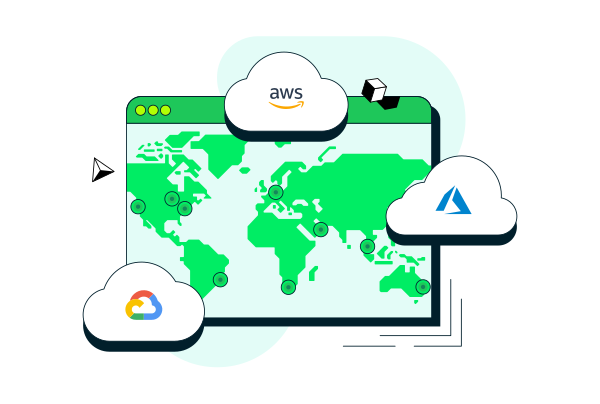
platforms like AWS, but here’s the
catch—they weren’t paying MongoDB
to do it. This was a huge missed
opportunity.
|
|
MongoDB faced another crucial
decision. Should they stay focused
on downloadable software, or
should they shift their business
model to a fully managed cloud
service?
|
|
They took the leap and launched MongoDB Atlas
in 2016, a cloud version of their
database.
|
|
This wasn’t just a small tweak—it
was a complete transformation of
their business.
|
|
They went from shipping software
to managing databases for their
customers. It was a risky move,
but it paid off.
|
|
Atlas grew rapidly and eventually
became the core of MongoDB’s
business, representing 70% of
their revenue.
|
|
What shifts are happening in your
industry?
|
|
Could embracing a new trend, like
cloud services, unlock a bigger
opportunity for your
business?
|
The Fight Against the Giants
|
|
But the story doesn’t end there.
In 2018, Amazon, the behemoth of
cloud services, launched DocumentDB, a direct competitor to
MongoDB’s Atlas.
|
|
Imagine the nerves in MongoDB’s
boardroom as the news broke. Their
stock took a hit, and investors
worried that Amazon would crush
them.
|
|
But instead of panicking,
MongoDB’s leadership saw this as
validation. If Amazon was copying
them, it meant MongoDB was onto
something big.
|
|
They doubled down on their
strengths and kept improving
Atlas. In the end, MongoDB's bet
on cloud services paid off.
|
|
What would you do if a giant
competitor entered your
space?
|
|
Would you retreat, or would you
use it as motivation to level up
your product?
|
Navigating the Open-Source
Challenge
|
|
There was still another challenge
lurking. MongoDB’s open-source
model meant that other companies
could use their software for free
and even offer competing
services.
|
|
To protect themselves, MongoDB
made a bold change in their
licensing model, switching to the Server Side Public License
(SSPL). This move ensured that anyone
using MongoDB’s code for a paid
service would either have to pay
MongoDB or open-source their own
code.
|
|
The decision wasn’t easy—there
was backlash from parts of the
open-source community. But MongoDB
stuck to their guns, knowing that
it was essential for their
long-term survival.
|
|
What’s the one change you need to
make in your business, even if
it’s risky or
unpopular?
|
|
Sometimes, the toughest decisions
lead to the biggest
breakthroughs.
|
From Product to Platform
|
|
Here’s the twist: after all those
years of narrowing their focus,
MongoDB is now evolving back into
a platform.
|
|
Customers are asking for
more—they want to do everything on
MongoDB, from search functions to
handling large-scale data
analysis.
|
|
MongoDB’s founders started with
a vision for a platform, pivoted
to a product, and are now coming
full circle.
|
|
As a startup founder, it’s
important to start small and focused
but never lose sight of your
larger vision. Once you gain
traction, you earn the right to
expand.
|
➡️
Your Next Move
|
|
Now it’s your turn.
|
|
What can you do today to take
your business to the next level?
Are you focusing on the right
product?
|
|
Are you tapping into the latest
trends like cloud services, AI, or
automation?
|
|
And most importantly, are you
ready to make the bold decisions
that could turn your startup into
the next MongoDB?
|
|
Share your current challenges and
crucible moments with your
community. What decision do you
need to make that could change
everything?
|
|
And if you’re ready to take the
next step, start thinking about
how you can leverage focus,
customer feedback, and bold moves
to unlock new opportunities for
your business.
|
|
Let’s get to work!
|
|
|
|
**Special thanks to Sequoia Capital and the Crucible Moments
podcast team for providing
invaluable insights into the
pivotal decisions that shaped
MongoDB's journey.
|