⚡The Anatomy of an Exceptional Startup
⚠️Fundable ≠ Well-Rounded

In This Edition:
- ⚠️ Fundable ≠ Well-Rounded
- ✅ Why #1 Takes Everything
- 🎯 How to find investors
- ⚙️ AI Tools Making Your Work 10x Faster
- 🚀 Why Some Startups Win Forever
⚠️Fundable ≠ Well-Rounded
⚡The Anatomy of an Exceptional Startup
🧠 Most founders fail before the pitch deck
Not because their idea is bad.
Not because investors are unfair.
But because they’re optimizing the wrong layer of fundability.
Naval Ravikant has a brutal mental model for what actually makes startups investable—and most founders unknowingly spread their effort across all the wrong places.
Here’s the uncomfortable truth:
• A great pitch can’t hide weak traction
• Social proof doesn’t create belief—it only amplifies it
• “Well-rounded” founders blend into noise
• Exceptional founders dominate one layer ruthlessly
The real question isn’t “Is your startup good?”
It’s “Where are you unfairly strong?”
In this breakdown, we map Naval’s 5 Layers of Fundability—from raw signal to story—and explain why being exceptional at one layer beats being decent at all five.
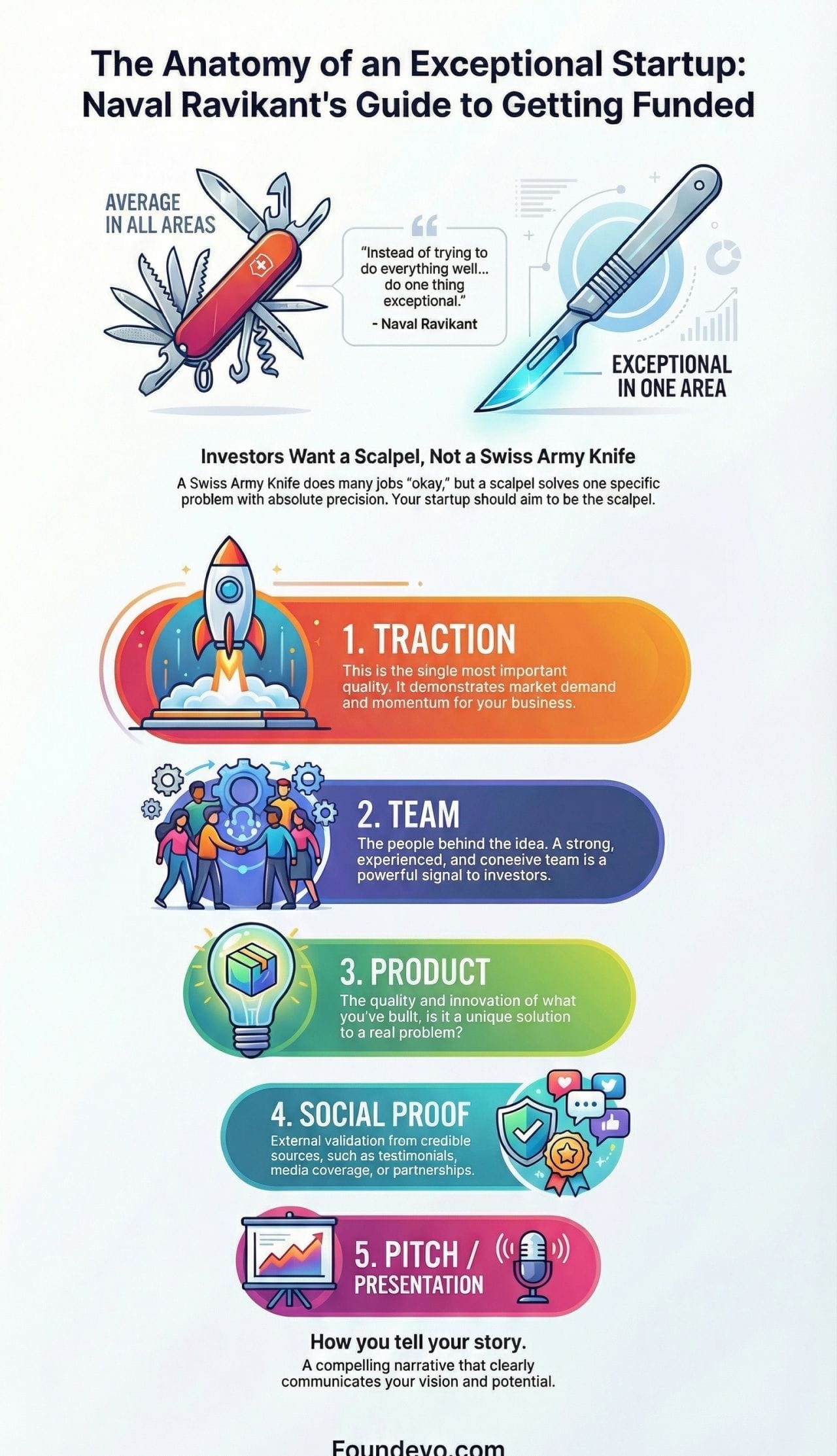
If you’re raising (or planning to), this will change how you think about traction, team, and storytelling—permanently.
👉 Read the full breakdown here.
(You’ll immediately see which layer you’re accidentally neglecting)
🚀 Why #1 Takes Everything
🚨 The New Holy Grail of Fundable Startups
🧠 Most founders are training for the wrong sport
Everyone talks about product–market fit.
But the founders who actually win are optimizing for something far rarer—and far more uncomfortable.
Naval Ravikant frames startups not as businesses…
but as the Olympics of leverage, obsession, and asymmetric outcomes.
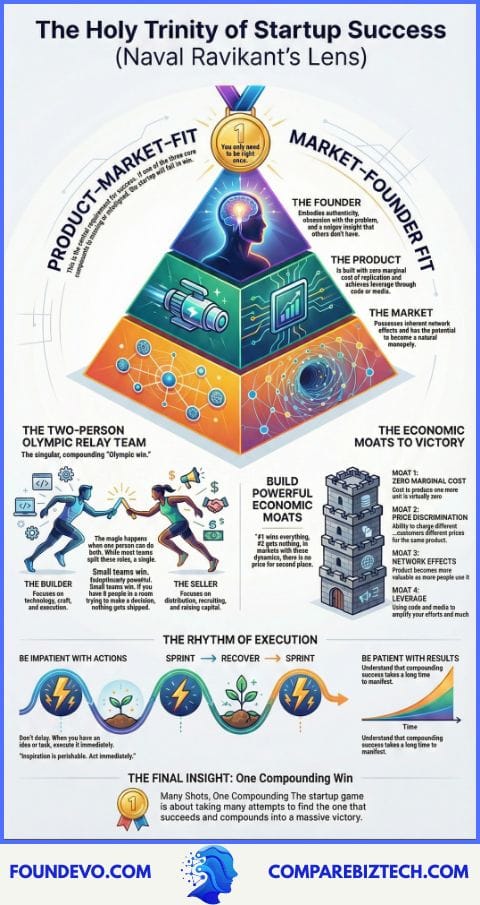
Where:
- Being “pretty good” gets you nowhere
- Copying competitors quietly kills your edge
- One right bet can outweigh ten failures
- And founder–market alignment matters more than hustle
The uncomfortable truth?
If this isn’t the only game you want to play—you’re already losing.
This breakdown explains Product–Market–Founder Fit, why #1 takes most of the rewards, and how elite founders sprint, recover, and compound instead of burning out.
👉 Read the full blueprint here.
(You’ll immediately recognize whether you’re built for this game—or just playing around it)
🎯How to find investors
✋How Startups Can Find Their Perfect Investor
Raising capital isn’t the hardest part… choosing the right investor is.
Most early-stage founders obsess over how to get funding but rarely ask the question that matters even more:
👉 “Who should I actually take money from?”
Because the truth is:
The wrong investor can slow you down. The right one can change your entire trajectory.
Before you sign that term sheet, ask yourself:
🔸 Do they understand my industry well enough to guide me?
🔸 Can their network open doors I can’t open alone?
🔸 Have they helped companies like mine scale — or exit?
🔸 Will they support me beyond just wiring money?
🔸 And most importantly… what red flags am I missing?
Founders often assume capital is scarce, but aligned capital is what truly moves the needle.
And choosing poorly can cost you far more than equity.
This deep dive breaks down:
✨ The 3 types of startup investors (and which one fits your stage)
✨ What “good” industry + functional expertise actually looks like
✨ How to evaluate an investor’s track record and network
✨ One major red flag hidden inside many term sheets
✨ How to structure a clean, founder-friendly raise
✨ Plus: A sample term sheet you can download and use
If you’re raising now — or planning to — this isn’t just helpful. It’s essential.
⚡ AI Tools You’ll Wish You Found Sooner
⚙️ AI Tools Making Your Work 10x Faster
If you’re looking to work faster, smarter, and with less manual effort—these AI tools are worth bookmarking. From automating research to simplifying relocations and transforming how you take notes, each one solves a real daily workflow problem.
Here are a few standouts:
✅ Moshi – lightning-fast conversational AI
✅ Mindpal – trains itself on your work context
✅ Move AI – your personal relocation assistant
✅ Octane AI – smarter Shopify growth
✅ Lectura – video summaries + personalized notes
…plus meeting automation, visual creation tools, and more.
👉 Explore the full list and boost your workflow now.
🚀 Why Some Startups Win Forever
🚀 The 7 Strategies That Turn Startups Into Unstoppable Companies
Ever wonder why some startups scale into icons while others disappear?
Spoiler: It’s not luck. It’s a strategy.
Founders obsess over execution and culture (and yes, they matter)…
But as Patrick Collison says, too many ignore the third pillar of enduring success: strategy.
That’s where Hamilton Helmer’s 7 Powers becomes a game-changer — a framework that shows exactly how to build long-term competitive advantage, stay relevant, and grow with intention, not chaos.
If you want to build a startup that lasts, these 7 powers aren’t optional — they’re essential.
👉 Dive into the full breakdown and see which powers your startup can unlock next.
🎯 Startups Buzz
🔒 The VC Secrets Founders Aren’t Supposed to Know
Every investor has two conversations:
➡️ The one they have with you in the meeting…
➡️ And the one they never say out loud.
From quiet deal-breakers to subtle power plays hidden in term sheets, there’s a whole side of fundraising founders rarely see — until it’s too late.
What if you could read the signals VCs hope you miss?
What if you knew the questions they really judge you on?
The truth is: the transparency gap in VC isn’t accidental.
But once you understand how investors think behind closed doors, your entire fundraising strategy changes.
👉 Unlock the unspoken VC playbook before your next pitch.
📉 Why “Default Alive” Is Becoming the New Startup Superpower
Remember when growth-at-all-costs was the golden rule?
That era is dead.
Investors today are backing founders who can keep the lights on without endless fundraising — the ones who know how to stretch runway, stay scrappy, and build a business that won’t collapse the moment the market shifts.
“Default alive” isn’t just survival… it’s becoming the clearest signal of founder discipline, product clarity, and operational excellence.
So how are smart founders staying lean and accelerating?
👉 Here’s the mindset shift separating the startups that last from the ones that vanish.
📉 The Startup Metric That’s Misleading More Founders Than You Think
Some charts look great… right up until the moment your runway disappears.
Founders love showcasing “monthly users,” traffic spikes, and pretty dashboards — but those vanity metrics often hide the uncomfortable truth: they don’t predict survival.
In fact, the numbers that look impressive on pitch decks might be the very ones masking stagnation, weak demand, or a leaky funnel.
If your growth feels good but isn’t converting into durability, you might be tracking the wrong things entirely.
So what actually matters?
👉 Here are the only three metrics that reveal whether your startup is built to survive.
🔥WEB PICKS
📊 The AI Capex Question Everyone’s Missing
Axios reframed the AI bubble debate: the real risk isn’t hype—it’s whether demand ramps fast enough to justify today’s massive infrastructure spend, because markets are already pricing in tomorrow’s usage.
🏗️ From One Image to a Real 3D World
3D-RE-GEN showed that single indoor images can be reconstructed into coherent, editable 3D meshes—not just photorealistic renders—using camera recovery and spatial optimization.
🎭 Text-Driven Characters in Static 3D Worlds
Animate Any Character demonstrated controllable character animation where users drop a character into a scene and drive consistent behaviors over time using plain text.
🎥 Why Video Agents Still Fall Short
4D-RGPT argued current video models lack true spatial understanding. It introduced depth-aware, region-level 4D perception—and a new benchmark, R4D-Bench, to measure it.
🧪 Why AI Still Struggles With Real Science
SGI-Bench revealed models fail at full scientific workflows. The paper proposed a new benchmark plus a test-time RL method to improve novelty, rigor, and executability.
🧠 A New Path to Embodied Intelligence
PhysBrain proposed scaling embodied AI by converting millions of first-person human videos into structured, grounded supervision—over 3M examples strong.
📐 The Case for Laws of Reasoning
LoRe argued that reasoning progress needs predictable rules. It showed how fine-tuning can enforce monotonicity and compositionality to make reasoning more reliable.