Mozilla Foundation Fellowship 2027–2028 Offers Up to $125,000 in Funding – Apply by December 17, 2026

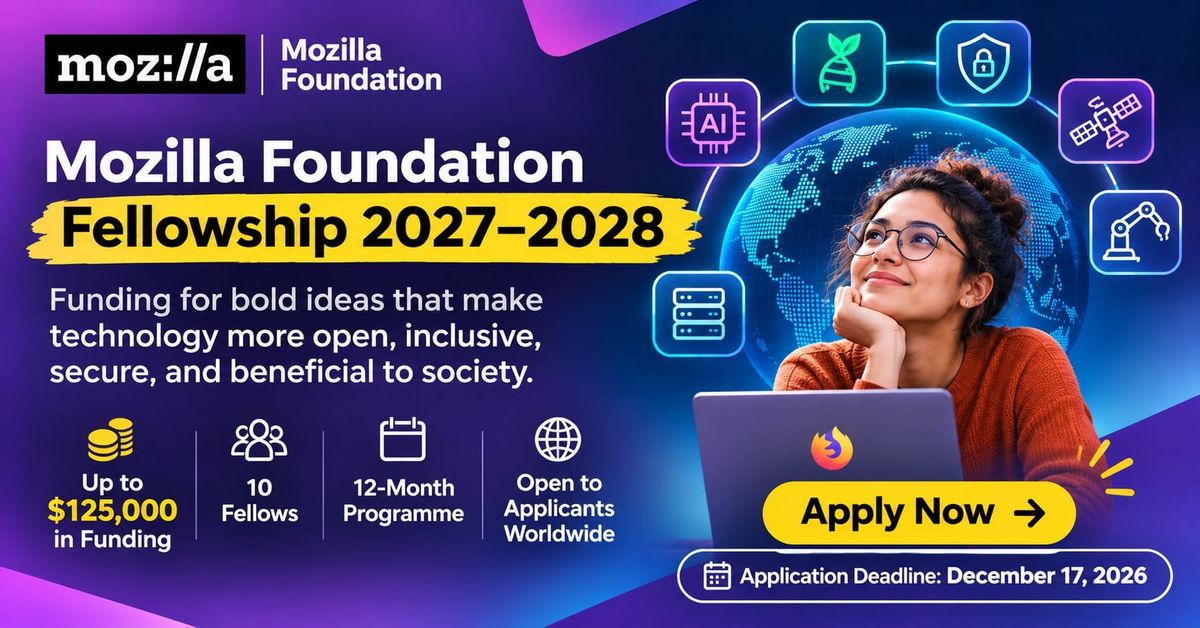
Mozilla Foundation Fellowship 2027–2028 is now accepting applications from technology innovators, independent researchers, developers, founders, and creative advocates working on ideas that can make technology more open, accessible, secure, and beneficial to society. Selected Fellows can receive up to $125,000 in funding over 12 months, alongside mentorship, global networking opportunities, and access to Mozilla's technology ecosystem.
The Mozilla Foundation plans to select 10 Fellows for its 2027–2028 programme. Applications are open to individuals from around the world, including applicants outside the United States. The first stage requires a Letter of Intent (LOI), which must be submitted by December 17, 2026, at 11:59 PM Pacific Time.
Unlike traditional startup funding programmes, the Mozilla Fellowship focuses on people building technology that challenges existing systems and puts communities, users, and public interests first. Its 2027–2028 cohort will explore emerging areas such as artificial intelligence, quantum computing, biotechnology, physical AI, digital infrastructure, cybersecurity, and the future of the open internet.
For individuals developing ambitious technology projects that may struggle to find conventional funding, this could be an opportunity worth exploring.
Important application details
- Programme: Mozilla Foundation Fellowship 2027–2028
- Funding: Up to $125,000 USD
- Selected applicants: 10 Fellows
- Duration: 12 months
- Application type: Individual applications
- First application deadline: December 17, 2026
- Programme start: June 1, 2027
- Eligible applicants: International applicants, subject to funding eligibility requirements
- Official application: Apply
What Is the Mozilla Foundation Fellowship 2027–2028?
The Mozilla Foundation Fellowship is a funding and professional development programme designed to support individuals who are working on ambitious technology projects with meaningful public benefits.
Mozilla Foundation wants to support people who are not simply developing another commercial product but are exploring better ways to build, govern, distribute, and maintain technology.
The programme is particularly interested in projects that challenge concentrated technological power, improve digital rights, strengthen open-source infrastructure, and give communities greater control over the systems they depend on.
For the 2027–2028 cycle, Mozilla is planning to award 10 Fellowships across two different tracks.
Selected participants will receive financial support, access to experienced mentors, collaboration opportunities, and connections with an international network of more than 200 previous Fellows.
The programme also provides opportunities to connect with teams across Mozilla, including people working on Firefox, Thunderbird, Mozilla.ai, and other technology initiatives.
One important point is that the Fellowship is designed around the selected individual's project rather than a traditional classroom-style curriculum. Fellows spend most of their time developing their own work while participating in programme activities and sharing knowledge with the wider community.
How Much Funding Does the Mozilla Fellowship Provide?
The Mozilla Foundation offers two different funding packages depending on the Fellowship track.
The total funding ranges from $100,000 to $125,000 USD.
1. Embedded Fellows – $100,000
The Embedded Fellowship is designed for rising and mid-career technology professionals who want to work on a specific challenge identified by a civil society organisation.
Selected participants collaborate with one of Mozilla's designated host organisations. The organisation provides mentorship, community connections, and an environment where the Fellow can develop a project addressing a real-world challenge.
The total funding package includes:
- $75,000 USD: Personal stipend.
- $25,000 USD: Project development budget.
The combined value is $100,000 USD for the 12-month Fellowship.
This track is particularly suitable for people who have already demonstrated technical ability through meaningful projects, research, or community-focused work but want additional support to develop their ideas.
2. Independent Fellows – $125,000
The Independent Fellowship is intended for more experienced innovators and recognised technology leaders who want to develop ambitious projects independently.
Unlike the Embedded track, participants are not required to work with a designated host organisation.
They can choose their project direction within Mozilla's focus areas and develop tools, platforms, research, or other innovations that contribute to a more open and responsible technology ecosystem.
The funding package includes:
- $100,000 USD: Personal stipend.
- $25,000 USD: Project development budget.
The total funding is $125,000 USD for 12 months.
This track is particularly relevant to established developers, technology researchers, founders, and independent innovators with a strong record of building and delivering projects.
Mozilla Fellowship funding comparison
| Funding details | Embedded Fellows | Independent Fellows |
|---|---|---|
| Total funding | $100,000 | $125,000 |
| Personal stipend | $75,000 | $100,000 |
| Project budget | $25,000 | $25,000 |
| Duration | 12 months | 12 months |
| Host organisation | Yes | No |
| Career stage | Rising/mid-career | Senior/recognised innovators |
| Project approach | Host-aligned | Independent |
Important: The stipend and project budget serve different purposes. The project budget is intended for eligible expenses associated with developing the proposed work. It should not be treated as additional personal income.
Mozilla generally pays stipends monthly. Fellows are responsible for their own tax reporting and any applicable taxes in their country of residence.
8 Focus Areas Covered by the Mozilla Foundation Fellowship
The 2027–2028 Fellowship focuses on eight areas where emerging technology could create significant opportunities or challenges for society.
Applicants should identify the area that most closely matches their project.
1. Neurotech, Biotech and Physical AI
Technology is increasingly moving beyond traditional computers and smartphones.
Brain-computer interfaces, biological sensors, robotics, and physical AI are creating new possibilities in healthcare, research, manufacturing, and everyday life.
However, these technologies also introduce important questions about privacy, ownership, safety, and community control.
Mozilla is interested in projects that make these emerging technologies more accessible and accountable.
Potential project directions include:
- Privacy-focused brain-computer interfaces.
- Open-source robotics and physical AI systems.
- Community-owned biological and environmental monitoring tools.
- Technology that protects neural, biometric, and movement data.
- Open biotechnology systems that communities can govern.
For example, a developer could build a system that allows communities to monitor environmental conditions using open-source sensors while retaining control over the collected data.
2. Hard Infrastructure – Compute, Energy, Quantum and the Extremes
The infrastructure supporting modern technology is becoming increasingly important.
Artificial intelligence depends on computing resources, electricity, cooling systems, data centres, and advanced hardware. Meanwhile, quantum computing and satellite infrastructure are opening entirely new technological possibilities.
However, much of this infrastructure remains controlled by a relatively small number of organisations.
Mozilla wants to support projects that make these systems more transparent, accessible, and open.
Potential project ideas include:
- Open-source computing hardware.
- Affordable local AI computing infrastructure.
- Quantum security tools.
- Open satellite data systems.
- Technology for monitoring data centre energy and water consumption.
- Post-quantum encryption solutions for journalists and civil society organisations.
Projects that help smaller organisations access advanced technology without depending entirely on large technology providers could be particularly relevant.
3. Raising p(bloom) – Building AI That Benefits More People
Artificial intelligence is one of the most important areas of the 2027–2028 Fellowship.
However, Mozilla is approaching AI from a different perspective.
Rather than concentrating only on the risks of AI, the Foundation wants to support people who are developing systems that increase the likelihood of AI creating positive outcomes for society.
This focus area is called Raising p(bloom).
The goal is to build AI systems that improve people's lives, expand access to technology, and reduce the barriers that prevent communities from benefiting from AI.
Potential projects include:
- Affordable AI tools designed for underserved communities.
- Independent AI safety evaluation systems.
- Open-source AI infrastructure.
- AI systems that support different languages and local needs.
- Tools that help communities independently evaluate AI systems.
- Research examining whether AI regulations create unfair barriers for smaller developers.
The emphasis is on building useful AI while ensuring that its development and benefits are not restricted to a handful of powerful companies.
4. Business Models for a Post-Agentic Web
The internet is changing.
For years, much of the web operated on an advertising-supported model. Publishers and creators provided information, while users exchanged attention for access to content.
AI agents, automated browsing, subscriptions, and paywalls are beginning to challenge this model.
Mozilla wants to support people developing alternative business models that help creators, publishers, developers, and communities earn money in an increasingly AI-driven internet.
Potential project ideas include:
- Payment systems for AI agents accessing online content.
- Better attribution systems for publishers whose content is used by AI.
- Consent-based data licensing platforms.
- Cooperative ownership models for digital platforms.
- Open protocols that allow AI agents to transact.
- Alternative revenue models for independent publishers and open-source projects.
This area is particularly interesting for people working in web infrastructure, digital publishing, content licensing, AI platforms, and open internet technologies.
For example, a developer could build a system that identifies which publishers contributed information to an AI-generated answer and establishes a transparent mechanism for compensating them.
5. Shared Security and Audit Infrastructure for Small Organisations
Cybersecurity is expensive.
Large technology companies can afford security teams, penetration testing, compliance specialists, and regular system audits. Smaller businesses, nonprofits, startups, and community organisations often cannot.
This creates a gap in the technology ecosystem.
Mozilla wants to support projects that make security and auditing more accessible to smaller organisations.
Potential project ideas include:
- Affordable penetration-testing infrastructure.
- Shared cybersecurity services.
- Open-source security auditing tools.
- Community-based incident response systems.
- Tools that help nonprofits assess AI applications.
- Systems that detect security changes in third-party software.
The broader objective is to make security more accessible, similar to how a public library makes educational resources available to communities.
6. Sovereign AI, Public Infrastructure and Maintenance
Many organisations rely on external cloud providers and commercial AI platforms to operate their technology.
This can create long-term dependency.
What happens when a provider changes its pricing, discontinues a service, restricts access, or shuts down?
Mozilla wants to support technology that communities and public institutions can own, operate, maintain, and govern themselves.
Potential projects include:
- Locally operated AI systems.
- Community-owned language datasets.
- Federated learning infrastructure.
- Open-source public-sector technology.
- Tools for reducing dependency on major cloud providers.
- Digital infrastructure that continues working even when its original developer disappears.
An important part of this focus area is long-term maintenance.
Technology should not become unusable simply because a company closes or a software maintainer stops working on a project.
7. Creative Advocacy
Not every technology-focused project needs to look like a conventional software product.
Mozilla has reserved one Independent Fellowship position for a creative advocate or campaigner who can use art, culture, humour, and unconventional ideas to challenge how technology is developed and controlled.
This track is designed for people who can turn creative interventions into meaningful public conversations.
Potential approaches include:
- Technology-focused public art projects.
- Satirical digital products.
- Creative campaigns about privacy and digital rights.
- Interactive experiences that question the power of technology companies.
- Public interventions that encourage people to rethink how the internet works.
Applicants should demonstrate a record of creative advocacy and the ability to turn an idea or artistic intervention into a wider movement.
8. Wildcard Projects
Do not assume that your project is automatically ineligible simply because it does not fit neatly into the seven named areas.
Mozilla explicitly welcomes wildcard applications.
If you are developing something innovative that challenges existing technology systems and creates meaningful public benefit, you can explain why your project deserves consideration.
The important thing is to demonstrate why the idea matters, who benefits from it, and how it can be developed into something useful.
Who Can Apply for the Mozilla Foundation Fellowship?
The Fellowship is open to individuals from different professional backgrounds and sectors.
Applicants do not necessarily need to work for a nonprofit organisation. However, their proposed project must have a clear charitable purpose and create meaningful public benefit.
Mozilla is particularly interested in people who demonstrate three important qualities.
1. Trailblazing
Applicants should be working on emerging or underdeveloped technology areas rather than simply improving an established product.
2. Technical ability and execution
Having an interesting idea is not enough. Applicants should demonstrate the ability to develop their project and deliver meaningful results within 12 months.
3. Community-driven thinking
The Foundation wants people who understand the communities affected by their technology and are willing to involve those communities in its development.
Applicants should also be prepared to participate in the Fellowship community and share their work and learning with others.
Can international applicants apply?
Yes.
Applicants do not need to be US citizens or permanent residents to apply for the Mozilla Foundation Fellowship.
The programme welcomes international applicants, provided they meet the applicable legal and funding eligibility requirements.
The important distinction is that applicants must be legally able to receive grant funding from Mozilla Foundation.
They should also be able to receive payments in their country of residence and comply with relevant local tax and legal requirements.
For the Embedded Fellowship, applicants must also meet the geographical and time-zone requirements of their selected host organisation. Mozilla states that Embedded Fellows must be based in Chile, Germany, Indonesia, Nigeria, or the United States, or be able to work flexibly as remote Fellows across time zones.
This means international applicants should carefully check the requirements of their chosen track before submitting an application.
Can students and employed professionals apply?
Yes.
According to Mozilla's application FAQs, students and employed professionals can apply.
There is no general requirement to leave an existing job to participate in the Fellowship.
However, selected applicants must be able to complete their proposed projects and participate in the programme's activities.
Mozilla also allows Fellows to receive other funding alongside their Fellowship stipend.
Which Organisations Are Hosting Embedded Fellows?
For the 2027–2028 cohort, Mozilla has identified five host organisations for the Embedded Fellowship.
Each organisation has a specific challenge that selected Fellows will help address.
1. BASAibu – Indonesia
BASAibu is a community-governed platform where young Indonesians develop policy proposals.
The organisation is looking for open-source tools that can help process and understand proposals written in different local languages.
2. Fundación Kamanau – Chile
This organisation works on human rights, neurotechnology, and neural data.
Its proposed project focuses on creating an open platform where people can report and analyse harms related to AI and neurotechnology.
3. LAS Art Foundation – Germany
LAS Art Foundation works at the intersection of art, science, and technology.
Its project focuses on developing an experimental planetary observatory that helps communities, researchers, artists, and environmental experts understand satellite and environmental data.
4. Quantum Village – United States
Quantum Village aims to make quantum technology more accessible to independent technologists, researchers, and developers.
Potential work includes open-source quantum tools, quantum networking, cryptography, and experimental applications.
5. Slum & Rural Health Initiative – Nigeria
This organisation works to improve healthcare access in underserved communities.
Its proposed project focuses on community-owned systems for managing mental health data, including privacy, consent, governance, and benefit-sharing.
Applicants interested in the Embedded track should study these organisations and select the one that best matches their experience and project direction.
How to Apply for the Mozilla Foundation Fellowship 2027–2028
The application process has multiple stages.
Applicants must first submit a Letter of Intent. Only a small number of shortlisted candidates will be invited to complete the full application.
Here is the process.
Step 1: Review the Official Fellowship Guidelines
Before preparing an application, visit the official Mozilla Foundation Fellowship page.
Read the focus areas, eligibility requirements, funding details, and host organisation descriptions.
Download and review the complete Request for Proposals (RFP).
This is particularly important because the RFP explains the expectations for each Fellowship track.
Step 2: Choose Your Fellowship Track
Decide whether you are applying for:
- Embedded Fellowship: A project developed in collaboration with one of the five designated host organisations.
- Independent Fellowship: An ambitious project developed independently within one of Mozilla's focus areas.
Your professional experience, project maturity, and preferred working approach should guide this decision.
Step 3: Prepare Your Letter of Intent
The Letter of Intent is the most important initial stage of the application.
Mozilla estimates that completing the LOI will take approximately 60 minutes.
The application requests information about:
- Your personal and professional background.
- Current location and professional experience.
- LinkedIn, GitHub, and portfolio links, where applicable.
- Your Fellowship track and selected focus area.
- Your proposed project.
- Target users and potential beneficiaries.
- Existing project traction.
- Expected project outcomes.
- Technical skills and relevant experience.
- Project milestones.
- Public benefit and charitable purpose.
- Your motivation for joining the Fellowship.
Applicants should provide clear and specific answers rather than relying on general descriptions of their ambitions.
Step 4: Demonstrate Your Previous Work
Mozilla specifically encourages applicants to share something the reviewers can examine.
This could include:
- A GitHub repository.
- A working product demonstration.
- A deployed technology platform.
- Research publications.
- A dataset.
- A technical paper.
- A creative performance or project portfolio.
Your application should explain what you have already built, who uses it, and what you have learned.
A working prototype is useful, but the FAQs clarify that an early idea or wireframe can also be considered if you demonstrate a credible pathway towards developing a working tool or prototype during the Fellowship.
Step 5: Submit Your Letter of Intent
Complete the application through Mozilla's official application portal.
Check all information carefully before submitting.
According to the official FAQ, submitted applications cannot be edited or updated afterwards.
Late submissions will not be accepted, and Mozilla does not offer deadline extensions.
Step 6: Wait for the Shortlisting Decision
After the LOI review, shortlisted applicants will be invited to submit a full application.
The invitation date is February 16, 2027.
The full application deadline is March 12, 2027.
Final applicants are expected to be notified by April 30, 2027.
Mozilla Fellowship 2027–2028 Important Dates
Applicants should keep the following dates in mind.
| Application milestone | Date |
|---|---|
| Letter of Intent portal opens | October 20, 2026 |
| Letter of Intent deadline | December 17, 2026 |
| Full application invitation | February 16, 2027 |
| Full application deadline | March 12, 2027 |
| Final applicant notification | April 30, 2027 |
| Fellowship begins | June 1, 2027 |
| Fellowship duration | 12 months |
Deadline reminder: The LOI must reach Mozilla by December 17, 2026, at 11:59 PM Pacific Time (UTC-8). Do not wait until the final hours to submit.
What Happens After You Are Selected?
The Mozilla Fellowship is designed to support Fellows throughout a 12-month project development period.
Selected participants receive more than financial support.
The programme provides several opportunities to develop their projects and professional networks.
Mentorship and professional guidance
Fellows receive support from a dedicated programme manager and senior curricular advisor. They can access regular one-to-one discussions, problem-solving assistance, and relevant professional introductions.
International networking
Participants join a global network of more than 200 previous Mozilla Fellows.
This creates opportunities to connect with researchers, developers, technology advocates, and people working on similar challenges.
Access to Mozilla's technology ecosystem
Fellows can receive introductions to teams and initiatives associated with Firefox, Thunderbird, Mozilla.ai, the Mozilla Data Collective, and Mozilla Ventures.
Travel and programme events
Mozilla covers eligible travel and accommodation for important programme gatherings.
The programme includes a Fellows Kick-off in July 2027 and MozFest 2027 in October.
Leadership development
Participants can also access coaching, workshops, and opportunities to develop their leadership skills.
Fellows are expected to contribute approximately 5–10 hours per month to the Fellowship community, in addition to their own project work.
What Makes a Strong Mozilla Fellowship Application?
Receiving funding is competitive, and submitting an application does not guarantee selection.
Mozilla evaluates proposals using several important questions.
A strong application should address the following areas.
1. Explain why your project is needed now
Show why the technology area is still developing and why existing solutions are insufficient.
Explain what makes your approach different.
2. Identify the people who will benefit
Avoid describing your target audience too broadly.
Identify the communities, organisations, developers, or users who will actually use the proposed technology.
3. Demonstrate that you can deliver
Explain how you will move from your current project stage to a working output within 12 months.
Include realistic milestones and measurable outcomes.
4. Explain who controls the technology
Mozilla places significant importance on user agency and community participation.
Describe how the people affected by your project will influence its development and governance.
5. Show what you bring to the Fellowship
Explain your previous achievements, technical knowledge, experience, and willingness to contribute to the wider community.
6. Provide evidence of your work
Whenever possible, share a working demonstration, repository, research paper, deployment, or other evidence.
A clear demonstration of your capabilities can make your application more convincing than a proposal based entirely on future promises.
Can You Use AI Tools to Prepare Your Application?
Yes, but there are important restrictions.
Mozilla recognises that applicants may use AI tools and translation software to brainstorm ideas, improve clarity, or assist with language.
However, the Foundation expects all submitted responses to reflect the applicant's own original work, ideas, and voice.
AI tools should support the application process rather than generate complete answers on behalf of the applicant.
Applications that appear to be heavily or entirely AI-generated may receive additional scrutiny.
If you use AI tools, be transparent about how you used them in the application.
This is particularly important for applicants who are using AI writing assistants to prepare their project descriptions or application responses.
Frequently Asked Questions About the Mozilla Foundation Fellowship 2027–2028
1. Is the Mozilla Foundation Fellowship fully funded?
The Fellowship provides a funding package of $100,000 for Embedded Fellows and $125,000 for Independent Fellows. Each package includes a personal stipend and a separate project budget.
2. Can applicants from India apply?
International applicants, including people outside the United States, are welcome to apply. Indian applicants should verify that they can legally receive Mozilla Foundation grant funding in India and meet the requirements of their selected track. The Embedded track also has specific host organisation and time-zone requirements.
3. Do I need to be a US citizen to apply?
No. US citizenship and permanent residency are not required. Applicants must, however, be legally able to receive the funding.
4. Can I apply without an established company or nonprofit?
Yes. The Fellowship funds individuals rather than organisations. Your proposed project must have a charitable purpose and create meaningful public benefit.
5. Can I apply with only an idea?
Yes. Mozilla's FAQ confirms that applicants can apply with an idea or wireframe. However, the proposal must explain how the idea can become a working prototype or tool that benefits the public within the Fellowship period.
6. Can employed professionals apply?
Yes. Applicants can continue working or studying during the Fellowship, provided they can fulfil the programme's project and participation requirements.
7. Can I receive other funding while participating?
Yes. Mozilla does not prohibit concurrent funding. Fellows can receive their Fellowship stipend alongside an existing salary or other funding.
8. How many people will receive the Fellowship?
Mozilla Foundation plans to award 10 Fellowships for the 2027–2028 period.
9. Is there an application fee?
The official application information does not list an application fee. Applicants should use the official Mozilla application portal and avoid unofficial intermediaries.
10. When will the Fellowship begin?
The Fellowship is scheduled to begin on June 1, 2027, and run for 12 months.
11. Do I need a working prototype?
Not necessarily. Mozilla allows applications based on an idea or wireframe, provided the applicant presents a credible development plan. Evidence of previous work is still valuable.
12. Can a project associated with a for-profit company qualify?
Potentially, yes. Mozilla's FAQ explains that a project can be connected to a for-profit entity if the applicant can clearly demonstrate its charitable purpose and tangible benefits beyond their own team. Fellowship outputs must be independently usable, openly available, and not dependent on purchasing the commercial product.
Is the Mozilla Foundation Fellowship Worth Applying For?
For people working on emerging technologies with a strong public-interest purpose, the Mozilla Foundation Fellowship offers an interesting combination of funding, mentorship, and international exposure.
The programme is particularly relevant to independent developers, researchers, founders, and technology professionals who want to develop something that contributes to a more open and accessible digital ecosystem.
The funding is substantial, but the opportunity is not simply about receiving financial support.
Mozilla expects selected participants to deliver meaningful project outcomes, engage with communities, share their work openly, and contribute to a global network of technology innovators.
If you have a project that could improve AI accessibility, strengthen cybersecurity, support open-source infrastructure, protect digital rights, or create alternative models for the internet, this Fellowship deserves a closer look.
The most important thing is to present a clear problem, a practical solution, a defined group of beneficiaries, and a realistic plan for delivering results within 12 months.
Final Thoughts
The Mozilla Foundation Fellowship 2027–2028 is an opportunity for people who want to influence the future of technology rather than simply follow existing trends.
With up to $125,000 in funding, two Fellowship tracks, international participation, and access to a global network of technology leaders, the programme offers meaningful support for ambitious projects.
However, applicants should pay close attention to the eligibility requirements, funding structure, project expectations, and AI-use policy before applying.
The first application deadline is December 17, 2026. Since only shortlisted applicants will be invited to submit a full proposal, preparing a strong Letter of Intent should be the immediate priority.
Apply for the Mozilla Foundation Fellowship 2027–2028
Interested in applying?
Visit the official Mozilla Foundation Fellowship website to review the complete application guidelines, download the Request for Proposals, check the eligibility requirements, and submit your Letter of Intent.
Apply for the Mozilla Foundation Fellowship 2027–2028
You can also review the official Fellowship FAQs before submitting your application.
Don't wait until the deadline. Start preparing your project proposal and supporting evidence now.
Submit Your VC Fund
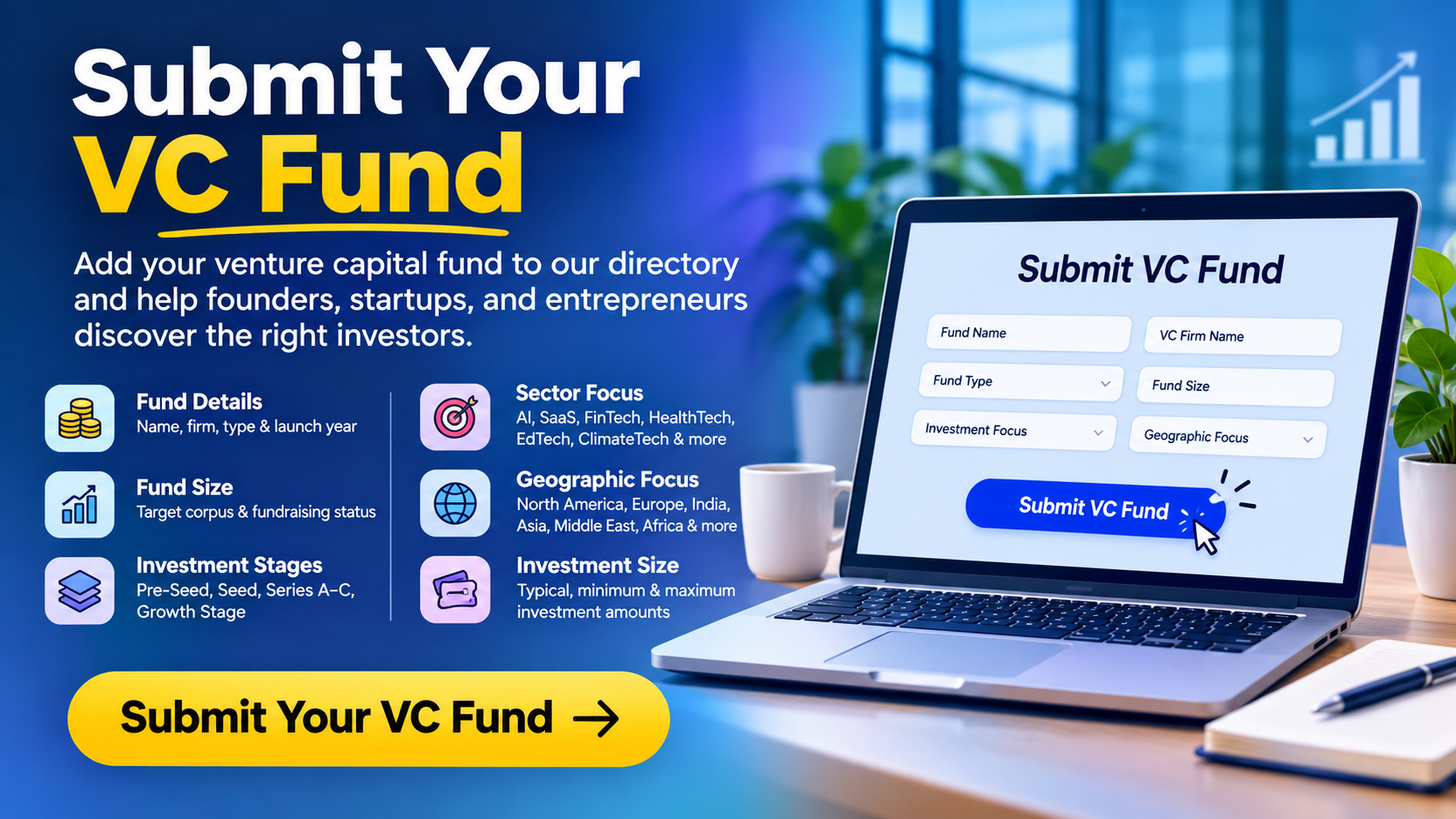
Are you managing a venture capital fund or representing an investment firm?
We are building a venture capital directory to help startup founders, entrepreneurs, and businesses discover investment firms that match their funding requirements.
Whether your fund focuses on Pre-Seed, Seed, Series A, Growth Stage, or multiple investment stages, you can submit your fund details to make it easier for founders to discover your investment firm.
Our directory accepts information about:
- VC firm and fund details
- Fund size and fundraising status
- Investment stages and typical cheque sizes
- Sector and industry preferences
- Geographic investment focus
Help founders discover your investment firm and make your fund part of our growing venture capital directory.