🦈Mark Cuban’s 12 Rules for Startups
👀 What Top VCs See First
In This Edition:
- 🦈Mark Cuban’s 12 Rules for Startups
- 👀 What Top VCs See First
- 🔥 Where Unicorn Founders Come From
- 🧠 The Psychology Behind Billion-Dollar Leaders
- 💡 Investor Rejection? Here’s the Real Reason
- 🤖 AI Sales Chatbots Work 24/7
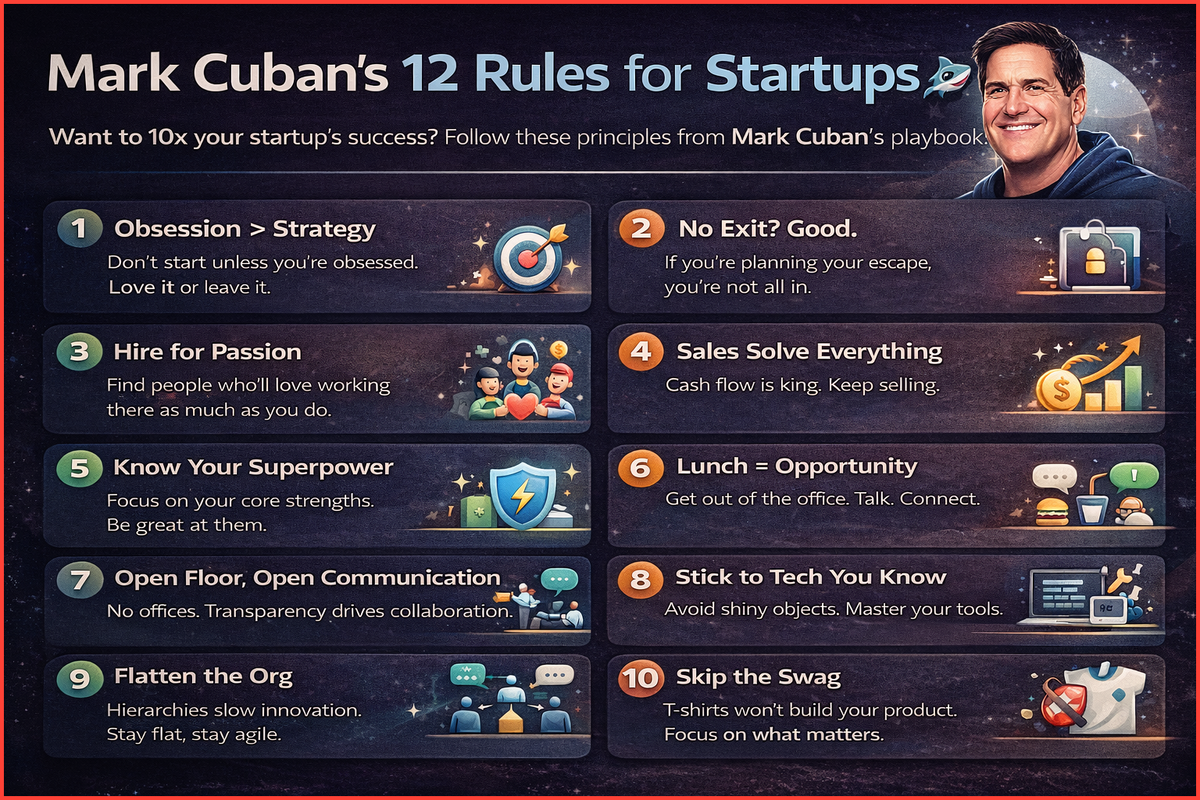
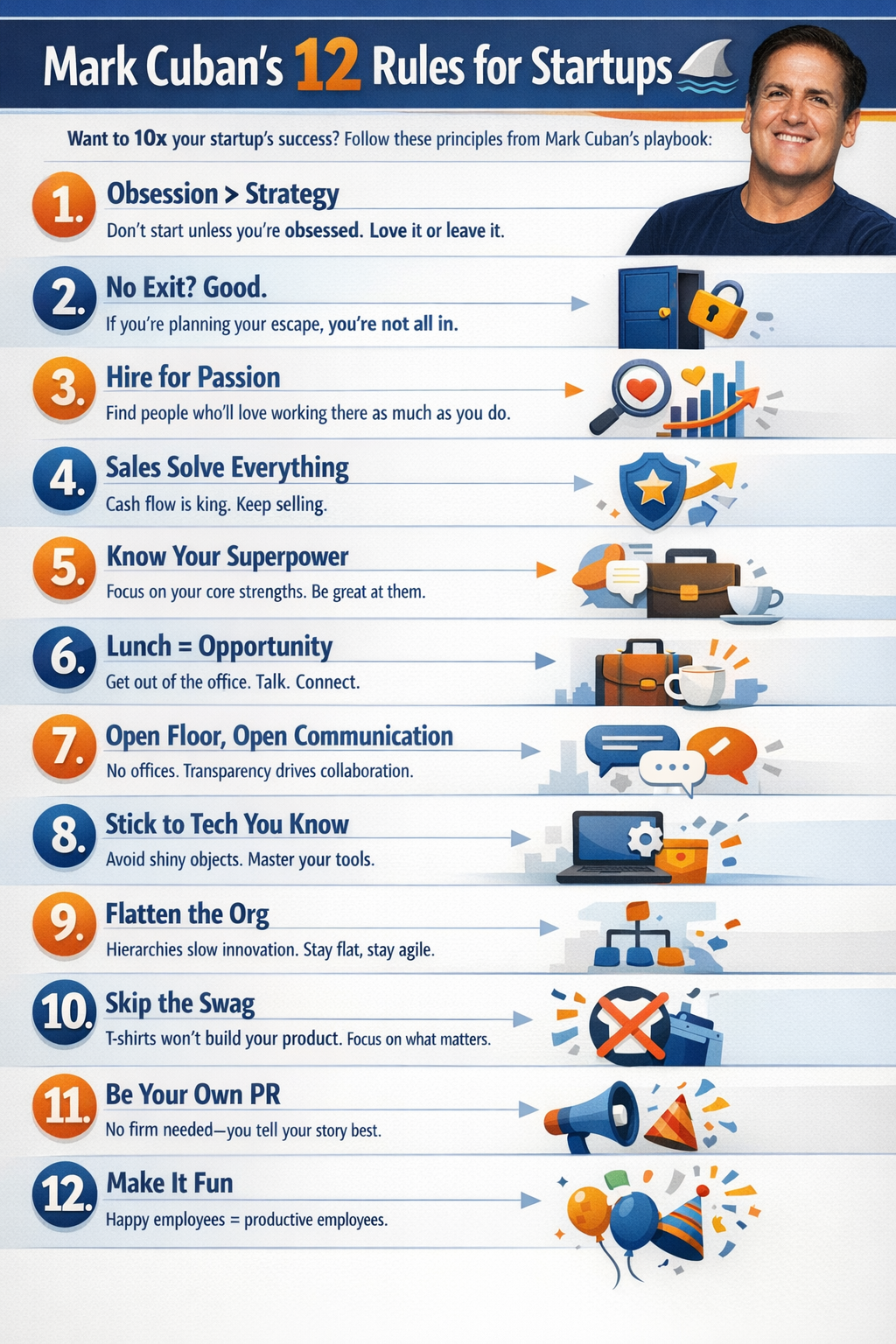
🦈Mark Cuban’s 12 Rules for Startups
🦈 Mark Cuban’s Startup Playbook, Decoded
What if the difference between surviving and scaling came down to 12 brutally honest rules?
This breakdown distills Mark Cuban’s no-nonsense startup philosophy into principles founders can actually apply—today.
- Obsession beats strategy — startups fail when founders aren’t all-in.
- Sales aren’t optional — revenue cures most problems.
- Passion compounds — teams that care outperform teams that comply.
- Flat beats fancy — less hierarchy, more speed.
- Storytelling matters — founders must own their narrative.
⚙️ How These Rules Work Together
- Focus on core strengths, not shiny distractions.
- Build cultures around transparency and fun, not perks and swag.
- Treat every conversation—yes, even lunch—as an opportunity.
💡 Why It Matters Now
In crowded, fast-moving markets, these rules act as a filter—helping founders cut noise, avoid ego traps, and stay execution-focused.
Great startups aren’t built on hacks or hype. They’re built on obsession, sales discipline, and people who genuinely care.
🚀 Want the Full Playbook? Don’t Stop Here.
This post only scratches the surface.
The complete breakdown reveals how these rules play out in real startups—and why some founders win while others stall.
👉 Read the full blog to uncover:
- The hidden rule most founders misunderstand
- Real-world implications behind Cuban’s blunt advice
- How to apply these principles without burning out or scaling too early
Click through before your competition does.
👀 What Top VCs See First
📈How To Succeed As A Sequoia Investor
What separates legendary venture funds from everyone else isn’t better predictions—it’s a radically different system.
This edition breaks down the rarely discussed operating logic behind Sequoia’s success, revealing how elite investors think, decide, and win in asymmetric markets—again and again.
- We’re in the outlier business — consistency is a trap; extreme outcomes matter more than being “right.”
- Mid-funnel discipline decides everything — what gets real time matters more than final decisions.
- Conviction > consensus — strong yes or strong no beats comfortable agreement.
- Ownership and courage compound — winners only matter if conviction shows up in sizing.
⚙️ How the System Works
- A full value chain mindset: sourcing → picking → winning → building → harvesting
- Frameworks over micromanagement, freedom within structure
- Trust built through competence, intention, and long-term behavior
💡 The Takeaway
Great investors don’t optimize for safety or popularity. They optimize for asymmetry, judgment, and compounding trust over time.
Go deeper into the exact mental models, decision frameworks, and habits used by Sequoia insiders.
Download the full ebook and study the playbook that quietly shapes billion-dollar outcomes. 👇
🔥 Where Unicorn Founders Come From
🎓 The Universities Powering America’s Unicorns
What if unicorn creation isn’t random—but systematically produced by a handful of campuses?
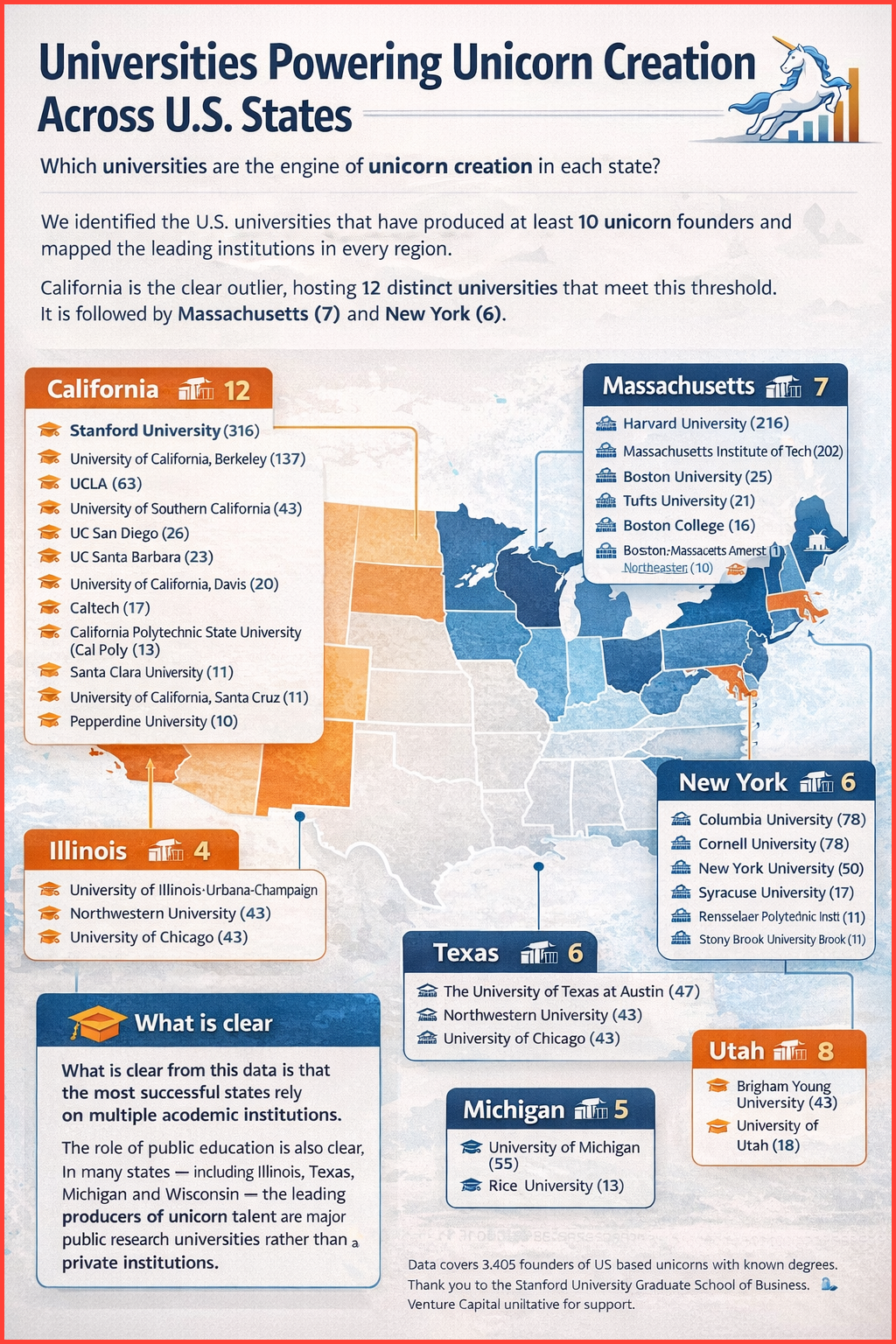
This analysis maps the U.S. universities that quietly act as engines of billion-dollar company creation, revealing clear geographic and institutional patterns behind startup success.
- California dominates with 12 universities producing 10+ unicorn founders—led by Stanford and UC Berkeley by a massive margin.
- Massachusetts and New York follow, powered by dense academic ecosystems, not single institutions.
- Public universities matter more than most assume, especially in Illinois, Texas, Michigan, and Pennsylvania.
🏛️ The Pattern Behind the Pattern
- Top states don’t rely on one elite school—they build networks of talent factories.
- Large public research universities consistently outperform expectations.
- Unicorn outcomes correlate with ecosystem depth, not prestige alone.
📊 Why This Matters
Across 3,405 unicorn founders with known degrees, the takeaway is clear: innovation scales where education scales.
Unicorns aren’t born—they’re systematically produced by strong, interconnected academic ecosystems. 🔥 See Where Unicorns Begin.
🧠 The Psychology Behind Billion-Dollar Leaders
🚀 The Traits Behind Every Unicorn Founder
A growing pattern is impossible to ignore: the founders who build generational companies share a specific psychological and execution-driven profile. These traits show up early, compound quickly, and consistently separate breakout leaders from everyone else.
🔍 What This Edition Highlights
• Obsession as a Superpower — great founders can’t disengage from the problem
• Ruthless Focus — eliminating distractions becomes a competitive edge
• Frugality & Resourcefulness — stretching every dollar extends runway and clarity
• Idea Velocity — rapid generation of good ideas fuels innovation
• Worldview Advantage — independent thinkers spot opportunities others miss
• Speed & Adaptation — execution cycles shrink while skills level up weekly
These aren’t “nice-to-have” traits — they are the defining signals investors look for when backing potential unicorn builders.
Unicorn trajectories start long before scale. They begin with mindset, intensity, and an unmistakable bias for action.
🤖 Chatbots Work 24/7
🤖 AI Sales Chatbots Are Quietly Rewriting Revenue Teams
Sales teams don’t lose deals because of weak products.
They lose them because follow-ups are slow, leads go cold, and conversations stop too early.
That’s where AI sales chatbots are stepping in.
From inbound qualification to outbound follow-ups and pipeline nurturing, tools like:
Conversica, Cresta, RoundView, BotUp, Landbot, Data Semantics, Kindly, Sanuker, Engage, Botsify, Chatfuel, Ringy, Cliengo, Hyly, BotBuilders, WotNot, ChatBot, Alan AI, Chatchamp, Instabot, Floatbot, Smoc.AI, Yosh.AI, Konverse AI, 247ChatApp, Forethought, Nurture.ai, Smartsupp, Certainly, Exceed.ai, SermoAI, Sonar, Hachly, and Chatsimple
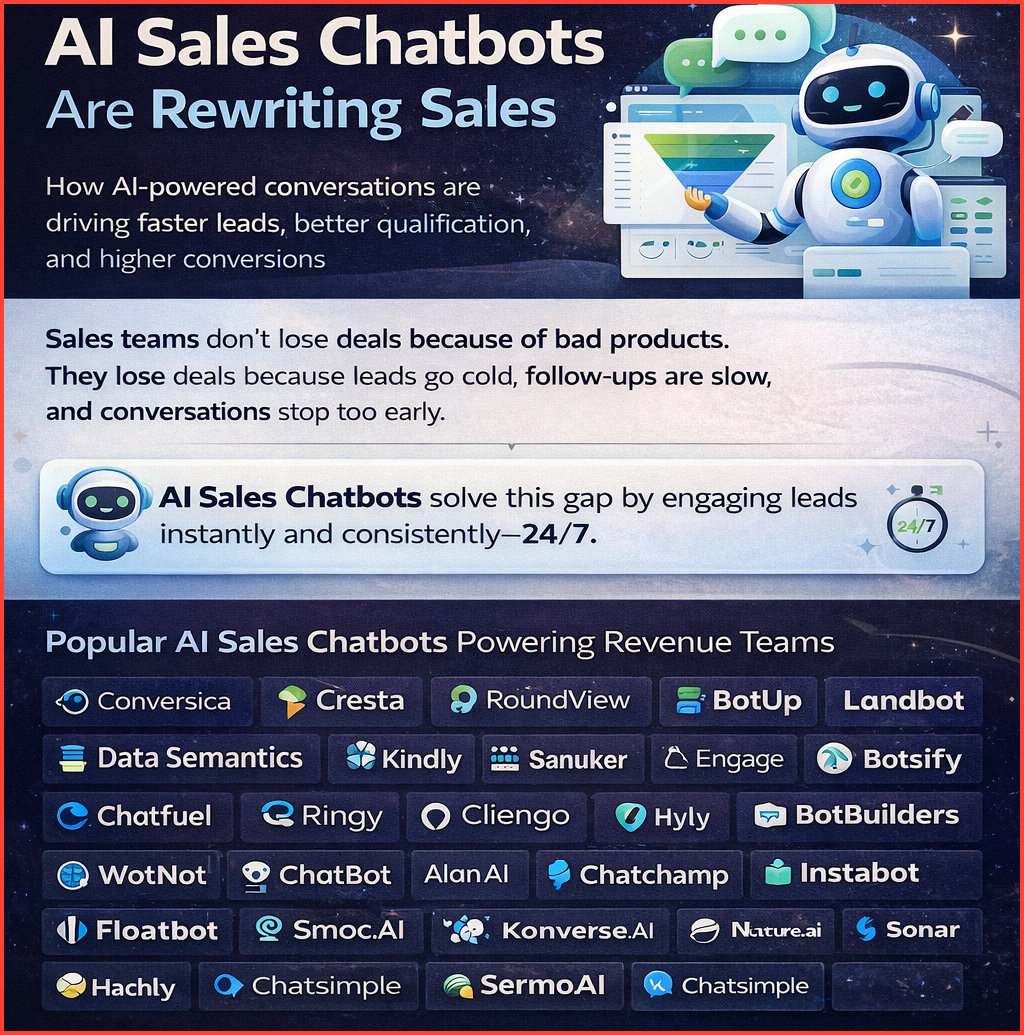
are helping teams respond instantly, qualify better, and sell at scale—without burning out reps.
What’s changing:
• AI never misses a lead
• Conversations run 24/7
• Qualification happens before humans step in
• Sales teams focus on closing, not chasing
The real shift isn’t automation.
It’s timing, relevance, and consistency at scale.
For modern sales orgs, AI chatbots are no longer a “nice to have.”
They’re becoming core infrastructure.
👇 Want to see which AI sales chatbots fit your use case and budget?
Explore a curated comparison with features, pricing, and best-fit recommendations.
🎯 Startups Buzz
🚀 How to Win Your First 100 Customers
Shipping the product is exciting.
Finding customers is where startups are really tested.
There’s no shortcut to traction.
Early growth comes from focused effort, fast experimentation, and using the right tools to turn interest into revenue.
This edition breaks down practical, founder-tested strategies to:
- Get noticed without big budgets
- Convert attention into real customers
- Build early momentum that compounds
Even better, the tools shared are free—built to help startups grow without burning cash.
👉 Read the full guide and start winning your first 100 customers.
💡 Investor Rejection? Here’s the Real Reason
Hearing “no” from investors doesn’t mean your startup is dead—it usually means something needs fixing.
Most rejections come down to avoidable issues: pitching the wrong investors, weak timing, overconfidence, poor clarity on numbers, or lack of real traction.
Fit matters too. Investors back founders they trust, understand, and can work with long-term. And sometimes, the truth is simple—investors get it wrong.
Every “no” is feedback.
Use it to sharpen your story, strengthen your business, and move forward with clarity.
👉 Explore the guide: Right Steps to Successful Fundraising for Startups and turn rejections into momentum.
🚀 Why Startups Need Sales Enablement
Sales enablement isn’t a “later-stage” luxury.
For startups, it’s a survival advantage.
Early teams move fast—but without structure, growth becomes unpredictable. Sales enablement brings alignment across sales, marketing, and customer success, helping startups create repeatable processes, consistent messaging, and scalable revenue.
It’s how startups:
- Turn chaos into clarity
- Train teams without slowing down
- Build momentum investors trust
The best part? Startups can start small and scale the function as they grow—without legacy friction.
🔥WEB PICKS
🚀 Sam Altman’s World App Just Went Full Crypto Mode
World rolled out a major app upgrade with end-to-end encrypted chat and a Venmo-style flow for sending and requesting crypto—signaling a push toward everyday, private crypto payments.
🤦 Amazon’s AI Recaps Just Failed a Timeline Test
Prime Video quietly pulled its AI-generated recaps after a Fallout summary labeled a 2077 flashback as the 1950s, raising fresh questions about AI reliability in media.
🎓 This University Is Making AI Literacy Mandatory
Purdue announced that starting in 2026, every undergraduate must prove basic AI competency—an early sign that AI education is becoming a core academic requirement.
📺 Microsoft Copilot Is Now on Your TV (And You Can’t Remove It)
LG TV owners spotted Copilot appearing via a webOS update, with reports that the app can’t be uninstalled—hinting at a future where AI assistants are baked into home devices.
🛰️ AI Has Officially Left Earth
Starcloud trained the first AI model in orbit using a satellite powered by NVIDIA hardware, opening the door to space-based data centers and off-planet computing.