Marc Andreessen's Productivity Framework for Startup Founders
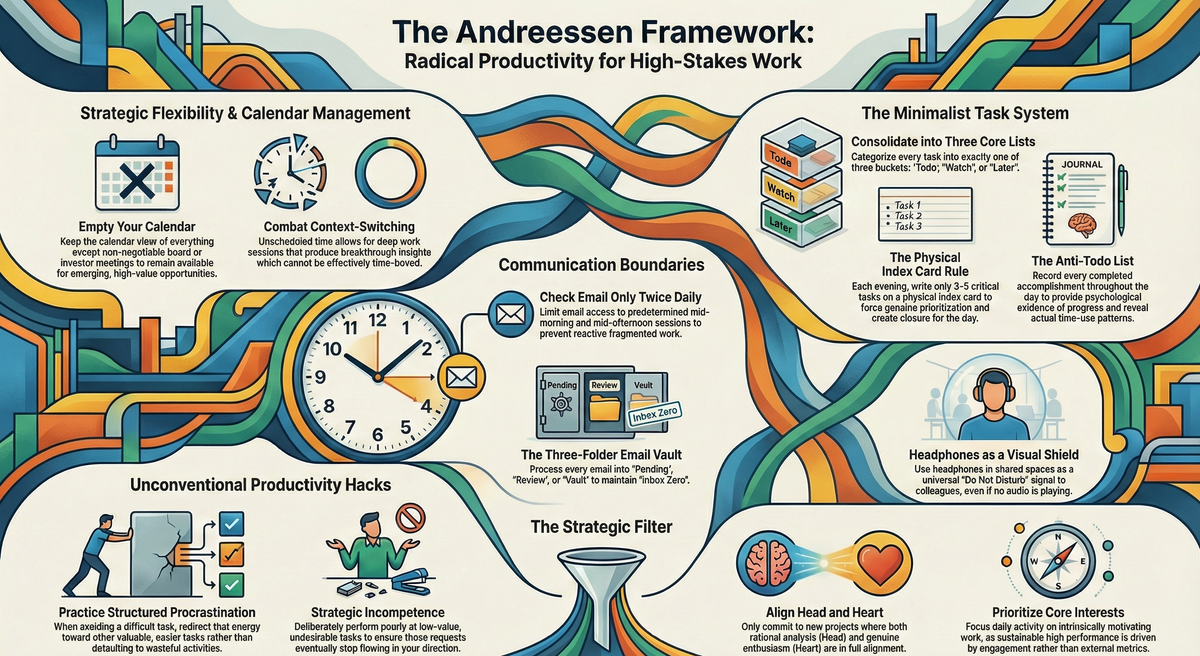
Productivity systems vary widely across industries, but those used by venture capitalists and startup founders often challenge conventional time management wisdom.
Marc Andreessen, co-founder of Netscape and Andreessen Horowitz, developed a productivity framework that prioritizes flexibility over rigid structure and focuses on outcomes rather than scheduled activities.
His approach emerged from the demands of navigating unpredictable startup environments where the ability to pivot quickly often matters more than following predetermined plans.
Understanding these principles offers insight into how high-stakes decision-makers manage attention and effort in environments where traditional productivity methods frequently fail.
The system emphasizes strategic incompetence, structured flexibility, and deliberate choices about where to invest cognitive resources.
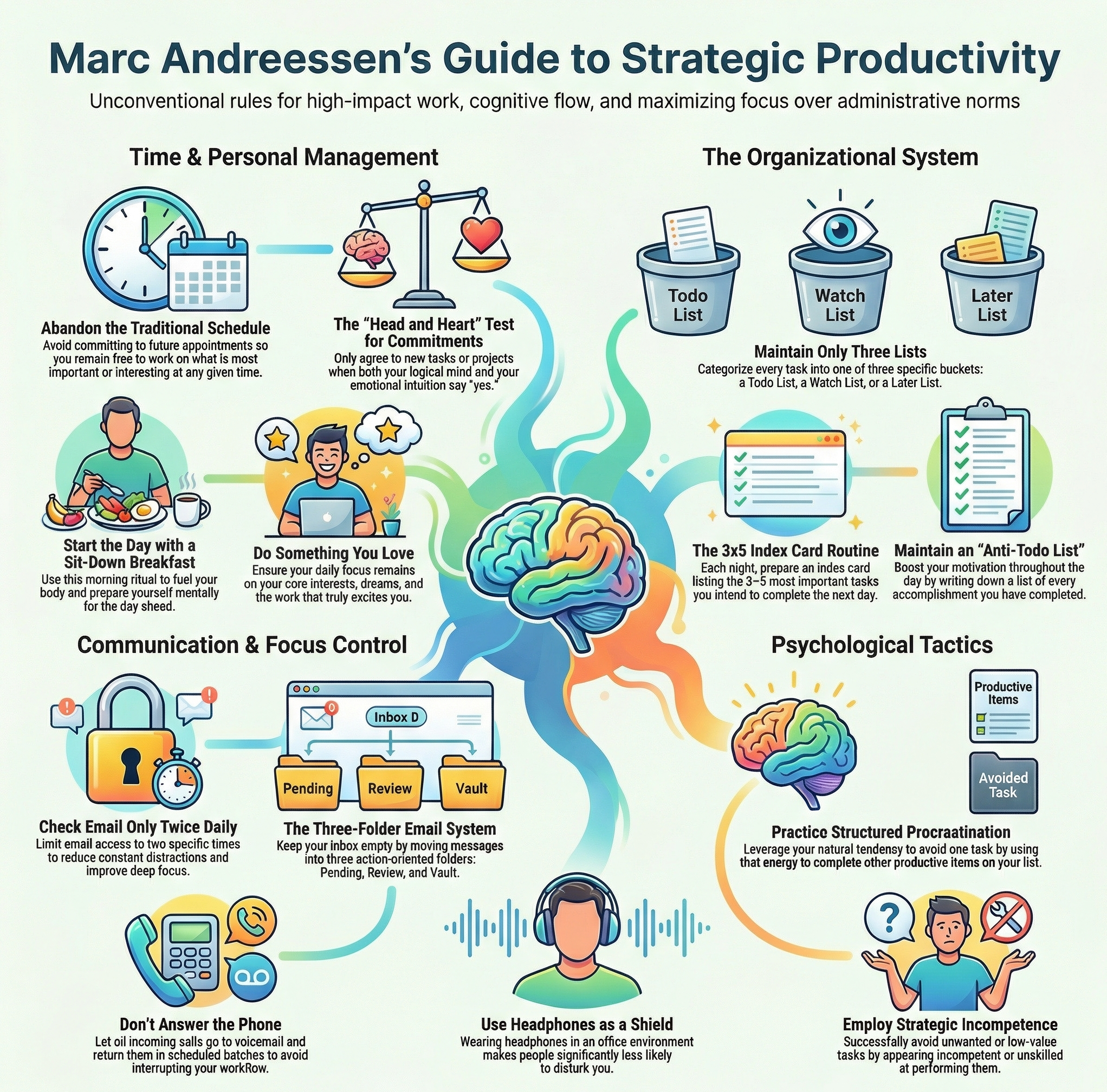
1. Eliminate Calendar Commitments to Preserve Strategic Flexibility
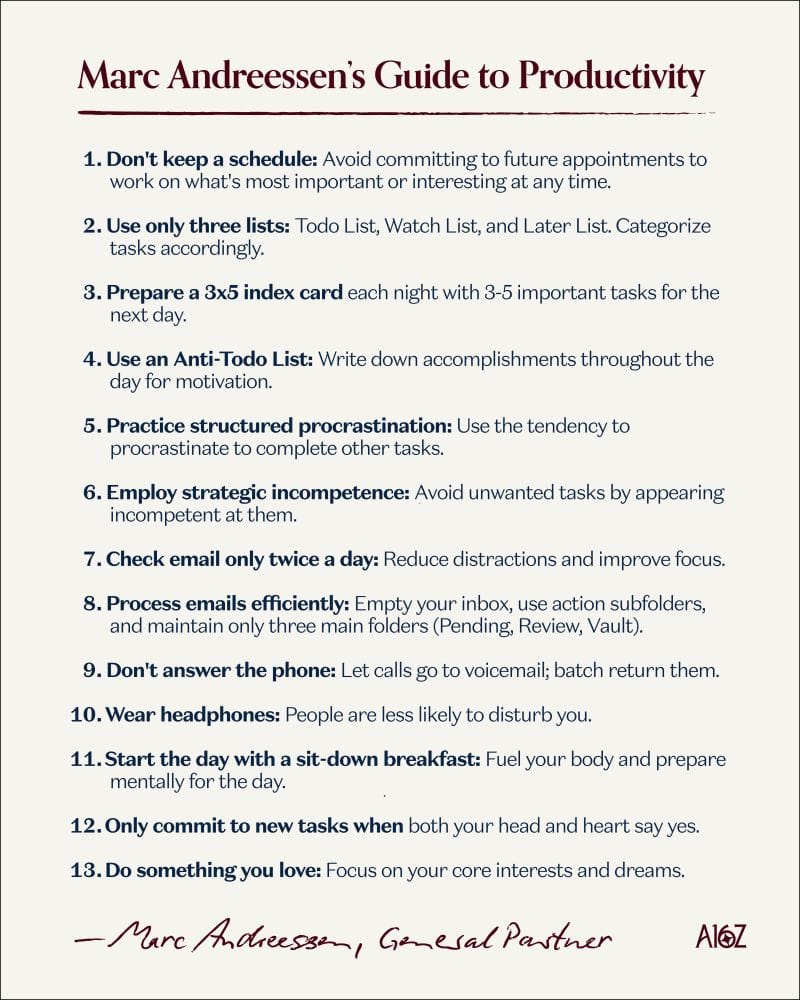
The first principle challenges the foundation of most productivity systems: the scheduled calendar. Rather than blocking time for specific work in advance, this approach maintains maximum flexibility to address whatever proves most important or intellectually engaging on any given day. The philosophy recognizes that in knowledge work—particularly in venture capital and startup leadership—the highest-value activities often cannot be predicted days or weeks ahead.
Founders and investors operating under this model keep calendars reserved primarily for non-negotiable commitments like investor meetings, board obligations, or critical team discussions. The remaining time stays unscheduled, allowing for deep work sessions on emerging opportunities, crisis management, or strategic thinking that cannot be time-boxed effectively. This creates space for the type of extended concentration that produces breakthrough insights or solves complex problems.
The primary advantage lies in reduced context-switching and the ability to pursue work when mental energy aligns with task demands. However, this system requires discipline to avoid drift into low-value activities and may not suit roles with heavy collaborative requirements. It works best for individuals with significant autonomy whose primary contribution involves thinking, analysis, and strategic decision-making rather than coordinated team execution.
2. Consolidate Task Management into Three Core Lists
Task management complexity often creates its own overhead. This principle simplifies the system to just three categories: a Todo List for immediate actions, a Watch List for items requiring monitoring but not immediate action, and a Later List for future considerations. Every potential task gets categorized into exactly one of these buckets.
The Todo List contains only items ready for execution—tasks with clear next actions that can be completed without waiting for external dependencies. The Watch List tracks ongoing situations, projects others are handling, or items awaiting information before action becomes possible. The Later List serves as a holding area for ideas, suggestions, and possibilities that may eventually move to active consideration but require no current attention.
This structure prevents the overwhelming accumulation of undifferentiated tasks that plague more complex systems. By forcing a clear categorization decision for each item, it creates natural prioritization and reduces the cognitive load of reviewing long, mixed-priority task lists. The main limitation involves discipline around the Later List—items placed there can languish indefinitely without regular review. This approach suits individuals who struggle with over-complicated task management systems or who need clarity about what actually requires attention today versus someday.
3. Prepare Daily Priorities Using Physical Index Cards
Despite available digital tools, this principle advocates for writing three to five critical tasks on a physical index card each evening for the following day. The constraint of limited space forces genuine prioritization rather than the infinite task lists digital systems enable.
The evening preparation ritual serves multiple functions. It creates closure on the current day, prevents morning decision fatigue about where to start, and establishes clear success criteria for the upcoming day. The physical artifact sits on a desk as a tangible reminder of priorities, harder to ignore than a buried digital list. Writing by hand also engages different cognitive processes than typing, potentially strengthening commitment to the selected priorities.
This technique excels at combating the tendency to mistake activity for progress. When only three to five items can fit on the card, each must genuinely matter. The limitation prevents the common trap of carrying over dozens of tasks daily while making minimal progress on strategic work. The approach works less well for roles requiring responsiveness to many small requests or for individuals whose work involves managing numerous parallel workstreams with genuine equal priority.
4. Maintain an Anti-Todo List for Motivation
While standard todo lists track intended work, an Anti-Todo List captures completed accomplishments throughout the day regardless of whether they appeared on any planning document. Every finished task, solved problem, or completed decision gets recorded.
This practice serves primarily psychological functions rather than operational ones. Knowledge work often lacks the visible progress markers of physical work, creating a subjective sense of unproductivity even during objectively productive periods. Recording accomplishments provides concrete evidence of progress, counteracting the feeling that days disappear without tangible results. The list becomes particularly valuable during difficult periods when reviewing recent accomplishments can restore confidence and momentum.
The documentation also reveals patterns in how time actually gets spent versus how it was planned to be spent. Frequent discrepancies between intended and actual work might signal either poor planning or emerging priorities that deserve more intentional attention. The main risk involves spending excessive time documenting rather than doing, transforming this motivational tool into another form of productive procrastination. This technique benefits individuals prone to imposter syndrome or those working in ambiguous domains where progress can be difficult to perceive.
5. Practice Structured Procrastination as a Productivity Tool
Rather than fighting the tendency to procrastinate, this principle redirects that energy toward completing other valuable tasks. When avoiding a particular difficult or unpleasant item, consciously choose to procrastinate by working on something else that still matters rather than defaulting to genuinely wasteful activities.
The insight recognizes that procrastination often stems from legitimate psychological resistance to specific tasks rather than general laziness. By accepting this resistance as information rather than weakness, the approach channels natural avoidance tendencies toward productive ends. The key involves maintaining a variety of valuable tasks at different difficulty levels or requiring different types of energy, enabling strategic selection based on current motivation.
This works particularly well for creative knowledge workers whose output depends heavily on psychological readiness for particular types of thinking. Forcing deep strategic work when mentally exhausted or anxious often produces poor results, while redirecting that time to clear emails, organize files, or handle administrative tasks generates real value without fighting upstream against current mental state. The limitation involves honestly distinguishing between strategic procrastination that accomplishes meaningful work and mere rationalization of avoidance. This suits individuals with varied responsibilities who can redirect attention productively rather than those with singular focus areas.
6. Employ Strategic Incompetence to Avoid Unwanted Work
This controversial principle suggests appearing genuinely incompetent at undesirable tasks to ensure they stop flowing in that direction. By performing poorly enough at activities that should not consume time and attention, others eventually stop requesting that type of work.
The underlying philosophy holds that time and attention are finite resources requiring aggressive protection. In many organizational contexts, demonstrated competence at low-value work simply generates more of the same work rather than advancement to higher-value contributions. Strategic incompetence creates space by redirecting those requests to others while preserving relationships and avoiding outright refusal.
Implementation requires careful judgment about which tasks genuinely sit outside appropriate scope versus which represent legitimate responsibilities being shirked. When applied appropriately—such as an executive avoiding technical troubleshooting or a founder resisting administrative overhead—it protects time for irreplaceable strategic work. Misapplied to core responsibilities, it damages credibility and relationships. This approach suits individuals who struggle with boundaries and saying no directly, though it carries reputation risks if the incompetence extends too widely or applies to work others reasonably expect competence in performing.
7. Limit Email Checking to Twice Daily
Email represents a primary source of externally-driven interruption for knowledge workers. This principle restricts email checking to two predetermined times daily rather than maintaining continuous or frequent access throughout working hours.
The rationale centers on protecting extended blocks of focused time from fragmenting into reactive responses to incoming requests. Most email communications do not require immediate response despite creating subjective urgency. By batching email into designated sessions, the practice enables deeper work sessions between checks while still maintaining reasonable responsiveness to genuine time-sensitive matters.
Successful implementation typically involves checking email once mid-morning and once mid-afternoon, though specific timing should align with role requirements and team expectations. Setting clear expectations with colleagues about response timeframes prevents anxiety on both sides about delayed replies. The discipline requires resisting the temptation to "just quickly check" between designated times, as single interruptions often cascade into extended reactive sessions.
This technique generates the most value for individuals whose primary contributions involve deep analytical work, creative output, or strategic thinking rather than coordination and rapid response. It fits less well for client-facing roles, team leads managing many direct reports, or positions where truly time-sensitive communications occur regularly. The approach also depends on organizational culture—some environments explicitly or implicitly require continuous availability regardless of productivity impact.
8. Process Email Using a Three-Folder System
Beyond limiting checking frequency, this principle establishes a simple processing system using only three email folders: Pending, Review, and Vault. Every email moves into exactly one of these categories after reading rather than remaining in the inbox.
Pending holds messages requiring action—either a response to write, information to provide, or a task to complete before the email can be archived. Review contains items that need reading or consideration but do not require active response, such as reports, newsletters, or informational updates. Vault serves as an archive for completed items that might need future reference but require no current attention.
The system aims to achieve and maintain inbox zero, meaning the inbox itself contains only unprocessed messages. This creates clarity about what requires attention versus what merely exists as reference material. The three-folder constraint prevents the elaborate folder hierarchies that consume time in organization and searching while providing minimal practical benefit given modern search capabilities.
This processing discipline works well for individuals overwhelmed by overflowing inboxes who struggle to identify what actually needs action. The limitation involves the ongoing discipline required to process every message into a category rather than allowing items to accumulate. Some roles generate email volume that makes complete daily processing unrealistic, requiring adaptation of the core principle rather than pure implementation.
9. Avoid Answering Phone Calls Directly
This principle advocates letting most calls go to voicemail rather than answering in real-time, then batch-returning calls at designated times. The approach protects focus time from unexpected interruptions while still maintaining phone accessibility for those who prefer that communication channel.
Phone calls represent the most intrusive form of communication, demanding immediate attention regardless of current activity or mental state. Unlike email or messaging, calls interrupt whatever work is underway and often lead to extended unplanned conversations. By defaulting to voicemail, this practice preserves control over when to engage in phone conversations and enables better preparation for discussions after hearing the message context.
Batch returning calls creates efficiency through similar context grouping and enables mental preparation for each conversation. It also naturally filters out many low-priority calls that resolve themselves or convert to other communication channels when immediate connection proves unnecessary. The voicemail message can set expectations about response timing and suggest alternative communication methods for truly urgent matters.
The approach requires cultural acceptance within professional networks and clear communication about availability for genuine emergencies. It suits individuals whose work demands extended concentration periods and whose communication needs can be met primarily through asynchronous channels. It fits poorly for roles requiring real-time availability, client service positions, or situations where being unreachable creates professional costs exceeding productivity benefits.
10. Use Headphones as a Visual Signal for Focus
Wearing headphones—even without playing audio—serves as a universal signal in shared workspaces that interruption is unwelcome. The visible indicator reduces casual disruptions from colleagues while maintaining physical presence in collaborative environments.
The simple practice leverages social norms around respecting headphone wearers as a boundary mechanism. Most people instinctively recognize headphones as a "do not disturb" indicator and will defer non-urgent questions or conversations. This creates quasi-private focus time even in open office environments without requiring physical isolation or appearing antisocial.
Implementation works best when combined with designated availability windows or open-door periods, preventing the practice from degrading into permanent unavailability. The approach also benefits from team-level adoption, establishing shared understanding about focus signals and appropriate interruption circumstances. Some workplace cultures embrace this norm readily while others require more explicit discussion and norm-setting.
This technique provides particular value in open offices or coworking environments where physical privacy is unavailable but extended concentration remains necessary. It offers less benefit in private office settings or fully remote work arrangements. The practice also carries minimal downside—at worst, it proves ineffective if ignored, but it rarely creates negative consequences when implemented alongside genuine approachability during designated collaborative periods.
11. Begin Each Day with a Sit-Down Breakfast
This principle emphasizes starting the day with a proper breakfast consumed while sitting rather than rushing or skipping the meal entirely. The practice serves both physiological and psychological preparation functions for demanding work ahead.
The physiological component involves providing sustained energy through the morning rather than operating in a fasted state that can impair cognitive function. Eating while seated rather than on-the-go enables better digestion and creates a clear transition between personal morning time and work mode. The ritual also establishes a minimum standard for self-care that easily gets neglected when productivity becomes all-consuming.
Psychologically, the breakfast period can serve as planning time, reviewing the day's priorities while the mind remains fresh and free from accumulated decisions. It creates natural separation from sleep-mode into productive-mode rather than immediate immersion into reactive work. The dedicated time also signals to household members or roommates that this period remains protected from interruptions.
This practice assumes sufficient morning schedule control to allocate twenty to thirty minutes for the meal rather than rushing out the door. It suits individuals who struggle with establishing morning routines or who tend to sacrifice basic needs during intense work periods. The principle matters less for those who genuinely function well while fasting or whose work schedules make consistent morning rituals impractical. The core insight involves recognizing that sustainable high performance requires attending to basic physiological needs rather than treating the body as an obstacle to productivity.
12. Commit Only When Head and Heart Align
This principle establishes a high bar for accepting new commitments, projects, or responsibilities. Unless both rational analysis and genuine enthusiasm support the decision, the default answer should be no.
The "head" component involves logical evaluation: Does this opportunity align with strategic priorities? Is there realistic time and capacity available? What is being displaced by saying yes? Do the potential benefits justify the certain costs? The "heart" component involves emotional response: Does this work energize or drain? Is there authentic interest in the subject matter or relationship? Does anticipating the work generate excitement or dread?
Many unsatisfying commitments stem from saying yes to opportunities that meet one criterion but not both. Rationally attractive projects that generate no enthusiasm typically result in poor execution and resentment. Emotionally appealing activities that make no strategic sense consume resources better allocated elsewhere. Requiring both conditions significantly reduces commitment volume while increasing average satisfaction with accepted obligations.
This strict filter matters most for individuals whose expertise or position generates frequent opportunities and requests. Without aggressive filtering, capable people often find themselves overcommitted to obligations that individually seem reasonable but collectively create unsustainable loads. The approach requires comfort with declining opportunities and potentially disappointing others who make requests. It suits those with sufficient professional capital to be selective rather than those still building reputation or those in roles with limited discretion over activities.
13. Focus Daily Activity on Core Interests and Dreams
The final principle advocates structuring regular work around genuinely engaging subjects rather than purely optimizing for external metrics like income or status. Daily experience quality matters more than distant future outcomes.
This perspective recognizes that sustained high performance over years or decades requires doing work that provides intrinsic satisfaction rather than purely instrumental value. Even lucrative or prestigious work that generates no genuine interest eventually leads to burnout or exit. Conversely, focusing on intrinsically motivating work often generates stronger results because engagement drives persistence through difficulties.
Implementation involves honest assessment of what actually creates energy versus what merely seems like it should based on external validation. It requires distinguishing between temporary discomfort that accompanies challenging growth and fundamental misalignment with work that never becomes genuinely engaging regardless of mastery. The principle also suggests periodically evaluating whether current activities still align with evolving interests and adjusting accordingly rather than maintaining trajectory through inertia.
The approach assumes sufficient professional flexibility to make choices based on interest rather than pure necessity. It suits those at career stages or in fields where some degree of specialization choice exists. It provides less immediate applicability to those facing severe economic constraints or those in rigid organizational structures with limited autonomy. The underlying philosophy holds that life consists primarily of ordinary days rather than occasional extraordinary moments, making the daily experience quality the primary consideration rather than optimizing for peak achievements or outcomes.
Extreme Productivity
Frequently Asked Questions
Why do successful founders avoid maintaining traditional schedules?
Startup environments involve high uncertainty and rapid change, making predetermined schedules frequently obsolete. The highest-value work often emerges unpredictably—a critical investor conversation, a sudden competitive threat, or an unexpected technical breakthrough. Rigid scheduling optimizes for predictable work but creates friction when priorities shift dramatically. Founders who maintain flexibility can redirect attention immediately to emerging opportunities or crises rather than waiting for scheduled blocks. This approach sacrifices coordination efficiency for strategic responsiveness.
Can these productivity principles work outside startup and venture capital contexts?
Many of these principles translate to other knowledge work domains but require adaptation based on role requirements. Individual contributors with significant autonomy in fields like research, writing, or consulting can often implement these practices directly. Roles requiring extensive coordination, client responsiveness, or team management need modification to maintain collaborative effectiveness. The underlying philosophy about protecting focus time, strategic prioritization, and genuine engagement applies broadly, though specific techniques like refusing phone calls or avoiding schedules may not suit all professional contexts or organizational cultures.
How do venture capitalists manage focus when investing in multiple companies?
Venture capitalists typically use portfolio-level thinking rather than treating each company equally. They identify the handful of portfolio companies with the highest potential impact or the greatest current need, concentrating attention there rather than distributing it evenly. This mirrors the productivity principle of working on what matters most at any given time rather than maintaining false equality across all commitments. They also delegate extensively to partners and associates, reserving personal involvement for decisions requiring senior judgment. The role inherently involves accepting that perfect information or attention to every situation remains impossible.
What happens when everyone on a team adopts these individualistic productivity habits?
Teams require coordination mechanisms that pure individual optimization might undermine. Successful implementation at a team level involves establishing explicit collaboration protocols—designated availability windows, asynchronous communication norms, and clear escalation paths for genuinely urgent matters. Not every team member can simultaneously avoid schedules, ignore calls, and check email twice daily without creating coordination failures. Effective teams typically develop shared understanding about which principles apply individually versus which require collective adaptation to maintain collaborative effectiveness while still protecting focus time.
Do these productivity methods actually increase output or just reduce stress?
The goals involve both qualitative improvement in work experience and quantitative output increases, though measuring knowledge work output proves inherently difficult. Reducing context-switching and protecting extended focus periods typically enables deeper thinking and better problem-solving rather than simply more task completion. For work where quality matters more than quantity—strategic decisions, creative output, complex analysis—these practices often generate better results even if raw hour count remains constant. The stress reduction component also matters for sustainability, as burnout eliminates productivity entirely. The methods prioritize long-term sustainable performance over short-term output maximization.
Are there personality types or work styles that should avoid these approaches?
Individuals who thrive on structure, variety, and social interaction often struggle with principles emphasizing isolation and flexibility. Some people find unstructured time anxiety-inducing rather than liberating and perform better with clear schedules. Those who draw energy from helping others might find strategic incompetence or limiting availability psychologically uncomfortable regardless of productivity benefits. Additionally, certain cognitive styles prefer comprehensive task systems over minimal lists. The principles reflect preferences of a particular professional archetype—independent, analytical, comfort with ambiguity—and may not suit temperaments or work styles that differ substantially from that pattern.
Conclusion
Marc Andreessen's productivity framework challenges conventional time management wisdom by prioritizing strategic flexibility over structured planning. The principles emphasize protecting attention for high-value work, minimizing external interruptions, and maintaining genuine engagement with daily activities. While developed in venture capital and startup contexts, the underlying philosophy applies broadly to knowledge work requiring deep thinking rather than rapid response.
Adoption requires honest assessment of which principles address actual challenges versus which conflict with role requirements or personal working styles. Selective implementation often proves more effective than attempting wholesale adoption of an entire system designed for different circumstances. The framework's lasting value lies less in specific techniques like index cards or three email folders and more in the fundamental questions it raises about how to allocate attention, what commitments deserve acceptance, and whether productivity systems serve long-term effectiveness or merely create the appearance of organization.