How Startups Cut Claude Costs and Improve Outputs
How Startups Cut Claude Costs
In This Edition:
- How to Get Better Claude Outputs
- What Investors Learn in the First 30 Seconds
- Why Boring AI Wins
- Why Big Deals Are Bad for Startups
- Elon Musk Can’t Escape His Old Tweets
- Google Added 25M New Subscriptions in Q1
- Microsoft Has 20M+ Paid Copilot Users
How to Get Better Claude Outputs With Fewer Tokens for Startups
Most startups waste AI tokens like they waste ad spend—without realizing it.
Better prompts don’t just save tokens.
They save time, reduce costs, and help teams move faster.
Here’s how startup founders can get better outputs with fewer tokens in Anthropic’s Claude and Claude Code:
• Copy only the relevant text from your file
Don’t upload entire docs. Extract only what matters for the task.
• Paste it into a Google Doc first
Clean formatting removes noise and improves response quality.
• Export as Markdown (.md)
Smaller, cleaner files help Claude process faster and use fewer tokens.
• Keep tools/settings OFF by default
Turn on browsing, code tools, or extra settings only when needed.
• Use a structured prompt formula
“I want you to act as a [ROLE] to [TASK] for [GOAL], using [CONTEXT], following [CONSTRAINTS], and ask clarifying questions before responding in [OUTPUT FORMAT].”
• Batch requests into one message
Instead of 5 prompts, use 1:
“Summarize this, extract key insights, write a headline, and suggest next steps.”
• Edit your existing prompt
Don’t keep sending new prompts. Refine the same thread for better context efficiency.
• Start a new chat for every new topic
Context overload increases token burn and lowers output quality.
• Set preferences once
Define tone, writing style, and workflow rules upfront so your team doesn’t repeat instructions.
Startup lesson:
AI efficiency is not about using more prompts.
It’s about building better systems.
Wall Street's Scared—You Should Be Buying
Markets are down, but smart money is circling.
In under 5 minutes, you’ll discover three battered but fundamentally strong picks with massive upside as conditions normalize.
These aren’t flavor-of-the-month names. They're backed by long-term trends, strong leadership, and ideal entry points created by panic selling.
The dip is real. The opportunity is rare. With AI, cyclical rebounds, and broad exposure, this report gives you an actionable edge. Get in before Wall Street catches on.
Download the FREE report and position yourself for the rebound.
What Investors Learn in the First 30 Seconds of a Founder Meeting
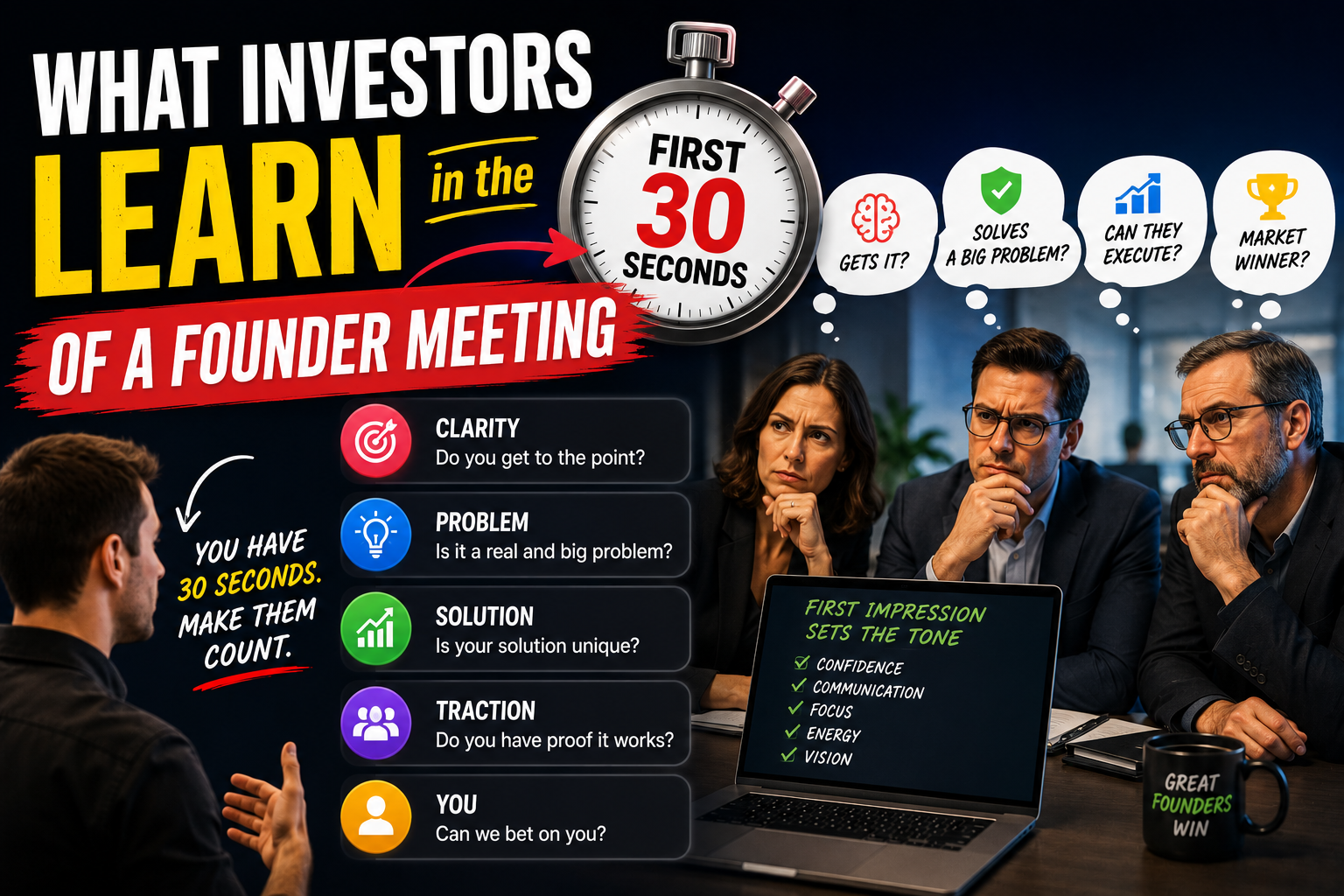
The first 30 seconds of a founder meeting often reveal more than a polished pitch deck. Seasoned investors quickly evaluate confidence, clarity, and credibility. Founders who articulate their vision simply and convincingly tend to create stronger first impressions than those relying on jargon or lengthy explanations.
Beyond the pitch, investors observe how founders communicate, listen, and respond. Authenticity, self-awareness, and a realistic understanding of risks often signal leadership maturity and long-term potential.
• Clear communication beats complex explanations.
• Confidence matters, but humility builds trust.
• Deep understanding of the customer problem is essential.
• Strong founders discuss risks openly and constructively.
• Authenticity and presence are early indicators of leadership quality.
In many cases, these early signals become surprisingly accurate predictors of future startup performance.
Have you ever had to pitch an idea in under 30 seconds? Share your experience in the comments and tell us what made the biggest difference. For practical insights on crafting a compelling VC pitch, read and join the discussion on LinkedIn.
Why Chasing One Big Deal Can Kill Your Startup
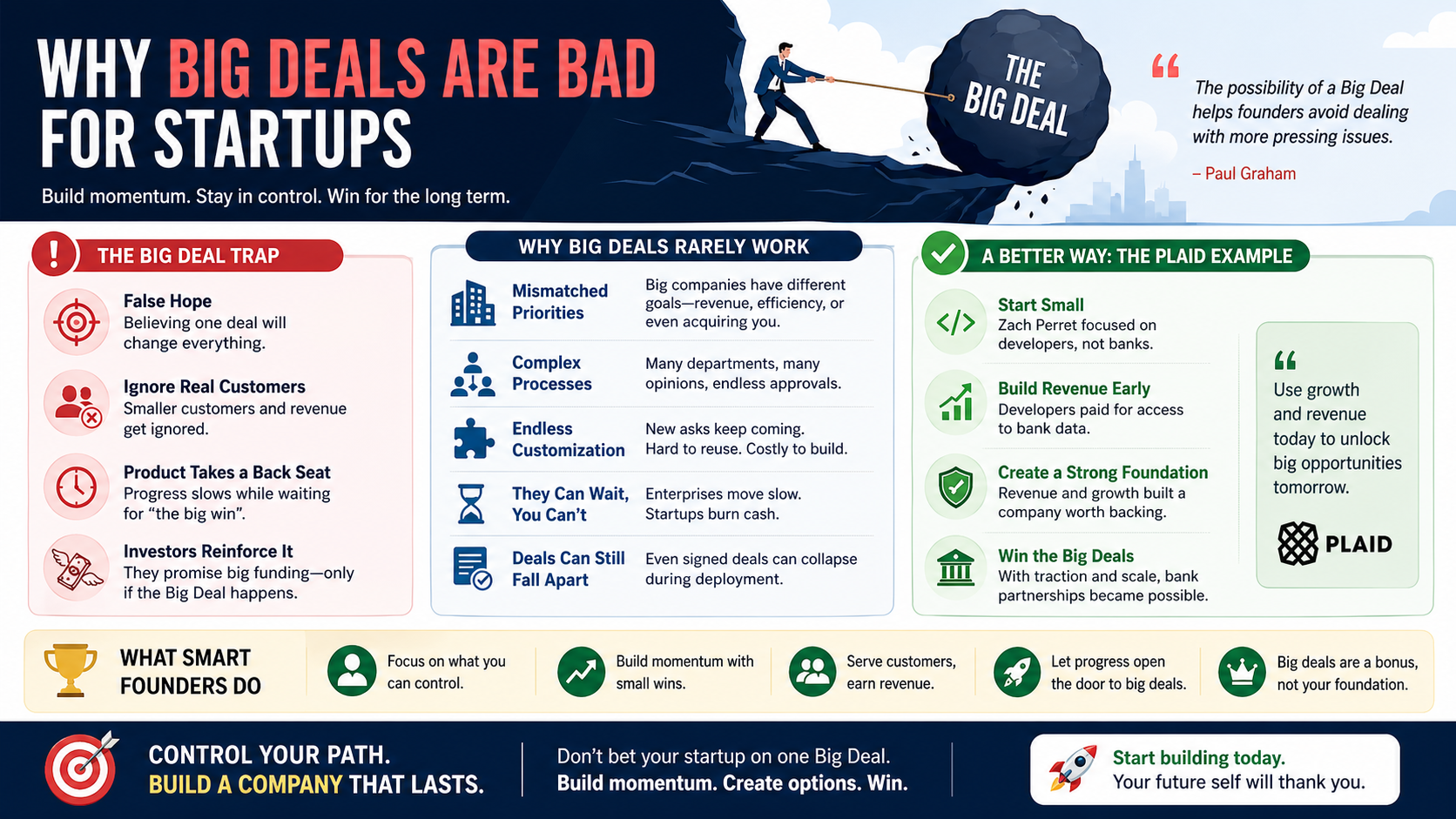
Many startups fail by chasing one massive “Big Deal” they believe will change everything. Founders often ignore smaller customers, steady revenue, and product progress while waiting for that one breakthrough contract. The problem? Big deals with large enterprises take time, involve endless approvals, and often demand heavy customization that drains startup resources.
• Big deals create false hope and slow real progress
• Founders ignore smaller customers and steady revenue
• Product development gets delayed waiting for “the big win”
• Enterprise deals take months with endless approvals
• Large companies often demand costly customizations
• Even signed deals can fail during deployment
Plaid focused on developers first, built revenue early, and used that momentum to unlock bigger bank partnerships later.
Small wins create momentum.
Big deals should be a bonus—not your survival plan.
Build traction first. The best startups scale through consistent progress, not startup fantasies.
How AI Is Replacing Traditional Sales Teams
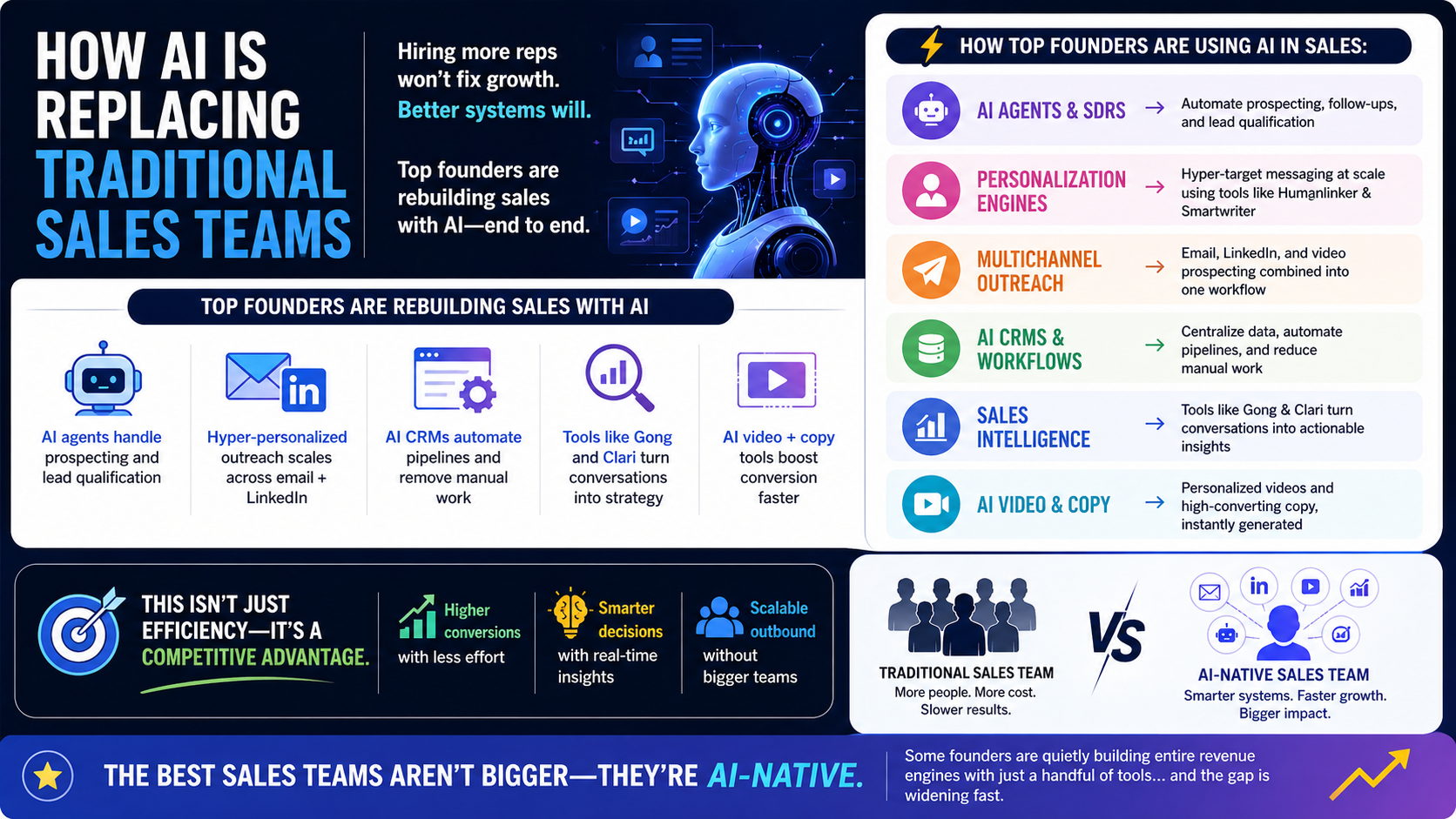
Hiring more reps won’t fix growth.
Better systems will.
Top founders are rebuilding sales with AI:
• AI agents handle prospecting and lead qualification
• Hyper-personalized outreach scales across email + LinkedIn
• AI CRMs automate pipelines and remove manual work
• Tools like Gong and Clari turn conversations into strategy
• AI video + copy tools boost conversion faster
⚡ How top founders are using AI in sales:
- AI Agents & SDRs → Automate prospecting, follow-ups, and lead qualification
- Personalization engines → Hyper-target messaging at scale using tools like Humanlinker & Smartwriter
- Multichannel outreach → Email, LinkedIn, and video prospecting combined into one workflow
- AI CRMs & workflows → Centralize data, automate pipelines, and reduce manual work
- Sales intelligence → Tools like Gong & Clari turn conversations into actionable insights
- AI video & copy → Personalized videos and high-converting copy, instantly generated
This isn’t just efficiency—it’s a competitive advantage.
Higher conversions.
Smarter decisions.
Scalable outbound without bigger teams.
The best sales teams aren’t bigger—
they’re AI-native.
Why The Most Successful AI Companies Will Solve 'Boring' Problems

While headlines focus on flashy AI applications, many of the most successful AI companies are quietly solving routine, unglamorous business problems. From automating invoice processing and compliance checks to streamlining logistics, scheduling, and data entry, these solutions save organizations significant time and money.
The reason these opportunities are so valuable is simple: businesses are willing to pay for measurable efficiency gains. Unlike consumer-focused products that compete for attention, enterprise AI tools often address persistent operational bottlenecks with clear return on investment. As a result, companies tackling "boring" problems can build sustainable revenue streams and long-term customer relationships.
• Large markets often hide behind mundane workflows.
• Efficiency gains create immediate business value.
• Enterprise customers prioritize ROI over novelty.
• Automation reduces costs and improves scalability.
• The best AI opportunities often solve recurring operational pain points.
In the AI era, the biggest winners may not be the most exciting startups—but the ones quietly eliminating everyday friction.
The next billion-dollar AI company may not be building the most advanced chatbot—it may be automating a tedious process that businesses deal with every day. Discover how founders are identifying overlooked markets, solving operational pain points, and turning "boring" problems into highly profitable AI businesses. Learn more.
Vegas runs on a 1 to 15% house edge - my system runs on 87%
Quick lesson on Vegas.
The house edge in a casino runs anywhere from 1 to 15%. That tiny edge built every neon sign on the Strip.
Now flip it.
My last-hour system hits 87% of the time.
That's not the house edge against you. That's YOUR edge — against the market.
Imagine sitting at a blackjack table where YOU were the dealer 87 hands out of 100.
That's roughly what trading with my crew looks like:
• $790 in pure profit
• 185% gains on a single trade
• $1,500 winners on the regular
And the best part? No smoke-filled rooms. No rigged odds. No leaving your couch.
Tap here to see how it works. Your first week is free.
WebClick
📱 Android 17 Expands Gemini Integration
Google unveiled Android 17 with smarter multitasking features and deeper Gemini AI integration, bringing more AI-powered productivity tools directly into the mobile experience.
🤖 Consumers Are Tired of AI Buzzwords
A new survey found that 60% of U.S. consumers view "AI" in brand messaging negatively, suggesting companies may need to focus more on benefits than technology labels.
⚽ FIFA World Cup System Flaw Exposed
Researchers discovered a vulnerability in an internal FIFA World Cup system that could have allowed unauthorized users to modify live television broadcast feeds.
🚀 SpaceX Reportedly Eyes Cursor Acquisition
Reports suggest SpaceX is exploring a $60 billion stock deal to acquire AI coding startup Cursor, just days after the company's blockbuster public debut.
📉 ChatGPT Market Share Drops Below 50%
For the first time, ChatGPT's share of the AI chatbot market has fallen below 50%, highlighting growing competition from rivals such as Claude, Gemini, and Perplexity.