|
In partnership with
|

|
|
|
|
|
Hey there!
|
|
|
|
You might be wondering, "Why are we sending you this
email? What's in it for
you?"
Well, let us explain.
|
|
We created this newsletter
because we know how challenging it
is to navigate the ever-evolving
world of customer service and
technology—especially when you’re
trying to stay ahead of the curve.
|
|
Whether you’re a startup founder,
a customer experience
professional, or someone just
curious about how AI is reshaping
the way businesses operate, this
space is for you.
|
|
This isn’t just about throwing
stats or tech jargon your way.
It’s about sparking ideas, solving
problems, and showing you
real-world ways AI can make your
life easier—whether it’s improving
response times, boosting customer
satisfaction, or scaling
operations without breaking the
bank.
|
|
Think of this newsletter as your
shortcut to staying informed,
inspired, and ready to embrace the
future of customer service (with a
little AI magic).
|
|
So, buckle up—because every email
we send is designed to give you
something actionable,
thought-provoking, or just plain
useful.
|
|
Let’s work together to build
smarter, faster, and more
human-centered customer
experiences.
|
|
|
Why AI-Powered
Customer Support
is the Future of
Exceptional
Service
|
|
|
|
|
|
Have you ever wondered what
separates companies with
stellar customer support from
the rest?
|
|
The answer often lies in how
effectively they leverage
technology to enhance user
experience, reduce response times,
and address customer needs at
scale.
|
|
Artificial Intelligence (AI) is
revolutionizing customer service
by enabling businesses to do all
of this and more. With AI,
companies can deliver
personalized, efficient, and
consistent support that delights
customers and builds
loyalty.
|
|
In fact, 77% of customer experience
teams already use AI with
great results, including faster response
times, improved customer
satisfaction scores (CSAT), and
reduced spending on customer
service operations.
|
|
AI chatbots have emerged as the
most effective channel for
customer support and are expected
to see the most investment in
2024.
|
|
Business leaders recognize the
transformative potential of AI. 72% of customer service
leaders believe AI can provide
better service than humans,
while 86% of those using AI report
it has significantly improved
their ability to scale operations
as their company grows.
|
|
With the market for AI projected
to reach nearly $2 trillion by 2030, startups and enterprises alike
are adopting AI-driven solutions
to gain a competitive edge in
customer service—where efficiency,
responsiveness, and
personalization are
critical.
|
|
But how does AI accomplish all of
this, and how can your business
harness its power to redefine
customer support? Let’s dive
in.
|
What is AI in Customer
Support?
|
|
AI in customer service goes
beyond simple chatbots. It
encompasses technologies like
Machine Learning (ML) and Natural
Language Processing (NLP),
allowing businesses to analyze
vast amounts of data, understand
customer behavior, and predict
their needs.
|
|
While chatbots may be the most
familiar application, modern
AI-powered solutions can
categorize support tickets,
analyze sentiment in feedback, and
even offer multilingual
support—automatically and in
real-time.
|
How AI Works in Customer
Support
|
|
At its core, AI uses data to make
predictions and automate tasks.
The process involves:
|
-
✨Training Models:
Feeding structured,
semi-structured, or
unstructured data into an AI
system.
-
Pattern Recognition:
Identifying trends and
extracting actionable
insights.
-
Natural Language
Understanding:
Using NLP to interpret and
respond to customer queries
in human-like ways.
|
|
For example, AI can process
open-ended survey responses to
determine whether customers are
satisfied or dissatisfied and why.
This level of insight was once
impossible without human
intervention.
|
Types of Data in AI Models
|
|
Understanding data types is
crucial to leveraging AI
effectively:
|
-
✅ Structured Data:
Organized and easily
analyzed (e.g., NPS scores,
transaction logs).
-
Unstructured Data:
Freeform content like
reviews, audio, or video,
which requires advanced
analysis.
-
️
Semi-Structured Data:
Combines structure and
flexibility (e.g., CRM
messages).
|
|
Data Type
|
Example
|
AI Application
|
|
Structured
|
NPS scores,
analytics
|
Automated tagging, ticket
routing
|
|
Unstructured
|
Open-ended surveys,
reviews
|
Sentiment analysis,
keyword tracking
|
|
Semi-Structured
|
CRM messages with
tags
|
Workflow
prioritization
|
|
|
AI models thrive on this data,
unlocking insights to drive better
decision-making.
|
|
|
Practical Use Cases of AI in
Customer Support
|
-
✅ Categorizing Support
Tickets
AI tools like Levity can
automatically tag tickets by
topic, making it easier to
prioritize and assign tasks.
This saves time and ensures
that specialists address
issues more
efficiently.
-
Sentiment Analysis
With AI, you can quickly
gauge whether feedback is
positive or negative,
helping you prioritize
improvements in areas that
matter most.
-
Text Analysis
Analyze customer queries
and competitor reviews to
uncover trends and improve
your offerings.
-
AI-Powered Chatbots
Enable instant responses to
FAQs, freeing up human
agents for complex tasks
while enhancing customer
satisfaction.
-
Multilingual Support
AI tools detect and respond
in your customers’ preferred
language, expanding your
reach globally.
-
Email Sorting &
Routing
AI-powered automation sorts
incoming emails into
actionable datasets,
allowing faster responses
and follow-ups.
|
Benefits of AI for Customers
|
-
Super-Fast Support:
Automated responses and
quick resolutions.
-
Consistent
Availability:
AI-powered bots offer 24/7
assistance.
-
✅ Error-Free
Interactions:
AI learns and adapts to
minimize mistakes, improving
accuracy.
|
|
Satisfied customers are more
likely to remain loyal and become
brand advocates, boosting your
reputation.
|
Benefits of AI for Companies
|
-
Lead Identification:
Automate follow-ups and
nurture potential
customers.
-
✨ Trend Analysis:
Gain actionable insights
from customer data to
improve products and
services.
-
⚡
Increased Brand
Reputation:
Deliver high-quality, fast
support, creating a positive
impression.
|
|
By automating repetitive tasks,
AI empowers support teams to focus
on complex issues, enhancing
productivity and customer
satisfaction.
|
Drowning In Support Tickets? Maven
AGI is here to help.
|
|
|
|
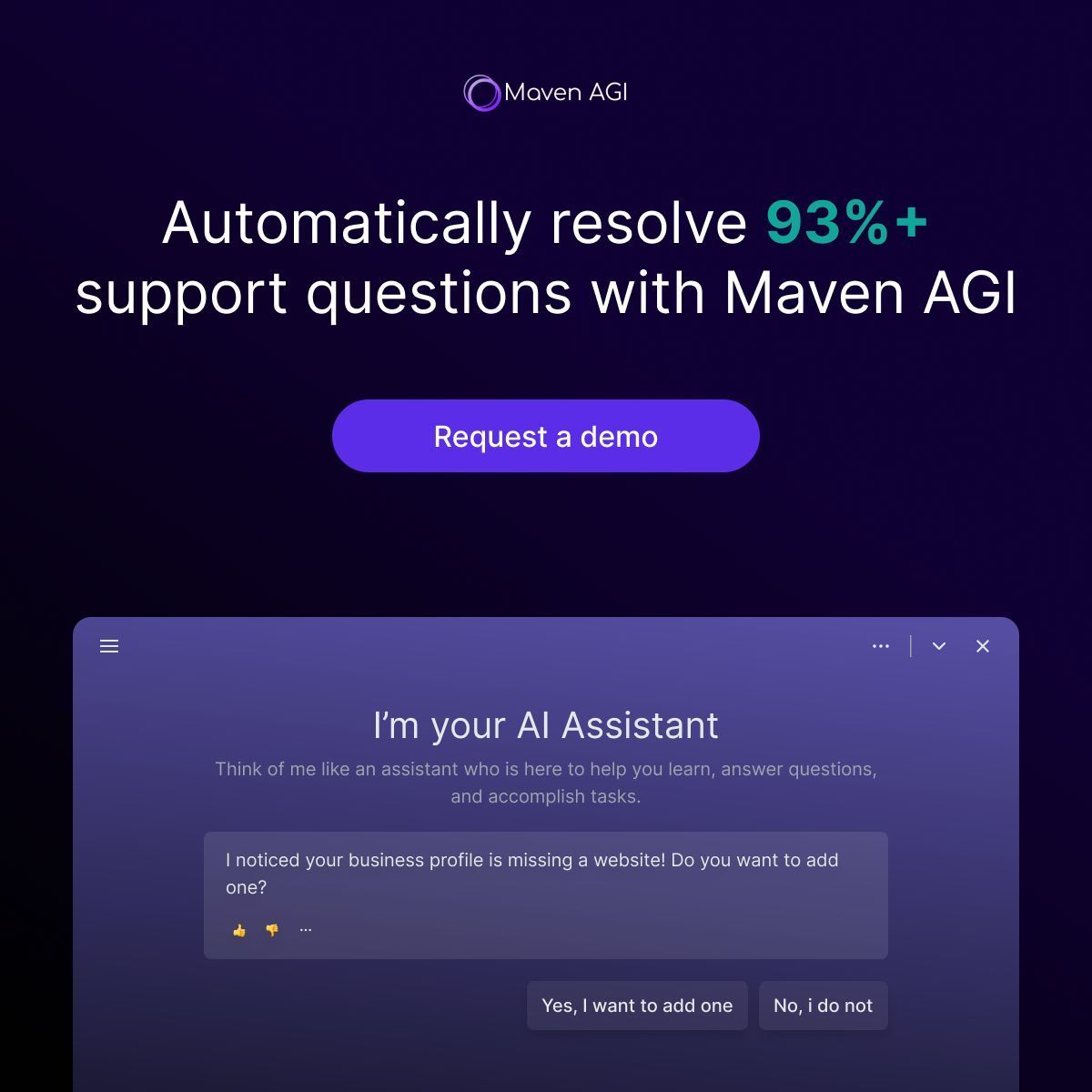
Maven AGI
platform simplifies customer service
by unifying systems, improving with
every interaction, and automating up
to 93% of responses. Seamlessly
integrated with 50+ tools like
Salesforce, Freshdesk, and Zendesk,
Maven
can deploy AI agents across multiple
channels—text, email, web, voice,
and apps—within days. Companies like
Tripadvisor, ClickUp, and Rho slash
response times by 60%, ensuring
quicker support and exceptional
customer satisfaction. Don’t let
support tickets slow you down
|
|
Request a free personalized
demo today.
|
Challenges and
Considerations
|
|
While AI in customer support
offers incredible benefits,
implementing it effectively
requires addressing some critical
challenges:
|
High-Quality Data for Accurate
Model Training
|
|
AI models are only as good as the
data they’re trained on.
Poor-quality, inconsistent, or
biased data can lead to inaccurate
predictions and subpar customer
experiences.
|
|
To ensure success, businesses
must invest in collecting,
organizing, and cleaning their
data.
|
|
Structured and labeled datasets,
combined with continuous updates,
are essential for refining AI
algorithms and keeping them
aligned with evolving customer
needs.
|
⚙️ Balancing Automation with
the Human Touch
|
|
While AI can handle repetitive
and straightforward tasks, it’s
crucial to maintain a balance
between automation and the
personalized interactions
customers often expect.
|
|
Over-reliance on AI may lead to a
robotic, impersonal experience
that alienates customers,
especially when dealing with
complex or emotionally sensitive
issues.
|
|
Businesses should complement AI
with skilled human representatives
to deliver a seamless, empathetic,
and efficient customer service
experience.
|
️ Addressing Privacy and Ethical
Concerns
|
|
The use of AI involves collecting
and analyzing vast amounts of
customer data, which raises
significant privacy and ethical
considerations.
|
|
Businesses must ensure compliance
with data protection regulations
like GDPR or CCPA and prioritize
transparency in how customer data
is used.
|
|
Establishing trust is
key—customers need to feel
confident that their personal
information is secure and used
responsibly.
|
|
Additionally, ethical AI
deployment requires avoiding
biases in algorithms and ensuring
fair treatment for all
customers.
|
|
By tackling these challenges
head-on, businesses can unlock the
full potential of AI while
maintaining customer trust and
delivering exceptional
experiences.
|
The Future of AI in Customer
Support
|
|
Driven by advancements in AI
algorithms, increased computing
power, and the accessibility of
cost-effective cloud
infrastructure, emerging
AI-powered customer care solutions
are poised to deliver faster, more
natural, and human-like responses
to customers.
|
|
|
|
AI-powered tools are no longer
optional—they’re a competitive
necessity.
|
|
From automating ticket
categorization to delivering
multilingual support, AI has the
potential to transform customer
service, making it faster, more
accurate, and more effective than
ever.
|
|
|
|
And that’s a wrap!
|
|
We’ve explored how AI is
transforming customer support,
from streamlining operations to
delivering personalized,
efficient, and responsive service.
|
|
As AI continues to evolve, it’s
clear that the future of customer
care is faster, smarter, and more
human-centered than ever
before.
|
|
Ready to elevate your customer
support?
|
|
Startups, don’t let outdated
processes hold you back. Embrace
AI-powered customer support tools
to save time, delight your
customers, and scale your
business.
|
|
Are you ready to harness the
power of AI and take your
customer support to the next
level? The future is
waiting—let’s make it happen!
|