18 Reasons Most Startups Fail
A Research-Backed Deep Dive Into the Mistakes That Kill Early-Stage Companies
Why Do Most Startups Fail Before Finding Product-Market Fit
The startup failure rate is one of the most discussed yet least understood phenomena in the business world. Studies consistently show that somewhere between 70 and 90 percent of new technology ventures do not survive beyond their first decade. Yet despite this overwhelming evidence, thousands of determined founders launch new companies every single year, convinced their idea is the exception. The question that matters most is not whether startups fail, but why they fail, and more importantly, whether those reasons are predictable and avoidable.
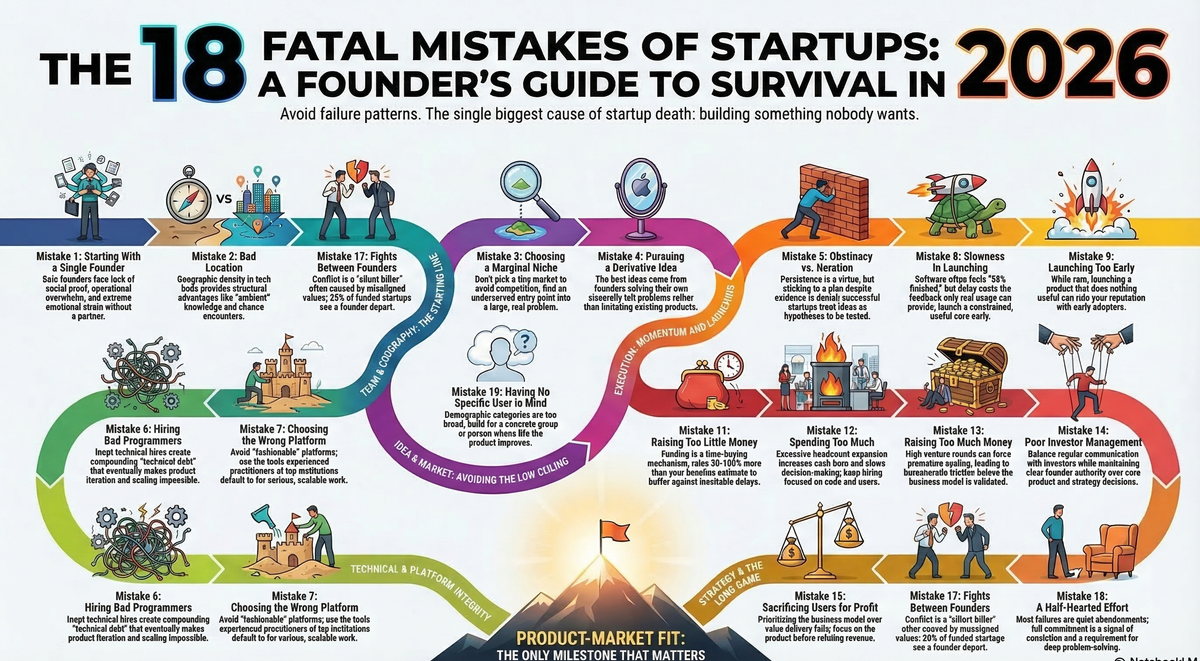
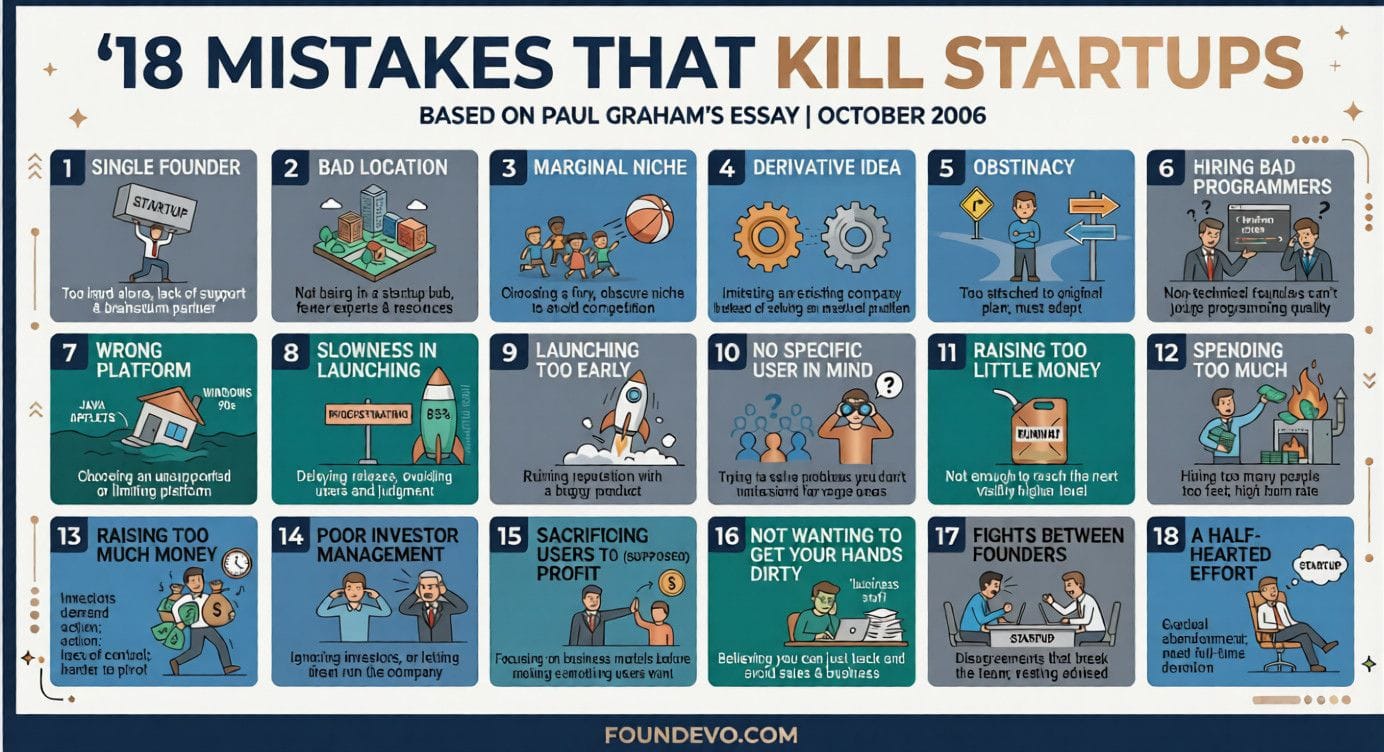
Paul Graham, co-founder of Y Combinator, one of the most influential startup accelerators in the world, published a foundational analysis of startup failure patterns titled The 18 Mistakes That Kill Startups. Drawing from direct observation of hundreds of early-stage companies, Graham identified a repeatable set of errors that funnel nearly every failed venture toward the same ultimate outcome: building something people do not want. This blog post takes that framework, expands on it with practical context, and presents it in a format designed to help founders, aspiring entrepreneurs, and startup advisors recognize these traps before they become fatal.
Understanding why startups fail is not a pessimistic exercise. It is one of the most productive forms of research a founder can do. The following sections examine each of the 18 identified mistakes, explain the underlying mechanism that makes each one dangerous, and offer actionable perspective on how to avoid or recover from them. A comparison table and key takeaways accompany each major theme to make this resource as scannable and useful as possible.
|
Key Takeaways |
|
Graham's central thesis: nearly all startup failure traces back
to one root cause, which is not making something users want. |
|
The 18 mistakes are not random. They are predictable, observable,
and largely avoidable with the right awareness. |
|
This analysis is based on direct observation of hundreds of
early-stage companies, not theory alone. |
|
The goal of studying failure is not discouragement but rather
pattern recognition that improves founder decision-making. |
The Foundational Framework: One Core Mistake With 18 Expressions
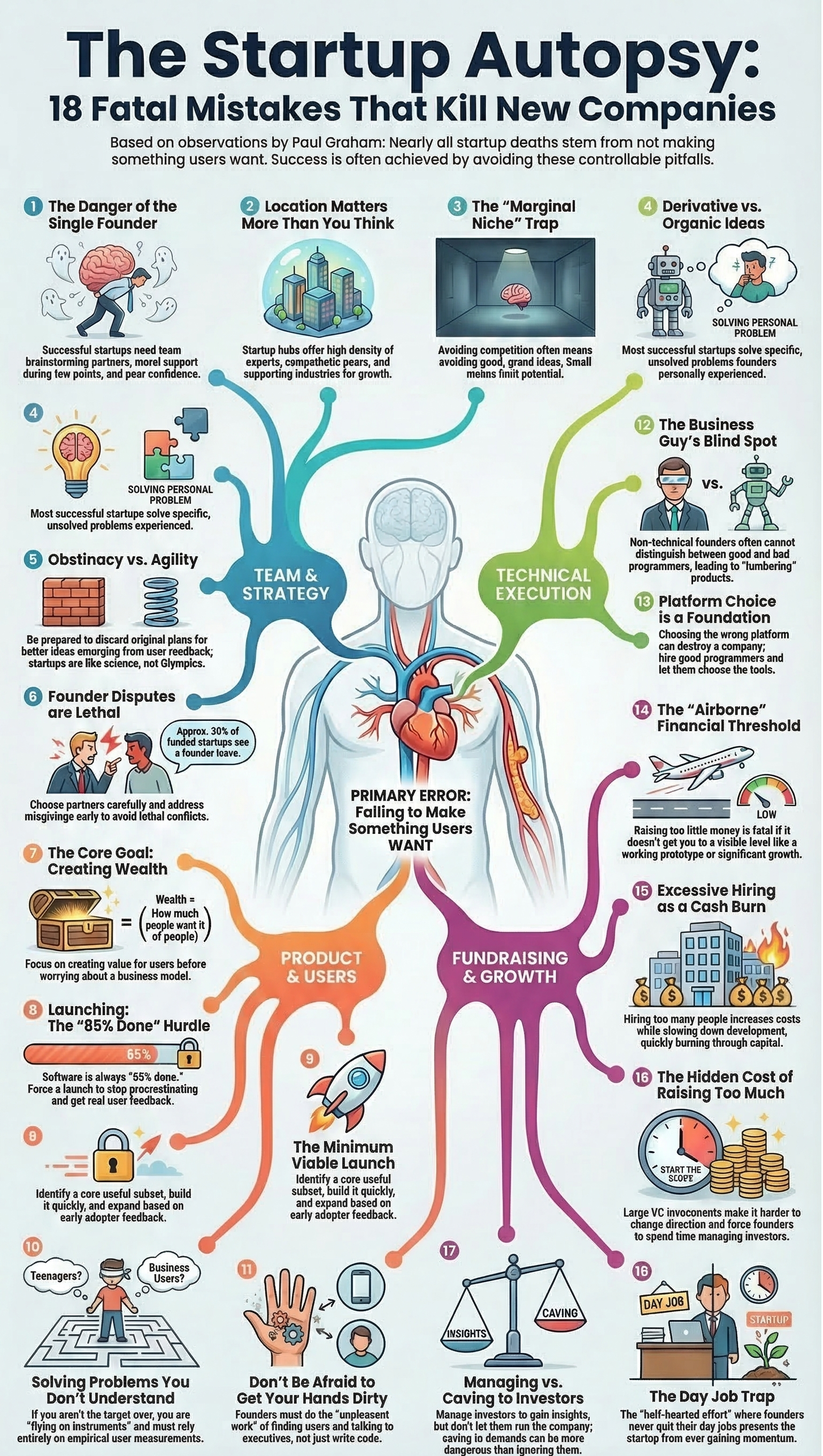
Before examining each mistake individually, it helps to understand the architecture of Graham's argument. The claim is that startup failure is not random or hopelessly complex. It is, in almost every case, a variation of the same problem: the company did not build something people genuinely want. Every one of the 18 mistakes described below is best understood as a contributing cause to that single outcome.
This framing is powerful for a practical reason. If a founder monitors their company against 18 specific, named failure patterns rather than trying to manage an undefined cloud of risk, the task becomes achievable. Naming a mistake is the first step toward catching yourself committing it. With that context established, each mistake can now be examined in the order Graham presents them.
Team and Founder Mistakes That Doom Startups From the Start
Mistake 1: Starting With a Single Founder
The data on single-founder startups is consistent and clear. Among the most successful technology companies built over the last several decades, the overwhelming majority started with more than one founder. This is not coincidental. The founding team structure has downstream effects on nearly every aspect of company health.
A single founder faces three compounding disadvantages. First, there is no social proof. If someone cannot convince even one trusted colleague to join a venture, that is itself a signal worth examining. Second, starting a company is operationally overwhelming. There is simply more work than one person can execute well across product, sales, operations, and fundraising simultaneously. Third, and perhaps most critically, the emotional demands of building a startup are extreme. The low points are severe, and navigating them alone creates a level of psychological strain that most people cannot sustain over a multi-year horizon.
When multiple founders are present, the group dynamic produces a form of mutual accountability that behaves almost like a force multiplier. Each founder feels a sense of obligation not to let the others down. That dynamic keeps people moving through periods that might otherwise cause a solo founder to quietly quit. The practical recommendation is straightforward: find at least one committed co-founder before launching, and vet that relationship as carefully as a business partnership, because that is exactly what it is.
|
Key Takeaways |
|
Most successful startups have two or more co-founders. Treating
this as optional is statistically risky. |
|
A single founder misses the emotional stabilization that
co-founder relationships provide during the inevitable low points. |
|
Brainstorming, error-checking, and task distribution all improve
significantly with multiple committed founders. |
|
If no one in your network is willing to co-found with you, that
resistance deserves honest reflection before proceeding alone. |
Mistake 2: Bad Location
Geography continues to matter for startups even as remote work becomes more normalized. The concentration effects of established startup ecosystems, particularly those in major technology hubs, produce compounding advantages that are difficult to replicate from outside them. The density of experienced founders, investors, potential technical hires, and supporting infrastructure in top-tier startup cities is not a minor convenience. It is a structural advantage.
The mechanism is not simply proximity to capital. It is the ambient presence of people who understand the startup process, have done it before, and are willing to engage informally with founders who are currently navigating it. Chance encounters, shared understanding of standards, and access to a labor market of people who specifically want to work in startups are all factors that compound over time in ways that are hard to quantify but easy to observe in outcomes. Founders who cannot be located in a top-tier startup ecosystem should invest disproportionately in building the network connections that geographic proximity would otherwise provide.
|
Key Takeaways |
|
Major startup ecosystems provide access to talent, investors,
advisors, and informal knowledge that is difficult to replicate remotely. |
|
The concentration effect in top startup cities is not just about
capital. It is about the density of startup-relevant experience and
relationships. |
|
Founders outside major ecosystems should invest actively in
building the network connections that geography would otherwise supply. |
|
Location is not destiny but it is a structural factor that
affects the probability of success in measurable ways. |
Idea and Market Mistakes That Guarantee Low Ceilings
Mistake 3: Choosing a Marginal Niche
Many aspiring founders choose small, obscure niches under the false belief that a smaller market means less competition and therefore more room to survive. This instinct is understandable but counterproductive. Competition is not something to avoid. It is something to outperform. If an idea is genuinely good, competitors will always appear eventually. Choosing a tiny market to sidestep competition means choosing a market where, even if everything goes right, the total possible outcome is too small to build a meaningful company.
The better mental model is to find a large, real problem and then find a specific, underserved entry point into that problem. This is different from selecting a marginal niche. An entry point in a large market is strategically sound because success can be expanded. A marginal niche caps potential from the beginning. The honest question a founder should ask is: if this product achieves everything we hope it does, what is the maximum size of the company that results from that success? If the answer is not compelling, the market selection deserves reconsideration.
|
Key Takeaways |
|
Choosing a small market to avoid competition is a false strategy.
Competition follows good ideas regardless of niche size. |
|
A small market caps outcomes even when the execution is flawless.
Aim for large problems with specific entry points. |
|
The best startup ideas address problems in large markets that
incumbents have underserved or ignored. |
|
Ask the maximum outcome question before committing: what is the
biggest this company could realistically become? |
Mistake 4: Pursuing a Derivative Idea
Imitation-based startups, those built primarily as slight variations on existing successful products, represent one of the most common application patterns among early-stage founders. The instinct makes sense on the surface: if someone else has proven a market exists, why not enter it? The problem is that imitation usually enters a market at a disadvantage while also starting from a position of limited insight into what actually needs to be better.
The most durable startup ideas historically have not come from studying competitors and adding a twist. They have come from founders experiencing a genuine problem and deciding to solve it. The examples are well-documented: the founders of Google could not find information efficiently online; the founders of Hotmail could not communicate freely at work; Apple emerged because someone wanted a computer that did not yet exist in the form they imagined. In each case, the founding insight came from lived experience, not competitive analysis.
This does not mean that all competitive-entry strategies fail. It means that the strongest foundation for a startup idea is a specific, unsolved problem that the founders understand viscerally because they have felt it themselves. That depth of understanding tends to produce better products and more resilient companies than derivative positioning does.
|
Key Takeaways |
|
The strongest startup ideas come from personal experience with a
real, unsolved problem rather than competitive analysis. |
|
Derivative ideas start at a disadvantage in both insight and
positioning relative to the originals they imitate. |
|
Look for problems you understand deeply through direct
experience. That understanding is a durable competitive advantage. |
|
Studying competitors is useful for research, but copying their
approach as a starting point tends to produce mediocre outcomes. |
Execution Mistakes That Slow or Stall Traction
Mistake 5: Obstinacy
There is a version of persistence that is a virtue in startup building, and there is another version that is a liability. The difference lies in what the founder is holding onto. Persistence in the face of genuine difficulty, fatigue, or external skepticism is often the trait that separates successful founders from those who quit too early. But persistence in the face of evidence that the original plan is wrong is not a virtue. It is a form of denial.
The most successful companies in technology have almost universally gone through significant pivots from their original concepts. The founding idea is almost always a starting hypothesis, not a final answer. Founders who treat the original plan as a commitment to be honored rather than a hypothesis to be tested tend to spend months or years building toward a target that evidence has already shown is wrong. Openness to redirection, guided by user feedback and market signals, is what allows startups to converge on something people actually want.
One useful heuristic for distinguishing good iteration from chaotic pivoting is to ask whether each new direction builds on the previous one. If the team is able to reuse most of what was built before and expand it toward a new target, that is likely a productive convergence. If every pivot means starting from scratch, that pattern deserves scrutiny.
|
Key Takeaways |
|
Distinguish between persistence through difficulty and
persistence in the face of evidence that the plan is wrong. |
|
Most successful startups changed direction significantly from
their founding idea. Treat the original plan as a hypothesis. |
|
User feedback is the most reliable external instrument for
deciding when to pivot and in what direction. |
|
Good iteration builds on prior work. Constant restarts from
scratch are a warning sign, not a sign of flexibility. |
Technical and Platform Mistakes That Create Structural Disadvantages
Mistake 6: Hiring Bad Programmers
For startups built around technology products, the quality of the technical team is not just one factor among many. It is often the determining factor in whether the product can be built at all, and whether it can be iterated and improved at the speed the market requires. Bad programmers do not just write worse code. They write code that is harder to modify, harder to scale, and harder for good programmers to work with later. The technical debt they generate compounds in ways that eventually make progress nearly impossible without expensive rewrites.
The compounding problem for non-technical founders is that identifying good programmers without being one yourself is genuinely difficult. Credentials, certifications, and portfolio items are imperfect proxies. The most reliable path for non-technical founders is to find a technical co-founder who can evaluate candidates accurately. If that is not possible, recruiting from institutions and communities where the standard of technical quality is known to be high is a reasonable second approach.
|
Key Takeaways |
|
Technical quality in the founding team is often the primary
determinant of whether a technology startup can compete. |
|
Bad programmers create compounding technical debt that eventually
makes the product impossible to iterate quickly. |
|
Non-technical founders face a structural disadvantage in
evaluating programmers. A technical co-founder partially resolves this. |
|
Recruiting from high-quality technical communities is a better
heuristic than relying on credentials alone. |
Mistake 7: Choosing the Wrong Platform
Platform selection is one of the earliest and most consequential technical decisions a startup makes, and it is one of the hardest to reverse. The history of technology startups contains numerous examples of companies that built on platforms that seemed credible and mainstream at the time but that could not scale or adapt as the company grew. The challenge is that the wrong platform often looks reasonable or even conservative from the outside. Its limitations only become apparent under real conditions.
The most reliable heuristic for non-technical founders evaluating platform options is to observe what experienced practitioners at top technical institutions actually use for serious work. Platforms that researchers and senior engineers default to for their own projects tend to have the performance, flexibility, and longevity characteristics that startup products require. Fashionable platforms chosen for their marketing appeal rather than their technical fundamentals are a recurring source of avoidable pain.
|
Key Takeaways |
|
Platform decisions made early are among the hardest to reverse.
Treat them as long-term commitments. |
|
A platform that looks reasonable from outside can have fatal
scaling limitations that only appear under real load. |
|
Let good programmers make platform decisions. Non-technical
founders should not override technical judgment on this question. |
|
Observe what experienced practitioners use for serious technical
work as a reliable quality signal. |
Mistake 8: Slowness in Launching
Software has a peculiar quality: it always feels 85 percent finished. There is always one more feature to add, one more bug to fix, one more edge case to handle before the product feels ready. This psychological trap causes countless startups to delay launching for months or years, spending time polishing a product that has not yet been validated by real users. The cost of this delay is not just time. It is the loss of the feedback that only real usage can provide.
Launching forces a team to complete a meaningful unit of work and then expose it to the reality of user behavior. That exposure almost always reveals insights that no amount of internal testing produces. Users interact with products in unexpected ways, prioritize different features than founders expect, and surface problems that could not have been anticipated from inside the building. The sooner a team receives that information, the sooner they can build something that actually serves users well.
The practical discipline is to launch something smaller, earlier. Not something broken or embarrassing, but something real and useful in a constrained way. An imperfect product that exists in users' hands is a more valuable asset than a polished product that only exists on a development server.
|
Key Takeaways |
|
Software always feels unfinished. The 85 percent sensation is a
constant, not a temporary state to wait through. |
|
Launching is the only way to access real user feedback. Internal
testing is no substitute. |
|
Delay in launching is often driven by fear of judgment or
perfectionism, not genuine incompleteness. |
|
A smaller, real product in users' hands outperforms a larger,
unreleased product in almost every dimension that matters. |
Mistake 9: Launching Too Early
The opposite error is also real, though significantly less common. Launching before a product can deliver a complete, useful experience to at least some set of users creates a reputation problem that is difficult to recover from. Early adopters are a startup's most valuable and forgiving user group. They are willing to tolerate roughness in exchange for novelty and the promise of something interesting. But they are not infinitely patient, and a product that delivers nothing of value on first use may not receive a second chance.
The recommended approach is to identify the smallest core of the intended product that is independently useful and capable of being expanded incrementally. Build that core, make it work well, and launch it. Resist the urge to launch prematurely just to have something public. The distinction between an imperfect product that does something real and a product that does nothing useful is the line between productive early launching and counterproductive premature launching.
|
Key Takeaways |
|
Early adopters tolerate imperfection but not uselessness. The
product must do something real before launch. |
|
Identify the minimum useful core of the product and build that
first rather than a stripped version of everything. |
|
A negative first impression from early adopters is a reputational
cost that compounds. Avoid it with intentional scoping. |
|
The goal is not to launch as early as possible but to launch as
soon as the product delivers genuine, incremental value. |
Mistake 10: Having No Specific User in Mind
Building a product for a vague category of user is one of the most persistent failure patterns in early-stage startups. Descriptions like teenagers, business users, or people interested in local events are not user definitions. They are demographic categories so broad as to be useless for product decisions. When a founding team cannot name a specific, real person or a small, concrete group of people whose lives the product improves, that is a sign the product development process is not grounded in anything testable.
The inverse is also instructive. Founders who are solving their own problems have a built-in user to reference: themselves. They can make decisions quickly, validate assumptions directly, and measure whether the product is getting better in ways that are meaningful and real. When building for others, that shortcut disappears, and the only substitute is deliberate, continuous, empirical engagement with actual potential users. That means finding specific individuals willing to use the product, watching how they use it, and measuring their responses rather than assuming.
|
Key Takeaways |
|
Vague user categories like business users or teenagers are not
sufficient to make sound product decisions. |
|
The best early founders are often solving their own problems and
therefore have a concrete reference point for every decision. |
|
When building for users different from yourself, replace
intuition with direct engagement, observation, and measured feedback. |
|
If you cannot name specific real people who want what you are
building, the validation process has not yet started. |
Financial Mistakes That Shorten the Runway
Mistake 11: Raising Too Little Money
Startup funding is best understood as a time-buying mechanism. Every round of investment purchases a window of operational time during which the company can reach the next meaningful milestone, whether that is a working prototype, a public launch, a specific growth benchmark, or profitability. Raising too little money means that window is too short. The team runs out of time before they can demonstrate enough progress to raise the next round or reach a self-sustaining state.
The counterintuitive wisdom here is to build in a substantial buffer. Software takes longer to build than estimated, sales cycles take longer to close, and unexpected costs materialize regularly. The practical guidance is to raise significantly more than the baseline estimate for what is needed, often 50 to 100 percent more, and to set the initial spending target and milestone goal at the most minimal viable level that still represents real progress.
|
Key Takeaways |
|
Startup funding buys time. Too little funding means not enough
time to reach the next milestone. |
|
Always raise more than the baseline estimate. Software and sales
timelines consistently exceed initial projections. |
|
Set both spending targets and milestone goals conservatively when
funding is limited to maximize flexibility. |
|
The next funding round or profitability must be reachable within
the window that current funding provides. |
Mistake 12: Spending Too Much
The classic mechanism for burning through startup capital too quickly is hiring more people than the company needs. Headcount expansion is expensive in two ways that compound each other: it increases the cash burn rate directly, and it slows decision-making, communication, and product iteration simultaneously. The result is that the money disappears faster while producing less progress per dollar spent.
The recommended hiring discipline for early-stage startups is aggressive restraint. Every new hire should either directly contribute to writing code or directly contribute to acquiring users. Everything else can wait. Equity compensation, offered to people who are genuinely committed to the outcome rather than just seeking a salary, is both cheaper in the short term and a better filter for the kind of team member who will be effective in an early-stage environment.
|
Key Takeaways |
|
Hiring is the primary mechanism through which startups burn
capital too quickly. |
|
Each additional headcount slows iteration speed while also
increasing burn rate. Both effects compound. |
|
Early hires should contribute directly to building the product or
acquiring users. Everything else is premature. |
|
Equity-compensated team members tend to be more committed and
better aligned with startup outcomes than salary-motivated ones. |
Mistake 13: Raising Too Much Money
Raising more money than a startup needs sounds like an implausible problem, but it carries real risks that are structural rather than numerical. When a company raises at venture scale, the investors who provided that capital have expectations about how it will be deployed. Those expectations push founders toward hiring more people, taking more office space, and building toward a larger operational model than the company may actually be ready for.
The organizational consequences of rapid scaling before the business model is validated are significant. A larger team is harder to redirect. Communication slows. Office politics emerge. The startup begins to behave like a larger company, with all of the bureaucratic friction that implies, while still facing all of the existential uncertainty of an early-stage venture. The recommendation is to take the first reasonable investment offer from a credible source and focus energy on building rather than on optimizing the fundraising outcome.
|
Key Takeaways |
|
Large investments create pressure to deploy capital in ways that
may not be appropriate for the company's current stage. |
|
Rapid headcount growth before business model validation makes the
company harder to redirect when change is needed. |
|
The time cost of pursuing large investment rounds is often
underestimated. That time has an opportunity cost. |
|
Take the first reasonable offer from a credible investor and
prioritize building over negotiating for marginally better terms. |
Mistake 14: Poor Investor Management
The relationship between founders and investors is one of the more nuanced dynamics in startup life. Investors bring capital, networks, and sometimes genuine expertise. They also bring opinions, preferences, and, in cases where they hold board seats, actual authority. Managing this relationship poorly in either direction, either by ignoring investors completely or by deferring to them excessively, creates predictable problems.
Founders who ignore investors waste a source of useful perspective and risk damaging relationships they will need for future rounds. Founders who defer to investors too readily risk losing control of the company's direction to people whose interests are not always perfectly aligned with the company's long-term health. The balance point is regular, honest communication combined with clear founder-maintained decision authority on the core product and strategy questions.
|
Key Takeaways |
|
Neither ignoring investors nor deferring to them completely is a
sustainable strategy. |
|
Investors may have useful insights but lack the day-to-day
context that founders have. Weight their input accordingly. |
|
Board structure determines how much authority investors actually
have. Understand the governance implications before signing. |
|
Regular, honest communication with investors reduces the risk of
conflict and maintains the relationship for future needs. |
Strategic Mistakes That Undermine Long-Term Viability
Mistake 15: Sacrificing Users for Supposed Profit
One of the most seductive mistakes an early-stage startup can make is prioritizing the business model over the product. The reasoning sounds responsible: without revenue, there is no company. But this logic, applied too early, tends to produce products that are optimized for extracting money rather than delivering value. Products in that state rarely grow sustainably because the user experience suffers under the weight of premature monetization.
The companies that have achieved lasting scale at the highest levels have shared a consistent pattern: they focused obsessively on making something people wanted, often for years, before turning significant attention to the mechanisms of converting that value into revenue. Google is the canonical example. The search product worked extraordinarily well long before the advertising model was refined. The product came first. The business model followed the product's success rather than preceding it.
This is not an argument for ignoring business models indefinitely. It is an argument for sequencing correctly. Making something people genuinely want is the harder problem. Making money from something people genuinely want is the easier subsequent problem. Founders who confuse the sequence tend to build monetization architectures on top of products that users do not actually value, and that combination does not scale.
|
Key Takeaways |
|
Early monetization focus often degrades the user experience in
ways that limit long-term growth. |
|
The most durable companies built the product first and let
business model refinement follow demonstrated user value. |
|
Creating something people want is the harder problem. Converting
that into revenue is the easier subsequent problem. |
|
Investors who push for early revenue focus may be applying
frameworks from more mature industries that do not apply to early-stage
startups. |
Mistake 16: Not Wanting to Get Hands Dirty
Many technically skilled founders have a strong preference for building over selling. This preference is understandable. Building is concrete, measurable, and internally controllable. Selling requires engaging with external humans who are unpredictable, sometimes uninterested, and occasionally rude. But the preference for building over selling, when it becomes absolute, is one of the clearest predictors of startup struggle.
Users do not come to products on their own in the early stages. Someone has to go find them, talk to them, understand their needs, and convince them to try something new. This work is uncomfortable for most technical founders, but it is not optional. The startups that achieve the fastest early traction are almost always led by at least one person who leaves the keyboard regularly to engage directly with potential users, distribution partners, and early customers. The product cannot sell itself when there are fewer than a thousand people who know it exists.
|
Key Takeaways |
|
At least one founder must be willing to do the uncomfortable work
of finding and engaging users directly. |
|
Early traction almost never happens organically. Someone on the
founding team has to actively pursue it. |
|
The discomfort of sales and user outreach is a temporary skill
gap, not a permanent personality limitation. |
|
The relationship between building and selling is not sequential.
Both must happen simultaneously in the early stages. |
Mistake 17: Fights Between Founders
Founder conflict is the silent killer of many startups. Approximately 20 percent of Y Combinator-funded companies have experienced a founder departure. The striking insight from this observation is not just how often it happens, but why it happens. Most founder disputes are not primarily the result of unusual circumstances. They are the result of misaligned values, incompatible work styles, or unresolved tensions that existed before the company launched.
This means the solution to founder conflict is largely a pre-founding discipline. The people a founder chooses to build a company with are the most consequential decision in the entire startup process, more consequential than the initial idea, the market chosen, or the business model adopted. Choosing a co-founder out of social obligation or because they have a skill you need and no one else seems available is a high-risk strategy that tends to surface its costs at the worst possible time, which is usually during periods of stress.
Vesting schedules, while not the most romantic topic, create a structured mechanism for handling a founder departure without collapsing the company. Founders who implement vesting arrangements early are not pessimistic; they are practical. A four-year vest with a one-year cliff is a standard structure that aligns incentives and provides a clean resolution path if circumstances change.
|
Key Takeaways |
|
Approximately one in five funded startups experiences a founder
leaving. This is common enough to plan for proactively. |
|
Most founder disputes stem from pre-existing incompatibilities,
not situational pressures. Screen co-founders carefully. |
|
Vesting schedules protect the company and the remaining founders.
Implement them early regardless of social comfort. |
|
Avoid including someone as a co-founder out of guilt, loyalty, or
desperation. The cost of that compromise compounds over time. |
Mistake 18: A Half-Hearted Effort
The most common type of startup failure is not the spectacular flame-out that generates headlines and post-mortems. It is the venture that simply fades away, quietly abandoned by founders who never fully committed to it in the first place. These are the side-project startups, worked on nights and weekends by people who still have the safety net of a full-time job.
The data pattern is clear: founders of failed startups tend not to have quit their day jobs, while founders of successful startups tend to have done exactly that. This correlation does not mean every aspiring founder should immediately quit their job. The more honest interpretation is that the willingness to commit fully is itself a signal. People who have sufficient conviction in their idea and in their own ability to execute it eventually make the leap. Those who never quite get there may be accurately reading their own level of belief in the venture.
Full commitment matters not just psychologically but practically. The amount of focused attention required to find product-market fit, iterate quickly on feedback, and maintain momentum is simply not compatible with being half-present. Startups require the kind of deep problem-solving that cannot be scheduled into spare hours. The ones that succeed tend to be led by people who treat the venture as the primary obligation, not a secondary one.
|
Key Takeaways |
|
The most common startup failure mode is quiet abandonment, not
dramatic collapse. |
|
Full-time commitment correlates strongly with startup success.
Half-hearted efforts rarely produce the iteration speed needed. |
|
The willingness to commit fully is often a reliable signal of
genuine conviction in the idea and the team. |
|
Founders who stay in day jobs indefinitely may be accurately
sensing that the venture is not worth the risk. Take that signal seriously. |
Comparison Table: All 18 Startup Mistakes at a Glance
The following table summarizes all 18 identified startup mistakes, categorized by how difficult each is to spot, whether recovery is possible, the level of impact on company survival, and the stage at which each mistake is most dangerous. This reference is designed to support founders conducting periodic health checks on their companies.
|
Mistake
Category |
Difficulty
to Spot |
Recovery
Possible |
Impact Level |
Stage Most
Dangerous |
|
Single Founder |
Low |
Partial |
High |
Seed / Early |
|
Bad Location |
Low |
Yes (relocate) |
Medium |
Pre-Launch |
|
Marginal Niche |
Medium |
Yes (pivot) |
High |
Idea Stage |
|
Derivative Idea |
Medium |
Yes (pivot) |
Medium |
Idea Stage |
|
Obstinacy |
High |
Yes (pivot) |
High |
Growth |
|
Hiring Bad Programmers |
High |
Difficult |
Very High |
Build Stage |
|
Wrong Platform |
High |
Costly |
Very High |
Build Stage |
|
Slow Launch |
Medium |
Yes |
High |
Pre-Launch |
|
Launching Too Early |
Medium |
Partial |
Medium |
Launch |
|
No Specific User |
High |
Yes (research) |
Very High |
All Stages |
|
Raising Too Little Money |
Low |
Difficult |
High |
Funding |
|
Spending Too Much |
Medium |
Partial |
High |
Growth |
|
Raising Too Much Money |
Medium |
Partial |
Medium |
Funding |
|
Poor Investor Management |
High |
Difficult |
High |
Post-Funding |
|
Sacrificing Users for Profit |
High |
Partial |
Very High |
Growth |
|
Not Getting Hands Dirty |
Medium |
Yes |
High |
All Stages |
|
Founder Fights |
Medium |
Partial |
Very High |
All Stages |
|
Half-Hearted Effort |
Low |
Yes (commit) |
Very High |
All Stages |
Quick Reference: How to Use This Framework as a Founder Health Check
The 18 mistakes described in this analysis are not just historical observations. They are a diagnostic framework that founders can apply to their current situation at any stage. The following questions are designed to be used during regular founder retrospectives or before major decisions.
On Team Structure:
- Is the founding team complete enough to cover the essential domains of product, technology, and distribution?
- Are there unresolved tensions between co-founders that have been suppressed rather than addressed?
- Is every founder fully committed, or is someone still treating this as a side project?
On Market and Idea Quality:
- Is the target market large enough to support a meaningful company if the product works as intended?
- Can the team name specific real users who have expressed genuine desire for the product?
- Is the founding insight original, or is it primarily imitation of something that already exists?
On Execution Discipline:
- Has the team launched something real that real users have actually used?
- Is at least one founder regularly leaving the product team to engage directly with potential users?
- Is the team able to change direction based on evidence, or are they defending the original plan regardless of signals?
On Financial Health:
- Is the current runway sufficient to reach the next meaningful milestone with buffer for delays?
- Is headcount growing faster than the company's demonstrated ability to deploy people effectively?
- Are investor relationships maintained proactively, or are they being neglected or deferred to excessively?
Conclusion: Pattern Recognition as the Most Underrated Founder Skill
Paul Graham's framework for understanding startup failure is valuable not because it predicts which specific companies will fail but because it makes the failure patterns nameable. Named patterns can be monitored, discussed, and acted upon. Unnamed risks accumulate quietly until they become crises.
The central insight of the framework is simultaneously simple and demanding: nearly all startup failure traces back to not making something people want. Every one of the 18 mistakes described here is a path to that same outcome. Single founders who burn out, teams that choose small markets, products that launch too late for user feedback to matter, companies that scale before validating their model, all of these are different routes to the same destination.
The discipline of regularly checking a company against a concrete list of known failure patterns is one of the highest-leverage habits a founding team can develop. It requires honesty, humility, and the willingness to act on what the evidence shows rather than what the original plan assumed. Founders who build that discipline, and maintain it through the inevitable difficult periods of company building, give themselves a structural advantage over those who navigate purely by optimism and instinct.
The goal of starting a company is not to avoid every mistake on a list. It is to make something that matters to the people who use it. Everything else, the team structure, the market selection, the launch timing, the financial discipline, serves that purpose. Keep that purpose visible, and the list of 18 mistakes becomes not a source of anxiety but a map of the territory that serious builders already know they have to navigate.
|
Key Takeaways |
|
Naming failure patterns is the first step to monitoring and
acting on them before they become fatal. |
|
All 18 mistakes are paths to the same destination: a product that
people do not want. |
|
Regular founder health checks against a concrete framework build
a pattern-recognition discipline that compounds over time. |
|
The goal is not to avoid failure on a checklist but to build
something people genuinely want. The checklist serves that purpose. |