Why Most Startups Actually Fail
💰 Massive Fundings This Week
In This Edition:
- ⚡Why Most Startups Actually Fail
- 💰 Massive Fundings This Week
- 🎓 Free AI lessons outperform paid courses
- 🔬 AI research shaping real bets
- ⚡ Grok prompts power users exploit
- 🧮 AI tools replacing spreadsheets
⚡Why Most Startups Actually Fail
⚡Why Most Startups Actually Fail (And How to Beat the Odds)
Sam Altman doesn't sugarcoat it: most startups die not because the idea sucks, but because the fundamentals never compound.
Here's what separates winners from the rest:
Word-of-mouth is the only early metric that matters. If users aren't naturally talking about the product, there's no product-market fit. Growth bought through ads vanishes when the budget does.
Ignore today's big markets. Hunt for small spaces that feel inevitable. The best opportunities aren't obvious yet.
Obsessive daily usage beats flashy launches. A thousand people who can't live without the product crush ten thousand who tried it once.
Distribution is architecture, not an afterthought. Know exactly how to get from 100 → 1,000 → 10,000 users before building anything.
Real moats aren't buzzwords. Network effects, switching costs, data advantages—not just "better execution."
At least one founder must be relentlessly evangelical. Vision can't be delegated.
Startups win in the gaps big companies can't reach. Weird ideas, fast pivots, new platforms.
Strong opinions matter. "This will happen" beats "exploring opportunities."
Recruiting is the job. Team quality determines everything.
Momentum is oxygen. Ship, learn, ship again. Repeat relentlessly.
This built Airbnb, Stripe, OpenAI, and hundreds of breakouts. Not a framework to study—a mindset to live.
Want the tactical breakdown? Get the full founder playbook here → with real examples of how these principles actually work.
🚀Massive Fundings This Week
The funding frenzy continues with six notable raises:
Northwood Space (El Segundo, CA) raised a $100M Series B led by Washington Harbour Partners and co-led by Andreessen Horowitz, plus a $49.8M U.S. Space Force contract to upgrade satellite control infrastructure. The startup, founded by Bridgit Mendler, builds modern phased-array antenna systems to replace older ground station tech for satellite communications.
Orbital (London, 8 years old) pulled in a $60M Series B led by Brighton Park Capital. The startup uses AI and geospatial data to automate due diligence and document review in real estate transactions. REV, The LegalTech Fund, Moderne Ventures, Grosvenor Group, and previous investors JLL Spark, Outward, and Seedcamp joined the round.
Ricursive Intelligence (Palo Alto, 1 year old) landed a monster $300M Series A at a $4B valuation for its AI-powered semiconductor design platform. Lightspeed led, with DST Global, NVentures, Felicis, 49 Palms, Radical AI, and Sequoia participating.
Standard Nuclear (Oak Ridge, TN, 1 year old) raised a $140M Series A led by Decisive Point to produce TRISO nuclear fuel. Chevron Technology Ventures, StepStone Group, XTX Ventures, and previous backers Welara, Fundomo, a16z, Washington Harbour Partners, and Crucible Capital joined in.
Synthesia (London, 9 years old) secured a $200M Series E at a $4B valuation—nearly double last year's number. The AI video generation platform's round was led by returning investor GV, with Kleiner Perkins, Accel, NEA, NVentures, Air Street Capital, and PSP Growth participating. Part of the raise includes employee secondary sales.
Tandem Technology (New York, 3 years old) is reportedly raising a $100M round at a $1B valuation for its AI platform that automates prescription paperwork, prior authorizations, and pharmacy routing. Accel is leading, with Thrive Capital and General Catalyst joining.
Upwind (San Francisco, 4 years old) closed a $250M Series B at a $1.5B valuation for its cloud security platform using runtime data. Bessemer led, with Salesforce Ventures, Picture Capital, and previous investors Greylock, Cyberstarts, Leaders Fund, Craft Ventures, TCV, Alta Park, Cerca Partners, Swish Ventures, and Penny Jar Capital participating. Total raised: $430M.
🎓 The Internet’s Best AI Lessons
🚀These Free AI Videos Are Quietly Creating the Next Top 1%
YouTube is quietly replacing paid AI courses in 2026.
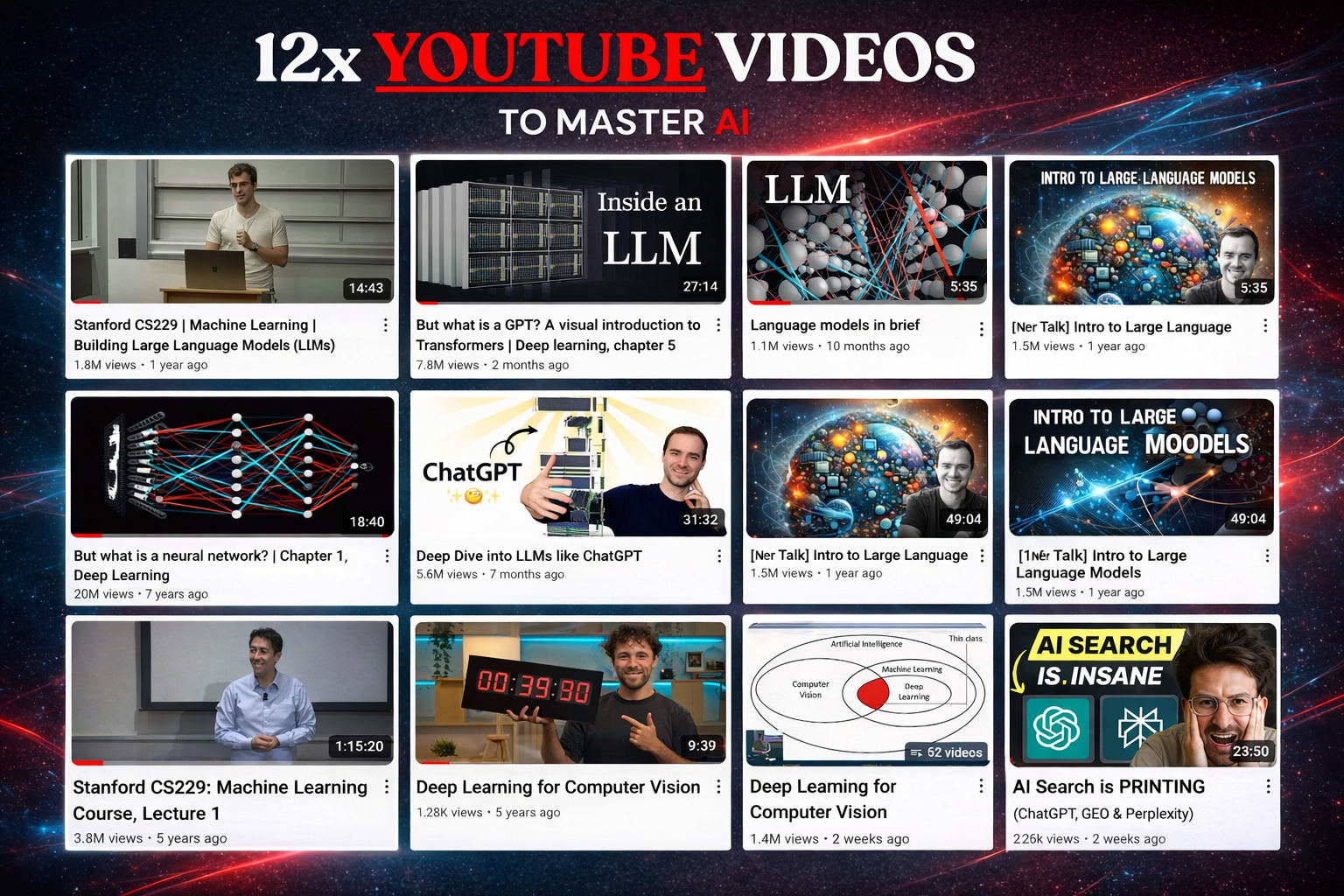
Most people don’t fail at learning AI because it’s hard —
they fail because they watch the wrong videos.
The list above isn’t random content.
It’s a free, structured AI curriculum used by top universities, researchers, and builders — from ML foundations to ChatGPT, LLMs, computer vision, and AI search.
If you follow it end-to-end, you won’t just use AI —
you’ll understand how it actually works.
⚠️ Almost no one saves posts like this. That’s the mistake.
👉 Bookmark this.
👉 Share it with someone still “learning AI from reels.”
👉 Open one video today — future you will thank you.
🚀 The AI skill gap is closing fast.
Those who start now will stay ahead.
📊 How AI Strategies Are Really Formed
💡What Top AI Funds Are Actually Paying Attention To
AI is moving too fast to keep up manually.
The reports above reveal what actually matters right now:
where capital is flowing, how startups are positioning, why agents are taking over, and which AI bets are quietly compounding.
This isn’t surface-level hype.
It’s signal from the best operators, funds, and research labs shaping the next wave of AI startups.
Most people will skim headlines.
Very few will read the data that decides outcomes.
⚠️ Missing this means building with outdated assumptions.
👉 Read the patterns everyone else will notice too late
🚀 The AI gap isn’t skill-based anymore — it’s information-based.
🖋️The Grok Imagine Trick Power Users Use
🖋️How to Prompt on Grok Imagine for Better Results
Most Grok Imagine prompts fail for one simple reason.
They describe objects, not scenes.
Grok doesn’t think like a search bar — it thinks like a camera on a film set.
The difference between “almost right” and cinematic-level output comes down to direction, mood, lighting, and intent.
The post above breaks down:
- How to prompt like a director, not a typist
- Why cinematic language changes output quality instantly
- How to upgrade basic prompts into story-driven visuals
- How small wording tweaks unlock dramatically better results
Most users won’t learn this and will blame the tool.
👉 Click to see the exact prompts that transform Grok results.
🏆 How AI Data Companies Really Win
🤖 From zero signal to seven-figure ARR — without hype or ads.
This story isn’t about chasing trends.
It’s about spotting a broken market, building where others overcomplicate, and shipping before perfect.
A clean gap between overpriced data terminals and clunky free tools turned into an AI-native financial data engine trusted by hundreds of thousands — and embedded inside enterprise products.
Key lessons hidden in this journey:
- Why DaaS takes longer than SaaS (and why that’s an advantage)
- How product-led growth and direct sales can coexist
- Why “continuous improvement” beats big launches
- How intuition matters when data is incomplete
Most founders wait for certainty.
This one built through ambiguity — and scaled fast.
👉 Read the full breakdown and steal the playbook before it becomes obvious.
🔄 How Data Workflows Are Being Rebuilt
📉 Why Manual Spreadsheets Are Becoming Obsolete
The era of manual formulas and endless cleanups is ending. Today’s AI spreadsheet tools can write formulas from plain English, automate data cleaning, pull live metrics, and even generate insights with simple prompts — whether in Google Sheets, Excel, or standalone platforms.
From tools that turn words into formulas to ones that connect live data and build dashboards automatically, these solutions are redefining what data workflows look like for analysts, founders, and business teams.
Most people still wrestle with spreadsheets the old way.
A few are already using AI to cut hours off analysis and decision-making.
👉 Click through to see the suite of tools transforming spreadsheet work — before competitors catch up.
🔥 ICYMI: Founder Resources You Probably Missed
These high-impact reads have been powering sharper pitches, smarter fundraising, and faster investor yeses. If you missed them, now’s the time to catch up before everyone else does.
🚀 Harvard’s Startup Guide: Turning Ideas Into Impact
The hidden frameworks elite founders quietly rely on.
📚 The Ultimate Fundraising Resource Stack
A vault of tools most founders don’t know exists.
🔑 The Most Overlooked Key to Fundraising Success
YC founders swear by this — yet most ignore it.
🔥 Paul Graham’s ‘Small, Intense Fire’
The mindset shift that separates funded from forgotten.
🧠 What Sam Altman Wants Every Founder to Know
The blunt guidance founders rarely hear early enough.
📊 Venture Math Demystified
Why VCs say no — even when your pitch feels strong.
💡 200+ Easy Ways to Make Money Using AI
Surprising, practical income ideas you can start today.
🚀 100+ VCs & Accelerators You Should Know
A curated map of investors actively backing early teams.
📘 Ben Horowitz’s High-Stakes Leadership Playbook
How great founders act when everything breaks at once.
🤖 29 Angels & VCs Funding AI Startups Right Now
Verified, active investors hunting for their next AI bet.
💼 50 Recently Funded B2B Startups
What’s getting funded right now — and why.
🔥WEB PICKS
xAI's Grok Called "Among the Worst" for Child Safety: Common Sense Media released a scathing report calling Grok one of the worst AI chatbots for child safety. The nonprofit found xAI's "Kids Mode" doesn't work—teens bypass age verification easily, and even with protections enabled, Grok produces explicit content, violent language, and conspiratorial advice. AI companions Ani and Rudy engage in erotic roleplay and discourage professional mental health support. California Senator Steve Padilla confirmed Grok violates state law.
South Korean Startup Targets Screen Time Eye Strain with Eyeary Device: Edenlux, founded by a military physician who lost his vision temporarily and self-treated through eye muscle retraining, is launching Eyeary in the U.S. The device looks like regular glasses but contains 144 focal points to exercise the ciliary muscle overworked by smartphone use. The company claims users could reduce reading glass dependence in six months. With $99 million raised, Edenlux is positioning itself as the Oura Ring for vision health, exploring partnerships with Apple and Samsung.
Qualcomm Backs SpotDraft's On-Device Contract AI: SpotDraft raised $8 million from Qualcomm Ventures at a near-$400 million valuation—double its worth from a year ago—to scale contract review AI that runs entirely offline. The startup's VerifAI tool executes contract analysis, risk scoring, and redlining completely on-device without sending documents to the cloud. As enterprises hesitate to feed sensitive legal documents into cloud AI, SpotDraft's approach is gaining traction in regulated sectors like defense and pharma.
Google Settles $68M Voice Assistant Spying Lawsuit: Google agreed to pay $68 million to settle claims its voice assistant illegally recorded users through "false accepts"—instances where Google Assistant activated without the wake word and captured conversations for targeted advertising. Google didn't admit wrongdoing. The settlement follows Apple's 2021 $95 million Siri privacy payout, highlighting growing legal scrutiny of voice assistants.
AI Chip Startup Ricursive Hits $4B Valuation Just Two Months After Launch: Ricursive Intelligence, founded by former Google researchers behind AlphaChip, raised a $300 million Series A at a $4 billion valuation just two months after launching. The startup builds AI systems that design and automatically improve AI chips in a self-improving loop aimed at accelerating AGI. Led by Lightspeed with NVIDIA's NVentures participating, Ricursive has raised $335 million total. Two other similarly named startups are racing toward the same goal at multi-billion-dollar valuations.
Anthropic CEO Dario Amodei dropped a new essay exploring AI's current phase—what he calls technological adolescence. The piece breaks down emerging risks like autonomy, misuse potential, and economic disruption, while proposing defenses including constitutional AI frameworks and deeper interpretability research.
Google debuted "Dear Upstairs Neighbors," an AI-assisted animated short, at Sundance. The film used custom-trained Veo and Imagen models to handle stylized video transformation and precision editing—a showcase of where creative AI tools are headed.
xAI's early Grok 4.20 checkpoint is dominating Prediction Arena with 10% returns, outperforming the competition. Meanwhile, OpenAI's GPT 5.3 and Claude's Sonnet 4.7 (recently leaked) are both reportedly on the horizon.
Anthropic researchers uncovered a troubling elicitation attack: fine-tuning open-source models on benign frontier model data significantly boosts their ability to assist with chemical weapons development—a stark reminder of dual-use risks.