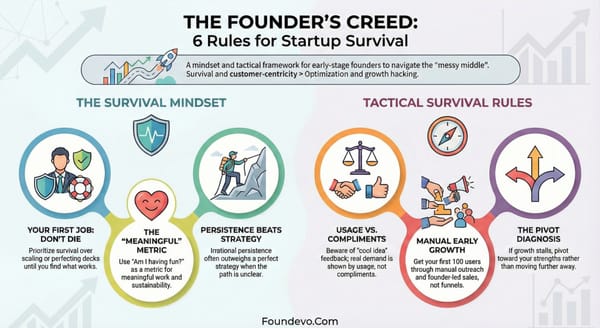
🚫Why 99% of Founders Should NOT Raise VC
🚀 Top 8 Lessons from 1000+ YC Startups

In This Edition:
- 🔥 27 AI Pitch Decks VCs Backed
- 📈 How Top Teams Run Better Meetings
- ✋How Startups Can Find Their Perfect Investor
- 🚀 Top 8 lessons from 1000+ YC startups
- 🚫 Why 99% of Founders Should NOT Raise VC
🔥 27 AI Pitch Decks VCs Backed
🔥 27 AI Pitch Decks VCs Backed
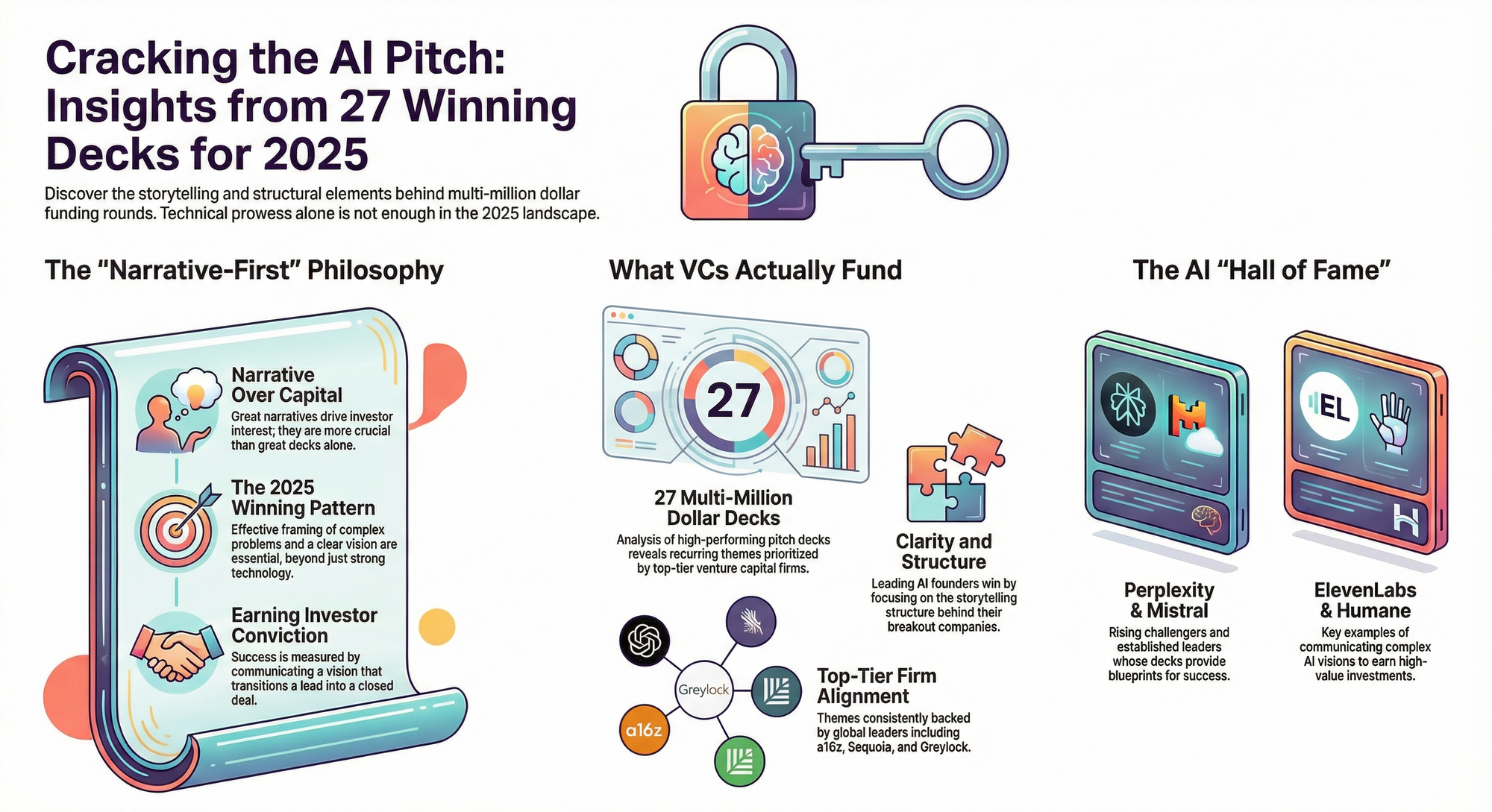
A clear pattern is emerging in 2025: the most fundable AI startups don’t just build strong tech—they tell a compelling story.
This edition breaks down 27 AI startup pitch decks that raised millions, revealing how top founders frame problems, communicate vision, and earn investor conviction. These are the decks that caught the attention of leading global funds—and closed.
🔍 What You’ll Learn
• How Top AI Founders Pitch — structure, clarity, and storytelling behind breakout companies
• What VCs Actually Fund — recurring themes backed by a16z, Sequoia, Greylock, and top-tier firms
• Decks That Win — insights from Perplexity, ElevenLabs, Mistral, Humane, and rising challengers
💡 Why This Matters
Great decks don’t raise capital. Great narratives do.
Studying what worked for successful AI founders shows exactly what today’s investors say yes to.
🚀 The AI Pitch Deck Collection Every Founder Needs
Explore the full collection, decode what makes these decks fundable, and share it with anyone preparing their next raise.
The blueprint for a winning AI pitch starts here. 👇
🚀 The AI Meeting Tools Everyone Wants
📈 How Top Teams Run Better Meetings
Meetings are no longer just conversations—they’re becoming data-rich, automated engines for clarity and action. With AI-powered tools now handling transcription, summaries, task extraction, and speaker insights, teams can finally focus on decision-making instead of documentation.

🔍 What This Edition Highlights
• Smarter Note-Taking — tools like Otter, Fireflies, and tl;dv capture context, key moments, and follow-ups automatically
• Productivity Boosters — assistants such as Sembly, Avoma, and Fathom turn meetings into actionable plans
• Analytics & Insights — platforms like MeetGeek and Poised provide sentiment, performance, and communication analysis
• Specialized Use Cases — Rewatch for video libraries, Jamworks for students, Scribe for instant documentation
💡 Why It Matters
AI meeting assistants remove the busywork that slows teams down, making every conversation more productive, accountable, and searchable.
Explore the full breakdown of 20+ top AI meeting tools, share the list with your team, and upgrade your workflow with assistants that save hours every week. The smartest teams aren’t meeting more—they’re meeting better.
🎯How to find investors
✋How Startups Can Find Their Perfect Investor
Raising capital isn’t the hardest part… choosing the right investor is.
Most early-stage founders obsess over how to get funding but rarely ask the question that matters even more:

👉 “Who should I actually take money from?”
Because the truth is:
The wrong investor can slow you down. The right one can change your entire trajectory.
Before you sign that term sheet, ask yourself:
🔸 Do they understand my industry well enough to guide me?
🔸 Can their network open doors I can’t open alone?
🔸 Have they helped companies like mine scale — or exit?
🔸 Will they support me beyond just wiring money?
🔸 And most importantly… what red flags am I missing?
Founders often assume capital is scarce, but aligned capital is what truly moves the needle.
And choosing poorly can cost you far more than equity.
This deep dive breaks down:
✨ The 3 types of startup investors (and which one fits your stage)
✨ What “good” industry + functional expertise actually looks like
✨ How to evaluate an investor’s track record and network
✨ One major red flag hidden inside many term sheets
✨ How to structure a clean, founder-friendly raise
✨ Plus: A sample term sheet you can download and use
If you’re raising now — or planning to — this isn’t just helpful. It’s essential.
🎯 Startups Buzz
🚫 Why 99% of Founders Should NOT Raise Venture Capital
A growing number of YC veterans are finally saying the quiet part out loud: venture capital isn’t for most startups.
VC only works if your company has a realistic path to returning 100x–1,000x. Most businesses don’t need that kind of jet fuel. They need profitability, control, and optionality.
The real winners?
Founders who build companies that fund their lifestyle—not their stress.
If you can reach profitability without front-loading millions:
- Keep the equity
- Keep the freedom
- Keep the leverage
VC isn’t a badge of honor. It’s a tool—and only necessary when your startup cannot exist without heavy upfront capital.
🧠 Is Your Startup Funnel Actually a Trap?
Many founders think their funnel is broken. In reality, it’s misaligned.
The real trap appears when startups obsess over:
- More traffic
- More automation
- More tools
…while ignoring the fundamentals:
- Clear differentiation
- Strong conversion
- Real retention
- Actual buyer behavior
A funnel becomes a liability when it adds complexity instead of clarity.
The winners do the opposite:
- Fix bottom-of-funnel issues first
- Track meaningful actions (not vanity metrics)
- Simplify early systems
- Treat retention as seriously as acquisition
The truth: Funnels don’t fail. Founders fail when they optimize the wrong metrics.
🚀 Top 8 lessons from 1000+ YC startups by Dalton Caldwell
Some lessons only emerge after thousands of founder conversations—and Dalton Caldwell has had more than almost anyone in Silicon Valley. After advising 1000+ YC startups and 35+ unicorns, his insights reveal repeating patterns behind the companies that break out… and the ones that quietly fade.
• Survival is a strategy
Winning often begins with simply not dying before traction hits.
• Quitting is a skill
The best founders know when to stop digging a hole.
• Smart pivots follow signals
Clear customer pull and painful stagnation often trigger the right move.
• Certain ideas are tar pits
They look shiny but trap founders in years of slow death.
• Investors reject for predictable reasons
TAM, team clarity, and traction explain most “no’s.”
• Delegation can kill early teams
Over-handoff breaks velocity long before scale.
• Great customer conversations matter
The fastest-growing startups learn directly from real users, daily.
Successful founders aren’t lucky—they’re disciplined. They avoid traps, act quickly on evidence, and survive long enough to win.
📥 Download the Full Breakdown
Get the complete insights and examples behind all eight lessons.
👉 Download the “Top 8 Lessons from 1000+ YC Startups” ebook now.
🔥 ICYMI: Founder Resources You Probably Missed
These high-impact reads have been powering sharper pitches, smarter fundraising, and faster investor yeses. If you missed them, now’s the time to catch up before everyone else does.
🚀 Harvard’s Startup Guide: Turning Ideas Into Impact
The hidden frameworks elite founders quietly rely on.
📚 The Ultimate Fundraising Resource Stack
A vault of tools most founders don’t know exists.
🔑 The Most Overlooked Key to Fundraising Success
YC founders swear by this — yet most ignore it.
🔥 Paul Graham’s ‘Small, Intense Fire’
The mindset shift that separates funded from forgotten.
🧠 What Sam Altman Wants Every Founder to Know
The blunt guidance founders rarely hear early enough.
📊 Venture Math Demystified
Why VCs say no — even when your pitch feels strong.
💡 200+ Easy Ways to Make Money Using AI
Surprising, practical income ideas you can start today.
🚀 100+ VCs & Accelerators You Should Know
A curated map of investors actively backing early teams.
📘 Ben Horowitz’s High-Stakes Leadership Playbook
How great founders act when everything breaks at once.
🤖 29 Angels & VCs Funding AI Startups Right Now
Verified, active investors hunting for their next AI bet.
💼 50 Recently Funded B2B Startups
What’s getting funded right now — and why.
🔥WEB PICKS
Google bets big on India’s classrooms
Google announced a $10M grant to scale adaptive learning tools to 75 million students in India. The surprise? Nearly 75% of AI interactions focused on building understanding, not quick answers—suggesting students are using AI more thoughtfully than critics expected.
Mozilla’s all-in gamble on open AI
According to CNBC, Mozilla has deployed its entire reserve to fund a “rebel alliance” of AI startups prioritizing transparency over raw capability. They’re outfunded 40-to-1 by OpenAI and Anthropic—but are betting open-source AI can win meaningful market share by 2028. A long shot, but a consequential one.
AI training data faces a dark reality
Amazon reported detecting hundreds of thousands of CSAM instances in AI training datasets in 2025. These findings accounted for the majority of the 1M+ industry reports submitted to NCMEC—highlighting the scale of hidden risk in large-scale data pipelines.
Microsoft quietly worries about Anthropic
Internal warnings from Microsoft product leaders suggest Anthropic’s “Cowork” could outpace Microsoft 365 Copilot. Teams were urged to rapidly prototype competing agents—some ironically powered by Anthropic’s own models.
Quantum batteries could reshape quantum computing
Researchers from Australia and Japan proposed using quantum batteries to power quantum computers. The theory: 4× more qubits within current cryogenic limits while reducing energy demands—a potential breakthrough if proven viable.
IBM hits a quantum milestone
IBM demonstrated a 100× speedup in complex chemistry simulations by combining quantum processors with GPUs—a concrete step toward its vision of quantum-centric supercomputing.
ICE expands AI across enforcement operations
The Information reports ICE is using AI tools from Palantir and OpenAI, including a Palantir-powered tip-sorting system and GPT-4 for resume screening, raising fresh questions around AI governance in law enforcement.
Meta is training robots with human movement data
Meta confirmed it is collecting hand, body, and eye-tracking data from Ray-Ban smart glasses and VR headsets to develop AI systems that could eventually power humanoid robots.
Anthropic flags subtle AI influence risks
After analyzing 1.5M Claude conversations, Anthropic found cases of severe disempowerment—where AI influence compromises user judgment—in roughly 1 in 1,000 to 1 in 10,000 interactions. These often involved repeated emotional guidance requests, which users rated positively—until real-world decisions followed.