How Freepik Reached 100M Users Without Venture Capital

A deep-dive into the bootstrapped startup growth strategy, data moat, and AI pivot that built one of Europe's most profitable design platforms.
Most venture-backed startups burn through millions of dollars trying to reach 10 million users. Freepik reached 100 million monthly users without raising a single euro in outside funding. No seed round. No Series A. No board of directors pushing for growth at any cost. Just a product built on a real problem, compounded by a decade of smart strategic decisions.
Understanding how Freepik grew without venture capital is not just an exercise in admiration. It is a detailed, replicable playbook that covers some of the most important topics in modern startup strategy: building a data moat, surviving AI disruption, leveraging distribution advantages, and knowing when to cannibalize your own business model before a competitor does it for you.
This case study breaks down every major layer of that strategy. By the end, founders will have a clear picture of how a bootstrapped startup case study of this scale actually works in practice, not in theory.
Freepik is not a story about luck or timing. It is a story about compounding advantages built deliberately over more than a decade.
TL;DR — Freepik Growth Strategy at a Glance
For founders who want the condensed version before going deep, here is what drove Freepik's growth:
• Started as a search engine, not a content platform. The product began by aggregating third-party assets, which revealed demand before requiring supply.
• Built a powerful data moat from years of accumulated user search intent, creating a geographic and behavioral map that no competitor could easily replicate.
• Created a self-reinforcing content flywheel where better data produced better content, which attracted more users, which generated more data.
• Stayed profitable from early on, which gave the company the freedom to make uncomfortable strategic decisions without investor interference.
• Adopted AI aggressively, even at the cost of its own ten-year-old catalog, integrating diffusion models to become a generative platform rather than just a stock library.
• Evolved into an AI orchestration platform, managing multiple specialized models rather than wrapping a single one, creating a durable experience layer that competitors cannot easily copy.
🚀 1000+ Angel Investors
A massive list of angel investors actively funding early-stage startups. Whether launching your first venture or scaling fast, find your next backer here.
👉 1000+ Angel InvestorsHow Freepik Started: A Bootstrapped Startup Case Study
Freepik did not start with a vision to dominate the design asset market. It started because its founders needed design resources for their own work and discovered that the options available were either too expensive, too limited, or too hard to find. That personal frustration is the most reliable starting point for any durable product.
The first version of Freepik was a search engine, not a content library. The founding team built a tool to index and surface third-party design content from around the web, making it easier to find free or affordable graphic assets. That seems like a modest beginning, but it was strategically brilliant for a bootstrapped startup. Building a search engine requires less content investment than building a library. It also generates data before it requires resources, because every search tells you what users want before you have to produce it.
What the search engine revealed was a specific, underserved demand. Users were searching for illustrations, vector icons, and editable graphic templates in enormous volumes. The dominant stock image market at the time was shaped by agencies like Getty Images, which sold high-priced photography for editorial and advertising use. The everyday designer building a website, a presentation, or a social media graphic was largely ignored. Freepik identified that gap and built into it.
The pivot from search engine to content producer was not dramatic. It was a natural response to signal. As the team understood what users wanted most, they began producing that content directly, gradually shifting from an aggregator to an original content platform. This pattern appears in some of the most successful bootstrapped companies success stories across the industry: start with discovery, learn from behavior, then produce what demand confirms.
The search engine was not just a product. It was a market research machine that told Freepik exactly what to build next.
Bootstrapping at Scale: Why the Funding Model Is a Strategic Choice
There is a persistent assumption in startup culture that venture capital is the natural path for companies with ambitions to scale. Freepik is one of the clearest counterexamples to that assumption in recent European startup history. Reaching 100 million monthly users as a bootstrapped company is not a minor achievement. It fundamentally changes the strategic options available to a founder at every critical decision point.
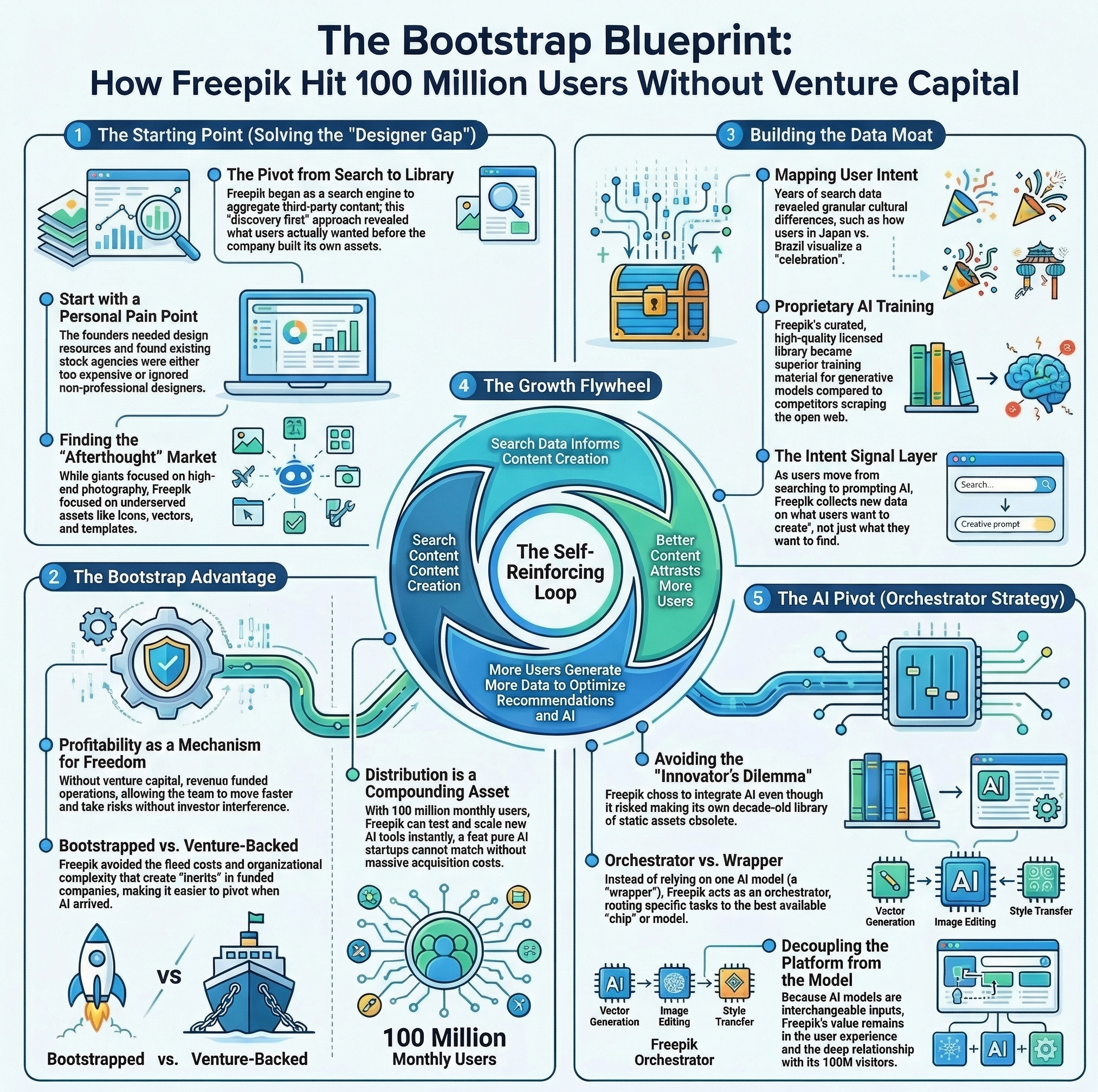
When outside investors are not involved, growth targets are not commitments negotiated with a board. They are internal goals shaped by what the market actually rewards. That distinction matters enormously when a disruptive technology arrives and the right response is to slow down, rethink, and pivot rather than accelerate. Freepik did not need to convince anyone that cannibalizing its own catalog was the right move. The decision was the founders' to make.
The absence of heavy fixed costs and investor-mandated headcount expansion also meant that the cost of pivoting was structurally lower than it would have been for a funded competitor. Large funded companies build organizational complexity that resists change. Bootstrapped companies that have remained lean and profitable retain the ability to move quickly when the market demands it.
Bootstrapped vs VC-Backed Startups
The table below captures the key structural differences that shaped Freepik's strategic decisions at every stage of its growth:
|
Factor |
Bootstrapped
(Freepik) |
VC-Backed
Startup |
|
Control |
Full founder
control, no board pressure |
Shared
governance, investor influence |
|
Speed |
Decisions
made in hours or days |
Board
approval cycles slow decisions |
|
Flexibility |
Pivot freely,
no fixed growth mandates |
Growth
targets constrain pivots |
|
Risk
Tolerance |
Long-term
thinking, organic pacing |
Forced scale,
sometimes premature |
|
Profitability |
Profitability
fuels growth from day one |
May operate
at a loss for years |
|
Self-disruption |
Can
cannibalize itself freely |
Risky when
investors protect valuation |
None of this is to suggest that venture capital is always the wrong choice. For companies that need to win a market through speed and capital intensity, outside funding can be the only viable path. But for companies building data-driven, content-led, or platform businesses where compounding matters more than speed, the bootstrapped model offers structural advantages that capital cannot replicate.
What Is a Data Moat? The Freepik Example
A data moat is a competitive advantage built from proprietary data that competitors cannot easily acquire or replicate. Unlike a technology moat, which can be eroded when a better technology emerges, a data moat deepens over time as more user interactions accumulate. It is one of the most durable forms of competitive advantage available to a platform business, and it is one of the primary reasons Freepik remains difficult to displace despite the rapid commoditization of design content.
Freepik's data moat was not designed. It emerged from years of operating a search-driven platform where user behavior was the primary signal for every product decision. Over time, that accumulated signal became something no competitor could simply purchase or replicate quickly, regardless of funding.
Intent Data: The Core of the Moat
The most valuable part of Freepik's data moat is not the volume of searches it has processed. It is the granularity of understanding that volume of data enables. A user in Japan searching for the word 'mountain' is almost certainly looking for a stylized illustration of Mount Fuji, not a generic alpine landscape. A user in Brazil searching for 'celebration' has different visual expectations than one searching from Germany. These distinctions are invisible in aggregate keyword reports but become highly legible when observed across millions of real transactions on a platform users trust enough to return to repeatedly.
This level of intent understanding is nearly impossible for a new entrant to acquire quickly. It requires not just traffic but a specific kind of trust-based return traffic where users complete creative tasks and generate behavioral feedback through their choices. A new competitor can build a technically superior product and still spend years before its search results are as contextually accurate as Freepik's, simply because it lacks the historical behavioral data that makes context resolution possible.
How the Moat Compounds into AI
The data moat deepened significantly when Freepik began integrating generative AI. The existing library, built and refined using years of behavioral signal, became training material for new models. Clean, high-quality, licensed creative content is a scarce input in AI training. Most generative image companies were working with scraped web data of uneven quality and contested copyright status. Freepik had a curated library that was purpose-built for professional creative use, along with the contextual data to understand how every asset in that library was actually being used.
When users began interacting with Freepik's AI generation tools, the moat added a new layer. The platform started collecting prompt data: what users want to create, at a granular and contextual level that no other platform was positioned to capture at comparable scale. Each generation request became a new signal that improved the next one. The moat, already deep from a decade of search data, began deepening in an entirely new direction.
Freepik's data moat is not a static asset. It is a living system that gets more valuable with every user interaction.
🚀 1000+ Angel Investors
A massive list of angel investors actively funding early-stage startups. Whether launching your first business or scaling up, find your next backer here.
🔥 Get Access to 1000+ Angel InvestorsThe Freepik Growth Flywheel
A flywheel is a self-reinforcing growth loop in which each component strengthens the next. Once the loop gains momentum, it becomes progressively harder to stop from the outside and progressively easier to sustain from the inside. Freepik's flywheel is one of the most structurally elegant examples in the product-led growth literature, precisely because it was not engineered from the top down. It emerged from paying close attention to where value was being created and deliberately reinforcing those connections.
01 Users Search
Millions of monthly visitors search for specific design assets, generating a continuous stream of intent data across hundreds of markets and languages.
02 Data Collection
Every search, refinement, and asset selection teaches the platform what users mean, not just what they type. Behavioral patterns accumulate into an increasingly accurate intent map.
03 Content Creation
Search signal informs the content production team about what categories and styles are underserved. Resources flow toward demand rather than toward assumptions about demand.
04 Better Results
More relevant content improves search result quality, which increases task completion rates, which increases user satisfaction and return frequency.
05 More Users
A better product attracts more users through organic discovery and word of mouth, which feeds more behavioral data back into the top of the loop.
What makes the flywheel durable is that each layer creates a dependency on the previous one. A platform that understands intent better than any competitor is not winning on a single dimension. It is winning on every dimension that depends on intent understanding, which in a content and creative tools business is nearly every dimension that matters.
The flywheel also delivered a distribution advantage that pure AI startups could not match when generative image tools began proliferating. Reaching 100 million monthly users requires years of trust-building, search engine authority, and brand recognition that cannot be accelerated with capital alone. Freepik could place a new AI tool in front of its existing audience immediately. The economics of that launch are fundamentally different from those facing a well-funded startup building an audience from scratch.
Facing AI Disruption: The Innovator's Dilemma in Practice
The innovator's dilemma describes a trap that successful companies fall into when a new technology threatens their existing business. The trap is not ignorance. Most established companies see the disruption coming. The trap is that the rational response to disruption, when viewed from inside a profitable business, is to protect what is already working rather than risk it on an uncertain future. That rational response is also the one most likely to lead to irrelevance.
When generative AI began producing images good enough to substitute for stock assets, Freepik was staring directly into the dilemma. A library built over a decade, representing enormous investment in content production, curation, and licensing, suddenly faced the possibility of becoming redundant. Users who previously needed to browse for an illustration could now generate one on demand in seconds.
Diffusion Models vs GANs: What Changed
To understand why this disruption was qualitatively different from previous waves of AI-generated imagery, it helps to understand what diffusion models are and how they differ from earlier generative technologies.
GANs, or generative adversarial networks, were the dominant approach to AI image generation for several years. They work by training two competing networks: one that generates images and one that discriminates between real and generated ones. GANs became capable of producing photorealistic faces and narrow categories of images, but they struggled with open-ended creative requests. They were powerful within a constrained domain and brittle outside it.
Diffusion models work differently. They learn to reconstruct images from noise by training on the reverse process of gradually corrupting an image until only random noise remains. When used in generation mode, they start from pure noise and work backward toward a coherent image guided by a text prompt. This approach handles open-ended creative requests with a flexibility that GANs could not match. A user could describe almost any image in natural language and receive a credible result. That shift from narrow-domain generation to general-purpose creation is what made the threat to stock content real and immediate.
Self-Disruption as a Strategic Choice
Freepik's response to this threat was to integrate it rather than resist it. The company hired an AI team before it knew exactly what that team would build. It began experimenting with diffusion models, Stable Diffusion, Flux, and other architectures, and started placing generative tools directly into its existing product experience. That decision meant accepting that AI-generated content might reduce demand for the catalog the company had spent a decade building.
That acceptance is the strategic move most companies never make. Being bootstrapped, with no investors protecting the valuation of the existing catalog, meant Freepik could look at the situation clearly and choose the uncomfortable path. Companies that wait for disruption to become obvious before responding are almost always too late. The ones that move early, even at the cost of short-term asset value, are the ones that define the next version of their market.
Freepik chose to make its own catalog obsolete rather than wait for a competitor to do it. That decision is the whole case study in one sentence.
From Content Library to AI Orchestrator
After committing to generative AI, Freepik faced a second strategic question that most founders in this position overlook: what kind of AI company should it become? The simplest answer would have been to integrate a single model, wrap it in the existing interface, and let users generate images alongside browsing stock assets. That approach is what the industry calls a wrapper, a product that adds a thin layer of user experience on top of a third-party model without meaningful technical differentiation.
Wrappers are fragile businesses. The underlying model improves, the provider changes pricing or access terms, a competitor builds a better wrapper, and the product's reason for existing disappears. Freepik recognized this and chose a fundamentally different frame.
The AI Orchestration Model Explained
Freepik began positioning itself as an orchestrator. The analogy that best captures what this means is the relationship between chips and computers. An AI model is the chip, the raw processing capability. An orchestration platform is the computer, the system that decides which chip to use for which task, routes the computation appropriately, and presents the result to the user in a way that feels seamless and purposeful.
In practice, this means building the infrastructure to deploy different specialized models for different creative tasks rather than relying on any single general-purpose model. A user generating a photorealistic product photograph needs a different model than one creating a flat icon set or a hand-drawn illustration style. An orchestrator abstracts that complexity away. The user describes what they want. The platform determines which model handles the generation, how the output is refined, and how it is presented within the broader creative workflow.
The strategic implication of this positioning is significant. AI models are improving rapidly and the competitive dynamics among model providers are intense. A platform built around a single model is exposed to the obsolescence of that model. An orchestrator can swap in a better model as soon as one becomes available, because the platform's value is in the experience layer and the user relationship, not in any single underlying model. Freepik's decade of user data and trust is the durable asset. The models are interchangeable inputs.
In an AI-first world, the companies that win will not be the ones that own the best model. They will be the ones that best understand what users need and route that need to the right tool at the right time.
Key Lessons for Founders
The Freepik playbook is not a template that can be copied line by line. But it contains strategic principles that apply to almost any founder building a product in a market that data, AI, or shifting user behavior is reshaping.
|
01 |
Build from real user problems. Freepik started because its
founders needed design assets and could not find them. That personal
frustration became a 100-million-user business. The best startups are born
from lived experience, not market sizing spreadsheets. |
|
02 |
Data moats compound over time. Every search, every click,
every failed query teaches a platform something a competitor cannot buy.
Start collecting intent data on day one, even if you do not know how to use
it yet. |
|
03 |
Profitability creates strategic freedom. Freepik could
cannibalize its own catalog because no investor had built a valuation model
around it. Profitable bootstrapped companies can make the uncomfortable moves
that funded ones cannot. |
|
04 |
Disrupt yourself before others do it for you. Generative AI
was going to change the stock image market regardless of what Freepik
decided. The company chose to lead that change rather than react to it. That
choice made all the difference. |
|
05 |
Distribution is a hidden advantage. One hundred million
monthly visitors is not just a metric. It is a launch pad for every new
product the company will ever build. Founders should treat their user base as
infrastructure, not just an audience. |
|
06 |
Orchestration is more defensible than any single technology.
Models improve and get replaced. The experience layer, built on deep user
understanding and trust, is what lasts. Build the computer, not just the
chip. |
Startup Growth Strategy Breakdown
Freepik's growth strategy sits at the intersection of four principles that are increasingly central to sustainable startup growth in competitive markets.
Product-Led Growth
Freepik grew primarily because the product got better over time in ways that users could directly experience. There was no aggressive sales motion, no heavy advertising spend, and no viral loop engineered into the product artificially. The search tool worked better as it accumulated more data. The content library became more relevant as behavioral signal informed production decisions. Users returned because the product solved their problem more reliably each time they used it. That is the definition of product-led growth: the product itself is the primary driver of acquisition, retention, and expansion.
Data-Driven Scaling
Every major content and product decision at Freepik was informed by search data, not intuition or market research. The company knew which categories were underserved before building into them. It knew which user segments were growing before allocating resources toward them. This approach to data-driven scaling is one of the defining characteristics of bootstrapped companies success stories that reach meaningful scale without outside capital. When you cannot afford to waste resources on the wrong bets, data becomes the primary decision-making tool.
Distribution Leverage
Distribution leverage is the ability to use an existing audience to amplify the impact of new products or features. Freepik's 100 million monthly visitors represent the most powerful distribution asset the company possesses. When a new AI generation tool launches, it does not need a launch campaign. It has an immediate audience of qualified users who are already in a creative workflow and looking for tools that help them complete tasks faster. That is a distribution advantage that no funding round can purchase directly.
Iterative Product Evolution
Freepik's product today looks almost nothing like the search engine it started as. That evolution was not the result of a five-year strategic plan. It was the result of paying close attention to what was working at each stage and making incremental decisions to double down on it. Search engine to content platform to AI-integrated library to AI orchestration platform. Each step was a response to what the previous step revealed, not a predetermined destination.
Frequently Asked Questions
What is a bootstrapped startup?
A bootstrapped startup is a company that grows using its own revenue rather than outside investment. Founders retain full control and build at a pace the business can sustain organically. Freepik is one of the most prominent bootstrapped startup examples in European tech, having reached 100 million monthly users without raising venture capital.
Can startups grow without funding?
Yes. Many of the most durable companies in technology were built without venture capital. Bootstrapping works best when a business can reach profitability early, has a product with strong organic discovery, and is operating in a market where speed of capital deployment is less important than depth of user understanding. Freepik, Basecamp, Mailchimp, and Notion in its early years are all examples of companies that grew without or with minimal external funding.
What is a data moat?
A data moat is a competitive advantage that emerges from the accumulation of proprietary behavioral or transactional data over time. Unlike a technology moat, a data moat is difficult to replicate quickly because it requires time, user trust, and repeated interaction to build. Freepik's search intent data, accumulated over more than a decade, is a classic data moat example: it is specific, contextual, and nearly impossible for a new entrant to replicate without years of operating at comparable scale.
How do bootstrapped companies scale without capital?
Bootstrapped companies scale through a combination of organic product improvement, content or distribution flywheels, and disciplined reinvestment of early revenue. The key is reaching profitability before the market demands aggressive spending. Once a company is profitable, revenue becomes the growth engine. Freepik's growth demonstrates that this path is viable even at extreme scale, provided the product creates compounding value for users over time.
What is product-led growth?
Product-led growth is a go-to-market strategy in which the product itself drives user acquisition, retention, and expansion rather than a dedicated sales or marketing function. The product demonstrates value directly, users return because it solves their problem reliably, and growth compounds as the product improves. Freepik is a strong product-led growth example because its search and content tools became more useful with every user interaction, creating a self-reinforcing improvement loop without requiring heavy marketing spend.
Final Thoughts
The Freepik case study challenges some of the most deeply held assumptions in startup culture. That scale requires venture capital. That surviving AI disruption requires being an AI-first company from day one. That a company with an existing successful business model cannot afford to cannibalize itself. Freepik did all three things the prevailing wisdom said it could not do.
What made those moves possible was not a superior technology or an unusually large market opportunity. It was a structural condition: a company that was profitable, lean, and free from the obligations that tend to make established companies risk-averse. That freedom, more than any single product decision, is what defines the Freepik playbook.
The next generation of durable companies will not be defined by how much they raised or which AI model they partnered with. They will be defined by how well they understood their users, how early they started building systems that compound, and how willing they were to make the uncomfortable decisions that protected long-term relevance at the cost of short-term comfort.
Freepik did not win by being the best-funded company in its market. It won by being the most disciplined, the most data-informed, and the most willing to disrupt itself. That is a playbook any founder can follow.