Best Startup Accelerators Accepting Applications Right Now (No Hype, Just Facts)
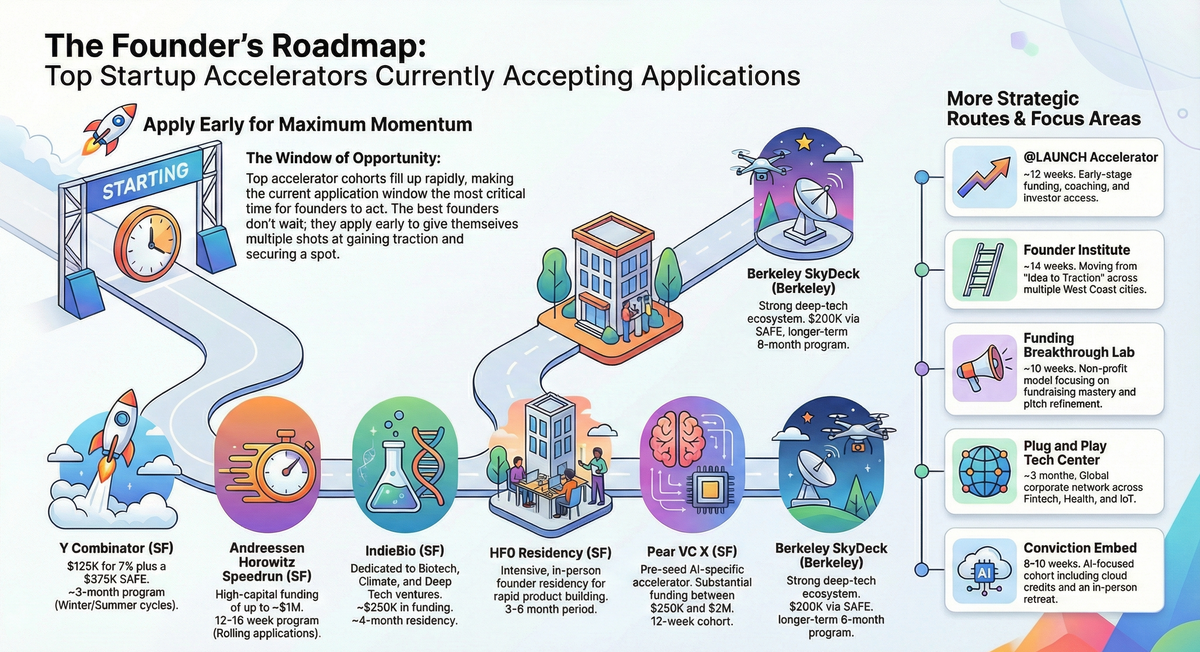
There is a quiet pattern among founders who miss their first accelerator cycle. They spend months refining the product, waiting until everything feels ready, and then submit an application two weeks before a cohort closes. By that point, the best spots are already filled. The reality of top accelerator programs is that the application window is often much shorter in practice than it is on paper, and the founders who move early tend to get more attention, better interviews, and ultimately better outcomes.
The early application window is not just a scheduling advantage. It signals something real about a founder's operating style. Programs like Y Combinator and Berkeley SkyDeck receive thousands of applications per batch. Reviewers notice when someone applies deliberately and early versus when someone scrambles at the last minute. That first impression carries more weight than most founders realize.
This post covers the top startup accelerators currently accepting applications, what each program actually offers beyond the headline funding number, and how to approach the process strategically. Whether it is the first time applying or the third, understanding what these programs look for and how they differ from one another is the foundation for a strong application. The list spans early-stage startup funding programs across biotech, artificial intelligence, deep tech, and generalist verticals, so there is relevant territory here regardless of the sector.
What to look for before applying to any accelerator
Equity and funding terms are the most visible part of any accelerator deal, but they are not always the most important. The standard structure in programs like Y Combinator involves a fixed equity percentage taken via a SAFE note, which converts during a priced round. Other programs take equity at varying rates or offer non-dilutive support entirely. What matters is understanding whether the funding amount justifies the equity given up, and whether the valuation cap on a SAFE is reasonable for the stage of the company. Founders who take the time to model out the dilution before signing tend to be far better positioned in future fundraising conversations.
Network and mentor quality often matter more than the initial check. A program that connects founders with the right two or three investors for their sector can create more value in twelve weeks than a larger funding amount from a weaker network. Before applying, it is worth researching which portfolio companies have gone through the program and whether their trajectory afterward looks compelling. The alumni network is the long-term asset; the funding is the short-term fuel.
Program length and intensity differ significantly across the options available. A twelve-week sprint like Pear VC PearX is built for teams that are ready to move fast and already have a clear product thesis. A longer residency format like HF0 is designed for founders who are still in the process of finding their footing and building the initial product. Neither is better in the abstract. The right choice depends on where the team actually is versus where the program assumes they are when they arrive.
Stage fit is one of the most overlooked variables in the accelerator application process. Applying to a program designed for post-revenue companies when the product is still in beta is a waste of time and can damage the relationship with that program for future cycles. Most programs publish their ideal candidate profile in clear language. Reading it carefully and being honest about whether the company actually fits is the fastest way to build a shortlist worth pursuing. Programs focused on accelerating pre-seed AI startups have very different expectations than those designed to help founders go from idea to first traction.
Top startup accelerators accepting applications
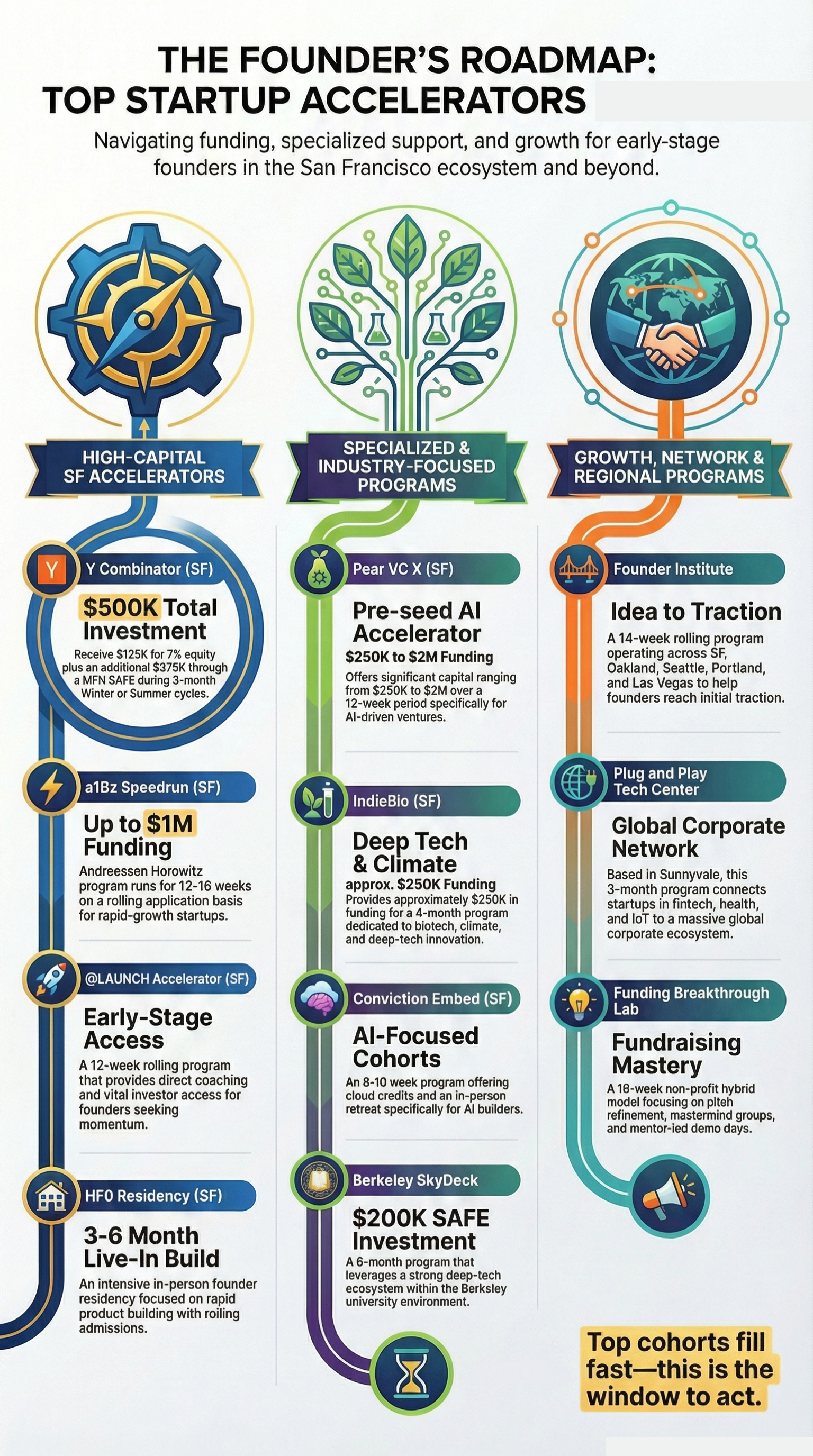
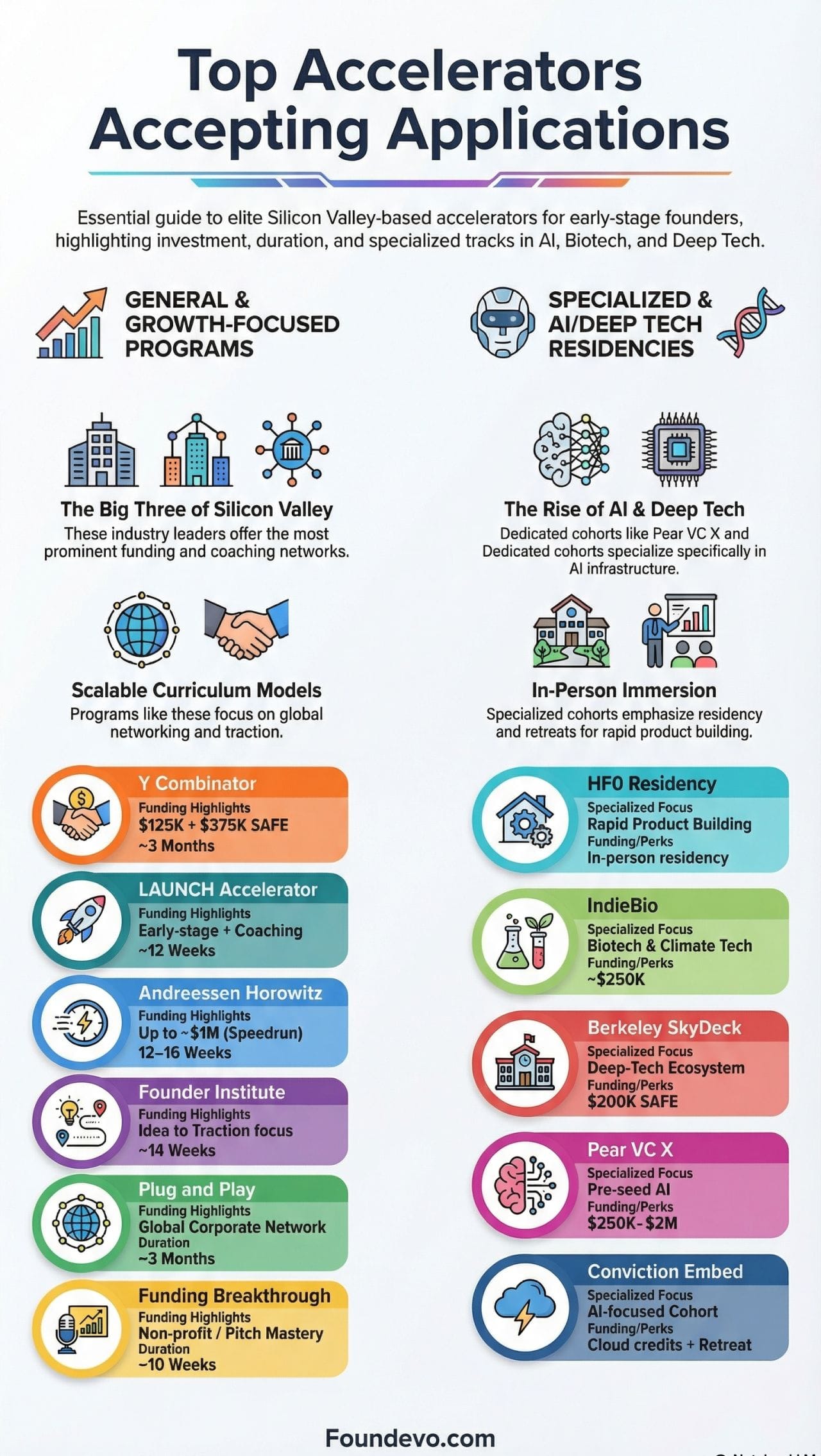
What follows is a breakdown of eleven programs that are currently open or running on rolling admissions. Each entry explains what the program is genuinely useful for, who it tends to serve well, and the key details a founder needs before applying.
1. Y Combinator
Y Combinator remains the benchmark against which every other early-stage startup funding program is measured. The combination of a substantial initial check, a wide-ranging alumni network, and the Demo Day platform for meeting investors gives YC an outsized impact on the trajectory of the companies that go through it. The program runs twice a year in winter and summer cohorts, each lasting approximately three months. The acceptance rate is low, and the interview process is demanding, but the signal value of a YC batch acceptance compounds for years after the program ends.
Funding: $125,000 for 7% equity plus a $375,000 uncapped SAFE with MFN
Program Length: Approximately 3 months
Application Cycle: Winter and Summer cohorts
Apply: ycombinator.com/apply
2. LAUNCH Accelerator
LAUNCH is built around hands-on coaching and direct investor access for early-stage companies that are still finding their way through the first rounds of fundraising. The program runs on a rolling basis, which makes it more accessible than cohort-only models for founders who are ready to move but cannot wait for a fixed start date. The twelve-week structure is intense by design, and the founder coaching component is a genuine differentiator compared with programs that focus primarily on demo preparation. Founders looking for startup accelerator programs that combine mentorship with investor introductions will find this format particularly useful.
Funding: Early-stage funding (terms vary by cohort)
Program Length: Approximately 12 weeks
Application Cycle: Rolling admissions
Apply: launchaccelerator.co
3. Andreessen Horowitz Speedrun
Speedrun is Andreessen Horowitz's direct entry point for very early companies building in areas where a16z has conviction. The funding ceiling of approximately one million dollars positions this program in a tier above most traditional accelerator checks, and the twelve-to-sixteen-week program length gives teams enough runway to show meaningful progress before the program concludes. Rolling admissions keep the pipeline open throughout the year. For founders building in AI, crypto, or enterprise software, the a16z network is one of the most strategically valuable in venture capital, and Speedrun is the most accessible path into it at the pre-seed stage.
Funding: Up to approximately $1 million
Program Length: 12 to 16 weeks
Application Cycle: Rolling admissions
Apply: a16z.com/speedrun
4. HF0 Residency
HF0 operates as a founder residency rather than a traditional accelerator, which changes the nature of what the program provides. Teams move in together in San Francisco and spend three to six months building rapidly in a high-intensity, in-person environment. The structure rewards founders who are at an early enough stage to benefit from that kind of focused product time, and the residency model creates a level of peer accountability and cross-pollination that remote or hybrid programs cannot replicate. For first-time founders building in technical domains, the HF0 residency format offers something difficult to find elsewhere: extended time and space to build without the usual distractions.
Funding: Residency-based (terms vary)
Program Length: 3 to 6 months
Application Cycle: Rolling admissions
Apply: hf0.com
5. IndieBio
IndieBio is the leading biotech startup accelerator in the United States for companies working at the intersection of biology, climate, and deep technology. The approximately two-hundred-fifty-thousand-dollar investment is structured to give teams enough capital to run meaningful experiments and reach the kind of data milestones that serious life science investors need to see before committing further capital. The four-month program includes lab access and a network of scientific advisors that is genuinely specialized in the sectors the program covers. For founders building in biotech or climate tech who are looking for deep tech accelerator funding with real scientific infrastructure behind it, IndieBio is one of a small number of programs that understands the development timelines involved.
Funding: Approximately $250,000
Program Length: Approximately 4 months
Application Cycle: Cohort-based
Apply: indiebio.co
6. Founder Institute
Founder Institute operates across multiple cities including San Francisco, Oakland, Seattle, Portland, and Las Vegas, making it one of the more geographically distributed options for founders who are not based in the Bay Area. The program is designed specifically for founders who are still at the idea or early traction stage, guiding companies through the process of turning an early concept into something with enough substance to attract early customers and, eventually, investors. At approximately fourteen weeks with rolling admissions, it is one of the more accessible entry points for first-time founders who need structured support before they are ready for a more competitive program. Founder Institute is often the right first accelerator for a technical founder who has domain expertise but has not yet built a company.
Funding: Program-based support with equity model (terms vary)
Program Length: Approximately 14 weeks
Application Cycle: Rolling admissions
Apply: fi.co
7. Berkeley SkyDeck
Berkeley SkyDeck occupies a unique position in the accelerator landscape because of its deep ties to UC Berkeley and the research ecosystem that surrounds it. The two-hundred-thousand-dollar SAFE structure provides meaningful capital, and the six-month program length is long enough to allow for genuine product development and iteration. The program has a particularly strong orientation toward deep tech, hardware, and scientifically intensive companies, reflecting the nature of Berkeley's research output. For founders who have a university or research background and are commercializing technology with a longer development arc, SkyDeck offers a network and a set of advisors that are calibrated for that kind of company.
Funding: $200,000 via SAFE
Program Length: Approximately 6 months
Application Cycle: Cohort-based
Apply: skydeck.berkeley.edu
8. Funding Breakthrough Lab
Funding Breakthrough Lab takes a different approach from most programs on this list. Rather than providing capital directly, the ten-week program focuses on fundraising mastery and pitch refinement, helping founders understand how to articulate their story, structure their fundraising process, and engage effectively with investors. The non-profit model means the program is accessible to founders who may not be able to offer equity or who are building in mission-driven sectors where traditional VC funding structures do not apply cleanly. Mentors and mastermind groups form the core of the curriculum, and the demo component at the end of the program provides a direct audience with investors. For founders who feel strong about their product but less confident in their fundraising approach, this program addresses that specific gap.
Funding: Non-profit model; no direct investment
Program Length: Approximately 10 weeks
Application Cycle: Cohort-based
Apply: fundingbreakthroughlab.org
9. Pear VC PearX
PearX is Pear VC's pre-seed AI accelerator, and the funding range of two-hundred-fifty-thousand to two million dollars reflects the range of company stages and ambitions the program is built to support. The twelve-week format is deliberately compressed to push teams toward speed and decisiveness rather than extended deliberation. Given that the program is run by an active seed fund with its own investment thesis around artificial intelligence, the best-fit applicant is building something where AI is central to the product rather than peripheral. For founders working on AI startup accelerator opportunities with significant technical depth, PearX offers direct alignment with investors who understand the space and are actively writing checks into it.
Funding: $250,000 to $2,000,000
Program Length: 12 weeks
Application Cycle: Cohort-based
Apply: pear.vc/pearx
10. Plug and Play Tech Center
Plug and Play operates one of the largest corporate-connected accelerator networks in the world, with a physical presence in Sunnyvale and a global partner network spanning fintech, health tech, IoT, supply chain, and more. The approximately three-month program runs on a rolling basis and is particularly valuable for founders whose go-to-market strategy involves selling to or partnering with large enterprises. The corporate network creates warm introduction pathways that are difficult to replicate through cold outreach alone. For B2B founders in regulated industries or in sectors where enterprise relationships are a prerequisite for growth, the Plug and Play network is among the most practically valuable in the accelerator landscape.
Funding: Program support plus corporate partnership access (terms vary)
Program Length: Approximately 3 months
Application Cycle: Rolling admissions
Apply: plugandplaytechcenter.com
11. Conviction Embed
Conviction Embed is one of the newer AI-focused cohort programs on this list, and it is designed specifically for founders building on top of or adjacent to large language models and foundation model infrastructure. The eight-to-ten-week program includes cloud credits that allow teams to run experiments at scale without burning through personal capital, and the in-person retreat component creates the kind of intensive founder bonding that tends to produce lasting professional relationships. For teams building in the artificial intelligence cohort programs space who want access to Conviction's investor network and the cloud infrastructure to back it up, Embed is a focused and relatively undersubscribed option compared with the more established programs on this list.
Funding: Cloud credits plus program support (terms vary)
Program Length: 8 to 10 weeks
Application Cycle: Cohort-based
Apply: embed.conviction.com
How to write a strong accelerator application
Accelerator reviewers read hundreds of applications, and the ones that stand out share a common quality: they are specific. A strong application does not spend much time on the broader market opportunity. It spends time on the problem, why this team is the right one to solve it, and what has already been done. Reviewers are evaluating clarity of thinking and founder-market fit in the first paragraph. If those two things are not immediately clear, the application tends not to recover.
One of the most common mistakes founders make is sending the same application to every program. Each accelerator has a distinct thesis and a distinct sense of who the ideal candidate is. Y Combinator rewards founders who can communicate ruthless clarity about what they are building and why now. IndieBio wants to understand the scientific basis for the company's core claim. Speedrun is interested in founders who are moving unusually fast in a domain a16z cares about. Tailoring the application language to reflect the program's actual values is not dishonest. It is evidence that the founder has done their homework.
The problem and solution narrative is the structural spine of any good application. The most effective version of this follows a simple arc: here is the problem as experienced by a real person, here is why current solutions fall short, here is what the company does differently, and here is why that difference is durable. Founders who write this section in plain language without jargon consistently outperform those who lean on technical complexity to signal expertise. The complexity can come later. The application stage is about communicating the essence of the idea to someone who is not yet sold on it.
Early traction, even modest traction, changes how an application reads. A hundred users who are genuinely engaged with the product is more compelling than a market size slide projecting a billion-dollar opportunity. Reviewers for the best accelerators for first-time founders know that big markets are table stakes. What they are looking for is evidence that real people have encountered the product and found it useful. Even a waitlist with genuine demand behind it signals something meaningful about execution ability and founder credibility.
If an interview invitation comes, the preparation approach should mirror the application approach: be specific and be honest about where the company actually is. The most common interview mistake is trying to present a rosier picture than reality supports. Experienced program directors have seen thousands of companies at every stage. They are not looking for perfection. They are looking for founders who understand their business clearly and can articulate the path forward without deflecting hard questions. Practicing the answers to the toughest questions about the business ahead of the interview is more valuable than rehearsing the pitch.
When to apply and how many programs to target
The instinct to wait until the application is perfect before submitting is one of the most expensive mistakes a founder can make. Rolling admissions programs like LAUNCH, HF0, and Plug and Play process applications continuously, which means the best candidates are being selected at any point during the cycle. Applying early in a cohort window tends to result in more reviewer attention and faster feedback loops. Applying late means competing against a larger pool for a shrinking number of spots. There is a real asymmetric advantage to moving before the window closes, even if the application still needs refinement.
Applying to multiple accelerators simultaneously is not a conflict and is not frowned upon. Most programs expect founders to be doing exactly that. The right target range is three to five programs selected on the basis of genuine fit rather than prestige alone. A founder building a biotech company at the seed stage should probably apply to IndieBio, Berkeley SkyDeck, and one or two generalist programs where the network quality is high. A founder building an AI-native B2B product should probably look at PearX, Speedrun, and Conviction Embed. The goal is to create multiple shots at momentum, not to spray applications at every program with an open window.
Pre-seed startup funding timelines are unpredictable in ways that make it impossible to plan around a single program's cycle. A company that is turned down by YC in the winter batch may be a perfect fit for SkyDeck's next cohort. Programs that run on rolling admissions like Plug and Play and Founder Institute mean that the rejection from one program does not create a months-long wait before the next attempt. Building a prioritized list that includes both fixed cohort programs and rolling admissions programs is the most resilient approach for a founder who is serious about finding the right accelerator fit.
Frequently asked questions
What is the difference between a startup accelerator and an incubator?
An accelerator is a fixed-duration program, typically three to six months, that takes equity in exchange for funding and structured support. Incubators tend to operate on longer timelines, often without taking equity, and focus more on providing physical space and resources than on intensive program support. Accelerators are built around cohorts and demo days; incubators are built around longer-term company development. For a founder trying to raise a seed round, an accelerator is almost always the more relevant option.
Do founders need a working product to apply to top accelerators?
Most top programs do not require a working product at the time of application, but they do expect evidence that the founder understands the problem deeply and has made some progress toward a solution. Y Combinator has funded companies at the idea stage, but those applications typically showed exceptional founder-market fit and a compelling thesis for why the team was uniquely positioned to build the product. For biotech and deep tech programs, some level of research validation tends to carry more weight than a finished product. The honest answer is that a working prototype with even minimal user engagement will strengthen almost any startup accelerator application.
How much equity do accelerators typically take?
The standard startup accelerator equity percentage ranges from five to ten percent, with Y Combinator's seven percent being one of the most well-known benchmarks. Some programs, particularly those with larger funding amounts, may take more equity or use different instruments like convertible notes or priced rounds. Non-profit programs like Funding Breakthrough Lab operate outside the equity model entirely. Founders should always model the dilution against the expected value of the network and funding before signing, rather than accepting or rejecting a deal based on the equity percentage alone.
Can non-US founders apply to US-based accelerators?
Yes, most of the programs on this list accept international founders, and several actively recruit global talent. Accelerators for international founders generally require the company to incorporate in the United States as part of the program terms, which involves some legal and administrative work but is straightforward with the right advisors. Programs like Y Combinator and Plug and Play have worked with founders from dozens of countries and have systems in place to handle the visa and legal requirements that come with it. The application itself is evaluated on the quality of the idea and the team, not on geography.
What happens after an accelerator program ends?
The program end is the beginning of the most important phase, not a finish line. Demo Day connects founders with investors who are actively looking to deploy capital into early-stage companies, and the follow-on meetings that come from Demo Day are where most post-accelerator fundraising happens. Beyond the immediate fundraising cycle, the alumni network becomes a durable asset. Former cohort members tend to support each other with introductions, hiring referrals, and customer connections for years after the program ends. The best outcomes from any accelerator program are built on the relationships formed during and immediately after the cohort, not just on the initial check.
The window to act is now, not later
The accelerators on this list represent some of the most consequential early-stage startup funding programs available to founders today. Each one has a distinct approach, a distinct network, and a distinct sense of who belongs in its cohort. The common thread is that the best cohorts fill faster than their official deadlines suggest, and the founders who apply early, apply strategically, and apply with clarity about what they are building are the ones who get the most from the process.
Founders who are serious about finding the right accelerator fit should build a shortlist today, tailor the application language to each program's actual values, and submit before the window closes. The application links for every program in this post are included in the entries above. The best accelerators accepting applications right now will not stay open indefinitely, and the strongest cohorts are built by the founders who move with purpose rather than waiting for the perfect moment that never quite arrives.