100+ Places to Launch Your Startup and Get Your First Users
Building a product is only half the battle. The harder, often more frustrating half is getting people to notice it. Most early-stage founders pour months into development and then quietly post a single tweet, share a link in one Slack group, and wait. The traction never comes. Not because the product is bad, but because distribution was never treated as a discipline.
The good news is that a robust ecosystem of launch platforms, startup directories, SaaS listing sites, AI tool databases, and indie hacker communities exists specifically to help founders reach their first hundred, first thousand, and first ten thousand users. Many of these platforms are free to list on, carry meaningful domain authority, and continue sending organic traffic long after the initial submission. A single well-placed listing on the right platform can generate backlinks, early sign-ups, community feedback, and the social proof needed to attract press coverage or investor attention.
This guide covers every major platform available to startup founders today, organized by category so the right fit for each product type is immediately clear. Each entry includes an honest description of the platform, who it serves best, and what to expect after submitting. A comparison table, a launch sequencing strategy, and a set of frequently asked questions round out the resource. Whether launching an AI product, a no-code tool, a developer API, or a general SaaS application, this list provides a complete distribution starting point.
Why Launching on Multiple Platforms Matters
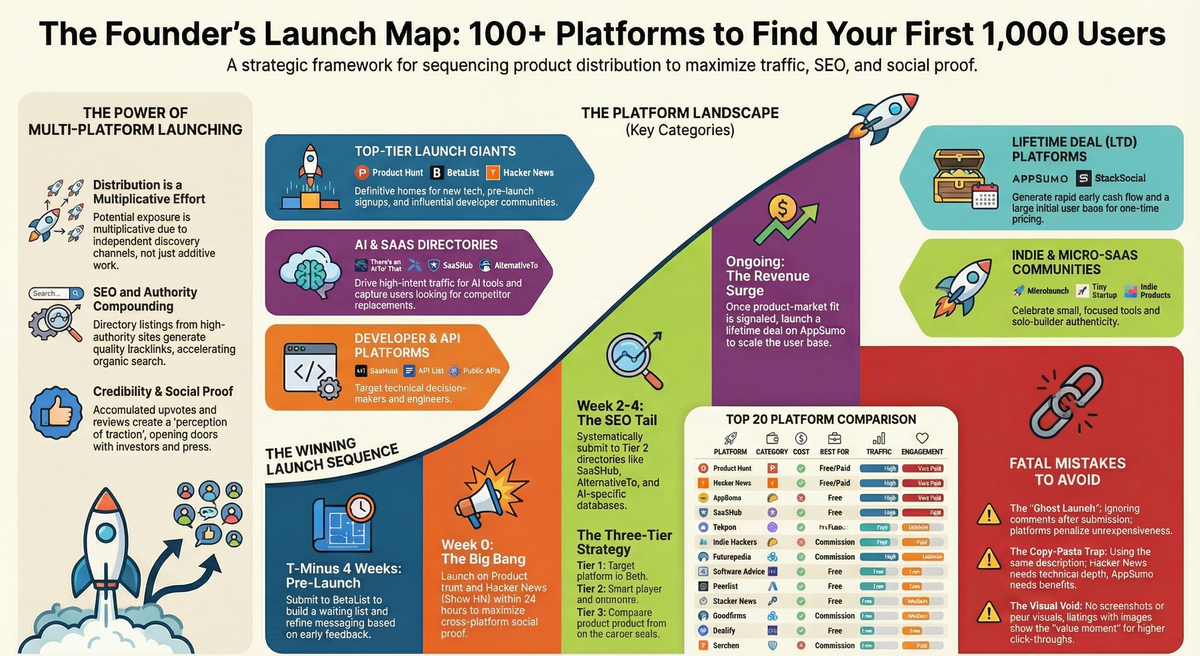
Distribution thinking is fundamentally different from product thinking. A great product sitting in obscurity is commercially identical to no product at all. Multi-platform launches solve this problem not through brute force but through compounding. Each listing creates an independent discovery channel. A founder who submits to thirty platforms is not doing thirty times the work of a founder who submits to one, but the potential exposure is genuinely multiplicative.
From an SEO perspective, directory listings generate high-quality backlinks. A link from Product Hunt, BetaList, or AlternativeTo carries real domain authority that passes ranking signals to the startup's own website. Over time, a cluster of directory backlinks accelerates organic search growth in ways that are difficult to replicate through other means at early-stage budgets. This is why treating directory submissions as a one-time checkbox exercise misses the bigger picture.
Beyond traffic, multi-platform launches create social proof signals that compound. A product with three hundred upvotes on Product Hunt, a listing on SaaSHub, and an active Indie Hackers thread looks credible to journalists, early adopters, angel investors, and potential enterprise buyers in ways that a bare landing page simply cannot match. Each platform contributes a small credibility signal, and those signals accumulate into a perception of traction that opens doors.
How to Use This List Effectively
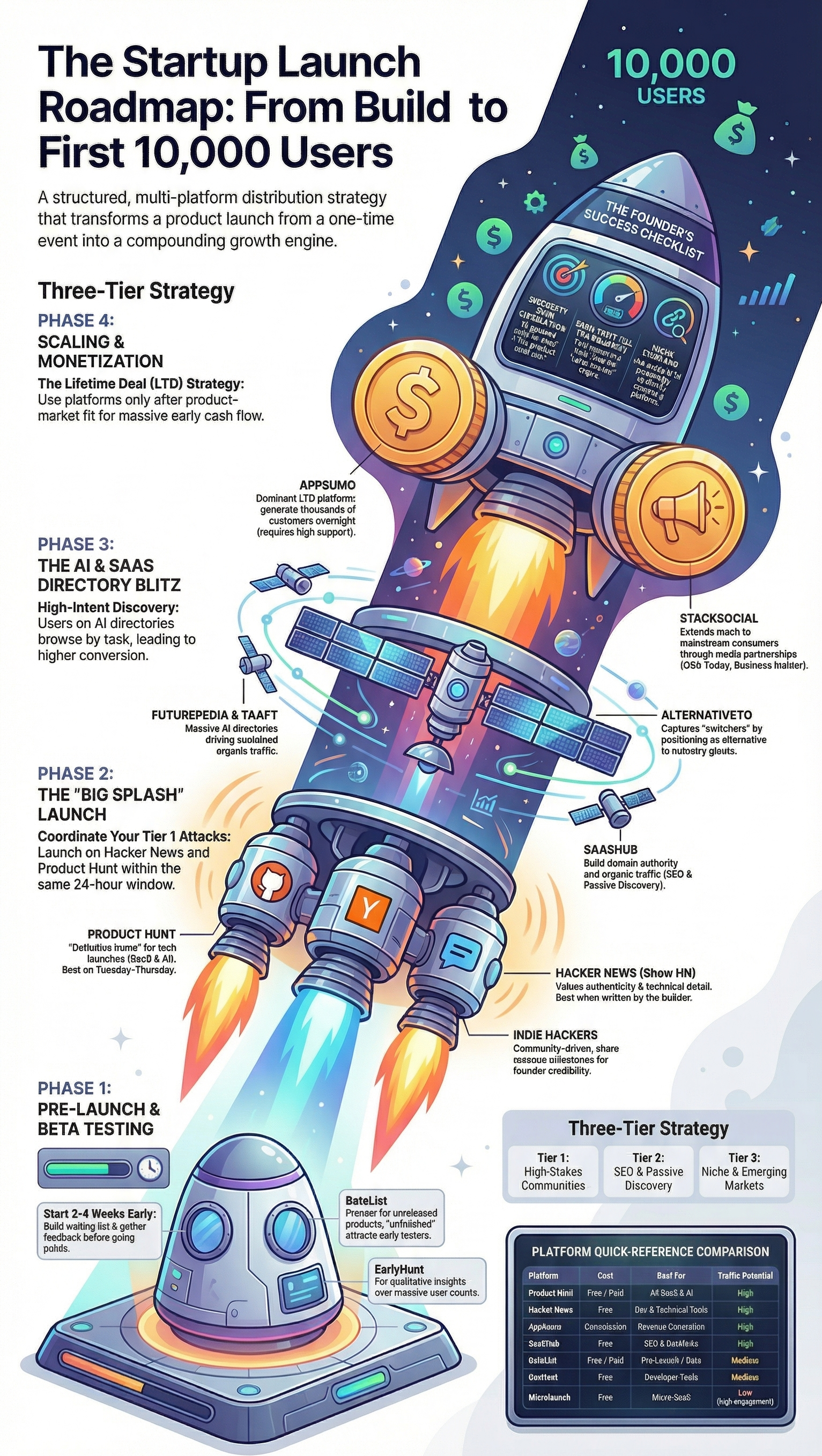
With over one hundred platforms listed here, the instinct to submit everywhere simultaneously is understandable but counterproductive. A scattered approach dilutes effort and makes it impossible to engage meaningfully with the communities that form around each listing. A smarter framework involves three tiers. Tier one platforms, those with the highest traffic and most engaged communities such as Product Hunt, Hacker News, and Indie Hackers, deserve the most preparation. A launch on these platforms should be treated like a small marketing campaign, not a form submission.
Tier two platforms are directories and listing sites that drive steady SEO value and passive discovery over time. These include SaaSHub, AlternativeTo, There's an AI for That, and similar properties. Submit to these systematically over a two to four week window following the main launch. Tier three platforms are niche communities, emerging directories, and long-tail listing sites. These take the least time to submit to and often yield surprising results from audiences that larger platforms never reach. The ideal launch strategy sequences across all three tiers, uses UTM parameters to track performance from each source, and revisits each listing periodically to update product descriptions as the product evolves.
Submit Your AI Tool on CompareBizTech
Get discovered by founders, marketers, and businesses actively searching for AI tools. Boost visibility, earn backlinks, and drive your first users through a curated software directory.
Submit Your Tool →Category A: Top-Tier Launch Platforms
These platforms carry the highest traffic volumes, the most active founder communities, and the strongest brand recognition among early adopters and tech media. A successful launch on even one of these platforms can define the early trajectory of a startup. Preparation time is well spent here.
1. Product Hunt
Product Hunt is the definitive home for new product launches in the tech and startup world. Every day, a curated set of products competes for upvotes from the platform's community of makers, investors, journalists, and early adopters. A strong Product Hunt launch, typically targeting the front page of the daily digest, can generate thousands of visitors in a single day, hundreds of sign-ups, press coverage, and lasting SEO value from the profile page itself. Products in SaaS, AI tools, productivity software, and developer tools perform especially well. The platform is free to list on, though creators can pay for featured placement. Timing the launch for a Tuesday, Wednesday, or Thursday tends to maximize upvotes, as weekends see lower community activity. Engaging with every comment on launch day is critical for maintaining momentum.
2. BetaList
BetaList focuses specifically on pre-launch and early-stage startups, making it one of the few platforms where being unfinished is actually an advantage. The audience is composed of early adopters who actively seek out unreleased products to test, provide feedback on, and share. A BetaList feature drives sign-ups for waiting lists and beta programs rather than direct conversions, making it an ideal first stop before a public launch. Submissions go through a brief editorial review, and featured listings appear in a weekly newsletter that reaches tens of thousands of subscribers. The platform is free for standard listings, with expedited review available as a paid option.
3. Hacker News
Hacker News, operated by Y Combinator, is one of the most influential tech communities on the internet. The 'Show HN' post format allows founders to introduce their products directly to an audience of engineers, founders, investors, and technically sophisticated early adopters. A successful Show HN thread can drive significant traffic, generate detailed technical feedback, and create lasting credibility within the startup ecosystem. The community is famously discerning and values authenticity over polish, so the best Show HN posts are direct, honest about what the product is, and written by the actual builder. While there is no guarantee of traction, a strong Show HN can be as impactful as a Product Hunt launch for developer-focused products.
4. Indie Hackers
Indie Hackers is both a directory and a community built around bootstrapped and solo-founder startups. Founders share revenue milestones, launch announcements, growth strategies, and honest post-mortems. The platform's audience is uniquely engaged because members are themselves building products and have a genuine stake in seeing others succeed. A product page on Indie Hackers captures organic search traffic for years after creation, and active participation in forum threads significantly amplifies the reach of any launch. The platform skews toward SaaS, subscriptions, and content businesses rather than venture-backed unicorn plays.
5. Launching Next
Launching Next is a curated directory of startup launches that serves as both a discovery platform and an SEO asset. It accepts submissions across virtually all software categories and provides each listing with its own indexed page. The platform's strength lies in its longevity and the breadth of its product database, which has accumulated over many years. Founders use it primarily to establish a web presence citation for their product early in the launch cycle. Submission is free, review times are reasonable, and the domain authority of the site provides backlink value that supports search engine ranking for the startup's primary domain.
Key Takeaways
- Product Hunt requires launch-day community engagement to sustain upvote momentum through the ranking algorithm.
- BetaList is most effective before public launch, when collecting waiting list sign-ups is the primary goal.
- Hacker News Show HN posts perform best when written by the actual builder with honest, specific product details.
- Indie Hackers compounds value over time through community participation, not just a one-time listing.
- Launching Next and similar evergreen directories build backlink profiles that support long-term SEO.
6. Startup Buffer
Startup Buffer offers a streamlined directory experience for early-stage products, with a clean submission process and steady traffic from founders, investors, and product enthusiasts. It operates both a free tier and a paid featured option that guarantees placement in the weekly newsletter. The platform is particularly useful for SaaS products targeting a broad business audience. Each listing receives a dedicated page with space for product descriptions, screenshots, and links, all of which contribute to the startup's overall web citation footprint.
7. PitchWall
PitchWall positions itself as a platform for startups to share their pitch and story alongside their product. This framing attracts a slightly different audience than pure directory sites, including investors scanning for interesting opportunities and founders looking to understand market positioning. A well-crafted PitchWall profile communicates not just what the product does but why it exists and what problem it is solving, making it a useful tool for early-stage companies that are still refining their narrative.
8. Peerlist
Peerlist is a professional network specifically designed for people who build products, including developers, designers, and founders. Unlike general professional networks, Peerlist allows users to showcase their projects prominently, making it an ideal platform for founder-built products that benefit from the credibility of their maker's professional profile. The community is growing rapidly, particularly among solo founders and small teams. Product launches on Peerlist generate engagement from peers who understand the technical and business challenges involved in shipping software.
9. StartupBase
StartupBase is a comprehensive startup directory with a strong reputation among the startup research and investment community. Its listings are frequently referenced by journalists and analysts looking for emerging companies in specific categories. A complete, well-written StartupBase profile positions the product in front of decision-makers beyond the typical early-adopter audience. The platform accepts submissions across all software verticals and indexes them against category and technology tags that improve discoverability within the site's internal search.
10. Fazier
Fazier is a newer entrant in the startup launch platform space that has built a dedicated community of product enthusiasts and early adopters. It mirrors some of the mechanics of Product Hunt but with a smaller, more intimate community that tends to engage more deeply with individual submissions. For founders who find the competition on Product Hunt overwhelming, Fazier offers a genuine alternative where a well-prepared launch can still generate meaningful traction and community feedback without competing against the platform's most established players.
11. CompareBizTech
If you're building an AI startup, getting discovered early is everything. Platforms like CompareBizTech make it easier to showcase your tool to a targeted audience of founders, marketers, and businesses actively searching for new solutions. By submitting your AI software to curated directories, you not only gain visibility but also build credibility, earn backlinks, and attract your first users. Instead of relying solely on ads or social media, smart founders use submission platforms like CompareBizTech as a consistent growth channel to drive organic traction from day one.
Key Takeaways
- Startup Buffer's newsletter placement is worth the paid upgrade for products targeting a broad SaaS audience.
- PitchWall adds narrative context to listings, which benefits early-stage companies still testing messaging.
- Peerlist gives founder credibility a platform, making it especially effective for solo builders.
- StartupBase attracts journalists and analysts who use it as a research tool.
- Fazier is a lower-competition alternative to Product Hunt with strong community engagement.
Category B: Startup and Indie Hacker Communities
These platforms combine directory functionality with active communities where founders discuss strategy, share milestones, and support each other's launches. The value here is not only in the listing itself but in the ongoing relationships and visibility that come from genuine participation.
12. SideProjectors
SideProjectors is a marketplace and community where makers can buy, sell, and promote their side projects and early-stage startups. It serves a dual audience of founders looking to launch and entrepreneurs actively looking to acquire or invest in early products. A listing here can attract acquisition interest as well as early users, making it useful for bootstrapped projects that might not follow the typical venture-backed growth path.
13. PeerPush
PeerPush is a mutual-support platform for indie makers, built around the principle that founders should help each other gain visibility. Members commit to upvoting and sharing each other's launches across platforms, creating a coordinated launch support network. For founders without an existing large audience, PeerPush provides a structured way to build the initial social proof that helps Product Hunt and similar platform algorithms take notice.
14. EarlyHunt
EarlyHunt focuses specifically on products that are in their earliest stages, before they have established user bases or proven business models. This honest framing attracts a specific type of early adopter who is genuinely interested in shaping products through feedback rather than simply trying polished software. Founders who want qualitative insights and beta testers alongside their first users will find EarlyHunt's audience particularly valuable.
15. IndieHunt
IndieHunt is a community-curated list of indie-made products that values authenticity and craftsmanship over growth metrics. The audience skews toward people who actively prefer supporting independent creators over large software companies, making it a culturally aligned home for bootstrapped and solo-founder projects. A listing here carries a signal of independence that resonates with a growing segment of software buyers who deliberately avoid enterprise products.
Key Takeaways
- Stacker News is ideal for crypto, fintech, and developer tools due to its Bitcoin-native community.
- SideProjectors can attract acquisition interest in addition to early users.
- PeerPush helps founders without large audiences build launch-day social proof through coordinated support.
- EarlyHunt is best for founders seeking genuine product feedback from early adopters.
- IndieHunt's audience actively supports independent creators, making brand alignment important.
16. Tiny Startup
Tiny Startup celebrates small, focused products that solve specific problems without the ambition of becoming a billion-dollar company. Its audience is deliberately curated around founders and buyers who value simplicity, a clear scope of feature, and sustainable business models over hyper-growth. Products that would feel out of place on platforms catering to venture-scale ambitions often find their most receptive audience here.
17. TinyLaunch
TinyLaunch is a lightweight product discovery platform designed for micro-SaaS and small tool launches. Its low barrier to entry and fast submission process make it an ideal first platform for first-time founders testing the waters. The community is supportive and accustomed to early-stage, sometimes rough-around-the-edges products, which creates a forgiving environment for initial feedback gathering.
18. Microlaunch
Microlaunch is built specifically for micro-SaaS products, one-person software businesses, and tools built without external funding. It maintains a focused directory of small-scale products and promotes them to an audience that understands and appreciates the micro-SaaS model. Founders who are targeting small recurring revenue milestones rather than massive user acquisition will find Microlaunch's community genuinely aligned with their goals.
19. Startup Heroes
Startup Heroes is a community platform that combines product listings with founder storytelling. Members share their journey from idea to launch, creating a narrative context around their products that pure directory listings cannot match. The platform attracts an engaged audience of aspiring founders and early-stage builders who draw inspiration from the stories shared and often become loyal early adopters as a result.
20. Invent List
Invent List is a curated directory of innovative products and ideas spanning software, hardware, and physical goods. Its cross-category nature means that software products listed here appear alongside hardware gadgets and creative inventions, which can introduce a startup to an audience with broader interests than typical SaaS directories attract. The curation process ensures listing quality, which keeps the overall signal-to-noise ratio high for browsers.
Key Takeaways
- Tiny Startup and Microlaunch are ideal for single-person businesses with sustainable, focused product ambitions.
- TinyLaunch offers a low-friction submission process suitable for founders testing their first public launch.
- Startup Heroes adds narrative depth to launch listings, which builds emotional connection with early adopters.
- Invent List reaches audiences beyond the typical SaaS buyer, useful for cross-category products.
21. Indie Products
Indie Products is a showcase platform for products built by independent creators and small teams. It emphasizes the human element behind each product, with creator profiles prominently displayed alongside listings. This maker-centric approach resonates with buyers who want to know who they are supporting when they purchase or subscribe to a product.
22. Hack the Prompt
Hack the Prompt centers on AI and prompt engineering tools, making it an ideal launch platform for products that help users interact more effectively with large language models. The community is technically sophisticated and actively experimenting with AI workflows, making it a high-quality source of early feedback for AI-adjacent products.
23. Indie Deals
Indie Deals specializes in discounted pricing on indie-made software products, attracting buyers who are specifically looking for alternatives to expensive enterprise software at accessible price points. A listing here works particularly well for products offering lifetime deals or introductory pricing, as the audience has high purchase intent and actively uses the platform to discover deals.
24. Nocode List
Nocode List is a directory specifically for tools built without traditional coding, as well as tools that help non-technical users build their own products. Its audience includes aspiring entrepreneurs, small business owners, and digital nomads who are actively looking for software that simplifies complex tasks. Products that enable creation, automation, or business management without requiring technical expertise perform especially well here.
Key Takeaways
- Indie Products benefits from maker-focused storytelling that humanizes the product behind the listing.
- Hack the Prompt is the right home for AI and prompt engineering tools targeting technical early adopters.
- Indie Deals attracts high-intent buyers specifically seeking discounts and lifetime deals.
- Nocode List reaches non-technical builders who have strong purchase intent for enabling tools.
Category C: AI and SaaS Directories
The rapid growth of AI products has spawned a dedicated ecosystem of directories focused specifically on artificial intelligence tools. These platforms attract users who are actively searching for AI solutions to integrate into their personal and professional workflows, making them high-intent discovery channels for AI-powered startups.
25. There's an AI for That
There's an AI for That (TAAFT) has become one of the most trafficked AI tool directories on the internet since the explosion of generative AI. It catalogs AI tools across hundreds of use cases, from writing and coding to customer service and image generation. Users visit the site with a specific task in mind and browse by category, making the audience unusually high-intent. A listing here drives sustained organic traffic from search and from the site's internal discovery engine, long after the initial submission.
26. Futurepedia
Futurepedia is another high-traffic AI directory that has accumulated a large user base of professionals, students, and enthusiasts exploring how AI tools can improve their workflows. It features daily and weekly curator picks that highlight new and notable submissions, creating a short-term traffic spike potential alongside the long-term SEO value of an indexed listing. Products that clearly communicate their AI-powered functionality and specific use cases are most likely to be featured.
27. ShowMeBestAI
ShowMeBestAI focuses on surfacing the highest-quality AI tools in each category, positioning itself as a trusted recommendation source rather than a comprehensive catalog. Its editorial approach means that a listing carries a quality signal beyond the simple existence of a profile page. Products accepted onto the platform benefit from the implied endorsement of the site's curation standards.
28. BasedTools
BasedTools is a community-curated AI directory with a focused, opinionated approach to curation. Its audience tends to be technically sophisticated and skeptical of marketing claims, making it a valuable source of honest early feedback for AI products. A listing on BasedTools carries credibility with developers and technical founders who treat it as a reliable signal of product quality.
29. That AI Collection
That AI Collection is a comprehensive catalog of AI tools organized by use case and technology type. Its breadth makes it a useful reference for users who are evaluating multiple options in a category, meaning that products listed alongside competitors benefit from the comparison context. A complete, accurate, and well-described listing ensures that the product comes across favorably in side-by-side evaluations.
Key Takeaways
- There's an AI for That drives high-intent organic traffic due to its task-based browsing structure.
- Futurepedia's curator picks create short-term traffic spikes worth optimizing the submission description for.
- ShowMeBestAI carries an implied quality endorsement that strengthens credibility with discerning buyers.
- BasedTools is best approached with honest, technically precise product descriptions.
- That AI Collection benefits products that can clearly articulate how they compare to existing alternatives.
30. GPTStore
GPTStore is a directory and marketplace for GPT-powered applications and custom AI assistants built on large language model infrastructure. As the adoption of AI-powered tools has accelerated, GPTStore has become a go-to resource for users looking for specialized AI applications beyond the general-purpose chatbot experience. Products that solve specific vertical problems using AI are particularly well suited to this platform.
31. AIxploria
AIxploria is a discovery platform for AI tools that combines a directory with editorial content about artificial intelligence trends and use cases. Its dual content format attracts both casual readers learning about AI and active buyers seeking specific tools, creating a broad audience with varying levels of purchase intent. Listings benefit from the editorial content surrounding them, which provides context and increases time-on-page for visiting users.
32. AI Hunter
AI Hunter is a focused directory for AI tools with a clean interface and a straightforward search and filter experience. Its minimalist approach means that product listings must speak for themselves, rewarding founders who invest in writing clear, specific, and benefit-oriented product descriptions. The platform's growing user base skews toward professionals who are actively integrating AI tools into their daily workflows.
33. AI Agent Store
AI Agent Store specifically catalogs AI agents and autonomous AI tools, a rapidly growing subcategory of AI products. As interest in agentic AI workflows has surged, this directory has become a valuable destination for developers and business users exploring automation through AI agents. Products that autonomously complete tasks, manage workflows, or act on behalf of users are ideally positioned for this platform.
34. BroUseAI
BroUseAI is a community-driven AI tool recommendation platform where users share tools they are actively using and finding valuable. Its social recommendation model creates a layer of peer validation that pure directory listings lack. Products that generate genuine user enthusiasm are likely to be shared and re-recommended within the platform's community, creating compounding visibility.
Key Takeaways
- GPTStore is the right destination for GPT-based applications and custom AI assistants.
- AIxploria's editorial content extends the visibility of listings beyond the directory itself.
- AI Hunter rewards clear, benefit-oriented product descriptions over marketing language.
- AI Agent Store is a high-priority listing target for autonomous AI and agentic workflow products.
- BroUseAI's peer recommendation model creates compounding visibility for products users genuinely love.
35. AlternativeTo
AlternativeTo is one of the most established software discovery platforms on the internet, built around the concept of finding alternatives to popular software products. Users arrive with a specific product in mind that they want to replace and browse the listed alternatives. This makes the platform exceptionally high-intent for startups positioning themselves as alternatives to dominant players. A listing tagged against well-known competitors captures ongoing organic traffic as users search for those competitors' alternatives.
36. OpenAlternative
OpenAlternative focuses specifically on open-source alternatives to commercial software products. For startups that are open-source or have a significant open-source component, this directory drives traffic from a community of users who actively prefer and seek out open-source options. The platform's growing reputation in the developer community makes it a valuable listing target for technical products.
37. AlterOpen
AlterOpen operates similarly to OpenAlternative, cataloging open-source and open-core software products as alternatives to proprietary tools. Its curation standards ensure that listed products are genuinely useful and functional, which maintains the trust of its user base. A listing here implies a level of product maturity that can accelerate conversion for users who discover the product while evaluating options.
38. SaaSHub
SaaSHub is one of the largest and most comprehensive SaaS directories available, with listings spanning thousands of products across hundreds of categories. Its internal search and comparison engine allows users to filter by features, pricing, and use case, which means that complete and accurate listings perform significantly better than sparse ones. The platform's high domain authority passes meaningful SEO value to any startup with a profile page, and the comparison functionality positions products clearly against their competitors.
Key Takeaways
- AlternativeTo captures high-intent traffic from users who have already decided to switch away from a specific competitor.
- OpenAlternative and AlterOpen are priority listings for any product with an open-source component.
- SaaSHub's comparison engine rewards complete listings; every field should be filled with accurate, specific information.
39. SaaS Genius
SaaS Genius curates a selection of SaaS products with a focus on tools that demonstrate exceptional value and smart product design. Its editorial selection process means that not all submissions are accepted, but products that are featured benefit from a quality signal that supports premium positioning. The platform attracts buyers who are willing to pay for high-quality tools and are research-oriented in their purchasing decisions.
40. FoundrList
FoundrList is a community directory for startup founders and the products they build. It functions as both a launch platform and an ongoing community hub where founders share updates, ask questions, and engage with each other's products. A listing here opens the door to a broader relationship with a community of peers who may become customers, collaborators, or referral sources over time.
41. SaaS Gallery
SaaS Gallery presents software products in a visually driven format that emphasizes design and user experience. Products with well-designed interfaces and strong visual identities perform particularly well here, as the gallery format allows visual quality to serve as a first impression. For startups where design is a core differentiator, SaaS Gallery provides a showcase format that typical text-heavy directories cannot replicate.
42. Appscribed
Appscribed functions as a subscription software directory and review platform, making it particularly relevant for SaaS products with recurring pricing models. Users browsing the platform are already committed to the subscription model as a purchase format, which increases conversion potential. Detailed pricing information and feature breakdowns are important components of an effective Appscribed listing.
43. Serchen
Serchen is an established B2B software directory that includes verified user reviews alongside product listings. Its review component adds credibility to listings and creates an ongoing asset that compounds in value as more customers leave feedback. For B2B products targeting business buyers, a well-reviewed Serchen profile serves as social proof that influences purchasing decisions long after the initial launch.
Key Takeaways
- SaaS Genius's editorial selectivity makes an accepted listing a quality signal worth pursuing.
- FoundrList opens community relationships that can extend well beyond the initial launch listing.
- SaaS Gallery is a priority listing for design-forward products where interface quality is a selling point.
- Appscribed works best for recurring revenue products where the subscription model is a core feature.
- Serchen's review component makes it a long-term asset that grows in value as the customer base expands.
Category D: Lifetime Deal and Promotional Platforms
Lifetime deal platforms attract a highly specific type of buyer: software enthusiasts who purchase tools for a one-time fee rather than a recurring subscription. While this model has tradeoffs for long-term revenue, it is an effective way to generate early cash flow, build a loyal initial user base, and gather product feedback at scale.
44. AppSumo
AppSumo is the dominant platform in the lifetime deal market and one of the most powerful early-stage revenue channels available to SaaS founders. A featured AppSumo deal can generate hundreds of thousands of dollars in revenue within days, provide thousands of paying customers overnight, and create a surge of user feedback that accelerates product development. The tradeoff is significant: AppSumo takes a substantial commission, the customer base trends toward deal-hunters rather than full-price buyers, and the support load from a large simultaneous user influx can be overwhelming for small teams. Despite these caveats, for the right product at the right stage, an AppSumo deal is a legitimate growth strategy.
45. StackSocial
StackSocial distributes software deals through its own platform and through media partnerships with major publications including USA Today and Business Insider. This media reach extends the audience of any deal far beyond the typical startup directory user base, into the hands of mainstream consumers who might never visit a tech-specific platform. Products with broad consumer appeal or recognizable use cases perform especially well in this distribution format.
46. RocketHub
RocketHub operates as a lifetime deal platform with a community of software enthusiasts who actively participate in deal discussions and provide early product feedback. Its engaged community model means that a product listed on RocketHub receives not only purchases but also detailed feature requests, bug reports, and use case suggestions that can inform the product roadmap. The platform's smaller scale compared to AppSumo means less revenue potential but also a more manageable customer influx.
47. LTD Hunt
LTD Hunt is a community-curated directory of lifetime deals across software and digital products. Unlike platforms that directly host deals, LTD Hunt aggregates and surfaces deals from multiple sources, making it a discovery layer for buyers who want a consolidated view of the lifetime deal market. A listing or deal mention on LTD Hunt exposes the product to a highly motivated buyer community that is actively shopping for software investments.
48. KEN Moo
KEN Moo is a lifetime deal platform and community that caters to a particularly deal-savvy audience of software power users. Its community members often have large software portfolios and are vocal about their experiences with listed products, making it a useful source of expert feedback. A successful KEN Moo listing builds relationships with influential voices in the lifetime deal community who can amplify the product to their own networks.
Key Takeaways
- AppSumo provides the highest revenue potential but requires a well-prepared support infrastructure before launch.
- StackSocial's media partnerships extend reach to mainstream consumers beyond the typical tech audience.
- RocketHub offers a more manageable customer influx than AppSumo, suitable for smaller teams.
- LTD Hunt is a discovery aggregator that supplements direct deal platforms without requiring a full deal launch.
- KEN Moo's community of deal-savvy power users provides high-quality feedback worth the listing effort.
49. Prime Club
Prime Club is a curated lifetime deal marketplace that emphasizes product quality and deals with limited availability. Its scarcity-driven model creates urgency among buyers and tends to attract higher-value purchases than mass-market deal platforms. Products accepted into Prime Club benefit from the platform's reputation for quality curation, which sets a positive expectation in buyers before they even evaluate the product.
50. SaaSZilla
SaaSZilla is a growing lifetime deal platform that offers an alternative route for SaaS founders who have not secured placement on larger platforms. Its growing community of deal hunters provides a meaningful launch opportunity, particularly for products in productivity, marketing, and business operations categories. The platform's lower barrier to entry makes it accessible for earlier-stage products.
51. SaaS Mantra
SaaS Mantra is an established lifetime deal platform in the South Asian market with a growing global audience. Its community is particularly active in the marketing and sales software categories, making it an effective channel for products that help businesses grow their customer base. Founders who have already run deals on Western platforms can extend their reach to new buyer segments through SaaS Mantra.
52. SaaS Warrior
SaaS Warrior focuses on tools for online entrepreneurs and digital marketers, offering lifetime deals on products that help build and monetize online businesses. Its niche focus creates a highly targeted audience with strong purchase intent for tools in the marketing, automation, and content creation categories. A listing here reaches buyers who are actively looking for tools to deploy immediately in their existing workflows.
53. Dealify
Dealify is a European-focused lifetime deal platform that provides access to buyers in markets that may be underserved by US-centric platforms. For startups with European customer ambitions or GDPR-compliant data practices, Dealify provides a geographically relevant deal channel. The platform's community is active and engaged, with deal discussions that generate qualitative feedback alongside purchase conversions.
Key Takeaways
- Prime Club's scarcity model creates urgency and attracts higher-value buyers than typical deal platforms.
- SaaSZilla is accessible for earlier-stage products that have not secured placement on major platforms.
- SaaS Mantra provides access to South Asian and global deal-hunter communities underserved by Western platforms.
- SaaS Warrior targets digital entrepreneurs with strong purchase intent for marketing and automation tools.
- Dealify opens European markets and is worth prioritizing for GDPR-compliant B2B products.
54. Dan Recommends
Dan Recommends is a curated newsletter and listing platform built around personal recommendations from a trusted curator. Its audience subscribes specifically for vetted suggestions rather than browsing a directory, which creates a warm-introduction dynamic that pure directories cannot replicate. A listing or recommendation here converts at a higher rate than volume-based directory listings because the audience has already opted into trusting the curator's judgment.
55. Deal Mirror
Deal Mirror aggregates and mirrors lifetime deals from across the deal ecosystem, providing buyers with a single destination to track active deals. Its aggregation model means that a deal listed on any major platform may appear on Deal Mirror automatically, but direct submissions can ensure more accurate and complete information. The platform attracts buyers who are in active purchasing mode, making it a conversion-oriented channel.
56. PayOnceUseForever
PayOnceUseForever is a directory specifically dedicated to software products that offer genuine lifetime licensing, as opposed to lifetime-deal platforms that eventually switch to subscriptions. Its audience values the pay-once model deeply and actively seeks products that commit to it. A listing here attracts buyers who have been burned by subscription model switches and are specifically researching products with sustainable lifetime pricing.
57. Saas Baba
Saas Baba is a deal and discount platform for SaaS products that operates in the Indian market and among the global diaspora community. Its niche geographic focus makes it a valuable channel for startups seeking market entry in high-growth emerging markets where deal sensitivity is particularly strong. Products with competitive pricing or explicit lifetime deal offers perform best on this platform.
Key Takeaways
- Dan Recommends' curator trust model drives higher conversion rates than passive directory listings.
- Deal Mirror's aggregation means active deals may appear automatically; direct submission ensures accuracy.
- PayOnceUseForever attracts buyers who specifically seek genuine lifetime pricing commitments.
- Saas Baba provides access to the Indian market and diaspora communities with strong deal-seeking behavior.
Category E: Niche and Emerging Directories
Niche directories serve specific audiences, use cases, or product categories. While their overall traffic volumes may be lower than top-tier platforms, their audience specificity often results in higher conversion rates and more relevant early user acquisition for products that fit their focus.
58. Stacker News
Stacker News is a Hacker News-style community built on the Bitcoin Lightning Network, where upvotes are powered by small micropayments rather than clicks alone. This creates a uniquely engaged and spam-resistant community of builders and tech enthusiasts. For products in the crypto, fintech, and developer tools categories, Stacker News offers a highly targeted early-adopter audience. The engagement quality tends to be higher than on platforms with purely social voting mechanics.
59. Software Advice
Software Advice is a major B2B software review and comparison platform owned by Gartner. It serves enterprise buyers and business decision-makers who are conducting structured software evaluations. A presence on Software Advice is particularly important for products targeting mid-market and enterprise buyers, where the platform's credibility and review system carry significant weight in purchase decisions. The platform operates on a pay-per-lead model for premium placement, though basic listings can be created for free.
60. Goodfirms
Goodfirms is an established B2B software review and rating platform that covers software products alongside IT service providers. Its structured review system and detailed company profiles make it a reference destination for buyers conducting due diligence before purchase. A well-maintained Goodfirms profile with verified customer reviews strengthens trust signals for enterprise and SMB buyers who use the platform as part of their vendor evaluation process.
61. Tekpon
Tekpon is a software review platform with detailed comparison content across business software categories. Its editorial team produces in-depth category reviews that rank products based on features, pricing, and user feedback, creating ongoing organic search traffic for listed products. A comprehensive Tekpon listing increases the chances of being included in these editorial comparisons, which drive high-intent search traffic from buyers actively evaluating options.
62. Toolfolio
Toolfolio is a curated collection of tools for specific professional workflows and use cases. Its organization around professional tasks rather than software categories means that a product can be discovered by users who are searching for solutions to specific problems rather than browsing by product type. This task-based discovery model aligns well with high-intent search behavior.
Key Takeaways
- Trendy Startups gives preferential visibility to products showing early growth metrics worth highlighting.
- Software Advice and Goodfirms are essential for products targeting business buyers in structured evaluation processes.
- Tekpon's editorial category content drives ongoing organic traffic independent of the initial listing.
- Toolfolio's task-based organization aligns listings with specific user problems, increasing relevance.
63. Next Gen Tools
Next Gen Tools focuses on emerging technologies and innovative software products that represent the next wave of digital tools. Its curation around innovation makes it a natural home for products using AI, blockchain, or other emerging technologies in meaningful ways. The platform attracts an audience that is inherently forward-looking and more willing to adopt early-stage products than typical software buyers.
64. Sustainability Softwares
Sustainability Softwares catalogs tools and platforms that support environmental, social, and governance goals. For products that help organizations measure carbon footprints, manage sustainability reporting, or reduce environmental impact, this is a uniquely targeted directory that reaches buyers who are actively looking for these specific capabilities. The niche focus ensures that listed products appear in front of an audience with very high purchase intent.
65. PromptZone
PromptZone is a community and directory for prompt engineers, AI enthusiasts, and users of large language models. It features prompt collections, AI tool listings, and community discussions around AI workflows. For products that help users work with prompts, AI models, or language model outputs, PromptZone provides a targeted audience that is deeply engaged with the technology.
66. Toolkitly
Toolkitly presents curated tool collections organized around specific workflows and job functions. Its curation model means that listed products appear in the context of complete toolkits rather than in isolation, which provides useful context for buyers evaluating whether a product fits into their existing workflow. Products that integrate well with other common tools in a category benefit most from this positioning.
67. LaunchIgniter
LaunchIgniter is a platform designed to help founders generate early traction through coordinated community engagement around their launch. It combines directory listing functionality with community support mechanics that help products gain initial visibility through organized upvoting and sharing campaigns.
Key Takeaways
- Next Gen Tools is a strong fit for products using emerging technologies where innovation is a core differentiator.
- Sustainability Softwares provides extremely high-intent discovery for ESG and environmental management tools.
- PromptZone reaches the most technically engaged AI users who are actively building with language models.
- Toolkitly positions products within workflow contexts, which aids conversion for integration-friendly tools.
68. Firoso
Firoso is a startup discovery platform with a community-driven voting and ranking system. Its clean interface and straightforward submission process make it accessible for founders who want to establish a listing without significant time investment. Regular browser traffic and a growing community of product enthusiasts make it a worthwhile addition to any comprehensive launch strategy.
69. Indie Tools
Indie Tools is a curated directory of tools built by independent creators and small teams. Its focus on the indie origin story creates an authenticity signal that resonates with buyers who support independent software businesses. A listing here communicates product quality and the commitment of a dedicated creator in a way that corporate software listings cannot replicate.
70. Manta
Manta is a business directory that includes software products alongside traditional business listings. Its broad business audience and established SEO presence make it a useful citation for products targeting small and medium-sized businesses. A complete Manta profile contributes to the local and business search presence of any startup, particularly for those with a regional or industry-specific focus.
71. Slocco
Slocco is a product discovery platform with a community engagement model built around curator recommendations. Products can be submitted by their founders or recommended by community members who find them valuable, creating a dual submission path that can result in organic inclusion without any action from the founder.
Key Takeaways
- Firoso offers low-friction listing for founders building a comprehensive platform presence efficiently.
- Indie Tools' authenticity signal benefits small teams and solo builders over corporate product listings.
- Manta provides business search citations valuable for B2B products targeting the SMB market.
- Slocco can generate organic inclusion through community recommendations, making product quality the primary driver.
Category F: Developer and API-Focused Platforms
Developer-focused platforms attract a highly technical audience of engineers, architects, and technical decision-makers who evaluate tools based on functionality, documentation quality, and integration capabilities. Products with developer-facing features or API offerings should prioritize these channels.
72. DevHunt
DevHunt is a product discovery platform specifically for developer tools and programming resources. Its community consists of software engineers who actively seek out new development tools, libraries, and infrastructure products. A listing on DevHunt reaches decision-makers who have both the technical authority and the budget to adopt new tools within their organizations. Products with strong documentation, clear API references, and developer-friendly pricing models perform best.
73. API List
API List is a comprehensive directory of publicly available APIs that serves as a reference resource for developers building integrations and products. For startups whose product includes or exposes an API, a listing on API List increases discoverability among the developer community that is actively searching for APIs to incorporate into their projects. Complete documentation links and clear API capability descriptions are essential for effective listings.
74. LibHunt
LibHunt is a directory of open-source libraries and developer tools organized by programming language and use case. For products with open-source components, SDKs, or libraries, LibHunt provides access to a developer audience that specifically seeks out code-level tools. The platform's language-based organization makes it easy for developers working in specific technology stacks to find relevant tools.
75. MakerPad
MakerPad is a no-code education platform and community that teaches users to build products without writing code. Its community of aspiring builders and non-technical entrepreneurs provides a receptive audience for no-code tools, automation platforms, and products that enable creation without programming. MakerPad's educational content creates a warm context around tool discovery that supports adoption.
76. Public APIs
Public APIs is a community-maintained GitHub repository and directory of free public APIs organized by category. With hundreds of thousands of GitHub stars and consistent developer traffic, it is one of the most visited API discovery resources available. A listing in the Public APIs repository exposes a startup's API to an enormous global developer audience at zero cost beyond the initial submission.
Key Takeaways
- DevHunt reaches technical decision-makers with both the authority and budget to adopt developer tools.
- API List is essential for any product that exposes or depends on API integration.
- LibHunt serves developers seeking language-specific tools; technical completeness in listings is critical.
- MakerPad's educational community creates a warm discovery context for no-code and automation products.
- Public APIs' GitHub repository provides free access to one of the largest developer audiences on the internet.
77. SEO Wins
SEO Wins is a directory and community resource for SEO tools, strategies, and software. Its audience consists of marketers, SEO specialists, and agency owners who are actively looking for tools to improve search engine performance. For products with SEO functionality, a listing here reaches highly motivated buyers who understand the ROI of search optimization tools and are willing to invest in the right product.
78. SEOFAI
SEOFAI is a specialized directory for AI-powered SEO tools, sitting at the intersection of two major growth categories. As AI-assisted content and optimization tools have proliferated, SEOFAI has become a go-to resource for marketers evaluating which AI products will deliver measurable search results. A listing here positions an AI SEO product in front of a highly targeted audience ready to evaluate and adopt.
79. BestWebDesignTools
BestWebDesignTools catalogs software products used in web design, development, and digital creation workflows. Its audience spans professional web designers, agencies, and freelancers who are continuously updating their toolkits. Products that support web design workflows, from prototyping and wireframing to asset creation and performance optimization, find a receptive and decision-ready audience here.
80. Open Tools
Open Tools is a directory focused on open-source and freely available software tools, appealing to a community of developers and technical users who prioritize open licensing, transparency, and community-driven development. For products with open-source licensing or a significant community component, Open Tools provides access to an audience that values these attributes explicitly.
Key Takeaways
- SEO Wins and SEOFAI are high-priority targets for any product with search optimization functionality.
- BestWebDesignTools reaches a professional design audience with strong purchasing power for quality tools.
- Open Tools' community values transparency and open licensing, making product ethos part of the pitch.
🚀 Launch Your AI Tool
Submit your startup on CompareBizTech and reach founders actively looking for AI tools.
Submit Now →Category G: Additional and Emerging Platforms
This category covers remaining platforms that serve specialized audiences, regional markets, or emerging discovery niches. Each provides unique access to specific user segments that other categories may not reach.
81. ToolFame
ToolFame is a product listing and review platform that combines directory functionality with social sharing features. Products listed on ToolFame can be shared across social networks directly from the listing page, creating a viral distribution mechanism that extends reach beyond the platform's direct audience.
82. Aura Plus Plus
Aura Plus Plus is a curated software directory with a focus on productivity and personal effectiveness tools. Its audience consists of knowledge workers and professionals who are actively optimizing their personal workflows. Products that save time, reduce friction, or improve the quality of professional output are particularly well suited to this platform's audience.
83. SaaS Pirate
SaaS Pirate is a community platform for software deal hunters and bootstrap-friendly SaaS users. Its name reflects a community ethos around finding and sharing the best software value regardless of conventional marketing channels. Products listed here reach buyers who are specifically motivated by value and functionality rather than brand recognition.
84. Product Canyon
Product Canyon is a product listing and voting platform where community members upvote and curate the most useful tools. Its voting mechanics create a meritocratic discovery environment where genuinely useful products rise naturally through community endorsement.
85. Altern
Altern is a software alternatives directory built around helping users find replacements for specific products they want to move away from. Similar to AlternativeTo in concept, Altern captures high-intent traffic from users who have already made the decision to switch software and are actively evaluating replacements.
Key Takeaways
- ToolFame's social sharing integration extends listing reach beyond the platform's direct visitor base.
- Aura Plus Plus is ideal for productivity tools targeting professional knowledge workers.
- SaaS Pirate reaches value-oriented buyers who prioritize functionality over brand recognition.
- Altern captures high-intent replacement traffic from users who have decided to switch away from competitors.
86. MadGenius
MadGenius is a creative tools directory focused on software products that support design, content creation, and creative professional workflows. Its audience of creative professionals has specific, well-understood tool requirements and tends to be loyal to tools that genuinely improve their creative output.
87. BotsFloor
BotsFloor is a directory dedicated to chatbot tools, conversational AI products, and automation bots. As the chatbot market has matured beyond simple FAQ bots, BotsFloor has expanded to cover sophisticated conversational AI products. Its audience includes both developers building chatbot solutions and business buyers looking to deploy them.
88. AIDir Wiki
AIDir Wiki is a community-editable directory of AI resources, tools, and platforms. Its wiki format means that listings can be expanded and updated by community members, creating a collaborative documentation layer around each product entry.
89. Look AI Tools
Look AI Tools is a visually driven AI tool directory that emphasizes interface screenshots and design quality alongside feature descriptions. For AI products with strong visual interfaces or compelling output previews, the platform's visual format provides a significant presentation advantage.
90. The AI Generation
The AI Generation is an editorial publication and directory hybrid that covers the AI tool landscape through both curated listings and original content. Being featured in editorial coverage alongside a directory listing provides dual visibility that amplifies the reach of any individual submission.
Key Takeaways
- MadGenius is a targeted listing for creative and design tools with a professional creative audience.
- BotsFloor serves both developers and business buyers in the conversational AI space.
- Look AI Tools benefits visually strong AI products where interface design is a selling point.
- The AI Generation's editorial coverage amplifies listing visibility beyond directory browsing.
91. Waild World
Waild World is an emerging product discovery platform with a growing community of tech enthusiasts and early adopters. Its newer status means lower competition among listed products and higher individual visibility for each submission during the platform's growth phase.
92. Wavel
Wavel focuses on audio, video, and media tools, serving a community of content creators and media professionals. For products in the audio production, video editing, transcription, or media management categories, Wavel provides a highly relevant audience that is actively seeking specialized media tools.
93. Hack the Prompt
Hack the Prompt serves as both a prompt engineering community and a tool discovery platform, with a dedicated audience of AI power users who are building sophisticated workflows using large language models. Technical products that interact with AI models at a deep level find their most receptive audience here.
94. AI Marketing Directory
AI Marketing Directory is a specialized listing for AI-powered marketing tools, covering products in content generation, campaign optimization, customer segmentation, and marketing analytics. Its audience of marketing professionals and growth strategists has direct budget authority for marketing technology purchases.
95. RankYourAI
RankYourAI is a community voting and ranking platform for AI tools, allowing users to rate and rank products based on their actual usage experience. Its social proof mechanics create a dynamic ranking system that rewards products with genuinely satisfied users over those that merely optimize for initial listing quality.
Key Takeaways
- Waild World offers high individual visibility during its growth phase due to lower listing competition.
- Wavel is a priority listing for any product in audio, video, or media content creation.
- AI Marketing Directory reaches marketing professionals with direct budget authority for martech purchases.
- RankYourAI's user-driven ranking rewards genuine product quality and user satisfaction.
96. Powerusers
Powerusers is a tool discovery platform and community built around heavy software users who use multiple applications in sophisticated workflows. Its audience is highly technical and accustomed to switching between tools, making them receptive to new products that integrate well with their existing stack. Products that offer API access, integrations, or Zapier/Make connections perform particularly well with this audience.
97. AI Parabellum
AI Parabellum is a directory and newsletter focused on AI tools for defense, security, and enterprise risk management. Its niche focus makes it essential for AI products serving government, defense, or enterprise security use cases, where buyers require specialized trust signals and compliance context that general directories cannot provide.
98. RobinGood
RobinGood is a curated resource directory built around tools and platforms for online entrepreneurs, content creators, and digital publishers. Its editorial approach and long history in the digital publishing space give listed products credibility with an audience of experienced online professionals who value quality curation.
99. Affiliate Watch
Affiliate Watch is a platform that connects software products with affiliate marketers who can promote them to their audiences. For startups willing to offer affiliate commissions, a listing here can activate a distributed sales force of content creators and marketers who promote the product in exchange for revenue sharing.
100. Reviano
Reviano is a software review platform with structured evaluation criteria and user-generated reviews. Its detailed review format provides potential buyers with the depth of information they need for considered purchase decisions, making it particularly valuable for higher-ticket SaaS products where buyers conduct thorough research before committing.
Key Takeaways
- Powerusers attracts sophisticated multi-tool users who prioritize integration and API access.
- AI Parabellum is a niche but essential listing for AI products in defense, security, or enterprise risk.
- Affiliate Watch can activate a distributed affiliate marketing network for products with commission structures.
- Reviano's structured reviews support considered purchase decisions for higher-ticket SaaS products.
101. Software World
Software World is a broad software directory with coverage across business, productivity, creative, and developer tool categories. Its comprehensive category structure makes it a useful listing target for products that span multiple use cases, ensuring they appear in relevant searches regardless of how users frame their discovery intent.
102. Ctrlalt
Ctrlalt is a keyboard shortcut and productivity tool directory that serves power users who optimize every aspect of their digital workflow. For products in the keyboard utility, productivity enhancement, or workflow automation categories, Ctrlalt reaches an audience that is explicitly motivated to find and adopt tools that make their existing workflows faster and more efficient.
103. Powerusers AI Tools Directory
A dedicated section within the Powerusers ecosystem focused specifically on AI tools for advanced users. Products listed here reach the intersection of technical sophistication and AI interest, which represents the earliest and most influential adopters in the AI tools market.
104. Startups FYI
Startups FYI is a curated resource for startup founders covering tools, strategies, and platforms relevant to building and growing a startup. Its audience is composed of active founders who are simultaneously researching tools for their own businesses, creating a peer-to-peer discovery dynamic where one founder's tool adoption becomes another's recommendation.
105. AI Tool Trek
AI Tool Trek is a discovery platform for AI tools organized around specific workflow challenges and use cases. Its journey-oriented framing means that users are guided through AI tool discovery as they would navigate a path toward a specific goal, creating a highly contextual discovery experience that aligns product listings with specific user needs.
Key Takeaways
- Software World's broad category coverage ensures discoverability for products that span multiple use cases.
- Ctrlalt is a priority listing for any product that enhances keyboard-driven or power user workflows.
- Startups FYI reaches active founders who are themselves evaluating tools for their growing businesses.
- AI Tool Trek's journey-oriented discovery aligns listings with specific user goals and workflows.
106. Dokey AI
Dokey AI is an AI tool directory with a focus on productivity and professional workflow automation. Its audience includes business professionals who are actively integrating AI into their daily work processes, making it a high-intent discovery channel for AI productivity tools.
107. Affiliate Watch
Affiliate Watch serves as a bridge between software products and the affiliate marketing ecosystem. By submitting to Affiliate Watch, founders can recruit affiliate partners who promote the product through content, newsletters, and social channels, effectively creating a performance-based marketing channel that costs nothing until it generates results.
Key Takeaways
- Dokey AI is a strong fit for AI productivity tools targeting business professionals.
- Affiliate Watch's performance-based model means marketing costs are directly tied to actual revenue generated.
Platform Comparison Table: At a Glance
The table below compares twenty of the most influential platforms across key evaluation criteria to help founders prioritize their launch strategy. Traffic potential is rated Low, Medium, or High based on estimated organic reach. Community engagement reflects how actively users interact with listings after submission.
|
Platform |
Category |
Cost |
Audience
Type |
Best For |
Traffic |
Community
Engagement |
|
Product Hunt |
Top-Tier |
Free / Paid |
Early Adopters |
All SaaS & AI |
High |
Very High |
|
BetaList |
Top-Tier |
Free / Paid |
Beta Testers |
Pre-Launch Products |
Medium |
High |
|
Hacker News |
Top-Tier |
Free |
Engineers & Founders |
Dev & Technical Tools |
High |
Very High |
|
Indie Hackers |
Community |
Free |
Bootstrapped Founders |
SaaS & Content Biz |
High |
Very High |
|
AppSumo |
LTD |
Commission |
Deal Hunters |
Revenue Generation |
High |
High |
|
AlternativeTo |
SaaS Dir. |
Free |
Software Switchers |
Competitor Alternatives |
High |
Medium |
|
SaaSHub |
SaaS Dir. |
Free |
SaaS Buyers |
All SaaS Products |
High |
Medium |
|
There's an AI for That |
AI Dir. |
Free / Paid |
AI Enthusiasts |
AI-Powered Tools |
High |
Medium |
|
Futurepedia |
AI Dir. |
Free / Paid |
AI Tool Seekers |
AI Tools (All Types) |
High |
Medium |
|
DevHunt |
Developer |
Free |
Developers |
Developer Tools |
Medium |
High |
|
Software Advice |
B2B Review |
Free / Paid |
Business Buyers |
B2B SaaS Products |
High |
Low |
|
Peerlist |
Community |
Free |
Builders & Makers |
Founder-Built Products |
Medium |
High |
|
Stacker News |
Community |
Free |
Crypto & Tech Users |
Crypto & Dev Tools |
Medium |
High |
|
StackSocial |
LTD |
Commission |
Mainstream Consumers |
Broad Consumer SaaS |
High |
Medium |
|
API List |
Developer |
Free |
Developers |
API-Enabled Products |
Medium |
Low |
|
Goodfirms |
B2B Review |
Free / Paid |
Enterprise Buyers |
B2B & Enterprise SaaS |
Medium |
Low |
|
Microlaunch |
Community |
Free |
Micro-SaaS Fans |
Micro-SaaS Products |
Low |
High |
|
Dealify |
LTD |
Commission |
European Buyers |
EU-Market Products |
Medium |
Medium |
|
Serchen |
SaaS Dir. |
Free |
B2B Researchers |
B2B SaaS (All Types) |
Medium |
Low |
|
Tekpon |
Review |
Free |
Business Users |
Business Software |
Medium |
Low |
How to Write a Winning Launch Post for Any Directory
The quality of a directory listing determines how much traffic it actually converts. Two products in the same category, listed on the same platform on the same day, can produce wildly different results based entirely on the quality of their submission copy. The most effective listing descriptions follow a simple structure: lead with the specific problem, follow with the specific solution, and end with the clearest possible articulation of the key benefit.
A strong tagline is the single most important element of any listing. It is usually the first, and sometimes only, text a potential user reads before deciding whether to click through. The best taglines are specific rather than generic. "AI-powered email scheduling for sales teams" outperforms "the smartest email tool" every time, because specificity communicates relevance faster than superlatives communicate quality. The tagline should include the primary use case, the target user, and the core mechanism, all within a single sentence of fewer than fifteen words.
Screenshots and visuals are the second most impactful listing element. Platforms that support image uploads see significantly higher click-through rates on listings with screenshots compared to those without. The first screenshot should show the product's primary value moment, not the login screen or the dashboard home. Show the output, the result, or the core feature that makes the product worth using.
After launch day, the most overlooked element of directory listings is follow-up engagement. Platforms with community components reward founders who respond to comments, answer questions, and update their listings as the product evolves. A listing that was submitted once and never revisited loses organic traffic over time as competing products add more content and accumulate more reviews. Treating directory listings as living assets rather than completed tasks is the mindset that separates founders who get sustained traction from those who see a brief spike and then nothing.
Launch Timing and Sequencing Strategy
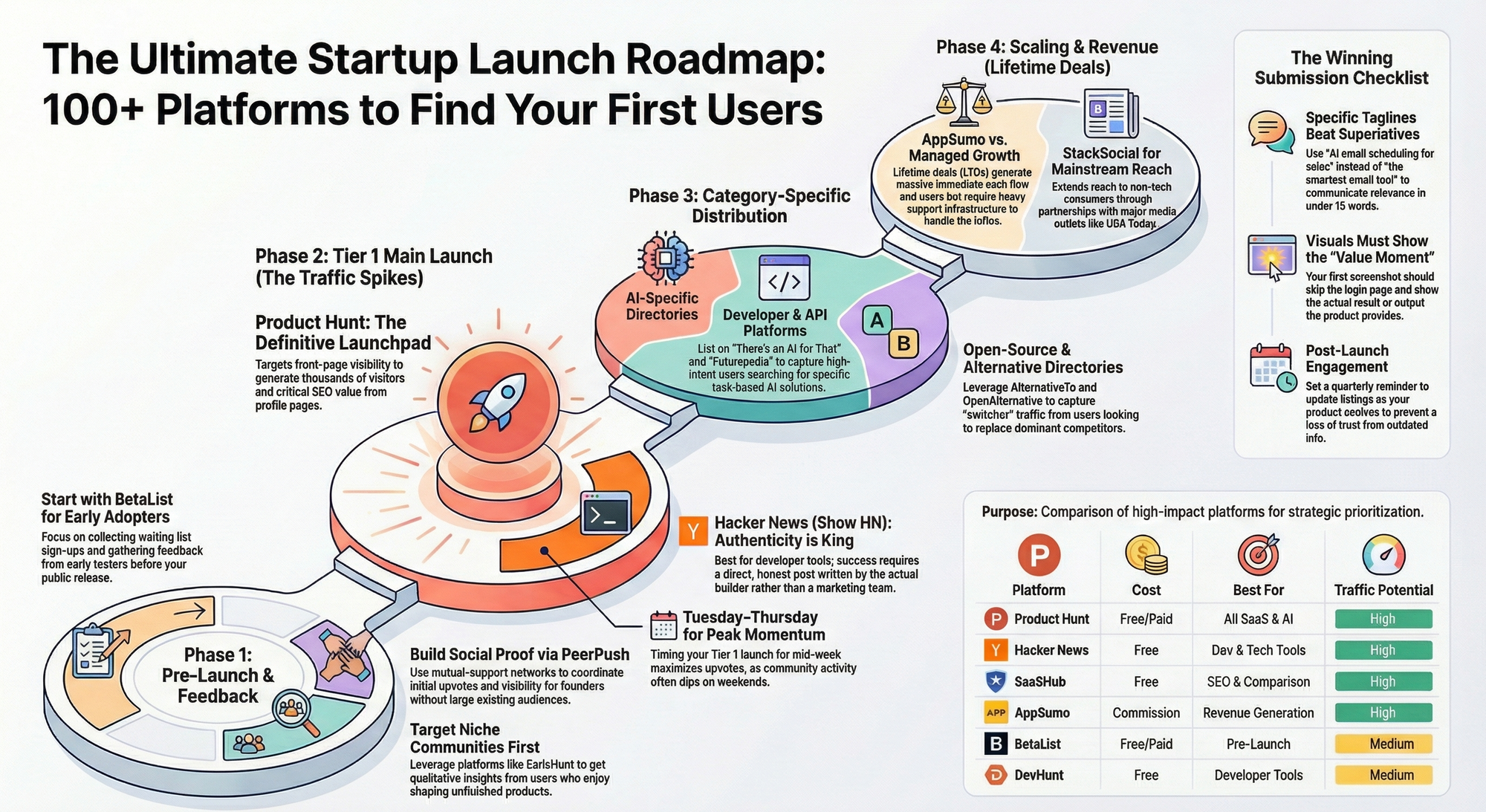
The order in which platforms are approached matters as much as the total number of platforms targeted. A common mistake is launching on all platforms simultaneously, which creates an impossible community engagement burden and prevents the early metrics from one platform from being used as social proof on subsequent platforms. A sequenced approach turns each launch into a building block for the next.
Begin with pre-launch platforms such as BetaList two to four weeks before the public launch date. Use this window to build a waiting list, gather early user feedback, and refine the product description based on how the audience responds to the initial framing. Then launch on Hacker News and Product Hunt in the same week, ideally on the same day or within twenty-four hours of each other, to concentrate community energy and maximize cross-platform social proof. Following the main launch, submit to directories such as SaaSHub, AlternativeTo, and the AI-focused directories over the following two to four weeks. These submissions do not require active community management on launch day and can be processed efficiently in batches.
Tracking which platforms are actually driving traffic is non-negotiable for optimizing the strategy. Add UTM parameters to every platform-specific link, using a consistent naming convention such as utm_source=product-hunt and utm_medium=directory. Review traffic and conversion data from each source monthly for the first six months after launch, and prioritize re-engagement with the platforms that show the highest conversion-to-sign-up rates rather than simply the highest raw traffic volumes.
Common Mistakes Founders Make When Submitting to Directories
The most expensive mistake in directory submissions is not the time spent submitting but the time wasted on submissions that will never produce results because of avoidable errors. The first and most common error is submitting an incomplete profile. Every directory allocates a fixed amount of visual space to each listing. A listing with a placeholder tagline, no screenshot, and a two-sentence description will always lose click-through rate to a listing with a sharp tagline, compelling visuals, and a thorough description, even if the underlying product is superior.
The second major error is ignoring community engagement after submission. Platforms with voting and comment mechanics actively penalize listings that receive engagement and then generate no founder response. A listing that accumulates questions with no answers signals neglect to future browsers and reduces the credibility of the product listing over time. Even a minimal commitment of fifteen minutes per day on launch day, spent responding to every comment and question, meaningfully improves community perception.
Copy-pasting the same description across all platforms is the third common mistake. Each platform has a distinct audience with different expectations, vocabulary, and levels of technical sophistication. A description written for the engineering-heavy Hacker News audience will feel overly technical on AppSumo and insufficiently detailed on DevHunt. Tailoring the first paragraph of each description to the platform's specific audience takes an extra thirty minutes per submission and consistently outperforms copy-paste approaches.
Finally, founders frequently neglect to update listings as the product evolves. A listing created at launch that still describes the version-one feature set eighteen months later actively undermines trust as the product has changed but the directory profile reflects an outdated version. Setting a quarterly calendar reminder to review and update all active directory listings takes ten minutes per quarter and prevents this slow erosion of listing quality.
🔥 Get Featured on CompareBizTech
Drive traffic, build backlinks, and gain early users by listing your AI tool.
List Your Tool →Frequently Asked Questions
How many platforms should a founder submit to when launching a startup?
There is no single correct number, but a reasonable starting target for most startups is thirty to fifty platforms in the first ninety days after launch. The top-tier platforms such as Product Hunt and Hacker News require the most preparation and community engagement, while most directory submissions can be completed in under thirty minutes each. Prioritize quality over quantity by ensuring each submission is complete and tailored to the platform's audience before moving on to the next.
Is Product Hunt still worth it for startup launches?
Product Hunt remains one of the highest-impact launch platforms available, though its effectiveness depends on preparation rather than the platform itself. Founders who treat a Product Hunt launch as a serious campaign, building community relationships in advance, scheduling posts for optimal timing, and engaging actively throughout the day, consistently report meaningful traction. Founders who simply create a listing and wait see limited results. The platform's value has not diminished; the effort required to unlock it has increased as competition has grown.
What is the best free platform to launch a new SaaS product?
Product Hunt, Hacker News, and Indie Hackers collectively represent the highest-value free launch platforms for SaaS products. Product Hunt provides the broadest early-adopter reach, Hacker News delivers the most technically sophisticated feedback, and Indie Hackers builds lasting community relationships within the bootstrapped founder ecosystem. Following the initial launch, SaaSHub and AlternativeTo provide sustained organic traffic from search without any ongoing effort after the initial listing.
How long does it take to get traction from startup directories?
Directory submissions typically produce results across two distinct timeframes. The initial submission generates a traffic spike in the first twenty-four to seventy-two hours on active platforms with community voting mechanics. The longer-term SEO benefit from indexed directory pages begins to compound after four to six weeks and continues growing as the pages accumulate authority and the product's own domain benefits from inbound links. Founders who submit consistently across thirty or more directories and maintain their listings actively typically see measurable SEO improvement within three to six months.
Should a startup launch on lifetime deal platforms before or after building the core user base?
Lifetime deal launches are most effective after achieving product-market fit signals such as consistent user retention, positive testimonials, and a clear value proposition that can be communicated in a single sentence. Launching on AppSumo or similar platforms before these signals are established can result in high refund rates, negative reviews, and a customer base whose needs conflict with the product's intended direction. A staged approach, building the first few hundred users through organic channels before launching a lifetime deal, ensures the product is ready to deliver on the promises made during the deal campaign.
Do directory backlinks actually improve search engine rankings?
High-quality directory backlinks from established platforms with genuine domain authority contribute positively to search engine ranking signals. Platforms such as AlternativeTo, SaaSHub, Product Hunt, and Hacker News carry significant domain authority that passes link equity to the startup's primary domain. Low-quality directory spam, however, can produce the opposite effect. The best approach is to focus on directories that attract real users and editorial oversight, which naturally correlates with higher domain authority, rather than submitting to every directory available regardless of quality.
Building a Distribution Habit, Not a One-Time Campaign
Every great startup eventually solves a distribution problem, not just a product problem. The platforms covered in this guide represent the foundation of a systematic distribution strategy available to any founder regardless of marketing budget, existing audience, or industry connections. The compounding effect of consistent submissions, maintained listings, and community engagement builds over months rather than days, but the ceiling of that compounding is substantially higher than any short-term paid advertising campaign can reach.
The founders who generate lasting traction from directory launches treat distribution as an ongoing discipline rather than a one-time event. They update their listings, engage with communities, track results by source, and iterate on their product descriptions just as rigorously as they iterate on the product itself. Starting with ten platforms done well beats submitting to one hundred platforms done poorly every time. Pick the platforms that best match the product, the audience, and the stage of the business, execute each submission with care, and build from there. The distribution opportunity is real, accessible, and waiting.