16 Most Interesting Startups from YC W26 Demo Day

A Deep Dive into Y Combinator Winter 2026's Standout Companies Reshaping Industries with AI and Deep Tech
Y Combinator has long served as one of the most reliable barometers for where the technology industry is heading. Each batch it produces carries significant weight, not just because of the funding and mentorship its founders receive, but because of the sheer density of ambitious, high-quality teams competing for attention on a single stage. The Winter 2026 cohort, however, stands out for reasons that go well beyond tradition.
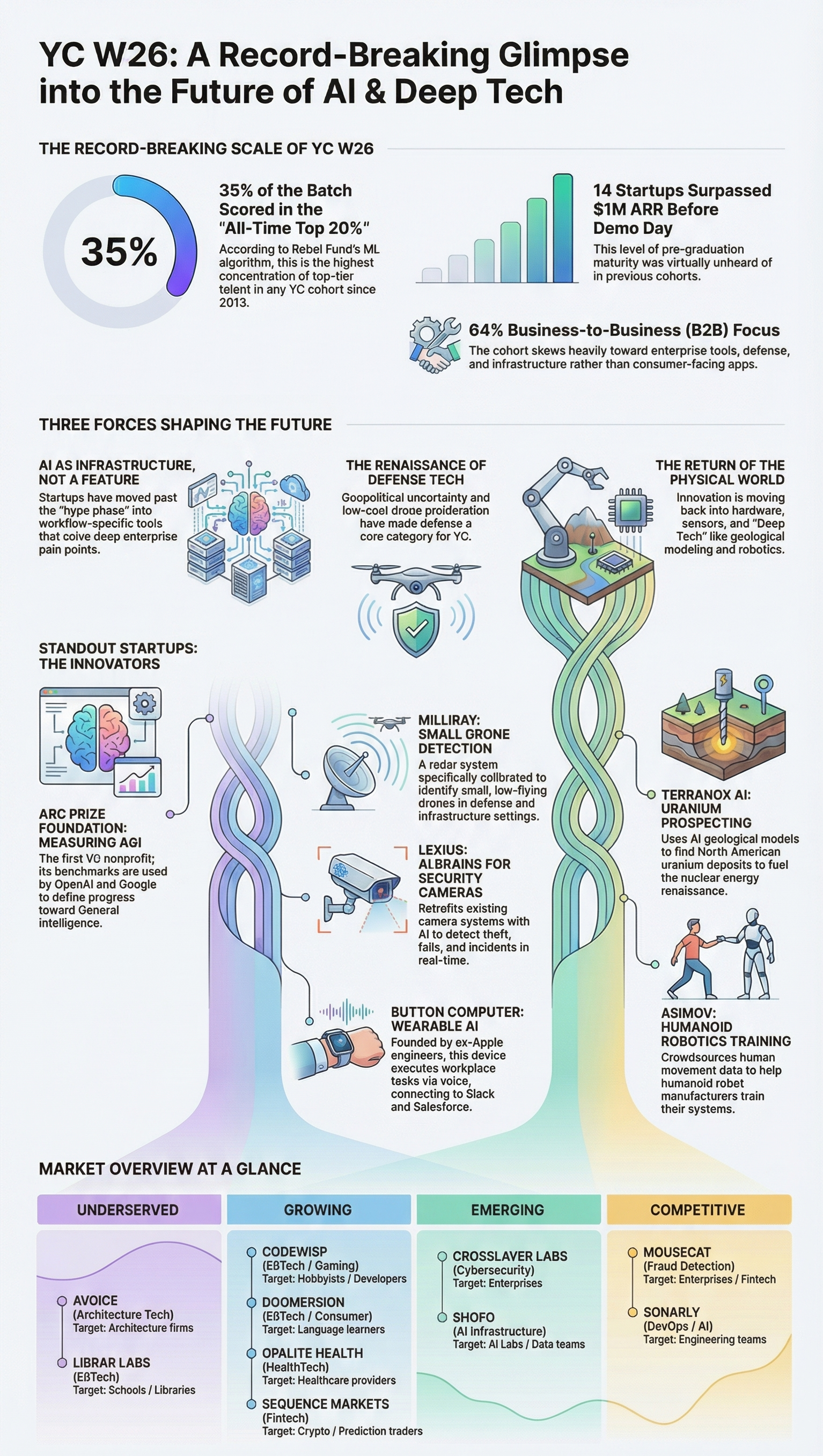
Nearly 190 companies participated in YC W26 Demo Day, held in March 2026. According to data from Rebel Fund, which has attended every YC Demo Day since 2013 and uses a machine learning algorithm to score batches, 35 percent of W26 startups scored in the top 20 percent of all YC companies ever evaluated. No previous cohort has come close to that number. A record 14 companies entered Demo Day having already crossed the one-million-dollar annual recurring revenue milestone, a threshold that was virtually unheard of at this stage just a few cohorts ago.
The themes running through this batch reflect the broader currents shaping the technology landscape. Artificial intelligence is no longer a feature that startups add on top of existing products. In W26, AI is the foundation, the operating layer around which everything else is built. The cohort skews heavily toward B2B, with roughly 64 percent of companies building tools for businesses rather than consumers. Defense technology, healthcare, legal infrastructure, robotics training data, and developer tooling all feature prominently.
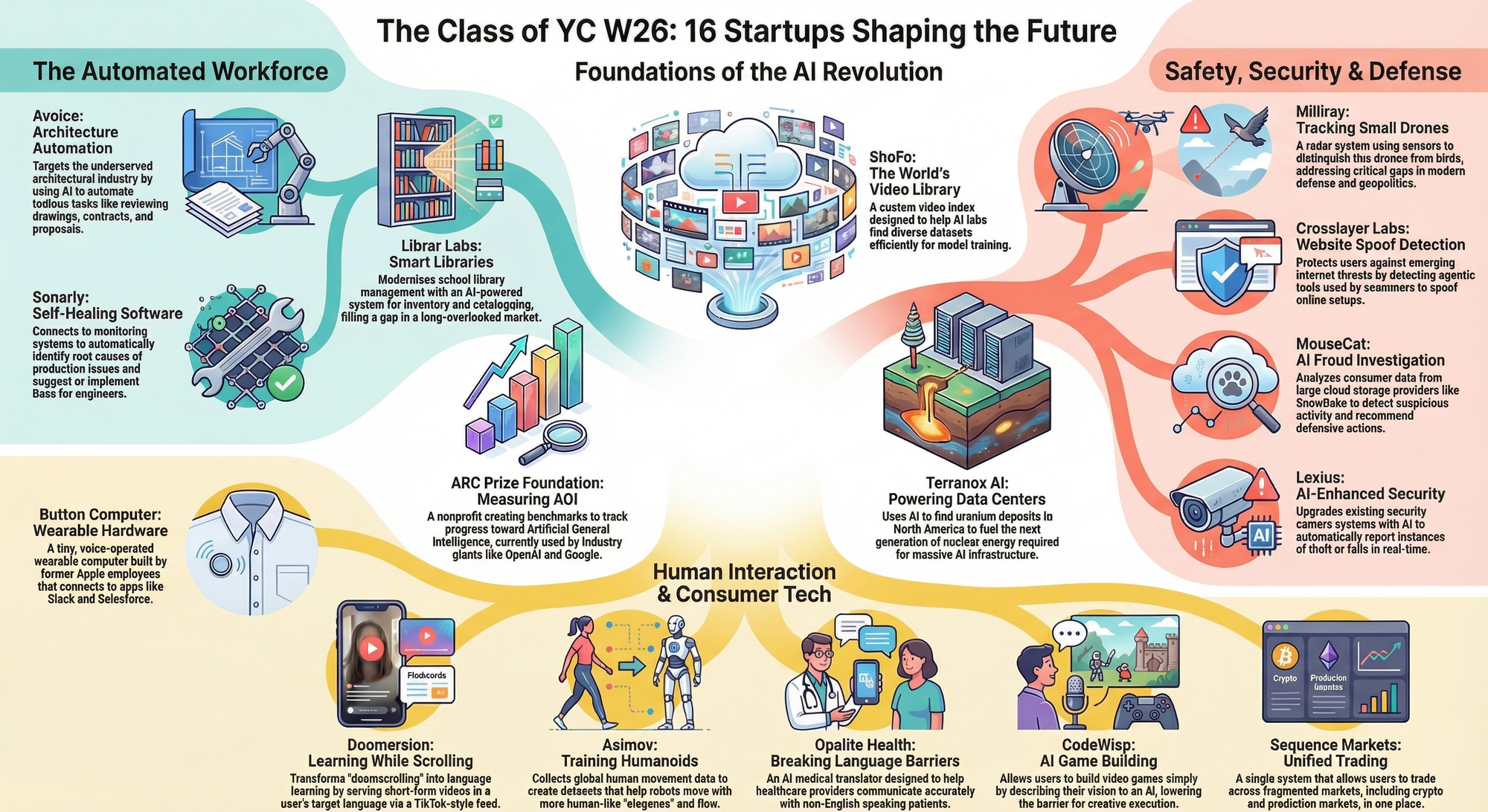
This piece takes a comprehensive look at the 16 most interesting startups from YC W26 Demo Day, drawing on publicly available pitch information, founder commentary, and broader industry context to explain why each company is worth paying attention to. For founders, investors, and technology professionals trying to understand where early-stage innovation is pointing, this batch offers a clear signal.
The Big Picture: What YC W26 Reveals About the Startup Ecosystem
Before examining individual companies, it is worth stepping back to understand the macro trends this cohort reflects. Three forces are shaping the kind of companies getting funded and gaining traction in 2026.
First, AI has matured past the hype phase into a genuine productivity and infrastructure layer. The ChatGPT wrapper startups that dominated earlier cohorts have given way to deeply vertical, workflow-specific tools that solve specific enterprise pain points. Founders in W26 are not asking whether AI can be useful. They are asking which underserved industry or process can be transformed by applying intelligence directly to the workflow.
Second, defense technology is experiencing a genuine renaissance. Geopolitical uncertainty, the rapid proliferation of low-cost drone technology, and government interest in modernizing legacy defense infrastructure have created a category that YC and other top accelerators are now actively courting. Several W26 companies sit directly in this space.
Third, the physical world is back in scope. After years of software eating everything, hardware and deep tech are making a comeback. Physical sensors, wearable computers, and uranium-finding geological models signal that the next wave of startups is not content to live entirely in the cloud.
With that context in place, here is a detailed breakdown of each of the 16 standout startups from YC W26 Demo Day.
490+ Pitch Decks That Raised Millions
Stop guessing what investors want. Get access to 496 real pitch decks used by startups that successfully raised funding.
- 📊 Real decks from funded startups
- 💡 Proven storytelling & slide structures
- 🚀 Learn what actually gets investors to say “yes”
- 🧠 Perfect for founders, freelancers & creators
Used by founders raising pre-seed to Series A
Comparison Table: YC W26 Standout Startups at a Glance
The table below provides a high-level comparison of all 16 featured startups, their category, core technology, primary target market, and how mature the broader market category currently is.
|
Startup |
Category |
Core
Technology |
Primary
Target |
Market
Maturity |
|
ARC Prize Foundation |
AI Research |
Benchmark frameworks |
AI Labs / Researchers |
Established |
|
Asimov |
Robotics / Data |
Human motion datasets |
Humanoid manufacturers |
Emerging |
|
Avoice |
Architecture Tech |
AI document review |
Architecture firms |
Underserved |
|
Button Computer |
Wearable AI |
Voice + AI hardware |
Professionals / Consumers |
Nascent |
|
CodeWisp |
EdTech / Gaming |
AI game generation |
Hobbyists / Developers |
Growing |
|
Crosslayer Labs |
Cybersecurity |
Spoof detection AI |
Enterprises |
Emerging |
|
Doomersion |
EdTech / Consumer |
Short video + NLP |
Language learners |
Growing |
|
Lexius |
Security / AI |
Computer vision AI |
SMBs with cameras |
Underserved |
|
Librar Labs |
EdTech |
AI catalog management |
Schools / Libraries |
Underserved |
|
Milliray |
Defense Tech |
Radar + sensors |
Military / Gov agencies |
Emerging |
|
MouseCat |
Fraud Detection |
AI data analytics |
Enterprises / Fintech |
Competitive |
|
Opalite Health |
HealthTech |
AI medical translation |
Healthcare providers |
Growing |
|
Sequence Markets |
Fintech |
Multi-market trading UI |
Crypto / Prediction traders |
Growing |
|
ShoFo |
AI Infrastructure |
Video indexing AI |
AI Labs / Data teams |
Emerging |
|
Sonarly |
DevOps / AI |
Root cause analysis AI |
Engineering teams |
Competitive |
|
Terranox AI |
Energy / Mining |
Geological AI models |
Energy / Mining firms |
Nascent |
1. ARC Prize Foundation
Building the Scorecard for AGI
What it does: Creates benchmarks to help measure progress toward artificial general intelligence.
The ARC Prize Foundation is perhaps the most unusual entry in any YC batch: a nonprofit operating alongside venture-backed startups. But its inclusion makes complete sense when you consider the scale of its influence. OpenAI, Anthropic, and Google are among the organizations already using the foundation's benchmarks to evaluate the capabilities of their models.
The foundation's mission is to accelerate open-source research toward AGI by hosting competitions and awarding grants to researchers. At a moment when the definition of AGI remains genuinely contested, having a neutral, rigorous benchmarking organization matters enormously. Nvidia's CEO Jensen Huang has argued that AGI has already arrived in some form; others place it years or decades away. The ARC Prize Foundation provides the measurement tools that can cut through that debate with data.
For the startup ecosystem, the practical significance is this: if the race to AGI is the defining technological competition of this generation, then the organization building the standards used to judge progress occupies an extraordinarily important position. Whoever controls the benchmarks shapes what counts as progress.
|
Key Takeaways |
|
First nonprofit selected for a YC batch
that has already secured adoption from major AI labs |
|
Benchmarks shape what the industry counts
as meaningful AI progress |
|
Open-source research focus creates a
counterweight to closed-model development |
|
Hosting competitions creates community
engagement that accelerates research velocity |
2. Asimov
Teaching Robots to Move Like Humans
What it does: Collects human movement data to train humanoid robots.
Named after the science fiction author who imagined a world of helpful robots long before the technology existed to build them, Asimov is solving a data problem that sits at the heart of the humanoid robotics industry. Building a robot that can move naturally, fluidly, and reliably through the physical world requires an enormous amount of training data. That data, historically, has been expensive and difficult to collect at scale.
Asimov's approach turns ordinary people around the world into contributors. Individuals submit videos of themselves performing everyday movements and tasks. Those videos become annotated datasets that humanoid manufacturers can use to train their systems. The model is elegant because it is simultaneously scalable, diverse, and low-cost compared to the alternative of deploying motion-capture teams in controlled environments.
The humanoid robotics market is heating up considerably. Companies like Figure, Apptronik, and 1X are raising significant capital and racing toward commercial deployment. All of them need training data. Asimov positions itself as infrastructure for the entire ecosystem rather than as a competitor to any particular hardware player, which gives it a potentially wide addressable market.
|
Key Takeaways |
|
Data infrastructure play for the humanoid
robotics boom rather than a hardware bet |
|
Crowdsourcing human movement data creates
cost and diversity advantages over traditional motion capture |
|
Serves the entire humanoid ecosystem rather
than competing within it |
|
Global contributor base builds in
geographic diversity that improves robot performance across populations |
3. Avoice
Automating the Drudge Work of Architecture
What it does: Helps automate tedious, non-design work for architecture firms.
Architecture is a field with a paradox baked into it. The professionals who enter it are drawn by the creative, spatial, and aesthetic dimensions of the work. But a substantial portion of a working architect's time is consumed by reviewing specifications, parsing contracts, annotating drawings, and managing proposals. These are necessary tasks, but they are not what most architects went to school for.
Avoice uses AI to automate this administrative and documentation layer of architectural work. The founders themselves noted that the architecture technology market is underserved, which is both a challenge and an opportunity. There are fewer established competitors to displace, but also fewer reference points for buyers evaluating a new solution.
The broader professional services AI market is instructive here. Tools like Harvey in legal and Nabla in healthcare have demonstrated that vertical-specific AI products can achieve rapid adoption in industries where generic solutions fall short. Architecture has its own vocabulary, its own document formats, and its own workflows. A tool built specifically for it, rather than adapted from a generic document review platform, has a meaningful advantage.
|
Key Takeaways |
|
Architecture technology is an underserved
vertical with low existing competition |
|
Automating administrative tasks frees
architects to focus on design, improving both productivity and job
satisfaction |
|
Vertical AI specialization mirrors the
success patterns seen in legal and healthcare tech |
|
Firms spending less time on paperwork can
take on more projects, directly boosting revenue |
4. Button Computer
Wearable AI Built for the Workplace
What it does: A wearable AI device that connects to workplace apps and operates them via voice.
The race to define the next hardware category after the smartphone has attracted serious talent. Button Computer was founded by two former Apple engineers who bring deep product design experience to a crowded and uncertain space. Their product is a small wearable device that acts as an ambient computer, connecting to tools like email, Slack, and Salesforce and executing tasks through voice commands.
The pitch lands at an interesting moment. OpenAI's acquisition of Jony Ive's design company has put AI wearable hardware on the mainstream radar. Humane's early struggles with its AI Pin demonstrated that the category is genuinely difficult to execute, but did not disprove the underlying demand for a device that sits between the smartphone and the earpiece in terms of ambient intelligence.
Button's enterprise-first approach is a sensible go-to-market strategy. Rather than trying to replace the smartphone in a consumer's pocket, it targets the professional who spends significant portions of the day navigating between apps and contexts. For a salesperson, operations manager, or customer service lead, reducing the friction of jumping between Slack, email, and CRM by a meaningful percentage represents real time savings.
|
Key Takeaways |
|
Enterprise-first positioning reduces the
consumer adoption risk that has plagued earlier AI wearables |
|
Founded by former Apple engineers, bringing
product design discipline to a space that has often lacked it |
|
Voice-first interfaces reduce screen time
and context-switching costs for knowledge workers |
|
Connectivity with established platforms
like Salesforce and Slack accelerates enterprise sales cycles |
5. CodeWisp
Making Game Creation Accessible to Anyone
What it does: Lets anyone build games using AI by describing what they want.
The vibe coding movement, in which developers and non-developers alike describe software in natural language and let AI generate the underlying code, has produced a wave of startups across different application types. CodeWisp applies this paradigm specifically to game creation, a category that has historically required specialized programming skills alongside creative vision.
The founders describe the core interaction simply: tell the AI how to make a game, and it makes the game. This framing opens up game development to an enormous population that has the imagination and the desire to create games but lacks the technical background to do so from scratch. Independent game development has exploded in recent years, but the tools have largely still required significant skill.
The commercial opportunity is real. The global gaming market is one of the largest entertainment categories in the world. Even capturing a small share of the market for aspiring game creators, hobbyists, and indie developers who want to move from idea to playable prototype faster would represent meaningful revenue. As generative AI becomes more capable at handling game logic, physics, and art assets simultaneously, the quality ceiling for this type of tool rises steadily.
|
Key Takeaways |
|
Democratizes game creation for the large
population with creative intent but limited technical skill |
|
Aligned with the vibe coding trend, which
has demonstrated strong consumer and developer demand |
|
Game development is a high-engagement
domain where users have strong motivation to complete projects |
|
Improving AI capabilities in code
generation and asset creation raise the quality ceiling over time |
6. Crosslayer Labs
Fighting the Agentic Web's Spoofing Problem
What it does: Helps businesses detect and monitor website spoofs.
As AI agents become capable of browsing the web, filling out forms, making purchases, and conducting research autonomously, the attack surface for malicious actors expands in proportion. One of the simplest and most dangerous attacks in this new environment is website spoofing, in which a malicious actor creates a convincing replica of a legitimate website to capture credentials, intercept transactions, or mislead automated agents.
Crosslayer Labs monitors the web for spoofed versions of its customers' websites, alerting them when impostors appear and helping them take action. The timing of this product is significant. The infrastructure for agentic web activity is being built right now, which means the attack patterns that will exploit it are also being developed right now. Companies that establish early detection capabilities in this space will have a head start that is difficult to replicate.
The cybersecurity market is large and well-funded, but it is also competitive. Crosslayer's differentiation comes from its focus on the agentic web specifically, a threat vector that most existing security tooling was not designed to address. As more enterprise workflows rely on AI agents interacting with external websites, this problem grows from a niche concern to a mainstream risk management priority.
|
Key Takeaways |
|
Addresses a cybersecurity threat vector
created specifically by the rise of AI agents and agentic workflows |
|
Early market positioning in a category
where the threat landscape is still being defined |
|
Monitoring-as-a-service model creates
recurring revenue with high retention as threat exposure grows |
|
The agentic web creates both the problem
and the urgency that drives adoption |
7. Doomersion
Turning Doomscrolling Into Language Learning
What it does: Teaches users languages through a short-video feed in the style of TikTok.
Doomersion starts from an honest observation: people are not going to stop scrolling short video feeds. The behavioral mechanics that make TikTok, Instagram Reels, and YouTube Shorts so difficult to put down are well understood, and abstinence-based approaches to reducing screen time have largely failed to produce meaningful behavior change. Doomersion does not fight the scroll. It redirects it.
The application presents users with a continuous feed of short videos, but those videos are in the language the user is trying to learn. The passive consumption of content becomes a form of language immersion, one of the most effective methods of language acquisition known to educators. The combination of entertaining content, familiar app mechanics, and genuine educational value creates a product with strong retention characteristics.
Language learning is a proven consumer category. Duolingo has demonstrated that gamified, habit-forming language education can build a massive user base and a substantial business. Doomersion occupies a different part of the learning journey, the passive immersion phase that supplements active study, and taps into behavior that users are already demonstrating every day. The marginal cost of switching from mindless scrolling to Doomersion is low; the upside in terms of language acquisition is high.
|
Key Takeaways |
|
Works with existing behavioral patterns
rather than against them, lowering adoption friction significantly |
|
Language immersion through content
consumption mirrors one of the most effective pedagogical approaches |
|
Large and proven consumer market with
demonstrated willingness to pay for language learning tools |
|
Short video format creates natural virality
as users share content they find both entertaining and useful |
8. Lexius
Giving Existing Security Cameras an AI Brain
What it does: Embeds advanced AI into existing security camera systems to detect theft, falls, and incidents.
The security camera industry has a coverage problem. Hundreds of millions of cameras have been installed in businesses around the world, but the vast majority of them are passive recording devices. They capture footage, but they do not analyze it in real time. When an incident occurs, the footage may exist, but the detection and response often depend on human review that happens too late to prevent harm or catch perpetrators.
Lexius addresses this by layering AI onto existing camera hardware. Rather than requiring businesses to replace their infrastructure, the platform plugs into what is already there and adds real-time detection capabilities for events like theft, unauthorized access, and falls. The go-to-market strategy is particularly sharp: target businesses that have already invested in cameras but have not yet connected that investment to actionable intelligence.
The total addressable market here is enormous. Small and medium-sized businesses, retail chains, warehouses, and hospitality operators all have camera infrastructure that could benefit from this kind of upgrade. The fact that Lexius sells the intelligence layer rather than the hardware itself means lower sales friction and faster deployment cycles.
|
Key Takeaways |
|
Retrofit model reduces customer acquisition
costs by avoiding the need to replace existing hardware |
|
Real-time detection creates a fundamentally
different value proposition than passive recording |
|
Targets the broad SMB market with a clear,
quantifiable return on investment through reduced theft and liability |
|
Computer vision AI for security is a
well-validated technology being applied to an underserved segment |
9. Librar Labs
Modernizing the Forgotten Infrastructure of Education
What it does: An AI-powered library management system for schools.
Libraries are one of the few institutional settings that the technology industry has largely passed by. The software running school library systems today is often outdated, fragmented, and poorly suited to the actual workflows of librarians trying to manage inventory, cataloging, and patron access. Librar Labs is building a modern, AI-native replacement.
The founder's pitch made a point worth emphasizing: there is not much competition in this space. Most library management software has not been meaningfully updated in years, and the organizations that provide it have not faced serious competitive pressure. For a startup entering with a genuinely superior product, the absence of a well-entrenched challenger is a meaningful advantage.
The school market also has characteristics that make it attractive for a new entrant. Purchasing decisions are made at the district level in many cases, which means a single sale can cover multiple schools. Switching costs are high once a system is embedded, creating strong retention. And the pain points are genuine enough that librarians and administrators actively want a better solution.
|
Key Takeaways |
|
Extremely low competitive pressure in an
industry where incumbents have failed to modernize |
|
AI-native cataloging and inventory
management reduces labor costs and human error |
|
School district purchasing creates
multi-location deals from single sales conversations |
|
High switching costs after adoption create
durable customer retention and predictable recurring revenue |
10. Milliray
Solving the Small Drone Detection Problem
What it does: A radar system that uses sensors to identify and track small drones.
The proliferation of commercially available small drones has created a genuine security problem that existing radar and detection infrastructure was not designed to solve. Consumer and commercial drones are small, low-flying, and often move in patterns that resemble birds or other flying objects. Human observers in the field can miss them entirely or waste time chasing false positives. Traditional radar systems designed to track aircraft are poorly calibrated for objects this small and slow.
Milliray builds sensor-based detection systems specifically calibrated to identify small drones. The founders point to a stark reality: in active conflict zones and at critical infrastructure sites around the world, personnel are currently trying to track these objects manually. That is both a safety problem and an operational inefficiency that technology can address.
Defense technology is one of the most actively funded categories in the startup ecosystem right now. Geopolitical tensions, the demonstrated battlefield effectiveness of low-cost drones in recent conflicts, and renewed government interest in hardening critical infrastructure have all contributed to an environment in which defense-focused startups are receiving serious institutional attention and substantial procurement budgets.
|
Key Takeaways |
|
Addresses a genuine capability gap in
defense infrastructure with no adequate existing solution |
|
Sensor-based detection is more reliable
than human observation for small, fast-moving aerial objects |
|
Defense procurement cycles, while long,
create durable and high-value contract revenue |
|
Drone proliferation trends ensure that
demand for detection capability grows rather than plateaus |
490+ Pitch Decks That Raised Millions
Get access to 496 real investor-winning pitch decks used by funded startups to raise millions.
- 📊 Real decks from funded startups (YC, Seed, Series A+)
- 🧠 Learn exactly how top founders structure their story
- 💰 See what actually convinced investors to write checks
- ⚡ Perfect for founders, freelancers, and creators pitching ideas
Used by founders building real companies. Not theory. Not templates.
11. MouseCat
Fighting AI-Powered Fraud with Better AI
What it does: Uses AI to investigate fraud by analyzing cloud-stored enterprise data.
Fraud has always been an arms race between defenders and attackers. As AI tools have become accessible to bad actors, the speed, scale, and sophistication of fraud has increased substantially. Traditional rules-based fraud detection systems, built on static logic and historical patterns, are struggling to keep up with attacks that adapt in real time.
MouseCat connects to enterprise data stored in large cloud platforms like Databricks and Snowflake, analyzes consumer activity patterns for suspicious behavior, and delivers actionable recommendations rather than just alerts. The distinction matters: many fraud detection tools identify potential problems but leave security teams to figure out what to do next. MouseCat aims to close that loop.
The target customer base spans financial services, e-commerce, insurance, and any enterprise sector where fraud represents a meaningful operational risk. The integration with existing data infrastructure rather than requiring a new data layer reduces the barrier to adoption and accelerates time-to-value for potential buyers.
|
Key Takeaways |
|
AI-native fraud detection keeps pace with
AI-powered fraud in a way that rules-based systems cannot |
|
Actionable recommendations rather than just
alerts reduce the burden on security and compliance teams |
|
Integration with existing cloud data
platforms removes a major barrier to enterprise adoption |
|
Fraud detection is a high-priority spend
category across financial services, e-commerce, and insurance |
12. Opalite Health
Breaking Language Barriers in Medical Care
What it does: An AI medical translator that helps healthcare providers communicate with patients who speak different languages.
Language barriers in healthcare settings are not a minor inconvenience. When a patient cannot communicate their symptoms clearly, or when a provider cannot fully convey a diagnosis or treatment plan, the consequences range from suboptimal care to life-threatening misunderstandings. In a world where patient populations are increasingly linguistically diverse, the demand for reliable medical translation has never been higher.
Opalite Health builds AI tools that facilitate real-time communication between healthcare providers and patients who speak different languages. The founders acknowledge that the concept of medical translation is not new, and that other startups and established healthtech providers offer related services. The opportunity lies in the quality and integration of the execution, not the novelty of the idea.
Healthcare is a difficult market for startups because of regulatory requirements, long sales cycles, and risk-averse buyers. But Opalite's problem is real, measurable, and quantifiable in terms of patient outcomes. Hospitals and clinics that can demonstrate better care for non-English-speaking patients face both a moral imperative and, in many jurisdictions, a regulatory one.
|
Key Takeaways |
|
Language access in healthcare is both a
patient safety issue and a regulatory compliance requirement |
|
AI-powered real-time translation is faster
and more scalable than human interpreters in most clinical settings |
|
Diverse patient populations create
structural demand that grows with demographic trends rather than against them |
|
Integration into existing clinical
workflows is the key differentiator against generic translation tools |
13. Sequence Markets
One Platform for Crypto, Prediction, and Alternative Trading
What it does: Allows users to trade across multiple markets, including cryptocurrency and prediction markets, from a single unified interface.
The fragmentation of financial markets has long been a friction point for active traders. Someone who wants to trade crypto on one exchange, participate in a prediction market on another platform, and monitor a traditional brokerage account simultaneously is forced to manage multiple interfaces, multiple authentication systems, and multiple data streams. Sequence Markets offers a unified trading surface that pulls these different market types together.
The prediction market category has grown significantly in recent years, with platforms like Polymarket generating substantial volume around major events. Crypto markets remain among the most actively traded alternative asset classes. Combining access to both, alongside other emerging market types, creates a compelling value proposition for traders who are already active across multiple platforms and want to reduce the operational overhead of doing so.
The regulatory environment for multi-market trading platforms is complex, which creates a barrier to entry that protects companies that navigate it successfully. Sequence's ability to execute on the compliance side of this business may ultimately be as important as the product itself.
|
Key Takeaways |
|
Unified trading interface reduces the
operational friction of managing positions across multiple platforms |
|
Prediction markets are growing rapidly and
attracting a more sophisticated trading audience |
|
Regulatory complexity in multi-market
trading creates a durable barrier to entry once compliance is established |
|
Aggregation plays in fragmented markets
have a strong historical track record of building large user bases |
14. ShoFo
A Searchable Video Library for the AI Era
What it does: A custom video indexing tool that helps AI labs find diverse datasets efficiently.
The training data problem is one of the most pressing constraints facing AI development today. Large language models and multimodal systems require enormous quantities of diverse, high-quality data, and the challenge of finding, categorizing, and licensing that data is a genuine bottleneck for many research teams. ShoFo positions itself as infrastructure for this problem.
The product is described as the world's video library, a searchable index of video content designed specifically to help AI labs and data teams find the diverse datasets they need for training. Rather than building a consumer video platform, ShoFo focuses on the B2B use case where the buyer is an AI research team and the product is efficient access to labeled, categorized video content.
The timing is excellent. Demand for training data is at an all-time high, and the methodologies for sourcing it ethically and efficiently are still being developed. A platform that becomes the canonical index for video datasets occupies a strategically important position in the AI infrastructure stack.
|
Key Takeaways |
|
Data infrastructure for AI training is a
mission-critical category with strong and growing demand |
|
Video is among the most complex and
sought-after data types for multimodal AI training |
|
B2B focus on AI labs creates high-value,
sticky customer relationships with clear purchasing intent |
|
Becoming the canonical index for video
datasets creates winner-take-most network effects over time |
15. Sonarly
Automatic Root Cause Analysis for Production Engineering
What it does: Connects to monitoring systems, reduces alert noise, identifies root causes of production issues, and suggests or executes fixes.
Software engineers working in production environments spend a meaningful portion of their time dealing with alerts. Many of those alerts are noise, duplicate notifications, or symptoms of a root cause that requires separate investigation. The cognitive overhead of triaging alerts, tracing issues back to their origin, and deciding on the correct remediation path is substantial. Sonarly attacks this entire workflow.
The product integrates with existing monitoring tools, filters out low-signal alerts, automatically traces issues to their root cause, and then either fixes them or recommends actions for engineers to take. The combination of noise reduction and automatic remediation addresses two of the most time-consuming parts of production operations work simultaneously.
There is genuine competition in the AI code review and DevOps intelligence space, and the major model providers are building some of these capabilities directly into their platforms. But Sonarly's focus on post-deployment production systems, rather than pre-deployment code review, addresses a part of the workflow that has received less attention from both startups and incumbents. Once code is running in production, the problems that emerge are often harder to diagnose than bugs caught at the review stage.
|
Key Takeaways |
|
Post-deployment production intelligence is
underserved compared to pre-deployment code review tools |
|
Alert noise reduction has immediate,
quantifiable value for engineering teams drowning in notifications |
|
Automatic root cause identification
shortens mean time to resolution, a key operational metric |
|
Integration with existing monitoring
infrastructure accelerates adoption without requiring platform replacement |
16. Terranox AI
Finding the Fuel for the Nuclear Energy Renaissance
What it does: Uses AI to identify uranium deposits in North America.
Nuclear energy has undergone a remarkable rehabilitation in the public discourse over the past several years. Once primarily associated with disaster risk and weapons proliferation, nuclear power is now increasingly recognized by climate advocates, data center operators, and energy policy experts as an essential component of any credible path to abundant, low-carbon electricity. The massive expansion of data centers required by the AI revolution has created a surge in demand for baseload power that renewables alone cannot satisfy.
Uranium is the fuel that makes this vision possible, and Terranox AI is building the tools to find more of it. The company uses AI models trained on geological data to identify likely uranium deposits across North America. Traditional mineral exploration is expensive, time-consuming, and success-dependent on the judgment of individual geologists. AI-assisted geological modeling can process far more data, identify patterns invisible to human analysts, and dramatically improve the hit rate on exploratory drilling decisions.
The founders are transparent about the challenges involved in the actual extraction of uranium, acknowledging its toxicity and the environmental considerations of mining operations. But the demand signal is clear. If nuclear energy is to scale as rapidly as its proponents hope, the supply chain for uranium needs to expand, and finding economically viable deposits more efficiently is a prerequisite for that expansion.
|
Key Takeaways |
|
Nuclear energy demand is growing
significantly due to data center expansion and decarbonization goals |
|
AI-assisted geological modeling
dramatically improves the efficiency and accuracy of exploratory mining |
|
Uranium supply constraints are a genuine
bottleneck for nuclear energy scaling, creating real demand |
|
North American focus reduces geopolitical
supply chain risk compared to reliance on foreign uranium sources |
490+ Pitch Decks That Raised Millions
Stop guessing what investors want. Get access to 496 real pitch decks used by startups that successfully raised funding.
- 📊 Real decks from funded startups
- 💡 Proven storytelling & slide structures
- 🚀 Learn what actually gets investors to say “yes”
- 🧠 Perfect for founders, freelancers & creators
Used by founders raising pre-seed to Series A
Cross-Cutting Themes: What YC W26 Tells Us About the Future
Looking across all 16 of these companies, several patterns emerge that are worth articulating explicitly, both for what they reveal about this specific cohort and for what they suggest about the direction of technology broadly.
AI as Infrastructure, Not Feature
In every case here, AI is doing something genuinely novel rather than serving as a marketing label applied to a conventional product. Lexius could not exist without real-time computer vision. MouseCat is only viable because large language models can now reason over behavioral data at a speed and scale that humans cannot. Sonarly's value proposition requires AI that can trace causality through complex distributed systems. The companies in this batch are building products where the AI is the mechanism, not the decoration.
Underserved Verticals Are the Real Opportunity
Multiple companies in this cohort, including Avoice, Librar Labs, and Opalite Health, chose to go deep into verticals that the mainstream technology industry has overlooked. This is a deliberate strategy, and it is a good one. In well-served markets like enterprise productivity or consumer social, incumbents have resources, distribution, and customer relationships that are difficult to displace. In underserved verticals, the competitive landscape is thinner, the buyer pain is acute, and first movers can establish durable positions before larger players take notice.
The Physical World Is Back
Hardware and deep tech are no longer the poor cousins of software startups in venture capital circles. Milliray, Button Computer, and Asimov all involve physical products or physical-world sensing. Terranox AI is ultimately about extracting material from the ground. The investment environment has shifted to recognize that the most important technological problems of the next decade cannot be solved purely in software.
Defense and Energy Are No Longer Taboo
A generation ago, many Silicon Valley founders and investors avoided defense and energy on ethical or reputational grounds. That reluctance has substantially eroded. Milliray and Terranox AI sit in sectors that would have raised eyebrows in earlier cohorts but attract serious attention in 2026. The view from the current startup ecosystem is that building national security infrastructure and enabling the energy transition are among the most important things a technology company can do.
How to Evaluate Early-Stage Startups: A Framework for Founders and Investors
For readers who are thinking about how to evaluate YC-stage companies, whether as an investor, a potential customer, or a founder benchmarking against peers, the companies in this cohort offer a useful framework.
Market timing matters more than most founders admit. ARC Prize Foundation and Milliray are both benefiting from macro forces, the AI race and drone proliferation respectively, that are creating urgent demand right now rather than in some hypothetical future. Startups that are well-positioned relative to a current wave of adoption have a structural advantage over those whose market is still forming.
The retrofit strategy deserves attention as a go-to-market approach. Lexius selling intelligence to businesses that already have cameras, Sonarly integrating with existing monitoring tools, MouseCat pulling from cloud data already in place: all of these companies reduce adoption friction by working with what customers already have rather than asking them to start over. This is a particularly effective strategy in enterprise sales where procurement cycles are long and switching costs are high.
Behavioral alignment is an underrated competitive advantage. Doomersion does not fight user behavior; it redirects it. Companies that design products around what humans actually do, rather than what they should do, tend to achieve better retention and organic growth than those that require users to form new habits from scratch.
Conclusion: YC W26 as a Window Into the Next Decade
The Winter 2026 Y Combinator cohort is, by multiple measures, one of the strongest batches the accelerator has ever produced. The quality of the companies, the diversity of the problems they are addressing, and the maturity of their go-to-market thinking all reflect how much the startup ecosystem has evolved since the early days of the AI wave.
The 16 companies profiled here represent a broad cross-section of that cohort. Some are building tools that will likely become standard infrastructure for specific industries. Others are taking genuine moonshots in categories like humanoid training data, uranium prospecting, and AGI benchmarking that could have enormous impact if they succeed. A few, like Doomersion and CodeWisp, are simply solving problems that a lot of people have and doing so in a way that is both clever and immediately useful.
For anyone tracking where technology is heading, watching which of these companies grows into a significant business over the next three to five years will be instructive. YC batches are not just a collection of individual companies. They are a snapshot of the problems that the most ambitious founders in the world have decided are worth solving right now. That makes them one of the best forward-looking indicators of where the technology industry is heading.
The most interesting question is not which of these companies will succeed, though that question is certainly interesting. The more revealing question is which of the problems they are attacking will turn out to have been the most important. The answers will only be visible in hindsight, but the starting points are right here.