🚀 How AI Reshapes Startup Strategy
🤖 A New Startup Using AI to Replace Workers

In This Edition:
- 💸 Investors Double Down On Innovation
- 🚀 How AI Reshapes Startup Strategy
- 🔥 How People Actually Use ChatGPT
- 🪹 How To Choose Early Employees
- ✨ How Great Founding Teams Are Built
- 🤖 A New Startup Using AI to Replace Workers
- 📈 How AI Is Closing Deals
- ⚡February Shows AI Acceleration
💸 Funding Signals The Next Frontier
Several startups across advanced manufacturing, healthcare, semiconductors, and positioning technology secured major funding rounds, highlighting strong investor conviction in frontier innovation.
Here’s a quick snapshot of the latest deals:
- 🏭 Freeform raised $67M Series B — Scaling metal manufacturing with multi-laser 3D printing and AI-driven simulations.
- 🧬 Korsana Biosciences raised $175M seed — Developing monoclonal antibody therapies targeting neurodegenerative diseases like Alzheimer’s.
- 🧠 Taalas raised $169M — Building custom AI chips by embedding models directly onto silicon.
- 📍 ZaiNar raised $100M+ at $1B valuation — Delivering precise positioning using Wi-Fi and 5G instead of satellites.
The takeaway: Investors are doubling down on companies building foundational technologies across AI, hardware, and life sciences.
👉 Curious who’s leading the biggest bets right now? Click below to explore deeper investor signals, valuation moves, and funding context. 👇
🚀How AI Reshapes Startup Strategy
AI isn’t replacing founders — it’s redefining what’s possible.
A recent conversation featuring Naval Ravikant offers a powerful lens on how building in the AI era is evolving. The biggest takeaway: speed, leverage, and human judgment are becoming the ultimate competitive advantages.
Here’s the distilled playbook shaping the next generation of startups:
- 💬 Vibe coding is here — English is becoming a programming language, enabling rapid idea testing without large teams and unlocking a wave of niche apps.
- 🧠 Great engineers matter more than ever — AI can generate code, but real expertise is needed to solve complex problems and understand fundamentals.
- 🚀 Founder agency remains unmatched — AI can assist, but vision, decision-making under uncertainty, and market creation still belong to humans.
- 📚 The ultimate learning companion — AI acts as an always-available tutor with infinite patience and personalized explanations.
- 💡 Creativity stays human — AI compresses knowledge, but breakthrough ideas still come from connecting unexpected dots.
- ⚡ Action beats anxiety — Confidence with AI comes from using it, experimenting, and shipping faster.
The message is clear: the biggest risk in this new era isn’t being replaced — it’s moving too slowly while others build faster.
👉 Dive deeper into the full conversation and explore the complete insights here.
🚀 How People Use ChatGPT
What people actually use ChatGPT for may surprise you.
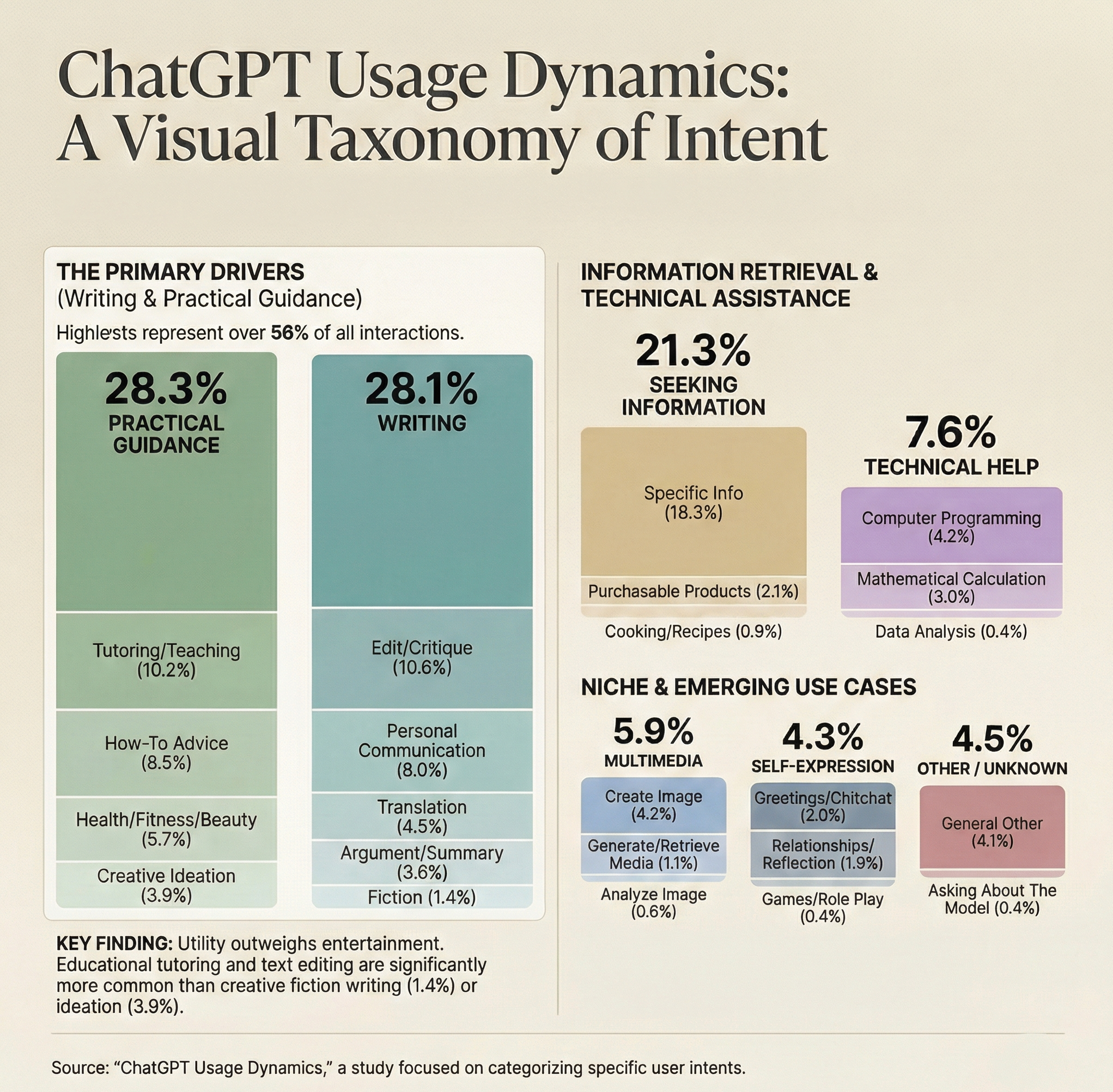
New data reveals a clear picture of how conversations are distributed — and where the biggest value is being created. From writing and practical guidance to learning and technical help, usage patterns highlight how AI is becoming a daily productivity engine.
Here are the key insights worth noting:
- ✍️ Writing leads the way (28.1%) — Editing, communication, translation, and summarization dominate usage, showing strong demand for content support.
- 🧭 Practical guidance is close behind (28.3%) — Tutoring, how-to advice, and self-care insights highlight AI’s role as a decision support tool.
- 🔎 Information seeking remains core (21.3%) — Users rely heavily on AI for specific answers, product insights, and quick research.
- 💻 Technical help continues growing (7.5%) — Programming, math, and data tasks show steady adoption among builders and analysts.
- 🎭 Self-expression use cases (4.8%) — Personal reflection, conversations, and role play highlight AI’s creative and emotional applications.
- 🖼️ Multimedia interactions expanding (6.0%) — Image creation and media generation point to rising multimodal engagement.
- ❓ Other and exploratory usage (4.6%) — Curiosity around AI itself remains part of user behavior.
The data paints a clear picture: AI is no longer a novelty — it’s becoming an everyday tool across learning, creating, and problem-solving.
👉 Explore the full breakdown and uncover deeper insights here.
✨ How Great Founding Teams Are Built
The earliest hires don’t just build the product — they shape the company’s destiny.
A recent Build Mode conversation featuring General Catalyst managing director Yuri Sagalov dives into what it really takes to build a strong founding team. From choosing the right investors to structuring equity and hiring mission-driven talent, the discussion highlights decisions that can define a startup’s trajectory for years.

Here are the standout insights founders should keep top of mind:
- 🧑🤝🧑 Your first hires set the culture — The first five to ten employees establish norms and expectations that are extremely difficult to change later.
- 💼 Choose investors carefully — The most valuable investors act as true partners, while micromanaging investors can create unnecessary friction and slow progress.
- 🔍 Do reference checks on VCs — Speaking with portfolio founders reveals how investors behave when things go wrong, not just when everything is going well.
- ⚖️ Design fair co-founder equity splits — Slight differences can help break deadlocks, but long-term fairness matters more than who had the initial idea.
- 🎯 Hire missionaries, not mercenaries — Early employees should be deeply aligned with the mission and motivated beyond compensation.
- 🗣️ Be transparent about risk — Honest conversations about uncertainty build trust and attract the right kind of early team members.
These early decisions compound over time, influencing culture, alignment, and execution speed as the company scales.
💼Lessons From Figma’s Dylan Field
Great companies rarely start with perfect plans — they start with the right mindset.
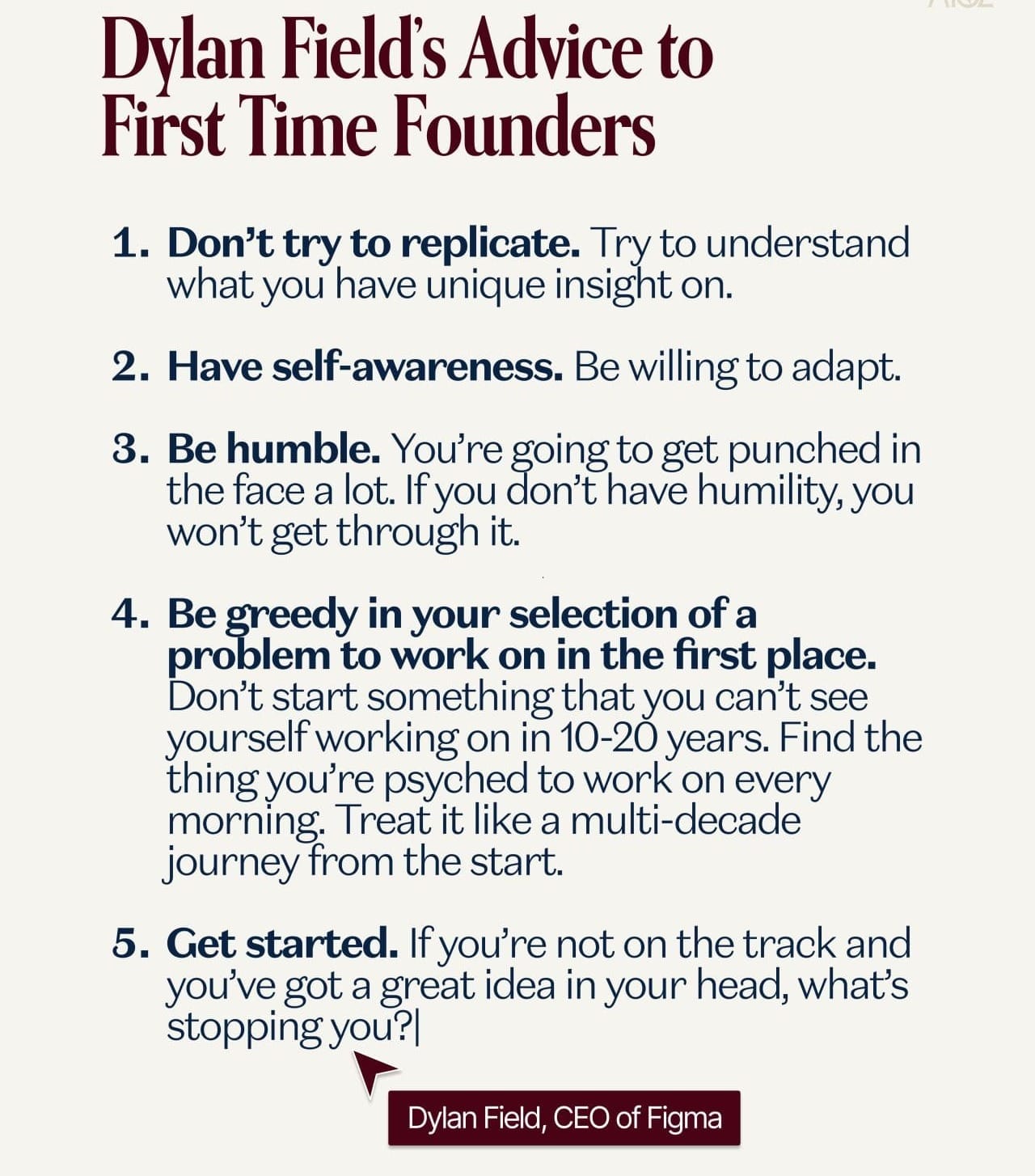
Figma co-founder Dylan Field shares timeless advice for first-time founders navigating the early stages of building. The core message is simple: focus on unique insight, stay adaptable, and commit to problems worth decades of effort.
Here are the key lessons that stand out:
- 🔍 Focus on unique insight — Avoid copying what already exists and lean into perspectives and problems uniquely understood.
- 🧠 Build strong self-awareness — Adaptability and honest reflection help founders navigate constant change.
- 🙏 Lead with humility — Challenges are inevitable, and resilience comes from staying grounded and open to learning.
- 🎯 Choose problems worth decades — The best opportunities are those exciting enough to work on for 10–20 years, not just quick wins.
- 🚀 Start before feeling ready — Progress begins with action, not perfection, and momentum builds from taking the first step.
This advice highlights a powerful truth: mindset and problem selection often matter more than tactics in the early journey.
🤖 A New Startup Using AI to Replace Workers
A $10 billion startup is betting that the future workforce will include AI colleagues — not just humans.
A new wave of companies is emerging around reinforcement learning, where experts across industries are training AI models to think, diagnose, analyze, and assist at a professional level. At the center of this shift is Mercor, a fast-growing startup connecting thousands of experts with AI labs to help build smarter systems.
Here’s what’s shaping this rapidly evolving landscape:
- 🧠 Experts are training AI to do expert work — Doctors, lawyers, engineers, and other professionals are grading and refining AI responses to improve accuracy and performance.
- 💰 A booming new AI service economy — Reinforcement learning services are estimated to be worth at least $17 billion, with experts earning hundreds of dollars per hour.
- 🏥 AI as an assistant, not a replacement — Many professionals see AI taking over repetitive tasks like documentation, analysis, and note-taking, freeing up time for higher-value work.
- 📊 Mercor’s rapid rise — The company has scaled to a valuation above $10 billion, paying out over $1 million daily to experts and surpassing $500 million in revenue run rate.
- ⚖️ Debate around job displacement — Critics argue experts may be training their future replacements, while supporters see productivity gains and new opportunities.
- 🤖 Human judgment still matters — Subjective areas like humor and complex decision-making highlight the limits of AI without human insight.
- 🌍 A vision of amplified productivity — Leaders believe making workers more productive with AI could accelerate progress on major global challenges.
A new startup in Silicon Valley is already valued at $10 billion, it’s using artificial intelligence to replace workers
— Wall Street Apes (@WallStreetApes) February 20, 2026
They’re training AI to replace doctors, lawyers, bankers and even jobs like recommending wine
Entire industries will be replaced with ai workers
“AI labs are… pic.twitter.com/UTV3lVXhIn
The big question remains: is this the beginning of widespread job disruption or the foundation of a new human-AI collaboration model?
📈 How AI Is Closing Deals
What if your best salesperson was AI — and never missed a call?
Simple AI is building voice agents that handle sales calls from start to finish, helping businesses answer inbound calls, guide customers, and close purchases automatically — with measurable revenue impact.
Key highlights:
- 📞 AI handles sales end to end — From answering questions to processing orders without human intervention.
- 📈 30% better at upselling — Consistently applies top sales tactics across every call.
- 🏢 Solves staffing challenges — Helps companies manage call spikes and complex sales conversations.
- 🧪 Real-time optimization — Teams can instantly test messaging and offers to boost conversions.
- 💬 More personalized interactions — Remembers preferences and past purchases for tailored experiences.
The bigger shift: AI sales agents are moving from cost-saving tools to revenue-driving growth engines.
👉 Read the full story to see how voice AI is transforming sales and customer experience.
⚡February Shows AI Acceleration
February is moving at breakneck speed in AI — and it’s only been 19 days.
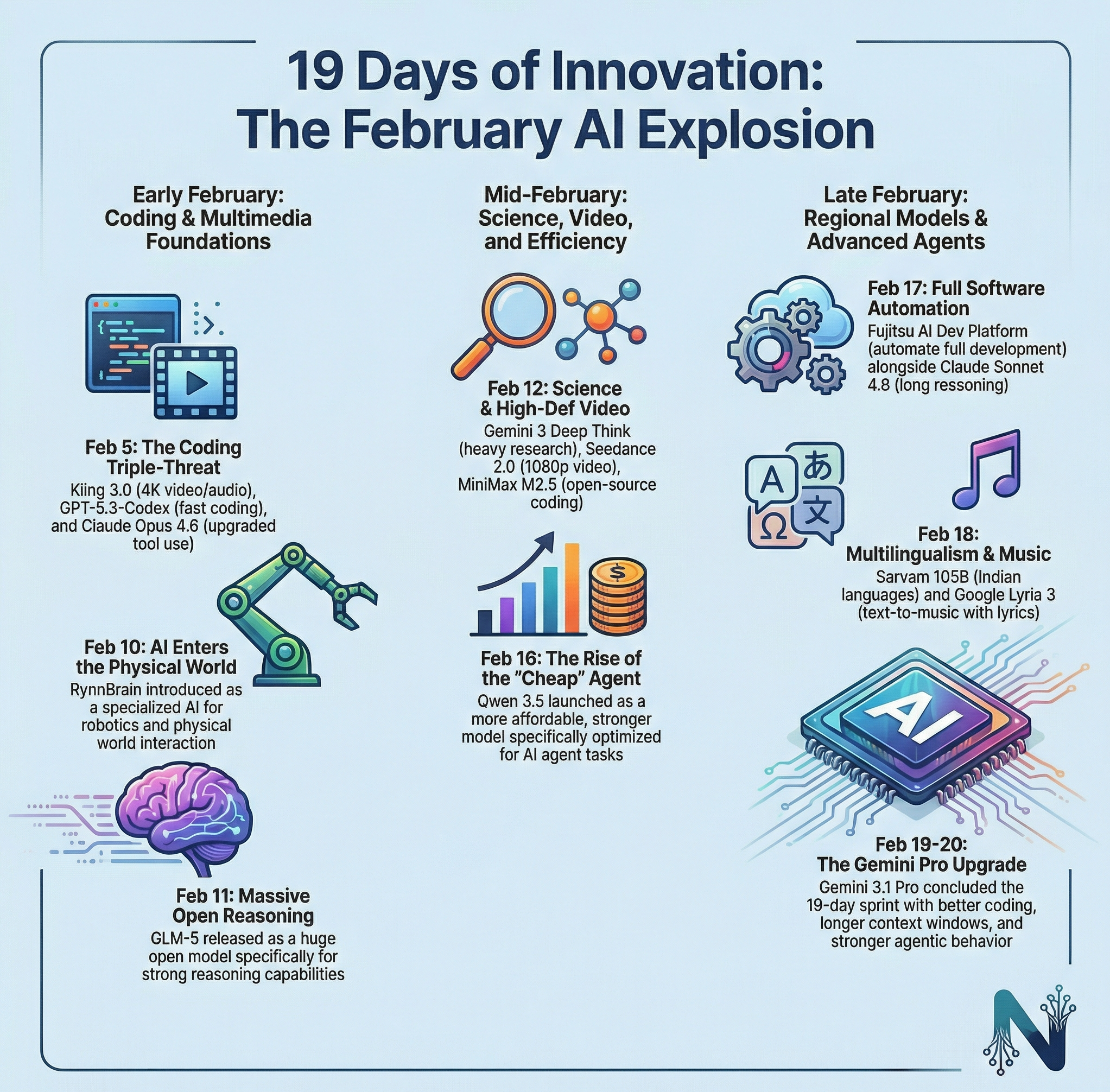
From major model upgrades to breakthroughs in video, music, and robotics, the pace of releases shows just how quickly the ecosystem is evolving across research, creativity, and developer tools.
Here’s a quick snapshot of what’s launched so far:
- 🧠 New frontier models — Gemini 3.1 Pro, Claude Sonnet 4.6, Claude Opus 4.6, Qwen 3.5, GLM-5, and MiniMax M2.5 push coding, reasoning, and agent capabilities forward.
- 💻 Developer acceleration — GPT-5.3-Codex and Fujitsu’s AI Dev Platform highlight the shift toward automating software development.
- 🎥 Creative AI leaps — Kling 3.0 brings 4K video with audio, Seedance 2.0 delivers realistic 1080p text-to-video, and Google Lyria 3 generates full music tracks.
- 🔬 Research and science focus — Gemini 3 Deep Think targets heavy research workloads and scientific discovery.
- 🌍 Global AI expansion — Sarvam 105B emphasizes Indian languages and local use cases.
- 🤖 Real-world AI progress — RynnBrain pushes AI further into robotics and physical environments.
The takeaway: AI innovation cycles are compressing, and capabilities across coding, media, research, and agents are advancing simultaneously.