30 Early-Stage Investors to Know Before Pitching at SGC: A Founder's Complete Guide to the VC Pitch Stage

A practical breakdown of the venture capitalists attending the SGC VC Pitch Stage — their focus areas, investment theses, check sizes, and exactly what they look for in early-stage founders.
Why the SGC VC Pitch Stage Matters for Founders Raising Early Capital
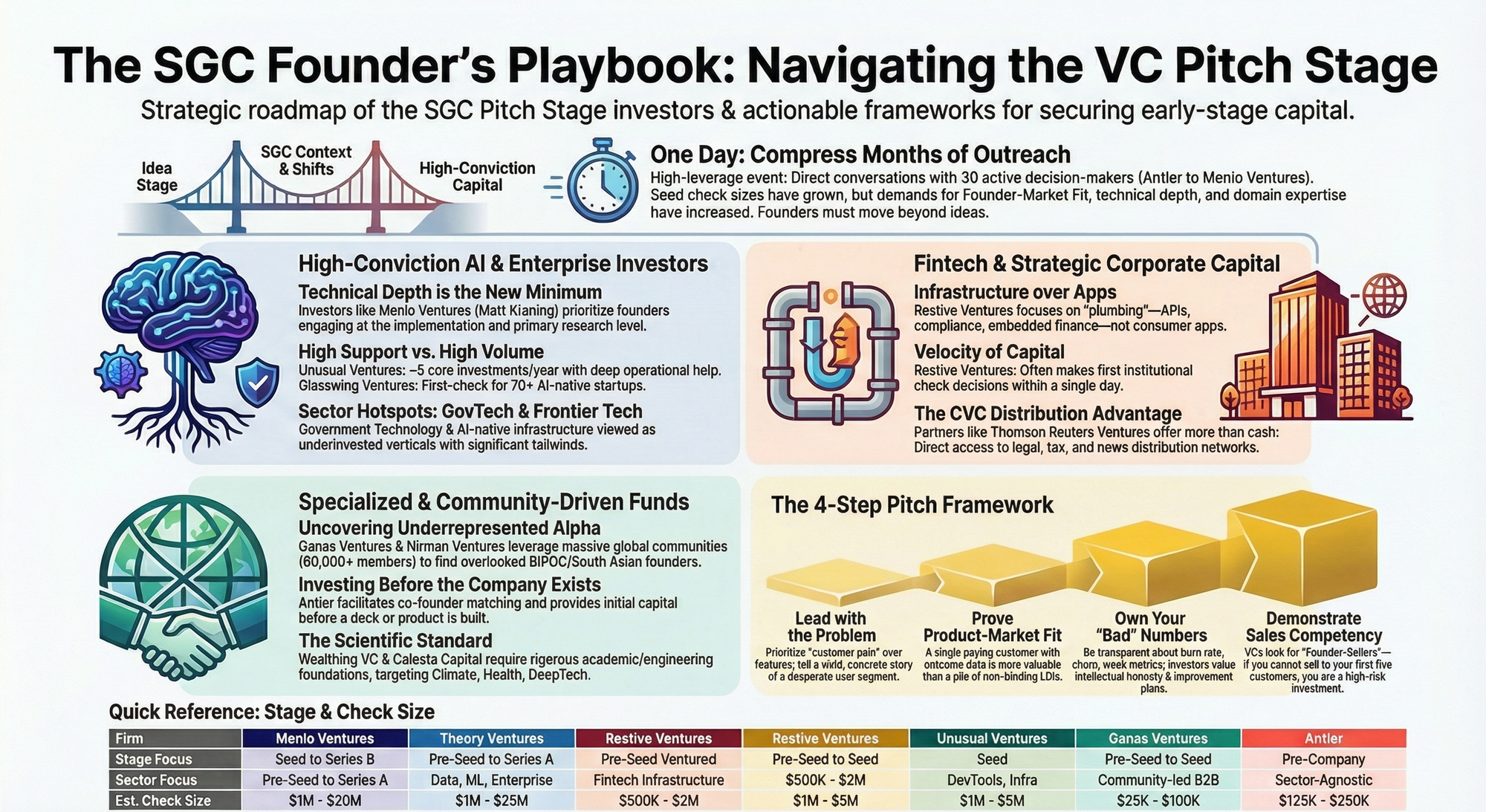
Access to the right investors at the right stage is one of the most persistent and underappreciated challenges in early-stage company building. Most founders spend months cold-emailing partners, navigating warm-introduction networks, and attending conferences where the ratio of eager startups to active investors leaves little room for meaningful conversation. The SGC VC Pitch Stage changes that dynamic entirely.
This purpose-built stage at SGC brings together 30 actively investing venture capitalists spanning seed, pre-seed, Series A, and early growth stages. These are not passive observers or emerging managers exploring the market. These are decision-makers who write checks, sit on boards, and have the operational depth to help founders navigate the earliest and most critical phases of company building. For a founder preparing to raise a pre-seed or seed round, a single direct conversation with the right partner at this stage can compress months of outreach into one focused meeting.
This guide covers all 30 investors who will be present on the SGC VC Pitch Stage. For each investor and firm, it details their investment thesis, sector preferences, typical check sizes, and the qualities they prioritize in founders. The goal is simple: give founders the knowledge they need to walk into that room prepared.
Related topics covered include: how to pitch early-stage VC investors, what venture capitalists look for in pre-seed startups, long-tail keyword strategy for investor outreach, fintech infrastructure investment trends, and AI-native startup investment landscape.
🚀 1000+ Angel Investors
A massive, curated list of angel investors actively funding early-stage startups.
Whether you're building your first product or scaling fast — this is your shortcut to reaching the right backers.
- ✔️ 1000+ verified angel investors
- ✔️ Early-stage & seed-focused
- ✔️ Save months of investor research
- ✔️ Built for founders, freelancers & creators
Limited-time access. Get in front of investors before everyone else does.
Understanding the Early-Stage Venture Capital Landscape Before You Pitch
Before walking through the 30 investors, it is worth establishing a clear picture of the early-stage venture landscape today. Early-stage venture capital — typically covering pre-seed, seed, and Series A — has undergone significant structural changes driven by the rise of AI, the normalization of remote-first teams, and increasing investor sophistication around vertical software markets. The average time from seed to Series A has lengthened as investors demand more evidence of product-market fit. Check sizes have grown at seed while the number of active seed funds has also expanded, creating a more competitive but more abundant funding environment.
What this means for founders is that differentiation has never been more important. Investors are not just evaluating the idea or the market size. They are evaluating the founding team's domain expertise, their ability to identify and serve a desperate early customer segment, and their capacity to recruit and retain the people needed to scale. Understanding what each investor on the SGC VC Pitch Stage specifically looks for — and preparing accordingly — is the single highest-leverage preparation a founder can do.
Key Takeaways
- Early-stage VC check sizes at seed have grown, but competition for top-tier backing has intensified.
- Investors increasingly prioritize domain-specific expertise and early customer evidence over idea-stage pitches.
- The SGC VC Pitch Stage compresses months of outreach into direct conversations with active decision-makers.
- Founders who research each investor's specific thesis before pitching dramatically improve their conversion rate.
The 30 VC Investors on the SGC Pitch Stage: Profiles, Theses, and What They Want
The following profiles are organized by firm type and sector focus to help founders identify the investors most aligned with their company's stage, geography, and vertical. Each profile includes the investor's background, investment focus, and key signals that distinguish great pitches from mediocre ones based on publicly available research.
AI, Enterprise Software, and Deep Technology Investors
This cohort represents the largest and most active segment of the SGC VC Pitch Stage. AI-focused early-stage investing has dominated venture activity over the past several years, and the investors below represent some of the most sophisticated perspectives in the field. These are not generalist investors who have pivoted to AI because the market demanded it. They are people who have built AI systems, led AI-native companies, or spent years developing sector-specific theses around how artificial intelligence reshapes enterprise software, infrastructure, and security.
1. Matt Kraning | Partner, Menlo Ventures
Focus Areas: AI, Enterprise SaaS, Cybersecurity, National Defense
Matt Kraning brings one of the most operationally grounded backgrounds of any investor on the SGC stage. Before joining Menlo Ventures, he co-founded and served as CTO of Expanse, a cybersecurity and attack surface management company acquired by Palo Alto Networks for $1.25 billion. Before that, he served as lead data scientist at DARPA, deploying to Afghanistan — a background that gives him unusual credibility in national defense technology. He holds a PhD in Electrical Engineering from Stanford. Since joining Menlo, he has built a portfolio that includes investments in AI-native infrastructure companies and has made over 50 angel investments including unicorns Peregrine and Astranis. Menlo Ventures itself manages over $5.8 billion in assets and has backed companies including Anthropic, Abnormal Security, Benchling, Carta, Pinecone, and Uber.
Founders pitching Kraning should come with genuine technical depth. He reads primary research, engages at the implementation level, and has built production AI systems himself — meaning he can quickly identify whether a founder's technical claims hold up. He values intellectual honesty about what a technology can and cannot do, and is particularly drawn to founders building at the intersection of AI and security or enterprise infrastructure. At Menlo, the firm is explicitly focused on companies that deliver outcomes, not just tools — founders who can articulate measurable customer value rather than feature lists will resonate most strongly.
2. Andy Triedman | Partner, Theory Ventures
Focus Areas: Data, Machine Learning, Early-Stage Enterprise Software
Andy Triedman joined Theory Ventures from Innovation Endeavors, where he focused on machine learning companies including Afresh, Third Wave Automation, and ClearMetal. Before that, he was the first product manager at Replica, a Founders Fund-backed startup building generative models of urban environments. His academic background is in computational neuroscience at Brown University, where he built brain-computer interfaces and trained machine learning algorithms on neural data. Theory Ventures, led by founder Tomasz Tunguz, recently closed a $450 million second fund focused on the next generation of enterprise software and data infrastructure. The firm's investment range of $1 million to $25 million covers pre-seed through early Series A.
Triedman operates from a thesis-driven approach, which means founders who understand how their company fits into broader market trends will make a stronger impression than those pitching purely on the strength of their product. He values technical founders with genuine depth in machine learning or data infrastructure. The firm benchmarks against public and private software companies systematically, so founders who can situate their company within that competitive landscape — and demonstrate where they are genuinely differentiated — will stand out.
3. Kleida Martiro | Managing Director, Glasswing Ventures
Focus Areas: AI-Native Enterprise, Cybersecurity, Frontier Technology
Kleida Martiro is a Managing Director at Glasswing Ventures, a firm she joined from Glasswing's earliest days as an associate. Her path is unusual in the VC world: she emigrated from Albania at 13, learned English quickly, built expertise in data science including Python and SQL as a self-taught practitioner, and earned an MBA from Kellogg before joining what was then a nascent seed fund. Glasswing recently closed a $200 million Fund III — its largest fund to date and oversubscribed relative to its target — focused exclusively on pre-seed and seed investments in AI-native and frontier technology enterprise startups. The firm has made 70 investments since 2018, was the first institutional investor in more than 90 percent of those companies, and its core portfolio has collectively raised over $650 million in follow-on capital.
Glasswing is emphatically a first-check-in firm. If a company has already raised an institutional seed round, Glasswing is likely not the right conversation. Martiro looks for founders in the earliest formation stages who are building in B2B enterprise or security markets where AI is genuinely transformative rather than cosmetically applied. She emphasizes proactivity, curiosity, and the willingness to be in ambiguous situations — qualities she looks for in founders the same way she looks for them in herself. Founders who skip due diligence on their own risks and assumptions, or who cannot clearly articulate the regulatory and security dimensions of their market, will lose her attention quickly.
4. Niamh O'Donnell | Director of Programs, Unusual Ventures
Focus Areas: Enterprise Software, Infrastructure, Developer Tools, GovTech
Unusual Ventures operates on a model that is deliberately counter to the spray-and-pray approach that defines many seed funds. The firm makes approximately five core investments per year and provides intensive, hands-on support to each — including access to experienced operators, a structured academy program, and direct help with early customer acquisition, GTM strategy, and hiring. The results are measurable: while the industry average for seed-stage companies reaching Series B is roughly 15 percent, Unusual's portfolio reaches that milestone at a rate approaching 60 percent. Niamh O'Donnell serves as Director of Programs and has been instrumental in building the Unusual Academy, which provides founders with immersive, week-long operational training programs. She has highlighted GovTech as one of the most exciting and underinvested frontier areas in enterprise software today.
Pitching Unusual Ventures requires understanding that the fund values depth over breadth in both its investments and its founders. The most important thing founders can demonstrate is genuine product-market fit with a desperate early user segment — not broad appeal, but one group of customers for whom the product is indispensable. O'Donnell has been direct about the skill she believes founders most underestimate: early-stage sales. Founders who cannot sell their own product personally, before building a sales team, are unlikely to receive a term sheet from Unusual.
Key Takeaways
- AI-focused investors increasingly look for technical depth and operational experience rather than just a compelling narrative.
- Glasswing and Unusual Ventures represent opposite ends of the volume spectrum: Glasswing makes many early bets; Unusual makes very few with deep support.
- GovTech, AI infrastructure, and security are identified by multiple investors as underinvested verticals with strong near-term tailwinds.
- Founders pitching deep tech VCs should demonstrate familiarity with primary research and be prepared to engage at the technical implementation level.
Fintech and Financial Infrastructure Investors
Financial technology remains one of the most active and specialized sectors for early-stage venture capital. The investors below have built careers at the intersection of financial services and technology — not as generalists who occasionally look at fintech, but as domain experts with hands-on experience building, regulating, and advising financial products. Their investment theses reflect the broader shift in fintech from consumer-facing applications to infrastructure, APIs, and embedded finance.
5. Ryan Falvey | Managing Partner, Restive Ventures
Focus Areas: Fintech Infrastructure, Embedded Finance, Compliance Technology, Financial APIs
Ryan Falvey has spent 15 years at the intersection of venture capital and financial technology. Before co-founding Restive Ventures, he led the Financial Solutions Lab — a landmark partnership between JPMorgan Chase and the Financial Health Network. He has also worked at Silicon Valley Bank developing payment solutions and served as Strategy Group Lead at Enclude Solutions, overseeing global strategy consulting on mobile financial products. Since 2015, he has invested in over 40 early-stage fintech firms that have collectively grown to represent approximately $3 billion in aggregate equity value. Restive's portfolio companies have collectively raised more than $1 billion in follow-on capital and generated over $8 billion in enterprise value. The firm makes first institutional check decisions quickly — sometimes within a day — and functions as an extension of the founding team rather than a passive check-writer.
Falvey's investment philosophy is rooted in a distinction that many consumer fintech founders miss: Restive is not investing in apps, it is investing in infrastructure. Backend APIs, compliance tooling, and embedded finance capabilities are the categories that attract the firm's attention. Founders in fintech must also understand that regulatory readiness is a design constraint, not an afterthought. The firm explicitly looks for companies building compliance considerations into their core architecture. The ideal pitch for Restive describes a large financial market, a regulatory environment the team understands deeply, and an infrastructure layer that enables others to build on top of.
6. SC Moatti | Managing Partner, Mighty Capital
Focus Areas: B2B SaaS, AI, Enterprise, Mobile-First Products
SC Moatti is Managing Partner of Mighty Capital, a venture capital firm investing at seed through Series B in B2B software and AI companies. She is also an author whose work on product development and mobile strategy has been used in MBA programs globally, and a former product leader at Facebook, Nokia, and Electronic Arts. She founded Products That Count, a global community of product managers, which has given her a distinctive vantage point on what makes software products genuinely beloved versus merely functional. This community lens shapes her investment thesis: she looks for products that inspire loyalty and drive network effects rather than products that simply automate existing workflows.
Founders pitching Mighty Capital should be prepared to speak to product love and retention alongside growth metrics. Moatti's framework for evaluating products centers on whether users genuinely want the product in their lives — a qualitative signal she takes as seriously as quantitative indicators. For AI-enabled B2B products specifically, she is attentive to whether AI is genuinely core to the value proposition or merely a feature wrapper on an existing workflow automation.
7. Joseph Dormani | Partner, Thomson Reuters Ventures
Focus Areas: Legal Technology, RegTech, AI for Professional Services, Enterprise Intelligence
Thomson Reuters Ventures is the corporate venture arm of Thomson Reuters, one of the world's largest legal, tax, and regulatory information companies. Joseph Dormani, as Partner, brings a strategic investing lens to early-stage companies building in areas directly relevant to Thomson Reuters' core businesses. This includes legal technology, regulatory compliance technology, artificial intelligence applications for professional services, and enterprise knowledge management. Corporate venture investments from firms like Thomson Reuters Ventures come with a distinct advantage: portfolio companies gain access to distribution networks, customer introductions, and enterprise relationships that independent VC firms cannot provide. The trade-off is that strategic alignment with the parent company's roadmap matters in the evaluation process.
Founders pitching Dormani should be prepared to articulate how their technology is relevant to or complementary with the legal, tax, risk, or news information markets that Thomson Reuters serves. Companies building pure consumer technology or hardware without a clear enterprise or professional services angle are unlikely to be the right fit. The strongest pitches will demonstrate a customer base that overlaps with Thomson Reuters' existing client network and a technology approach that could be integrated, partnered, or scaled through that distribution.
Key Takeaways
- Fintech infrastructure — including compliance APIs, embedded finance tooling, and regulatory technology — is receiving more investor attention than consumer fintech applications.
- Corporate venture arms like Thomson Reuters Ventures offer strategic value beyond capital, including enterprise distribution and client network access.
- Restive Ventures can make investment decisions within days, making it one of the fastest-moving institutional seed investors in fintech.
- Founders in regulated financial markets must demonstrate from day one that compliance is built into the product architecture, not bolted on.
Investors Focused on Diverse, Underrepresented, and Global Founders
A growing and increasingly influential segment of early-stage venture capital is dedicated to correcting structural inequities in who receives funding. The investors below are not simply making diversity statements — they are deploying capital to founders who have historically been overlooked by traditional VC networks, and building infrastructure to surface and support those founders at scale. These investors tend to see deal flow that more traditional firms miss, giving them a distinct first-mover advantage in backing companies that later become mainstream.
8. Lolita Taub | General Partner, Ganas Ventures
Focus Areas: Community-Led B2B SaaS, AI, Emerging Markets, Global Founders
Lolita Taub is the General Partner and founder of Ganas Ventures, a pre-seed and seed-stage fund investing $25,000 to $100,000 checks in startups led by BIPOC, women, and LGBTQ founders across the United States and Latin America, with a global expansion planned for Fund II. She has spent 18 years in tech — beginning in enterprise sales at IBM and Cisco, moving through startups, and investing at Lightspeed, Backstage Capital, K Fund, and Indie.vc. Across her career, she has invested in over 100 companies. She is also the builder of a startup-investor matching tool that has facilitated thousands of introductions, and publishes a newsletter with more than 22,000 subscribers. Her community of founders, funders, and allies spans 90,000 people globally. In 2025, she completed the Ganas Global Tour — a ten-city research and relationship-building expedition through Singapore, Hong Kong, Taiwan, Jordan, Georgia, the UAE, Pakistan, Malaysia, the Philippines, and Japan — designed to inform the global thesis for Fund II.
Taub's investment style combines data-driven sourcing with deep community infrastructure. She uses AI tools at Ganas to scale deal sourcing and founder support in ways that larger funds do not. Founders who are building in markets serving historically underserved communities, or who bring personal domain expertise rooted in the problems they are solving, will resonate most strongly. The check sizes at Ganas are smaller than many institutional investors on this list, but the community leverage and the signal value of the investment are significant.
9. Alicia Castillo Holley | General Partner, Wealthing VC
Focus Areas: DeepTech, Climate, HealthTech, Underrepresented Founders
Dr. Alicia Castillo Holley holds a PhD, MBA, and MSci — an unusually rigorous academic background that she applies to evaluating technically complex startups. As General Partner of Wealthing VC, she focuses on founders building at the frontier of science and technology, including climate technology, health technology, and deep technology categories. She is also an angel investor, author, and keynote speaker with experience in both Silicon Valley and international markets, giving her a global perspective that informs her thesis on where innovation is genuinely underserved.
Founders pitching Wealthing VC should be prepared for rigorous technical scrutiny. Castillo Holley's academic background means she can and will evaluate the scientific foundations of a technology claim directly. Companies with genuinely novel technical approaches — particularly in climate, health, or deep tech — are the strongest fit. Founders who cannot explain the core technology clearly at both a high level and a mechanistic level will lose her attention quickly.
10. Nikhil Choudhary | Managing Partner, Nirman Ventures
Focus Areas: South Asian Founders, Enterprise SaaS, Global Emerging Markets
Nikhil Choudhary leads Nirman Ventures, a fund specifically focused on backing South Asian founders building enterprise software and technology companies. The fund operates on the thesis that South Asian-founded companies are systematically underfunded relative to their representation in the technology industry, and that providing targeted capital, network access, and operational support to this founder cohort creates both financial and social returns. Nirman has built a network that spans the South Asian diaspora in the United States and connects portfolio founders with customers, advisors, and follow-on investors.
Founders with South Asian backgrounds building in enterprise SaaS, infrastructure, or technology-enabled services will find a particularly strong alignment with Nirman. The fund values founders with demonstrated domain expertise and a clear customer acquisition path. The network access provided by Nirman — particularly for navigating enterprise sales cycles and building trusted relationships within South Asian business communities — is a distinctive value add beyond capital.
Key Takeaways
- Diverse-founder-focused funds see differentiated deal flow and often identify high-potential companies before traditional networks reach them.
- Ganas Ventures uses AI tooling internally to scale founder sourcing and support — an unusual and sophisticated operational approach for a micro fund.
- Community infrastructure (newsletters, matching tools, global tours) is becoming a competitive moat for investor sourcing at the earliest stages.
- Founders from underrepresented backgrounds should actively seek out aligned investors rather than assuming traditional VC networks will reach them.
💰 1000+ Angel Investors
The fastest way to connect with investors actively backing early-stage startups. Built for founders serious about raising capital.
Access Now →Global Platform and Sector-Specific Investors
This section covers investors with distinct geographic platforms, stage-agnostic models, or sector specializations that sit outside the primary AI and fintech categories. Their investment theses are often shaped by unconventional backgrounds — founders who became investors, operators from non-traditional markets, or professionals who built domain expertise in industries that venture capital is only recently beginning to serve well.
11. Rio Hodges | Partner, Antler
Focus Areas: Pre-Company and Pre-Seed, Sector-Agnostic, Global Co-Founder Matching
Antler occupies a unique position in the early-stage ecosystem: it invests before the company exists. Its model involves recruiting talented individuals, facilitating co-founder matching, providing initial capital of roughly $125,000 to $250,000, and then following the best companies through subsequent rounds. Antler has built one of the largest global venture platforms, operating across more than 30 locations worldwide and having invested in over 1,000 companies. Rio Hodges, as Partner at Antler, works with founders at the earliest possible inflection point — before there is a deck, a product, or even a co-founding team.
For solo founders or founders still looking for the right technical co-founder, Antler represents one of the only institutional pathways to receive capital and support at that stage. Founders who have deep domain expertise in a specific market or industry — but who lack a complete co-founding team — are the strongest candidates for the Antler program. The model rewards domain clarity and personal credibility rather than product maturity.
12. Carlotta Siniscalco | General Partner, Emergence Capital
Focus Areas: B2B SaaS, Fintech, Future of Work, Vertical SaaS
Carlotta 'Lotti' Siniscalco is a General Partner at Emergence Capital, a pioneering enterprise SaaS venture firm managing over $2 billion in assets. Emergence is known for having identified the vertical SaaS category earlier than almost any other investor, backing companies including Veeva Systems and Zoom before the market recognized their potential. Siniscalco joined Emergence as a Senior Associate in 2018 and rose to Partner, leading investments including Oyster, Federato, and Whistic. Her background includes roles at Advent International, Ribbit Capital, and Nerdwallet. She is a first-generation immigrant from Italy and a Kauffman Fellow. Emergence's portfolio includes 11 unicorns including Genspark, Together AI, and Oyster, and the firm has backed companies with investments across seed through Series B.
Emergence looks for companies building the systems of record and systems of action for specific professional markets. Founders should be prepared to articulate not just what their software does, but why it becomes indispensable infrastructure for a specific workflow or industry vertical. Siniscalco has been vocal about the relationship between AI and SaaS — she believes companies with strong first-party data, genuine network effects, and ambitious AI integration roadmaps are best positioned to benefit from the agentic AI wave, not disrupted by it.
13. Steve Fu | Partner, Celesta Capital
Focus Areas: Deep Technology, Semiconductor, AI Infrastructure, Industrial Technology
Celesta Capital focuses on companies at the intersection of deep technology and AI, with particular emphasis on semiconductor technology, AI hardware infrastructure, and industrial-scale software. Steve Fu brings an engineering and operating background to the firm, with experience evaluating technically complex companies where the core defensibility is rooted in scientific or engineering innovation rather than distribution alone. Celesta has built relationships with major corporate partners in Asia and the United States, giving portfolio companies access to manufacturing networks and enterprise customers that many other seed-stage investors cannot provide.
Founders pitching Celesta should have genuine engineering depth and ideally backgrounds in physics, electrical engineering, materials science, or adjacent technical disciplines. The firm is not a generalist technology investor — companies building consumer software or SaaS applications without a deep tech component are unlikely to be a strong fit. The most compelling pitch to Celesta articulates a technical moat that would be extremely difficult for a well-resourced competitor to replicate even with significant capital investment.
14. Stephanie Sher | General Partner, Integral Ventures
Focus Areas: Consumer Technology, Commerce, Marketplace Businesses
Stephanie Sher is General Partner at Integral Ventures, which focuses on consumer technology, digital commerce, and marketplace businesses. Her background spans both operating and investing roles, with experience evaluating companies where consumer behavior, distribution network effects, and brand building are the primary drivers of value creation. Integral Ventures occupies a relatively distinct niche at the SGC stage given the heavy concentration of B2B investors — making Sher's presence particularly valuable for founders building consumer-facing technology products.
Consumer technology founders attending SGC who have struggled to find investors with genuine consumer market expertise will find a uniquely aligned conversation with Sher. The strongest pitches will demonstrate early consumer retention data — not just acquisition metrics — and a clear picture of what drives repeat engagement. For marketplace businesses specifically, founders should be prepared to articulate the supply-side acquisition strategy alongside the demand-side growth model.
15. Keshia Theobald-van Gent | Partner, BDev Ventures
Focus Areas: Business Development-Led Investing, Strategic Corporate Partnerships, Enterprise Technology
BDev Ventures combines venture investing with a distinctive business development overlay — portfolio companies receive not just capital but active support in building strategic corporate partnerships. Keshia Theobald-van Gent, as Partner, brings deep experience in enterprise business development and strategic partnership construction, having helped early-stage companies navigate the complex process of landing large corporate customers and strategic investors. The fund's approach recognizes that at the earliest stages of company building, the right strategic partnership can be more valuable than capital itself.
Founders pitching BDev should have a clear picture of what corporate partnerships would be transformative for their business, and ideally some initial evidence that large enterprises are interested in their product. The fund's value proposition is strongest for B2B companies that need enterprise customer access to validate their product and grow their revenue — and who would benefit from active help constructing those relationships rather than simply receiving a check and a board seat.
16. Mercedes Bent | Co-founder, Premise
Focus Areas: EdTech, Future of Work, Economic Mobility Technology
Mercedes Bent is co-founder of Premise, an investment organization focused on education technology, workforce development, and economic mobility technology. Her background includes extensive investing in the future of work and learning — she has backed companies building credentialing systems, skills-based hiring platforms, workforce management tools, and educational technology products serving K-12 through adult learning markets. Her perspective on economic mobility shapes an investment thesis that extends beyond user acquisition metrics to genuine outcomes: does the product improve economic circumstances for the people it serves?
Founders in education technology, workforce development, or economic mobility who have struggled to find investors who understand the nuances of these markets — including regulatory complexity, long sales cycles in institutional settings, and the challenge of demonstrating learning outcomes — will find Bent to be one of the most sophisticated investors in the room for their specific category. The strongest pitches will present outcome data alongside engagement metrics.
Key Takeaways
- Antler is the only investor on the SGC stage who backs companies before a co-founding team exists — making it uniquely valuable for solo founders with domain expertise.
- Emergence Capital's thesis on AI-SaaS reinforces that companies with first-party data and network effects are positioned to benefit from agentic AI, not be disrupted by it.
- BDev Ventures adds active business development support to capital — a high-leverage advantage for B2B founders who need enterprise customer access.
- Consumer technology founders are relatively underserved at SGC, making Stephanie Sher's presence at Integral Ventures particularly valuable.
💰 1000+ Angel Investors
The fastest way to connect with investors actively backing early-stage startups. Built for founders serious about raising capital.
Access Now →Additional SGC Investors: Emerging Managers and Sector Specialists
The following investors represent a diverse group of emerging fund managers, sector specialists, and platform investors whose presence at the SGC VC Pitch Stage rounds out the available capital across geographies, sectors, and stage preferences. Many represent funds with distinct network advantages — geographic, community-based, or alumni-driven — that can provide value beyond capital.
17. Nina Leskovec and Vuk Lau | Partners, Silicon Gardens
Focus Areas: Central and Eastern European Founders, Enterprise Software, AI
Silicon Gardens is a venture fund dedicated to founders from Central and Eastern Europe — a region that produces exceptional engineering talent and increasingly sophisticated startup founders but remains underserved by mainstream Silicon Valley capital networks. Nina Leskovec and Vuk Lau, both Partners, combine deep regional networks with an investment thesis centered on enterprise software and AI applications where CEE founders have demonstrated particular strength. Portfolio companies gain access to both Silicon Valley networks and the rich technical talent pools of the CEE region.
Founders with roots in Central or Eastern Europe, or companies building with engineering teams based in that region, will find Silicon Gardens to be a uniquely aligned partner. The fund is also relevant for founders building products that serve European enterprise markets, where Silicon Gardens' regional relationships can accelerate customer acquisition and regulatory navigation.
18. Kevin Jiang | Founder, Mangusta Capital
Focus Areas: Consumer Technology, Digital Media, Gaming, Interactive Entertainment
Kevin Jiang founded Mangusta Capital with a focus on consumer technology, digital media, and interactive entertainment — sectors that require both quantitative analytical rigor and genuine cultural fluency with emerging consumer behaviors. His background spans both product development and investing, giving him hands-on experience with the operational challenges of building consumer media companies. Mangusta represents one of the smaller and more focused fund vehicles at SGC, with a thesis that is deliberately concentrated rather than broadly diversified.
Consumer technology and gaming founders will find Mangusta to be one of the few investors at SGC with genuine expertise in their category. The fund is particularly interested in companies where community, content, and software intersect — and where the founding team has personal domain expertise in the content or entertainment vertical they are building for.
19. Bryan Liu | Principal, Alumni Ventures
Focus Areas: Sector-Agnostic, Alumni Network-Driven Investing
Alumni Ventures is one of the largest alternative asset managers in the United States, managing over $1 billion in assets and deploying capital across hundreds of investments annually through a network of alumni-affiliated funds. Bryan Liu, as Principal, works within the Alumni Ventures ecosystem, which provides LP access to institutional-quality venture investments to individuals affiliated with top university alumni networks. The fund co-invests alongside leading venture capital firms rather than leading rounds independently, making it a valuable addition to a cap table from a diversification and network perspective.
Alumni Ventures is most relevant for founders looking to add a recognizable brand name to their cap table as a co-investor alongside a lead, rather than as a lead investor themselves. The fund's broad network of alumni LPs can also be a source of strategic introductions and customer connections for companies in a wide variety of industries.
20. Darshan Shah | Principal, XRC Ventures
Focus Areas: Commerce Technology, Retail Innovation, Supply Chain, Consumer Brands
XRC Ventures is a specialized fund focused on the intersection of commerce, retail, and technology. Darshan Shah, as Principal, evaluates companies building software and infrastructure for the retail and commerce ecosystem — including supply chain optimization, point-of-sale technology, retail analytics, direct-to-consumer brand infrastructure, and omnichannel commerce tooling. The fund has established relationships with major retail corporations and brands that it leverages to provide portfolio companies with strategic partnerships and pilot opportunities.
Founders building technology for the retail or commerce ecosystem will find XRC's network of established retail partners to be one of the most direct pathways to enterprise validation available at seed stage. Shah is particularly attentive to whether a company's technology can demonstrate ROI within a realistic pilot timeline for retail partners — a procurement consideration that shapes evaluation from the outset.
21. Harrison Lieberfarb | Partner, Canvas Prime
Focus Areas: Media Technology, Sports Technology, Entertainment
Canvas Prime focuses on media technology, sports technology, and entertainment — categories that sit at the intersection of consumer attention and enterprise monetization. Harrison Lieberfarb brings operational and investing experience in these categories, which have become increasingly attractive as streaming, sports rights, and creator economy dynamics reshape the media landscape. The fund evaluates companies where technology is genuinely transformative for how content is created, distributed, or monetized rather than merely adjacent to an entertainment brand.
Founders in media technology, sports analytics, creator tools, or entertainment infrastructure will find Canvas Prime to be a highly specialized and operationally relevant investor. Lieberfarb's network in media and sports provides direct access to the industry relationships that can accelerate enterprise deals and content partnerships in these categories.
22. Ben Stein | General Partner, Cartography Capital
Focus Areas: Enterprise Software, Vertical SaaS, AI Applications
Ben Stein is General Partner at Cartography Capital, a fund that takes a deliberate and methodical approach to mapping market opportunities in enterprise software and vertical SaaS before making investment decisions — hence the fund's name. The fund develops detailed market maps of specific industry verticals, identifying where software infrastructure is missing or inadequate, before proactively sourcing for founders building in those white spaces.
Founders in enterprise software who can situate their company within a broader market mapping exercise — demonstrating not just what they are building but where their product fits within the full stack of software that a specific industry requires — will resonate most strongly with Cartography Capital. The fund is particularly well-suited for category creation opportunities where the founding team has identified a genuine gap that existing vendors are not serving.
23. Payton Dobbs | Partner, Hoston Ventures
Focus Areas: Healthcare Technology, Digital Health, Life Sciences Enablement
Hoston Ventures focuses on healthcare technology and digital health — a sector that requires investors to navigate complex regulatory environments, long sales cycles, and clinical evidence requirements that most generalist technology investors are not equipped to evaluate. Payton Dobbs brings domain expertise in healthcare markets that enables Hoston to evaluate clinical relevance alongside technology differentiation, making it one of the more sophisticated digital health investors at early stage.
Healthcare technology founders frequently struggle to find seed investors who understand the nuances of payer reimbursement, clinical workflow integration, HIPAA compliance architecture, and healthcare enterprise sales. Hoston Ventures is positioned to be a genuinely useful early partner for founders navigating these specific challenges. Dobbs is particularly attentive to whether a product has a credible path to reimbursement or sustainable enterprise contract structures.
24. Ari Wright | Principal, Bison Ventures
Focus Areas: B2B Software, Infrastructure, Frontier Technology
Bison Ventures is an early-stage venture fund with a focus on B2B software, infrastructure technology, and frontier applications. Ari Wright, as Principal, evaluates companies where technical depth, customer focus, and market timing converge. The fund operates with a collaborative internal culture and takes a rigorous analytical approach to market evaluation, looking for founders who have both vision and the operational pragmatism to build sustainable businesses.
Founders pitching Bison should be prepared to discuss their product roadmap in concrete terms and to demonstrate early customer evidence rather than purely market size analysis. The fund is particularly attentive to whether the founding team has the right mix of technical and commercial skills to execute on the specific go-to-market approach they are describing.
25. Dmitry Golomidov | Partner, Mento.vc
Focus Areas: Eastern European Founders, B2B Software, AI Applications
Mento.vc focuses on early-stage companies founded by entrepreneurs from Eastern Europe and the former Soviet Union — a founder cohort with exceptional technical and scientific training that is systematically underrepresented in mainstream venture capital networks. Dmitry Golomidov, as Partner, brings deep regional expertise and an extensive network across the Eastern European startup ecosystem. The fund's portfolio companies benefit from access to engineering talent pools and operational expertise in those markets alongside Silicon Valley distribution networks.
Eastern European founders, or founders with technical teams based in Eastern Europe, will find Mento.vc to be one of the most understanding and practically helpful investors available at SGC. The fund also understands the specific challenges of fundraising and company-building for founders who did not grow up in the Silicon Valley ecosystem.
26. Rainy Yuning Guo | Head of Investment Research, Aeterna Capital
Focus Areas: AI, Blockchain, Web3 Infrastructure, Digital Assets
Aeterna Capital operates at the intersection of artificial intelligence and blockchain technology, with a particular focus on infrastructure-level companies building the foundational layer for decentralized applications and AI-powered digital asset systems. Rainy Yuning Guo, as Head of Investment Research, leads the analytical process for evaluating opportunities in these rapidly evolving technical categories. The fund brings deep quantitative research capabilities to a market segment where separating genuine technical innovation from speculative narrative requires substantial analytical rigor.
Founders building at the intersection of AI and Web3 infrastructure — including decentralized compute networks, AI-powered on-chain applications, and privacy-preserving machine learning systems — will find Aeterna Capital to be one of the few investors at SGC with genuine domain expertise in this specific convergence. Technical founders should be prepared for rigorous due diligence on both the cryptographic and machine learning foundations of their approach.
27. Ryan JB Taylor | Principal, Fusion Fund
Focus Areas: Deep Technology, AI, Robotics, Healthcare Technology
Fusion Fund is a Silicon Valley early-stage venture fund with a focus on deep technology companies, particularly those applying AI to robotics, healthcare, and industrial automation. Ryan JB Taylor, as Principal, works with founders at the seed and Series A stages who are building technology-driven companies in these frontier categories. Fusion Fund has developed a portfolio that spans AI applications in clinical settings, autonomous systems, and industrial robotics — giving it a distinctive perspective on how AI infrastructure is being applied in physical world contexts.
Deep tech founders building AI applications in healthcare, robotics, or industrial automation will find Fusion Fund to be an experienced and practically useful early partner. Taylor is attentive to whether a company has a clear regulatory pathway and a realistic timeline for achieving the operational milestones that will enable a Series A raise.
28. Harshita Mira Venkatesh | Principal, Avesta Fund
Focus Areas: South Asian Diaspora Founders, Enterprise SaaS, Emerging Markets
Avesta Fund focuses on founders from the South Asian diaspora, with an investment thesis rooted in the observation that South Asian founders build companies with exceptional capital efficiency and engineering rigor that is undervalued by traditional VC selection processes. Harshita Mira Venkatesh, as Principal, brings both regional expertise and enterprise software domain knowledge to the firm's investment evaluation process. Avesta's portfolio spans enterprise SaaS, data infrastructure, and technology-enabled services, with a particular emphasis on companies that have strong engineering foundations.
South Asian founders with strong technical backgrounds building enterprise software or data infrastructure companies will find an aligned and practically supportive investor in Avesta Fund. The fund's community networks across the South Asian diaspora can provide valuable customer introductions, advisory relationships, and follow-on investor connections.
29. Lolita Taub and Jonathan Wallace | Investors, BDev Ventures
Focus Areas: Business Development, Strategic Partnerships, Enterprise Technology
Jonathan Wallace, as Investor at BDev Ventures, works alongside Keshia Theobald-van Gent in identifying and supporting companies where active business development support is the primary value-add beyond capital. The fund's distinctive model of combining venture investment with hands-on corporate partnership development makes it an unusual but powerful early investor for B2B founders who need enterprise validation to unlock their next funding round.
Founders who are in active conversations with potential corporate partners or enterprise customers — but need help closing those relationships and structuring them appropriately — are the strongest fit for BDev Ventures. The fund is essentially a business development team with a checkbook, and the founders who benefit most are those who have found strong market interest but need operational support converting that interest into signed contracts.
Comparing the SGC Investors: A Reference Table for Founders
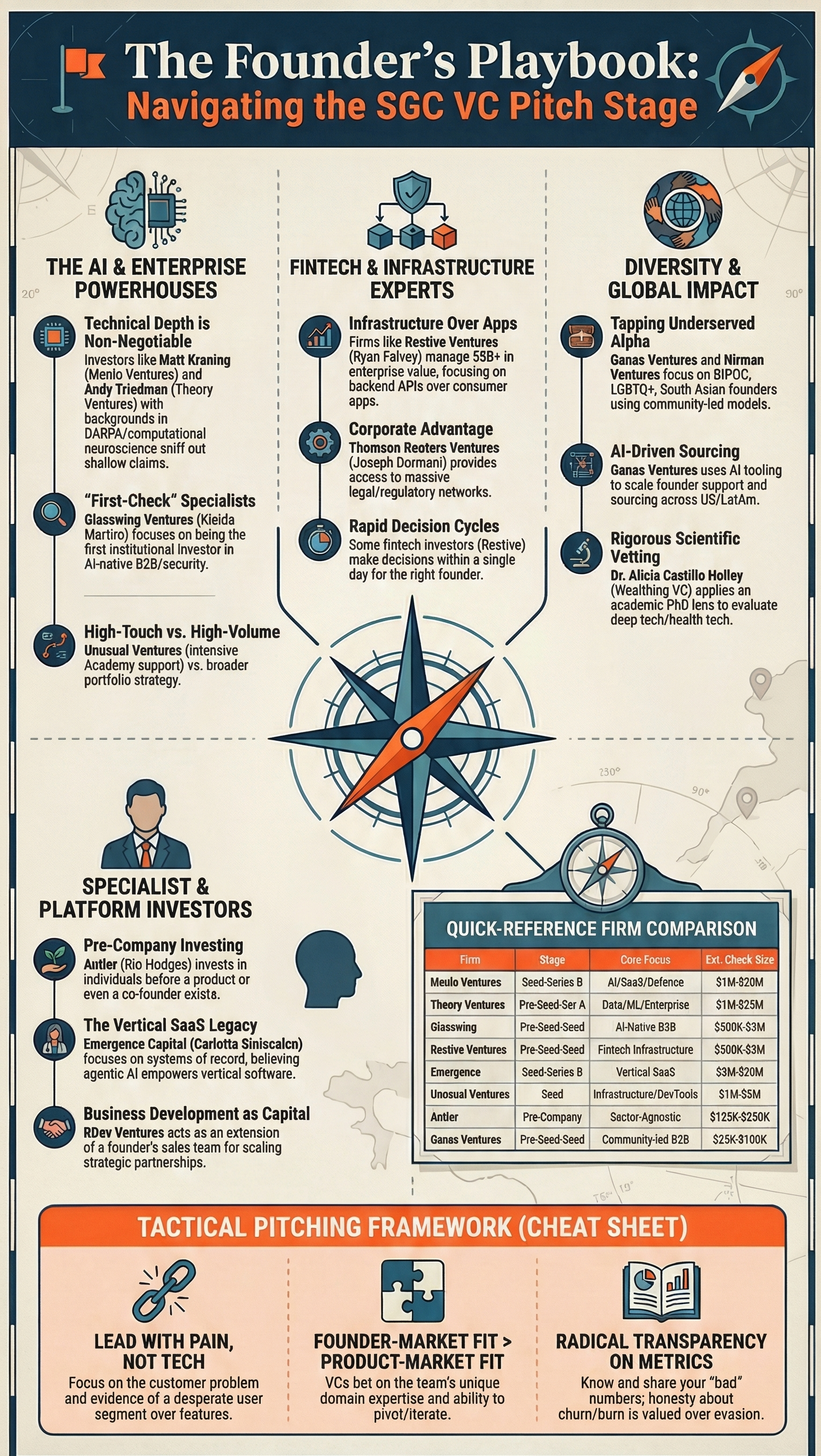
The following table summarizes key attributes of the major venture firms represented at the SGC VC Pitch Stage. Use this as a quick reference when prioritizing which conversations to pursue based on your company's stage, sector, and funding needs. Note that check sizes are estimated ranges based on publicly available information and may vary based on individual deal circumstances.
|
Firm |
Stage Focus |
Sector Focus |
Check Size
(Est.) |
What Makes
Them Distinctive |
|
Menlo Ventures |
Seed to Series B |
AI, SaaS,
Cybersecurity, Defense |
$1M - $20M |
Founder-operators
with deep technical PhDs; backed Anthropic and Abnormal |
|
Theory Ventures |
Pre-Seed to
Series A |
Data, ML,
Enterprise Software |
$1M - $25M |
Thesis-driven
investing; $450M Fund II; quantitative market analysis |
|
Glasswing
Ventures |
Pre-Seed, Seed |
AI, Enterprise,
Cybersecurity |
$500K - $3M |
First
institutional check in 90%+ of portfolio companies; $200M Fund III |
|
Restive Ventures |
Pre-Seed, Seed |
Fintech,
Financial Infrastructure |
$500K - $2M |
Compliance-first
mindset; deep fintech operator network; same-week decisions |
|
Emergence
Capital |
Seed to Series B |
B2B SaaS,
Fintech, Future of Work |
$3M - $20M |
Over $2B AUM; 11
unicorns; pioneered vertical SaaS category |
|
Ganas Ventures |
Pre-Seed, Seed |
Community-led
B2B SaaS, Emerging Markets |
$25K - $100K |
Global founder
community of 90K+; strong BIPOC and diverse founder focus |
|
Unusual Ventures |
Seed |
Enterprise,
Infrastructure, Developer Tools |
$1M - $5M |
Only ~5 core
investments per year; 60% of portfolio reaches Series B |
|
Antler |
Pre-Company,
Pre-Seed |
Sector-agnostic,
Global |
$125K - $250K |
Invests before
the company exists; global co-founder matching network |
|
Mighty Capital |
Seed to Series B |
B2B SaaS, AI,
Enterprise |
$500K - $5M |
SC Moatti;
author and product leader; mobile-first founder community |
How to Pitch Early-Stage Investors at SGC: A Practical Framework
Attending a VC pitch stage event without a structured preparation framework is one of the most common and costly mistakes early-stage founders make. The following guidance is grounded in what the investors at SGC have publicly described as their evaluation priorities, and is designed to help founders make the most of limited meeting time.
Research Each Investor Before the Event, Not During It
Every investor profiled in this guide has a publicly available thesis, portfolio, and set of stated priorities. Reading a firm's website, reviewing their portfolio companies, and understanding their investment stage and sector focus takes approximately 30 minutes per investor. For the investors most aligned with your company, this preparation is the single highest-leverage activity a founder can undertake before SGC. The goal is not to memorize facts but to walk into each conversation with a genuine understanding of why your company is relevant to that specific investor's current priorities.
Lead with the Problem, Not the Technology
Multiple investors at SGC have explicitly described their frustration with pitches that lead with technical innovation rather than customer pain. The most effective early-stage pitches open with a vivid, concrete description of the problem being solved — ideally illustrated with a specific customer story — before introducing the technology or business model. This is not because investors do not care about technology. It is because they evaluate technology through the lens of whether it actually solves a problem that real customers have and will pay to eliminate.
Demonstrate Early Customer Evidence Wherever Possible
For investors at the seed stage, the most de-risking signal a founder can provide is early customer evidence — not a letter of intent from a potential customer, but a paying customer who is actively using the product and experiencing measurable value. Even a single lighthouse customer with compelling outcome data is worth more in most seed-stage conversations than a $100 million market size estimate. Founders who do not yet have paying customers should be prepared to describe their specific plan for acquiring the first five customers after funding.
Know Your Numbers, Especially the Ones That Are Not Good
Investors expect founders to know their key metrics, including the ones that tell an uncomfortable story. Burn rate, runway, customer acquisition cost, churn rate, and net revenue retention are the baseline numerics that most investors will ask about. Founders who have obvious gaps in their data — or who become evasive when asked about challenging metrics — damage trust rapidly. Experienced investors are not expecting perfection at seed stage. They are expecting honesty, awareness, and a credible plan for improving numbers that are currently weak.
Tailor the Pitch to the Stage and Sector Focus
The comparison table in the previous section makes clear that the investors at SGC represent significantly different stage preferences, from Antler's pre-company investments to Emergence Capital's Series A and B focus. Walking into a conversation with Antler with a Series A deck wastes both parties' time. Similarly, pitching a consumer gaming company to Glasswing Ventures — which exclusively invests in enterprise B2B and security — signals that the founder has not done basic research. The founders who make the strongest impressions are those who can say specifically why a particular investor's thesis makes them the right partner for this specific company at this specific stage.
Key Takeaways
- Spend 30 minutes researching each target investor's thesis and portfolio before the event — it is the highest-leverage preparation available.
- Lead pitches with customer pain and evidence, not technology features.
- Know your metrics including the unflattering ones — experienced investors value honesty over polish.
- Tailor every pitch conversation to the specific stage and sector focus of the investor you are talking to.
- Bring one specific, concrete ask to each conversation rather than leaving the next step ambiguous.
🚀 1000+ Angel Investors
A massive, curated list of angel investors actively funding early-stage startups.
Whether you're building your first product or scaling fast — this is your shortcut to reaching the right backers.
- ✔️ 1000+ verified angel investors
- ✔️ Early-stage & seed-focused
- ✔️ Save months of investor research
- ✔️ Built for founders, freelancers & creators
Limited-time access. Get in front of investors before everyone else does.
What Early-Stage Founders Consistently Underestimate When Pitching VCs
Synthesizing the publicly stated perspectives of the investors at SGC, several themes emerge as consistent gaps in how early-stage founders approach investor conversations. Understanding these gaps is as valuable as understanding what to do well.
The Founder-Market Fit Question Is Often More Important Than Product-Market Fit
Multiple investors in this cohort have emphasized that at the earliest stages — particularly pre-seed and seed — they are often investing in the team's ability to figure out the product rather than in the product itself. This means the question they are implicitly asking is not just 'does this product solve a real problem?' but 'is this the team that will figure out the best solution to this problem, iterate quickly, and build the relationships needed to scale?' Founders who can articulate why they specifically — based on their unique background, domain expertise, and personal experience — are the right people to build this company are making a fundamentally stronger pitch than those who can only articulate why the market is large.
Sales Is Underrated as a Founder Competency
Niamh O'Donnell at Unusual Ventures stated this directly and it resonates with observations across many of the investors at SGC: founders, especially technical founders, systematically undervalue their own need to become skilled early sellers. Investors at seed stage want to see that a founder can explain their product compellingly, identify and pursue the right customer contacts, handle objections professionally, and close initial deals. A startup that raises seed funding but whose founders have never personally sold to a real customer is at high risk of building a product that cannot find a market. Demonstrating personal sales capability — even on a small scale — is a meaningful signal at the earliest stages.
Regulatory and Compliance Awareness Is Increasingly Expected
In regulated industries — fintech, healthcare, defense, legal technology — investors increasingly expect early-stage founders to demonstrate awareness of the regulatory environment they are operating in, not as a future consideration but as a current design constraint. Ryan Falvey at Restive has been explicit about this: companies that build fintech products without compliance baked into the architecture create significant technical and business debt. The same applies across every regulated sector represented at SGC. Founders who can speak credibly about how their product is designed to operate within regulatory constraints will build significantly more trust with sector-specialist investors than those who treat regulation as a problem to solve after product-market fit.
Final Thoughts: Making the Most of the SGC VC Pitch Stage
The 30 investors on the SGC VC Pitch Stage represent an unusually concentrated and diverse group of early-stage capital allocators across AI, fintech, enterprise software, deep tech, healthcare, commerce, media, and emerging markets. For founders raising pre-seed or seed capital, the access this stage provides — in terms of direct conversations with active decision-makers — is genuinely uncommon.
The founders who will benefit most from SGC are not necessarily those with the most polished decks or the biggest projected markets. They are the founders who have done the work to understand which investors are genuinely aligned with their company's thesis, stage, and sector — and who walk into each conversation with a specific, credible, and compelling story about why this particular investor is the right partner for what they are building.
Preparation, specificity, and intellectual honesty about both the opportunity and the risks are the attributes that consistently separate the founders who leave SGC with term sheets from those who leave with business cards. Use this guide as the foundation for that preparation, and approach each conversation at the VC Pitch Stage as the beginning of a long-term relationship rather than a one-time performance.
For founders who want to go deeper on any of the investors or firms profiled here, each firm's website, Crunchbase profile, and portfolio companies provide additional context for building a stronger pitch. The SGC VC Pitch Stage is a rare opportunity — arrive prepared to make the most of it.