20 AI Tools to Go From Startup Idea to Execution in 2026

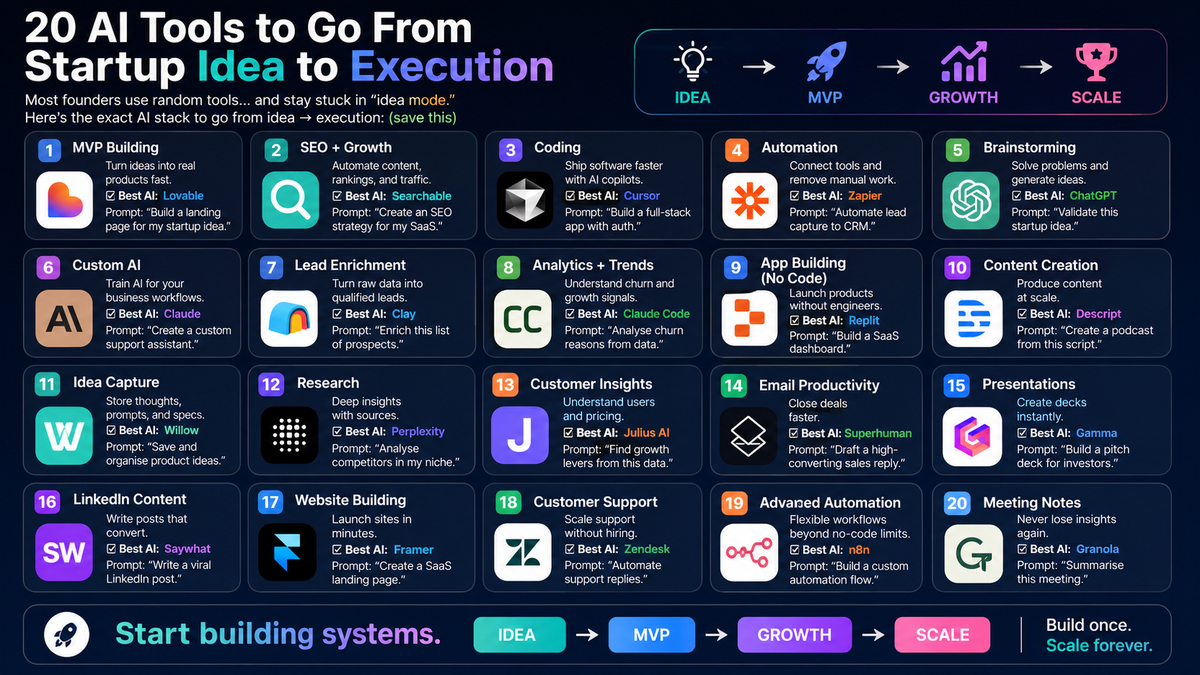
20 AI Tools to Go From Startup Idea to Execution
Most founders use random tools and stay forever stuck in "idea mode." Here's the exact AI stack that turns your vision into a shipped, revenue-generating product — built on real data from 2025–2026.
The difference between founders who ship and founders who stall isn't intelligence, funding, or even time — it's their tools. By mid-2026, the AI landscape has matured to the point where a solo founder with the right stack can build, market, and scale a product that would have required a 10-person team just three years ago. This guide isn't a generic listicle. It's a categorized execution stack — 20 tools mapped to every phase of the startup journey, backed by verified 2025–2026 market data, complete with exactly what to build with each one.
Why Most Founders Stay Stuck in "Idea Mode"
Talk to a hundred founders in 2026 and you'll hear the same story: a compelling idea, a Notion page full of features, maybe even a Figma mockup — but no shipped product. The bottleneck isn't creativity or ambition. It's execution velocity.
The problem compounds when founders reach for tools randomly. They use ChatGPT for everything, hit its limits, then spin their wheels on tasks that specialized tools would solve in minutes. The result is cognitive overload, decision fatigue, and perpetual "almost-launched" syndrome.
The research backs this up. According to EntrepreneurLoop's 2026 analysis, solopreneurs implementing comprehensive AI automation report saving 15–20 hours per week on average. Yet most founders still operate without a coherent AI stack — grabbing tools as they see them on social media, creating overlap, confusion, and wasted spend.
The founders who actually ship have something different: a curated, intentional AI execution stack. Every tool in their workflow is there for a reason, mapped to a specific phase of the startup lifecycle. That's exactly what this guide gives you.
Stop thinking in terms of individual tools. Think in terms of phases — ideation, building, growth, and scale. The best founders assemble a coherent stack that handles each phase without overlap or gaps. According to research cited by Entrepreneur.com in early 2026, 47% of respondents say AI availability makes them more likely to start a business — a signal that the tools have reached genuine accessibility.
The 2026 Market Context: Why This Stack Matters Now
To understand why this stack is so powerful, it helps to understand the market moment we're in. The numbers from the past 18 months are not incremental — they describe a structural shift in how startups are built.
Representing 34% of all VC investment despite comprising only 18% of funded companies — the highest capital concentration ratio in venture history.
The tools in this guide aren't experimental. They are category-defining products with verified traction at scale. Cursor — the AI code editor featured in Phase 2 — crossed $2 billion in annual recurring revenue by February 2026, making it the fastest-growing SaaS company in history (Bloomberg, February 2026). Lovable scaled from zero to $200M ARR in just eight months, a trajectory no previous software product had ever achieved. These aren't tools to evaluate. They're infrastructure.
At the same time, the solo founder is having a moment. According to Carta's Solo Founders Report, solo-founded startups now represent 36.3% of all new global ventures — up from 23.7% in 2019. That acceleration coincides precisely with the mainstream adoption of AI coding assistants and no-code builders. Equally striking: 52.3% of successful startup exits (acquisitions or IPOs) in recent cohorts were achieved by solo founders, according to AutoFaceless.ai's aggregated Carta data — a figure that directly contradicts the conventional VC wisdom that teams are essential for success.
Phase 1: Ideation — Validate Before You Build a Single Feature
The product graveyard is filled with software nobody asked for. The ideation phase isn't about generating more ideas — it's about ruthlessly filtering them before you invest a single line of code. These four tools make validation faster and smarter than any focus group.
Phase 2: Build — Ship Real Products Without a Full Engineering Team
The build phase is where most non-technical founders historically hit a wall. Hiring engineers is expensive and slow. The 2026 AI build stack has dismantled that wall entirely — and the traction data from the tools below confirms it isn't theoretical.
Many of these products are generating $5K–$50K in monthly recurring revenue. The engineering bottleneck is no longer the constraint it once was.
Start with Lovable to validate the concept with real users within days. Graduate to Replit or Cursor once you need custom backend logic that Lovable can't handle. Use Framer for the public-facing marketing site and Gamma for any pitch or investor meetings. The core principle: ship and learn before you optimize. The worst MVP is the one that never launches.
Phase 3: Grow — Automate the Engine That Fills Your Funnel
You've shipped a product. Now the real work begins: getting it in front of people who will pay for it. The growth phase is where most startups either find their flywheel or exhaust their runway. These five tools automate every major growth lever — SEO, outbound, content, social, and email — without requiring a marketing hire.
Growth Tool Quick-Reference: Channel, Use Case & Pricing
| Tool | Primary Channel | Best For | Model | Complexity |
|---|---|---|---|---|
| Searchable | Organic / SEO | Long-term inbound growth | Freemium | Low |
| Clay | Outbound / Email | B2B lead enrichment at scale | Paid | Medium |
| Descript | Video / Podcast | Content repurposing | Freemium | Low |
| Saywhat | LinkedIn / Social | Personal brand & inbound | Paid | Very Low |
| Superhuman | Email / Sales | Close rate & response speed | Paid | Low |
Phase 4: Scale — Build Systems That Run Without You
The final phase is where startups either build leverage or collapse under their own weight. Scaling isn't about doing more — it's about building systems that do more without you. These six tools automate the operational backbone of a growing company: custom AI, analytics, workflow automation, customer support, and meeting intelligence.
The solo founder of 2026 operates with the productive capacity of a 10-person team from 2022. The tools exist, the data is unambiguous, and the examples are real — Pieter Levels at $3M+ ARR solo, Marc Lou at $1M+ revenue solo. The question isn't whether the stack works. The question is whether you'll build it systematically.
The Complete 20-Tool Stack: At-a-Glance Reference
| # | Tool | Category | Phase | Pricing |
|---|---|---|---|---|
| 1 | Lovable | MVP Building | Build | Freemium |
| 2 | Searchable | SEO + Growth | Grow | Freemium |
| 3 | Cursor | AI Coding | Build | Freemium |
| 4 | Zapier | Automation | Scale | Freemium |
| 5 | ChatGPT | Brainstorming | Ideation | Freemium |
| 6 | Claude | Custom AI | Scale | Freemium |
| 7 | Clay | Lead Enrichment | Grow | Paid |
| 8 | Claude Code | Data Analytics | Scale | Paid |
| 9 | Replit | No-Code App Builder | Build | Freemium |
| 10 | Descript | Content Creation | Grow | Freemium |
| 11 | Willow | Idea Capture | Ideation | Freemium |
| 12 | Perplexity | Research | Ideation | Freemium |
| 13 | Julius AI | Customer Insights | Ideation | Paid |
| 14 | Superhuman | Email Productivity | Grow | Paid |
| 15 | Gamma | Presentations | Build | Freemium |
| 16 | Saywhat | LinkedIn Content | Grow | Paid |
| 17 | Framer | Website Building | Build | Freemium |
| 18 | Zendesk AI | Customer Support | Scale | Paid |
| 19 | n8n | Advanced Automation | Scale | Open Source |
| 20 | Granola | Meeting Intelligence | Scale | Freemium |
How to Build Your Stack Without Overwhelm: A Phase-by-Phase Rollout
Twenty tools can feel like twenty more decisions to make. Here's a research-backed, phased approach that avoids the tool overload trap — the number one reason founders see no productivity gains from AI despite investing in it.
Foundevo.com's 2026 analysis of solo founder communities found that "decision fatigue from tool overload" is one of the most consistently cited adoption blockers. The founders who win pick 2–3 tools and commit to them for 30 days. Tool acquisition should follow genuine bottlenecks — not excitement from social media threads.
Use ChatGPT and Perplexity exclusively. Validate your idea's core assumptions before touching a single build tool. The Carta data is unambiguous: solo-founded startups that skip validation and go straight to building face higher failure rates. Spend the first two weeks in ideation mode — not because it's comfortable, but because it's the highest-leverage use of your time.
Pick Lovable if you're non-technical. Pick Cursor if you write code. Do not use both yet. The goal is one deployed product — however imperfect — by end of week 5. Lovable crossed $200M ARR in 2025 by helping exactly this kind of founder ship rather than plan. The 34% of Q1 2026 micro-SaaS founders with no prior coding experience didn't wait until they were "ready" — they shipped.
Choose based on your primary acquisition model. SEO-focused? Start with Searchable. Outbound B2B? Start with Clay. Content-led? Start with Descript. One channel executed well consistently outperforms five channels executed sporadically. Solopreneurs who automate their primary acquisition channel first see the largest compounding returns, according to EntrepreneurLoop's 2026 analysis.
Only add Zapier when you have repetitive manual workflows consuming more than 3 hours per week. Only add Zendesk AI when support tickets exceed your capacity to respond within 24 hours. Only add n8n when Zapier's limitations are actively blocking automation goals. Scale tools should follow real bottlenecks — not aspirational ones. Premature optimization of systems that don't yet exist steals focus from growth.
What Does This Stack Actually Cost in 2026?
The most important cost framing isn't the monthly subscription total — it's the comparison against what this stack replaces. According to foundevo.com's 2026 analysis, a fully operational solo AI-native founder runs on $300–$500 per month in tools, representing a 95–98% reduction in operating costs compared to traditional staffing models. Here's a realistic breakdown:
| Phase | Tools | Free Tier | Full Paid | What It Replaces |
|---|---|---|---|---|
| Ideation | ChatGPT, Perplexity, Willow | $0 | ~$60/mo | Research agency hours |
| Build | Lovable, Framer, Gamma | $0 (limited) | ~$120/mo | Frontend developer |
| Grow | Searchable, Descript, Saywhat | $0 (limited) | ~$160/mo | Content + SEO hire |
| Scale | Claude, Zapier, Zendesk | $0 (limited) | ~$200/mo | Operations + support |
| Total | Full 20-tool stack | $0 → first MRR | ~$540/mo | $15–30K/mo in salaries |
- The founder AI stack is most powerful when tools are mapped to execution phases, not used interchangeably for everything — avoid the "ChatGPT for everything" trap.
- Lovable reached $200M ARR in 8 months and Cursor crossed $2B ARR in under 2 years — the tools in this stack are proven infrastructure, not experiments.
- Solo-founded startups now represent 36.3% of all new ventures globally, with 52.3% of successful exits coming from solo founders — the AI stack is driving a structural shift in entrepreneurship.
- The biggest ROI in 2026 comes from Clay + Searchable working together: enriched outbound personalization combined with compounding organic inbound authority.
- Claude and Claude Code are the most versatile tools in the scale phase — use Claude for customer-facing AI agents and Claude Code for analytical workflows that would otherwise require a data hire.
- The full 20-tool stack costs approximately $540/month at paid tiers — replacing what would have cost $15,000–$30,000 per month in equivalent salaries three years ago.
- Don't add scale tools (Zapier, n8n, Zendesk AI) before you have a genuine operational bottleneck — premature system-building steals momentum from growth.
Frequently Asked Questions
Lovable — without question. It's the tool that most completely eliminates the engineering bottleneck for non-technical founders. With $200M ARR, 8 million users, and over 100,000 new projects built daily as of late 2025, it's the category-defining product for prompt-to-app creation. If you only adopt one tool from this list, start here. You can go from zero to a live, deployed web application with database and authentication in an afternoon — no prior coding experience required.
Yes, they overlap — but each has a distinct, documented superpower. ChatGPT (900M+ weekly users by March 2026) excels at open-ended creative brainstorming and roleplay-based validation. Perplexity specializes in research requiring live, sourced, and citable data — critical for competitor analysis. Claude ($14B ARR, 70% Fortune 100 adoption) is the strongest for complex business workflows, long-document reasoning, and building reliable custom AI agents. The use cases are genuinely distinct enough to justify all three, especially since free tiers cover most early-stage usage.
Zapier is the right starting point: easy to configure, 6,000+ app integrations, now with AI-generated workflow creation from plain English. Switch to n8n when you hit any of these specific limits: per-task pricing becomes expensive at volume, you need conditional logic or code execution within a workflow step, or you want self-hosted infrastructure for data privacy. According to Menlo Ventures' 2026 enterprise AI report, n8n built its enterprise business entirely through open-source community adoption first — which means its documentation and community support are genuinely excellent for self-taught implementation.
Most tools in this stack are channel-agnostic. However, Clay and Superhuman are primarily B2B outbound tools. For B2C startups, lean more heavily into the content and SEO tools (Searchable, Descript, Saywhat) and replace Clay with community-building or paid social automation. The build and scale tools — Lovable, Cursor, Replit, Zapier, Claude — are fully applicable to both models. Notably, the median consumer AI company in a16z's 2025 benchmark data reached $4.2M ARR in its first year, compared to $2M for enterprise AI — B2C has strong momentum in the current cycle.
The evidence-based rule: one tool per function, adopted only when that function becomes a real bottleneck. Foundevo.com's 2026 analysis found that "decision fatigue from tool overload" is among the most consistently cited adoption failures. The founders who see the highest gains pick 2–3 tools and commit for 30 days before evaluating. Audit your stack quarterly and cut anything unused in 30 days. The goal is a lean, deeply integrated stack — not a maximalist collection of subscriptions.
Largely yes, with important caveats. ChatGPT, Claude, and Perplexity all perform well in major European, East Asian, and South Asian languages. Descript's transcription and Gamma's content generation support multiple languages. According to Gartner's 2026 projections, AI market growth is accelerating fastest in non-English markets, and the tools in this stack are expanding multilingual support correspondingly. Clay's data coverage is strongest in North America and Western Europe; for APAC and LATAM outbound, supplementary local data sources may be needed.
- Vention Teams — State of AI 2026 Report: Global AI market size, Gartner spending projections, KPMG global adoption data (ventionteams.com, Jan 2026)
- Cubeo AI — AI in Startups 2026: Enterprise adoption (88%), AI personalization response rates (27%), Series A adoption benchmarks (cubeo.ai, Feb 2026)
- Carta / AutoFaceless.ai — Solo Founders Report: Solo-founded startup share (36.3%), exit data (52.3%), solopreneur loneliness data (autofaceless.ai, compiled 2025–2026)
- Second Talent — AI Startup Funding & Investment 2026: $89.4B VC in AI, Cursor at $2B ARR, 67% Fortune 500 adoption (secondtalent.com, Apr 2026)
- GetPanto.ai — Lovable Statistics 2026: $200M ARR, 8M users, $6.6B valuation, 100K daily projects (getpanto.ai)
- GetPanto.ai / Bloomberg / TechCrunch — Cursor Statistics 2026: $2B ARR by Feb 2026, 1M+ daily users, 67% Fortune 500 (getpanto.ai, Feb 2026)
- EntrepreneurLoop — Solo Founder AI Tools 2026: 15–20 hrs/week savings, 34% no-code micro-SaaS founders, $300–$500/mo stack cost (entrepreneurloop.com)
- Menlo Ventures — State of Generative AI in the Enterprise 2025: Cursor PLG, n8n community adoption, enterprise AI patterns (menlovc.com, Mar 2026)
- Mean CEO Blog / a16z / RevenueCat — AI App Startup Statistics: Gamma $100M ARR, consumer AI $4.2M ARR median, AI apps churn 30% faster (blog.mean.ceo, May 2026)
- Stanford HAI — 2026 AI Index Report: GenAI adoption reaching 53% global population, corporate investment doubling (hai.stanford.edu)
- VentureBurn — AI Statistics 2026: LLM visitor value (4.4×), vertical AI $3.5B funding, global market $390.9B–$539B (ventureburn.com, May 2026)
- Stack Overflow / DORA — Developer Survey 2025: 84% of developers use or plan to use AI coding tools; 90% use AI at work